

Tencent's $3B+ Healthcare Investment Blueprint: Partnering with Yuwell and Mindray, Focusing on AI and Innovation

Tencent
Internet Comprehensive Service Provider
2022 Was a Year of Contraction in Overseas Investment by Internet Giants. Data shows that Tencent made over 80 overseas investments in 2022, significantly lower than the 210 deals recorded in the previous year. The change was not only in quantity; Tencent’s investment portfolio also became more “hard-tech” oriented.
In the healthcare sector, Tencent has made six investments this year, backing multiple hard-tech healthcare companies.
Among these, the most notable transaction was Tencent’s acquisition of a stake in Xunjie Medical, a subsidiary of Yuwell Medical, in September. Yuwell Medical announced that it intended to introduce Shenzhen Shechuang Xiangshan Technology Limited Partnership as a strategic investor through capital increase and share expansion. It is reported that Tencent is the controlling shareholder behind Shechuang Xiangshan. According to the announcement, Tencent subscribed for a 19.5% equity interest in Xunjie Medical with a cash contribution of RMB 291 million, becoming the company’s second-largest shareholder.
Li Zhaohui, Vice President of Tencent Group, once stated, “Tencent’s investment strategy focuses primarily on the consumer internet sector, such as content, gaming, and entertainment. The secondary priorities include retail, education, and healthcare.”
Healthcare, as a second-tier strategic focus for Tencent’s investments, has seen the company shift its approach. Previously, Tencent primarily invested in internet healthcare ventures aligned with its core business. Now, making frequent and substantial moves in the healthcare sector, Tencent has significantly changed its strategy, focusing mainly on investments in biotechnology and medical technology.
Prior to investing in Xunjie Medical, Tencent had also invested in Yuanin Biotechnology, a developer of circular RNA vaccines; Weiyuan Gene, an mNGS company; Nanovision, a developer of X-ray detectors and static CT products; Ruipai Medical, a manufacturer of single-use endoscopes; Saihe Medical, an implantable medical device company; Jingyi Technology; and MicroTech Medical, a blood glucose management enterprise.
Today, investment has become Tencent’s key lever for deep engagement in the healthcare industry chain. As a tech giant, Tencent’s each move involves substantial capital outlays. Which sectors does Tencent favor? VCBeat (WeChat ID: vcbeat) has compiled an overview.
The latest sector to capture Tencent’s attention is cardiac defibrillators. In recent years, driven by supportive policies, the automatic external defibrillator (AED) market has maintained rapid growth. Both Mindray and Yuwell, two giants in the medical device industry, place significant emphasis on the AED market.
China’s AED market is in a phase of rapid volume expansion. The AED penetration rate in China stands at only 0.2 units per 100,000 people, significantly lower than international levels such as Japan (555 units per 100,000 people) and the United States (317 units per 100,000 people).
In recent years, automated external defibrillators (AEDs) have been hailed as “life-saving devices,” prompting major cities to prioritize their deployment. The Shenzhen Municipal Government’s Implementation Plan for AED Deployment and Use during the 13th Five-Year Plan period set a goal of reaching the international benchmark of 100 AEDs per 100,000 people within ten years. Currently, Shenzhen’s AED density has reached 17.5 units per 100,000 people. The Chinese government attaches great importance to AED deployment. The Healthy China Action (2019–2030) explicitly calls for improving standards for the配备 of emergency medical equipment in public spaces and urges the government to strengthen AED configuration in long-term care facilities.
Driven by policy support, the domestic AED market in China has experienced rapid growth. According to Yuwell Medical’s annual report released on April 22, its domestic AED business achieved a year-on-year growth of over 30% in 2021. Mindray’s annual report also highlighted that both AEDs and minimally invasive surgery, as its two seed businesses, realized high-speed growth.
Currently, the domestic defibrillator market in China is dominated by imported brands such as Philips and Spain’s OSATU, with Mindray holding a significant advantage among domestic brands. AEDs are categorized into semi-automatic and fully automatic models, with imported brands occupying the majority of the AED market. Several Chinese manufacturers have already obtained approval for their semi-automatic defibrillators. Mindray Medical leads the domestic tier, with a market share exceeding 20%, and has cumulatively deployed and installed 110,000 AED units.
Primed, a subsidiary of Yuwell in which Tencent holds a stake, commands a significant market share in Europe and ranks among the top tier in brand recognition and market share in the domestic Chinese market.
Xunjie Medical was established on November 4, 2021, and serves as the primary entity for Yuwell Medical’s emergency care business segment. In 2017, Yuwell fully acquired German company Primedic. With over 40 years of experience in the medical emergency field, Primedic’s semi-automatic external defibrillators (AEDs) and defibrillation monitoring products enjoy high recognition in the global medical emergency industry.
Ping An Securities’ research report pointed out that Primedic’s imported brand status has encountered significant obstacles in domestic tenders. Since acquiring Primedic in 2017, Yuwell has been committed to advancing the localization of product technology and manufacturing. Yuwell’s China-produced AED received approval in April this year.
Currently, Xunjie Medical is still operating at a loss. In the first half of this year, the company reported an operating loss of RMB 28.3745 million.
As a life-saving device in public spaces, the most effective way to prevent sudden cardiac death during cardiac arrest is to perform defibrillation with an AED and administer cardiopulmonary resuscitation (CPR) within the "golden 4 minutes," the optimal window for rescue. According to statistics from the "Report on Cardiovascular Health and Diseases in China" released by the National Center for Cardiovascular Diseases, more than 540,000 people in China die from sudden cardiac death each year. Among them, approximately 1,500 people die from cardiac arrest daily, with over 90% of these cases occurring outside of hospitals.
Tencent’s investment in Primedic is also aligned with ESG principles. Given the current situation in which sudden cardiac death claims over 500,000 lives annually while AED penetration remains low, the significance of this investment may extend far beyond mere financial metrics.
In the industry, Tencent’s investment style is often characterized as fast, precise, and decisive—efficient and agile, while “quietly reaping substantial profits.”
This efficient and agile investment style is also reflected in healthcare investments. Before its investment in a Yuwell subsidiary drew industry attention, Tencent had already quietly invested in multiple medical technology enterprises. In the official announcements of these transactions, Tencent did not publicly disclose its name, instead appearing as a well-known industrial capital investor.
Prior to 2018, Tencent primarily invested in internet healthcare companies, favoring early-stage projects. Early investment followed by continued backing is Tencent’s hallmark strategy.
Tencent invested in Shuidi Huzhu during its angel round and in Sipay Health during its Series B round. Tencent first invested $70 million in DXY in 2014, and was also a lead investor in DXY’s latest $500 million financing round in 2020.
At that time, Tencent had acquired stakes across nearly the entire internet healthcare sector. This strategy was driven, on one hand, by the strong synergy between internet healthcare and Tencent’s core business, as investments in this field would help the company build a more robust internet healthcare ecosystem. On the other hand, amidst the wave of technology-driven transformation, internet healthcare was seen as a fertile ground for the emergence of groundbreaking companies. Through investment and mergers and acquisitions, Tencent could expand its ecological footprint, strengthen its competitiveness in the internet healthcare sector, and ensure it remained at the forefront of the industry’s evolution.
As investment has become a core strategy for Tencent, its investment preferences have begun to shift. In the past, Tencent’s investment approach focused exclusively on sectors related to its own business, primarily consumer internet. This refers to application models centered on individual users and everyday life scenarios, specifically characterized by the comprehensive online migration of personal lifestyle domains such as clothing, food, housing, transportation, and healthcare.
This style has not been fully carried over into Tencent’s current healthcare investments. In 2019, Martin Lau, President of Tencent, stated that investment had become a core strategy for the company. Tencent’s approach to healthcare investing has also begun to resemble that of an independent institution, shifting from focusing solely on internet healthcare ventures tied to its own business to targeting high-quality assets across the entire healthcare sector.
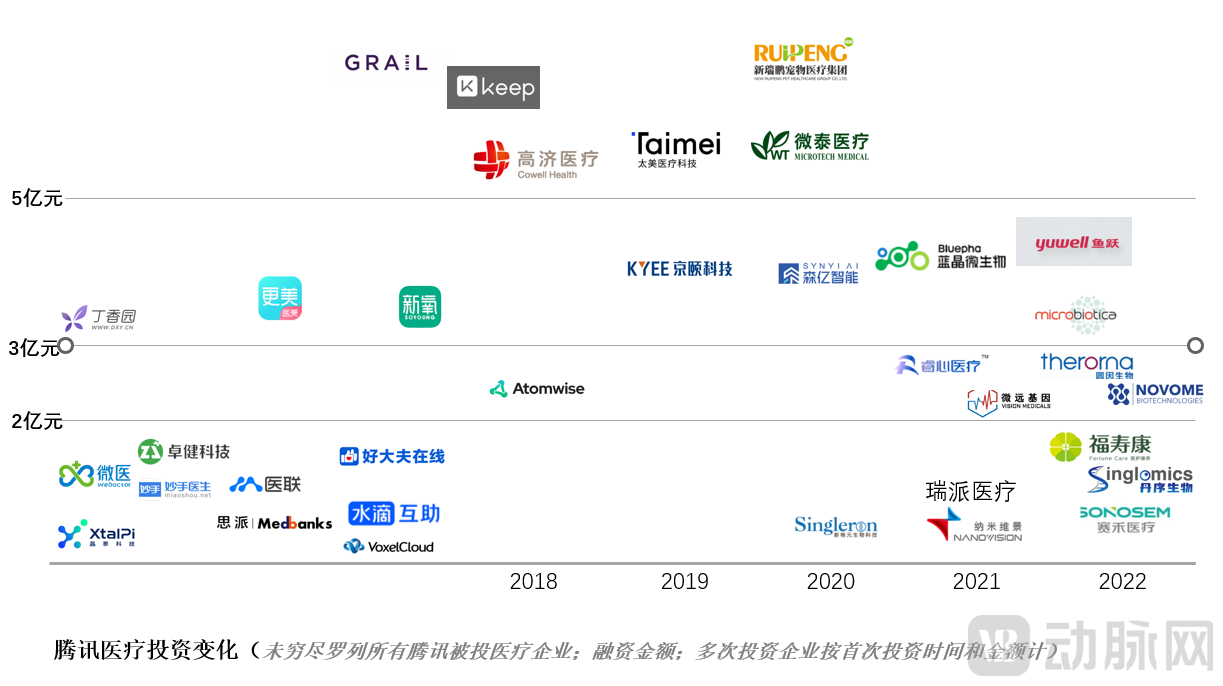
Tencent’s former goal was to “connect everything,” but the company has now established a presence in multiple core healthcare sectors, including precision diagnostics, drug development, healthcare digitalization, high-value medical devices, synthetic biology, and chronic disease management.
Unlike the early-stage, sector-focused investment strategy adopted during the internet healthcare boom, Tencent’s current investment approach targets both frontier technologies and the weaknesses within China’s domestic healthcare system.
First, there is optimism toward cutting-edge technologies,Tencent’s domestic investments in Bluepha, Danxu Bio, Singleron, Yuanin Bio, Microbiotica, NOVOME, and Weiyuan Genomics are all poised to yield transformative technologies. Regarding frontier technologies, Tencent favors global innovation rather than focusing solely on domestic advancements. In addition to investing in leading teams within China, Tencent actively participates in investments in overseas biotechnology companies.
In terms of overseas investment, Tencent invested in Grail, a leader in liquid biopsy, as early as 2017. Tencent annually invests heavily in numerous gaming companies abroad. Through these endeavors, Tencent has accumulated extensive experience and resources in overseas investments, making its investment in overseas biotechnology firms a distinct advantage.
In addition to betting on cutting-edge technologies, Tencent’s healthcare investments also focus on addressing the gaps and shortcomings within China’s domestic healthcare system.
For instance, to address the supply shortage in the rehabilitation and elderly care sector amid an aging population, Tencent invested in Fushoukang, China’s largest home-based medical care service provider; to remedy the lack of emergency rescue facilities in public spaces, Tencent invested in Xunjie, an AED manufacturer.
It is worth noting that for this category of overseas markets with mature development, Tencent prefers to invest in late-stage mature projects when selecting healthcare targets.
In the financing for the IPO of CGM company MicroTech Medical, Tencent entered at Series D and served as a cornerstone investor prior to the listing. It also invested in Taimei Medical Technology at its Series E+ round; Taimei is currently striving for a listing on the STAR Market.
For the biotechnology sector, which is characterized by high barriers to entry and long development cycles, what distinguishes Tencent’s investment portfolio from those of other institutions?
Collaboration within the industrial ecosystem may be Tencent’s advantage. Martin Lau once stated, “In developing its industrial internet initiatives, Tencent is keen to closely integrate its consumer-facing (to-C) capabilities with its business-facing (to-B) capabilities, thereby enabling our to-C strengths to better serve our partners. Take healthcare as an example: the healthcare industry involves an exceptionally long value chain. If we can effectively integrate and package solutions so that users gain access to the best available options, it will create value for both our to-C and to-B operations. Meanwhile, our partners can leverage this channel to deliver their services more effectively.”
Secondly, for the long-cycle medical sector, Tencent also possesses the strength to wait.
Li Zhaohui, a managing partner at Tencent Investment, stated in an interview with Bloomberg Businessweek/Chinese Edition that Tencent is a long-term investor. Not only is our capital committed for the longer term, free from the typical three- to five-year constraints faced by conventional funds, but this also reflects our focus on the long-term success of portfolio companies in terms of product development and business models, rather than merely short-term performance. An external early-stage fund might invest whenever there is a profit opportunity, without giving much thought to later stages. In contrast, even when evaluating a Series A opportunity, we consider implications for Series C, Series D, and beyond. Regarding our investment criteria, if we believe a company does not deliver sufficient value to the business community, or if its commercial practices are overly speculative and irresponsible, we will not invest, regardless of its profitability. We prioritize companies that demonstrate greater prudence and pragmatism in their operations and corporate culture, which is of paramount importance to us.
This is further corroborated by Tencent’s continued increased investment in internet healthcare enterprises.
Certainly, Tencent’s investment in healthcare has consistently been characterized by its bold approach. In 2018 alone, Tencent invested in more than 35 healthcare companies, with total investments exceeding RMB 20 billion. In recent financing rounds, Tencent has remained generous, typically participating with investments amounting to hundreds of millions of yuan.
Since the second quarter of 2021, Tencent has proactively withdrawn from non-core businesses, tightened marketing expenditures, and reduced operating expenses. As healthcare is not a core business for Tencent, the company’s activities in the medical sector have been limited over the past year, with its strategic moves becoming increasingly cautious.. Medical initiatives are primarily categorized into three areas: focusing on basic research, expanding AI-plus-healthcare applications, and exploring the healthcare industrial internet.
In the realm of basic research, Tencent has established a new Sustainable Social Value (SSV) business unit, integrating corporate social responsibility with philanthropy. With an initial investment of RMB 50 billion, it is pioneering social value innovation in key areas, including basic scientific research, educational innovation, rural revitalization, carbon neutrality, primary healthcare, public welfare platforms, public emergency response, technology for the aging population, technological accessibility, and digital culture.
Tencent has also partnered with the China Association for Science and Technology, committing RMB 10 billion over the next decade to support basic scientific research through the “New Cornerstone Investigator Program.” Starting in 2022, the program will provide funding to 60 scientists focused on two major fields: mathematics and physical sciences, and biological and medical sciences. The funding is divided into two categories: experimental projects, with annual grants of up to RMB 5 million per recipient, and theoretical projects, with annual grants of up to RMB 3 million per recipient, both supported continuously for five years.
In the realm of AI technology, where Tencent excels, Tencent and Mindray have engaged in in-depth collaboration to develop AI-powered pathology products.
In March this year, the “Fully Automated Peripheral Blood Cell Morphology Analyzer,” jointly developed by Mindray Medical and Tencent AI Lab, officially entered the National Medical Products Administration’s Special Review Procedure for Innovative Medical Devices.
The slide scanner jointly developed by Tencent and Mindray accurately reconstructs the three-dimensional structure and details of cells, and integrates AI algorithms to significantly improve the accuracy and overall efficiency of slide reading, filling a gap in China. Previously, in the field of pathological AI, Tencent also collaborated with Philips to jointly develop an AI-assisted diagnostic system for colposcopy.
In the realm of the medical industrial internet, Johnson & Johnson China Consumer Health announced in March this year a comprehensive strategic partnership with Tencent. The two parties will jointly explore innovative digital technologies such as digital therapeutics, artificial intelligence, and cloud computing, focusing on their digital applications in the healthcare sector to drive the development and innovation of health management services.
Healthcare is a long-cycle industry. Leveraging its extensive experience and technological platform advantages, Tencent is providing the pharmaceutical industry with an optimal path for digital transformation, facilitating a smooth transition. Currently, this effort remains in the early exploratory stage, and we look forward to Tencent delivering more advanced and effective digital solutions for the healthcare sector.
For a giant like Tencent, societal expectations go beyond merely being an investment enterprise with high returns. As an entity that functions akin to social infrastructure, Tencent wields significant influence in driving social change. The industry is eager to see Tencent’s power in promoting industrial development.
Today, Tencent’s reach in the healthcare sector has become increasingly diversified, engaging with the industry through multiple avenues ranging from basic research and investment in emerging technologies to enhancing industrial efficiency.