

Genecast Submits Hong Kong IPO Prospectus, Reports Nearly 30% Revenue Growth Amid Pandemic
Genecast
Innovative Molecular Diagnostics and Testing Technologies, Products, and Services Provider for Oncology
From research services to clinical applications, and from tumor companion diagnostics to MRD and early screening, the commercialization scenarios in China’s oncology molecular diagnostics market continue to emerge, maintaining robust vitality.
In 2022, the oncology molecular diagnostics market exhibited a trend toward greater calmness, rationality, and maturity, with “calmness” emerging as the keyword. Industry bubbles gradually subsided, prompting companies to focus on strengthening their core competencies—vertically refining core technologies and horizontally accelerating product line expansion—thereby further accelerating the growth of leading enterprises.
September 26,Genecast Submits Prospectus to the Hong Kong Stock Exchange,It is a long-awaited landmark event in the tumor molecular diagnostics industry, creating significant ripples.
Genecast has long been a highly sought-after company in the capital market. To date, Genecast has completed seven rounds of financing, with investors including Matrix Partners China, Lyra Capital, Chende Capital, CICC Capital, Hillhouse, China State-owned Enterprise Structure Adjustment Fund, Kaifeng Venture Capital, Yahui Investment, CCB International Equity, and Taikang Life Insurance, among other prominent institutions. The company’s Series E financing round exceeded RMB 1 billion.
During the industry’s quiet period, every move by leading companies tends to draw heightened attention. Has Genecast identified the driving force behind the sustained development of tumor molecular diagnostics? How is it creating new growth for the sector? Let us examine the answer sheet that Genecast has delivered.
“Burning cash” is one of the labels associated with the oncology molecular diagnostics industry. In particular, over the past two years, revenue figures have seemingly become a major bottleneck constraining the development of companies in this sector, especially those specializing in tumor next-generation sequencing (NGS).
Genecast is one of the companies with the highest revenue growth rates among the leading enterprises in China's molecular oncology diagnostics and testing industry.Even amid the impact of the pandemic, the growth rate exceeded 20%. The Company’s revenues for 2020, 2021, and the six months ended June 30, 2021 and 2022 were RMB 304 million, RMB 393 million, RMB 171 million, and RMB 207 million, respectively. From 2020 to 2021, the Company’s revenue increased by 29.2% year-over-year, representing substantial growth.
Specifically, Genecast provided diagnostic and testing services to 20,585, 27,304, and 15,257 cancer patients in 2020, 2021, and the six months ended June 30, 2022, respectively. In 2021 and the six months ended June 30, 2022, the revenue generated from sales of its core product, Genecast IVD–KNBP, under the hospital-based business model amounted to RMB 6.6 million and RMB 4.8 million, respectively. As of June 30, 2020, 2021, and 2022, the Company had 16, 35, and 40 hospital clients under its hospital-based business, respectively.
Whether in terms of the number of patients served, the revenue generated by Genecast IVD–KNBP under the hospital-entry model, or the company’s hospital-entry business overall, sustained growth has been maintained, demonstrating Genecast’s strong growth capability.
In terms of gross profit, Genecast reported gross profits of RMB 209 million, RMB 263 million, and RMB 124 million in 2020, 2021, and the six months ended June 30, 2022, respectively, with corresponding gross margins of 68.6%, 66.9%, and 59.8%. Meanwhile, the company’s adjusted net loss (excluding non-operating items such as preferred share impairment adjustments and share-based compensation) was RMB 160 million in 2020, a level lower than the industry average.
In terms of the proportion of R&D and sales expenditures to revenue, Genecast’s cash burn rate is not high either.
In 2020, 2021, and the six months ended June 30, 2021 and 2022, Genecast’s R&D expenses were RMB 137 million, RMB 176 million, RMB 80 million, and RMB 102 million, respectively, while its sales and marketing expenses were RMB 187 million, RMB 253 million, RMB 119 million, and RMB 128 million, respectively.
It can be seen that Genecast’s R&D expenses as a percentage of revenue for individual products or services launched in 2020, 2021, and the six months ended June 30, 2022, as well as its sales and marketing expenses and administrative expenses as a percentage of revenue in 2021 and the six months ended June 30, 2022, were at relatively low levels within the industry.
As of June 30, 2022, the Company’s total cash, cash equivalents, and financial assets at fair value through profit or loss amounted to RMB710 million. According to Frost & Sullivan,Genecast’s operational efficiency is among the highest in China’s industry.
Given Genecast’s low cash burn rate, ample cash flow, and the anticipated improvement in operational efficiency driven by economies of scale, management projects that its existing cash reserves will be sufficient to fund R&D and market expansion for at least the next three years. Genecast is poised to establish a leadership position in the market and become the first to break through the profitability challenge.
In the early stages of industry development, companion diagnostics served as the primary entry point for most oncology molecular diagnostics companies. In recent years, as the companion diagnostics market has matured, the progression from companion diagnostics to minimal residual disease (MRD) testing, and further to cancer early screening, has become an essential pathway for precision oncology enterprises. Consequently, MRD testing and early screening have witnessed rapid growth in recent years, attracting significant capital investment from numerous companies.
Now,Accelerating the broad coverage of application scenarios, while simultaneously implementing differentiated strategies in key areas such as minimal residual disease (MRD) testing, has become a critical competitive strategy among companies in the oncology molecular diagnostics sector.
It is evident that comprehensive coverage and differentiated deployment are the distinguishing features of Genecast.
Genecast focuses on the entire cycle of cancer diagnosis and treatment, encompassing the full workflow of molecular diagnostics. In addition to NGS platform-based testing, the company has independently developed assays and services for multiplex immunohistochemistry and digital pathology, comprehensively covering three major application scenarios: medication guidance, prognosis and monitoring, and early screening. It has launched 20 commercialized products and services spanning more than 20 cancer types, along with 18 products and services in development, including 12 IVD products. In its LDT business, Genecast provides testing services to over 83,000 patients across 829 hospitals in China, holding a 9.0% market share in China’s NGS-based tumor molecular diagnostic LDT market in 2021.
Meanwhile, through license-in agreements and acquisitions, the company has secured MammaPrint, a test recommended by multiple authoritative international clinical practice guidelines.®、Immunoscore®、Tissue of Origin®The products have been acquired, expanding the application of diagnostic products to cover the entire cycle of cancer treatment.
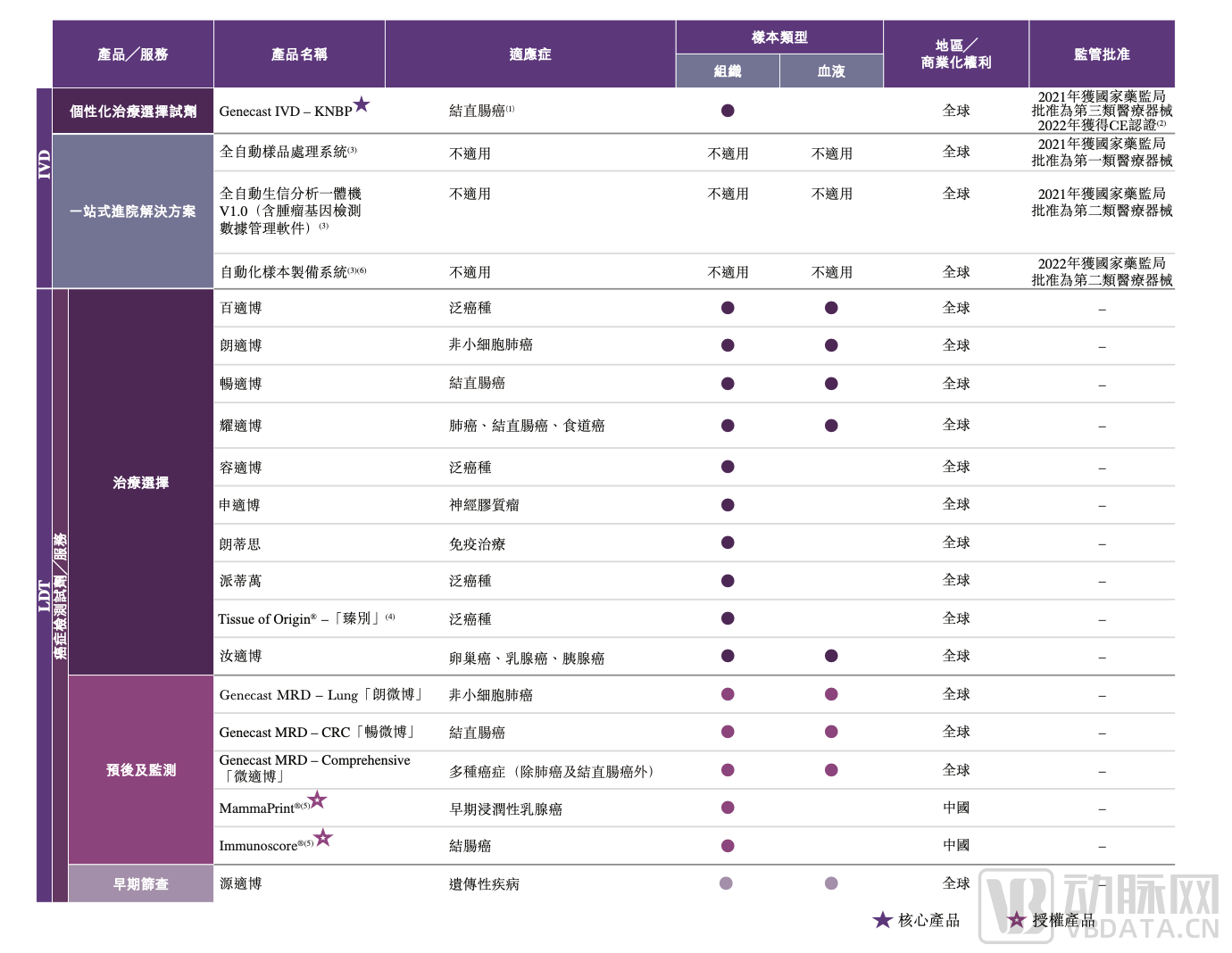
Genecast Commercial Products and Services
Genecast is also one of the few companies to have successfully launched an integrated, one-stop hospital adoption solution, addressing the key challenges hindering the introduction of NGS products into hospitals—such as limited laboratory construction experience, insufficient staffing, and a restricted range of approved test kits. It provides a fully automated, one-stop, user-friendly solution spanning from sample preparation to report generation.
Core technological prowess serves as the value anchor for companies in the field of tumor molecular diagnostics. Genecast has established a robust competitive moat in research and development, encompassing leading DNA mutation sequencing technologies, RNA extraction and sequencing technologies, and MinerVa-based®The technical platform’s MRD detection technology, DNA methylation sequencing technology, multiplex immunohistochemistry technology, digital pathology technology, etc.
As of the latest practicable date, a total of 839 hospitals in China were using Genecast’s products and services, and 7,140 physicians had placed orders for them.
Tumor Prognosis and Monitoring Market Share Reaches 36.8%, Poised to Establish MRD Leadership
In the field of prognostic monitoring, Genecast is the first company to launch postoperative cancer recurrence and prognostic monitoring services based on MRD technology. It currently offers five commercialized cancer prognosis and monitoring products, ranking first in China by product count.
Furthermore, the prospectus shows that, based on 2021 revenue from NGS-based prognosis and monitoring,Genecast holds the largest market share in the tumor prognosis and monitoring market, reaching 36.8%,Meanwhile, Genecast is also an industry pioneer and leading enterprise in the prognosis and monitoring sector driven by minimal residual disease (MRD) technology.A total of 361 hospitals have subscribed, 1,539 physicians have recommended, and over 10,000 patients have utilized Genecast’s prognosis and monitoring services.
Genecast is also the first company to commercialize MRD testing services.In November 2020, the company leveraged its patented MinerVa®Leveraging its platform and proprietary algorithms, the company launched “LangWeibo,” an MRD detection product for non-small cell lung cancer; in February 2022, it introduced “ChangWeibo,” an MRD detection product for colorectal cancer; and in June 2022, it rolled out “WeiShiBo,” a pan-cancer MRD detection product.
Based on market maturity and commercialization challenges, Genecast has chosen MRD as its primary strategic focus.MRD testing provides a timely, accurate, and effective monitoring tool for detecting cancer recurrence in post-treatment cancer patients. As physicians’ awareness of the importance of MRD testing continues to grow, MRD testing holds significant market potential in China.
Moreover, although early screening has a higher market ceiling, it still has a long way to go in terms of technological breakthroughs and market education, requiring sustained, large-scale capital investment from companies. In contrast, MRD technology is more mature, addresses a more pressing clinical need, and can generate commercial value faster than early screening.
Genecast's MinerVa for MRD Detection®The platform employs an innovative joint probability model (constructed from data collected from thousands of ctDNA samples) to suppress sequence noise, thereby enabling highly specific detection of ultra-low-frequency mutations. Its sample-level limit of detection is as low as 0.008% ctDNA fraction, while maintaining a high specificity of over 99.5% in analytical performance validation.
The key to the clinical implementation of MRD lies in the accumulation of clinical evidence.MRD testing requires longer-term dynamic follow-up and the collection of higher-quality clinical data to robustly demonstrate its clinical value.
Genecast is the first company in China to accumulate clinical data on MRD testing for lung cancer, and also the first to conduct prospective interventional clinical trials in the MRD market and release large-scale prospective cohort MRD data.Data published in Clinical Cancer Research indicate that the company’s LUNGCA cohort represents the largest known cohort of lung cancer patients worldwide.
Meanwhile, the company has partnered with Hansoh Pharmaceutical to conduct the APEX study across 34 clinical centers in China, marking the first prospective Phase III trial of MRD-stratified EGFR tyrosine kinase inhibitor therapy for non-small cell lung cancer.
Early Screening Has a Broad Potential Audience; A Trillion-Yuan Blue Ocean Will Emerge After the Latent Period
Emerging technologies such as NGS-based liquid biopsy can detect tumor-derived circulating tumor DNA (ctDNA) in the bloodstream earlier than imaging modalities, driving increasing momentum in the cancer early screening market. The potential target population for cancer early screening is extensive; according to Frost & Sullivan, the target population for early screening in China was 434 million in 2021 and is projected to reach 553 million by 2030. Although cancer early screening is currently in a nascent stage due to constraints related to cost, market awareness, and technological limitations, it undoubtedly represents a blue-ocean market worth hundreds of billions of yuan.
Regarding early cancer screening, Genecast proactively established its strategic layout as early as 2018, developing DNA methylation technologies and bioinformatics algorithm models, with multiple early-screening products currently under research and development. The company’s laboratory-developed test (LDT) service for genetic screening, “Yuan Shi Bo,” is an NGS-based early detection assay that performs multi-gene identification of over 50 hereditary tumor syndromes associated with solid tumors, providing cancer risk assessment for high-risk populations.
Seizing the Opportunity in Immunotherapy: First to Offer Blood-Based TMB and MSI Testing
Tumor-guided medication determines whether patients are sensitive to targeted therapy by detecting specific gene mutations and biomarkers. In the field of medication guidance services, Genecast has successfully launched its core product, Genecast IVD–KNBP, along with 10 other LDT services.
Genecast seized the window of opportunity presented by the shift in precision medicine from targeted therapy to immunotherapy.The demand for medication guidance for immunotherapy drugs is no less than that for targeted therapies. As pharmaceutical companies have shown increasing enthusiasm for developing immunotherapies such as PD-(L)1 inhibitors, the relationship between biomarkers like TMB and MSI and the efficacy of immunotherapy has been established. Consequently, biomarker-guided therapy in oncology has reached a peak in the immunotherapy market, with MSL and TMB emerging as new stars in guiding immunotherapy use.
Genecast is the first oncology molecular diagnostics company in China to develop comprehensive predictive services for immunotherapy efficacy, and among the first to offer blood-based TMB and MSI testing.
From the introduction of the concept of precision medicine in 2015, to its surge in popularity in 2016, and then to a new wave of development in 2020, tumor molecular diagnostics has experienced years of rapid growth. However, the industry's vast potential has yet to be fully unleashed.
China has the highest cancer incidence rate globally, and this figure is projected to continue rising in the future. According to Frost & Sullivan, the number of new cancer cases in China increased from 4.1 million in 2016 to 4.7 million in 2021, representing a compound annual growth rate (CAGR) of 2.9%. The number is expected to reach 5.3 million by 2026, with a CAGR of 2.5% from 2021 to 2026, and is further projected to increase to 5.8 million by 2030, reflecting a CAGR of 2.3% from 2026 to 2030.
The persistently high incidence and mortality rates of cancer, coupled with the limited efficacy of traditional chemotherapy and insufficient penetration of targeted and immunotherapies, are driving continuous expansion of the tumor molecular diagnostics market, thereby fostering a substantial market for therapy guidance, early screening, and prognostic monitoring in oncology.
Molecular tumor diagnostics has also become a key area of policy focus. In 2018, the National Health Commission of China issued the “Notice on Printing and Distributing the Diagnostic and Treatment Specifications for 18 Cancers, Including Primary Lung Cancer (2018 Edition),” indicating that treatment selection based on in vitro diagnostics (IVD) has become a mainstream trend. Since the National Medical Products Administration approved the first next-generation sequencing (NGS)-based IVD product for treatment selection in July 2018, it has gradually relaxed the approval process for related products. Furthermore, the “14th Five-Year Plan for the Development of the Pharmaceutical Industry,” issued in January 2022, supports the development of molecular tumor diagnostics and testing for disease screening and treatment selection.
Driven by robust clinical demand and supportive policies, the widespread adoption of technologies such as next-generation sequencing (NGS) will further popularize the clinical application of tumor molecular diagnostics, unlocking significant growth potential. According to Frost & Sullivan, the total potential market size for tumor molecular diagnostics and testing in China was RMB 271.2 billion in 2021, and is projected to reach RMB 561.1 billion by 2030. By 2030, the penetration rate of NGS-based tumor molecular diagnostics in treatment selection scenarios in China is expected to reach 68.7%.
Currently, the NGS-based molecular diagnostics industry for oncology in China is still in its early stages of development, characterized by intensifying competition and complex business models, with the majority of revenue derived from tumor-guided medication services. Against the backdrop of technological advancements and growing clinical demand, the market is expanding into areas such as prognosis, monitoring, and early screening.
However, this does not mean that the business of tumor-guided medication is a thing of the past. Data from Frost & Sullivan shows that in 2021, the penetration rates of targeted therapy and immunotherapy in China's cancer market were 32.5% and 7.1%, respectively, far lower than the global penetration rates of 61.0% and 23.4%. This indicates that there is still significant room for growth in China's tumor-guided medication market, especially for guidance based on immunotherapy. It is reported that in 2021, the penetration rate of tumor molecular diagnostics based on NGS treatment selection scenarios in China was 13.4%, and it is expected to reach 68.7% by 2030.
Overall,The three major application scenarios—prognosis and monitoring, early screening, and medication guidance—all have vast room for growth and will continue to maintain rapid expansion.In 2030, the total potential market size for tumor-guided medication products and services will reach RMB 45.6 billion, that for prognosis and monitoring will reach RMB 194.2 billion, and that for early cancer screening will reach RMB 321.3 billion.
Genecast is a deep participant in China’s oncology molecular diagnostics market. In the future, as this market continues to develop in depth, comprehensive layout targeting the entire cycle of cancer diagnosis and treatment will present long-term opportunities. Genecast’s listing is a significant event that optimizes the competitive landscape of the industry. Moving forward, Genecast will continue to achieve breakthroughs in full-cycle layout, technology, hospital-based markets, and payment solutions, injecting strong momentum into its subsequent development.