

Guangdong's Medical 'Specialized, Sophisticated, Distinctive, and Innovative' Industry Atlas: Significant Spillover Effects from the Medical Device Sector and Outstanding Cultivation of 'Little Giants'
Guangdong has long been the “bellwether” of China’s economic development.
As the first province in China to achieve a GDP of 12 trillion yuan, Guangdong has ranked first nationwide in total GDP for 33 consecutive years and is recognized as a world-class manufacturing hub. In the healthcare sector, the Pearl River Delta region is one of China’s four major clusters for the medical device industry. Furthermore, Guangdong is home to 15 national institutions filed for stem cell clinical research, ranking second among all provinces and municipalities in China.
Recently, the Ministry of Industry and Information Technology (MIIT) announced the list of the fourth batch of national-level “Little Giant” enterprises specializing in refined, specialized, distinctive, and innovative fields. Guangdong Province ranked second with 448 such enterprises. This outstanding achievement in nurturing these companies is not only attributable to Guangdong’s mature market environment and robust economic development, but also closely linked to factors such as policy support, financial backing, and a solid industrial foundation, all of which have created favorable conditions for small and medium-sized enterprises (SMEs) to grow into “Little Giants.”
“Specialized, Refined, Differential, and Innovative” Healthcare Industry Series: Taking Guangdong Province as an example, this series will analyze and review policy support, regional distribution, industrial structure, and investment and financing activities of “specialized, refined, differential, and innovative” healthcare enterprises in Guangdong from 2020 to 2021. It aims to map the development landscape of this sector, decode the secrets behind cultivating “Little Giant” firms, and empower the accelerated growth of these specialized innovators.
Frequent Launch of Funding and Talent Policies Provides Multi-Faceted Support for the Development of “Specialized, Refined, Differential, and Innovative” Enterprises
In June this year, the Ministry of Industry and Information Technology (MIIT) issued the Interim Measures for the Gradient Cultivation and Management of High-Quality Small and Medium-sized Enterprises (SMEs), which uniformly clarified the certification criteria for innovative SMEs, specialized and sophisticated SMEs, and specialized and sophisticated “Little Giant” enterprises. The Measures propose to “enhance the innovation capability and specialization level of SMEs, promote high-quality development of SMEs, and facilitate the advancement of industrial foundations and the modernization of industrial chains.”
The certification of national-level “Little Giant” enterprises specializing in niche markets requires simultaneous compliance with six indicators: specialization, refinement, distinctiveness, innovation, supply chain integration, and brand quality. The certification criteria are shown in the figure below:
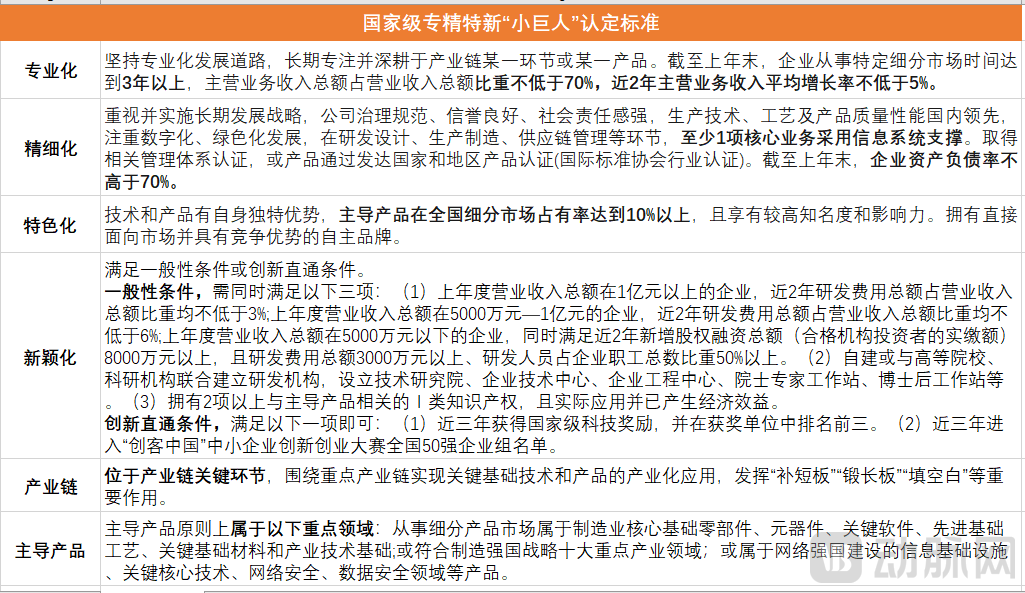
National-Level "Little Giant" Specialized, Refined, Differential, and Innovative Enterprise Certification Criteria
Against the backdrop of strong national support, Guangdong Province has successively issued policy documents such as the Several Policy Measures on Promoting High-Quality Development of the Private Economy, Several Opinions on Improving the System for Supporting the Development of Small and Medium-Sized Enterprises, and the Selection Measures for Specialized, Refined, Differential, and Innovative Small and Medium-Sized Enterprises by the Department of Industry and Information Technology of Guangdong Province, thereby creating a favorable policy environment for the development of specialized, refined, differential, and innovative enterprises.
In August this year, the application process for the 2022 Recognition of Specialized, Refined, Differential, and Innovative (SRDI) Small and Medium-sized Enterprises in Guangdong Province officially commenced. Entities meeting all four of the following criteria shall be deemed to satisfy the recognition requirements:
(1) Having operated in a specific niche market for more than two years;
(II) The total R&D expenses in the previous year shall be no less than RMB 1 million, and account for no less than 3% of the total operating revenue;
(3) The total operating revenue in the previous year exceeded RMB 10 million, or was RMB 10 million or less, but the total amount of new equity financing raised in the past two years (actual paid-in capital from qualified institutional investors) reached RMB 20 million or more.
(4) Achieve an evaluation score of 60 or higher, or meet at least one of the following conditions: 1. Received a provincial-level science and technology award in the past three years and ranked among the top three recipient entities, or received a national-level science and technology award and ranked among the top five recipient entities; 2. The average total R&D expenditure over the past two years exceeded RMB 10 million; 3. The total amount of new equity financing (paid-in capital from qualified institutional investors) over the past two years exceeded RMB 60 million; 4. Listed among the top 500 enterprises in the “Maker China” SME Innovation and Entrepreneurship Competition at the national level within the past three years.
In response to enterprises successfully recognized as “Specialized, Refined, Differential, and Innovative” (SRDI) firms and “Little Giant” firms, Guangdong Province and its local jurisdictions have also issued targeted incentive measures. These are summarized below:
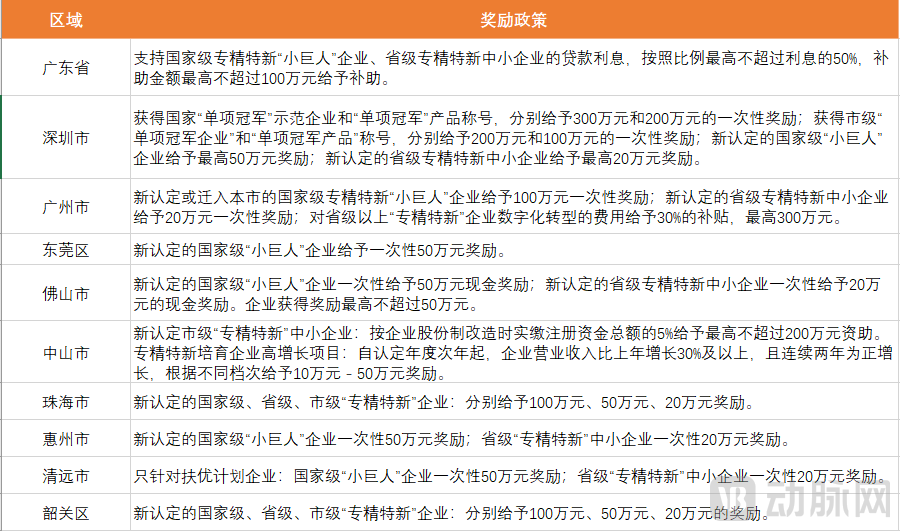
Guangdong Province and Municipalities’ Reward Policies for Specialized, Refined, Differential, and Innovative (SRDI) Enterprises (Incomplete Compilation)
At the provincial level, Guangdong Province provides subsidies to “Little Giant” firms designated as specialized, refined, distinctive, and innovative by the Ministry of Industry and Information Technology (MIIT), as well as to small and medium-sized enterprises (SMEs) recognized at the provincial level for their specialization, refinement, distinctiveness, and innovation. The subsidy applies to expenditures on interest actually incurred from RMB loans obtained from commercial banks between July 1, 2020, and June 30, 2021, provided that the total interest amount reaches RMB 300,000 or more. The subsidy rate for each enterprise shall not exceed 50% of the interest paid, with a maximum subsidy amount of RMB 1 million.
In addition to interest subsidy policies, to effectively address the financing needs of “Specialized, Refined, Differential, and Innovative” (SRDI) enterprises, the Department of Industry and Information Technology of Guangdong Province has successively established government-bank partnerships with the Guangdong Branches of Bank of Communications, Bank of China, and China Construction Bank since the beginning of this year. During the 14th Five-Year Plan period, these collaborations will introduce RMB 300 billion, RMB 100 billion, and RMB 200 billion in financing support respectively, bringing the total comprehensive financing amount to RMB 600 billion. Meanwhile, through its government-bank partnerships with the Guangdong Branches of Bank of China and China Construction Bank, the Department of Industry and Information Technology of Guangdong Province has also developed a series of tailored financing service products specifically for SRDI enterprises.
Among these, the Guangdong Branch of China Construction Bank has implemented differentiated credit support for specialized and sophisticated “Little Giant” enterprises, provincial-level specialized and sophisticated small and medium-sized enterprises (SMEs), and single-champion enterprises within Guangdong Province, in terms of credit limits, interest rates, loan tenors, disbursement speed, and team services. Additionally, it has developed 17 financial products—including Smart Manufacturing R&D Loans, Smart Manufacturing Achievement Commercialization Loans, Smart Manufacturing Supply Chain Loans, and Smart Manufacturing Industrial Park Entry Loans—to meet the needs of specialized and sophisticated enterprises in daily operations, fixed asset acquisition, investment-loan linkage, mergers and acquisitions, and talent services.
Bank of China’s Guangdong Branch has launched the “Specialized, Refined, Distinctive, and Innovative (SRDI) Cultivation Loan,” the “SRDI SME Loan,” and the “SRDI Giant Loan,” targeting SRDI cultivation enterprises, SRDI small and medium-sized enterprises (SMEs), SRDI “Little Giant” enterprises, and Single Champion enterprises, respectively. Notably, the “SRDI Cultivation Loan” offers a collateral-free credit line of up to RMB 3 million to enterprises included in the “Small-to-Regulated” cultivation databases maintained by local industry and information technology departments, specifically during their “upgrading to regulated size” cultivation phase.
Furthermore, in collaboration with the Guangdong Regulatory Bureau, the Shanghai Stock Exchange, the Shenzhen Stock Exchange, and the National Equities Exchange and Quotations (NEEQ), we have jointly launched China’s first financing service scheme to support the listing and fundraising of “Specialized, Refined, Differential, and Innovative” (SRDI) small and medium-sized enterprises (SMEs). Over the next five years, we aim to facilitate the direct financing of 300 SRDI SMEs through their entry into the capital markets.
In addition to financial support, Guangdong Province has bolstered talent development by organizing campus recruitment fairs for “Specialized, Refined, Differential, and Innovative” (SRDI) enterprises, facilitating connections between 1,500 companies and nearly 30,000 college students. The province has also implemented the New Yue Merchants Training Program, which has provided training services to 345 SRDI enterprises since 2020. Furthermore, live-streaming job recruitment initiatives have been launched to help SRDI and other enterprises better match talent supply with demand.
109 specialized, refined, distinctive, and innovative medical enterprises, including 23 national-level “Little Giants”
According to data from the Department of Industry and Information Technology of Guangdong Province, a total of 1,459 “Specialized, Refined, Differential, and Innovative” (SRDI) small and medium-sized enterprises (SMEs) were cultivated in Guangdong Province from 2020 to 2021. As the vanguard of SMEs in the province, these enterprises have driven the rapid development of industries across Guangdong. Among them, 109 were medical-related SRDI enterprises, accounting for 4.8% of the total.
Notably,Among the 109 specialized, refined, distinctive, and innovative (“SRDI”) healthcare enterprises, 23 are nationally recognized “Little Giant” SRDI enterprises, accounting for a significant proportion of 21.1%.As can be seen, although the number of healthcare companies is not large, they excel in high quality.
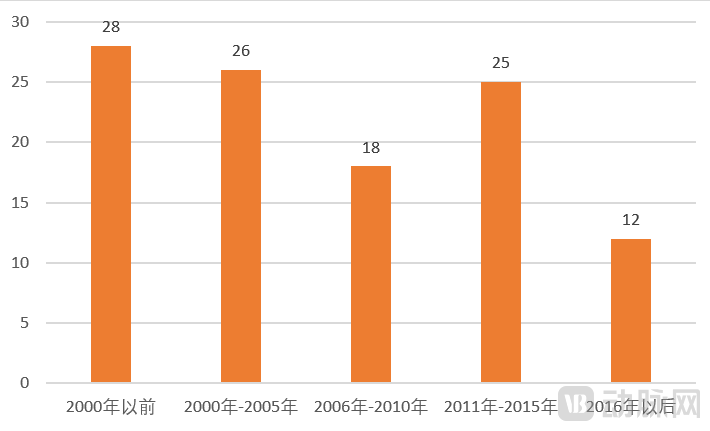
Year of Establishment of "Specialized, Refined, Differential, and Innovative" SMEs in Guangdong Province's Medical Sector
In terms of establishment date, Guangdong Province’s “specialized, refined, distinctive, and innovative” medical enterprises were founded relatively early on average, with the largest number established before 2000. Specifically, 72 enterprises were founded before 2010, nearly twice as many as the 37 founded in 2011 or later.
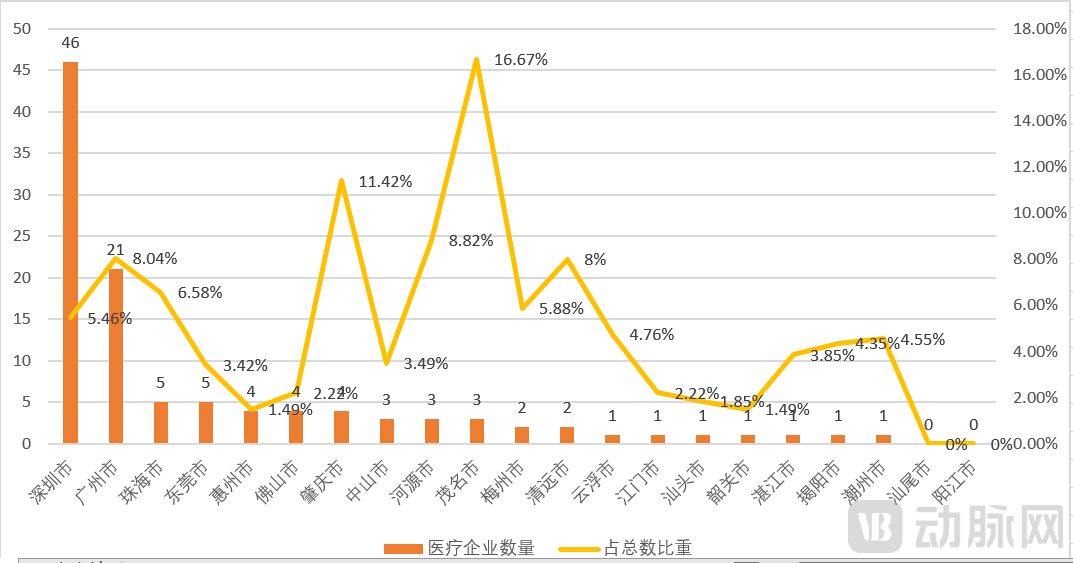
Regional Distribution of “Specialized, Refined, Differential, and Innovative” SMEs in Guangdong Province’s Medical Sector and the Proportion of “Little Giant” Enterprises
In terms of regional distribution, Shenzhen has the highest number of medical "specialized, refined, distinctive, and innovative" enterprises, with 46 companies, followed by Guangzhou with 21. Zhuhai and Dongguan are tied for third place.
On the one hand, Shenzhen firmly holds the top position with an absolute numerical advantage, boasting a total of 841 “Specialized, Refined, Differential, and Innovative” (SRDI) enterprises, ranking first in overall count. Among these, 46 are medical-related companies, accounting for 5.46%, which is slightly higher than the average level.
On the other hand, Guangzhou has 261 “Specialized, Refined, Differential, and Innovative” (SRDI) enterprises, including 21 in the medical sector, accounting for 8.04%—significantly exceeding the average level.
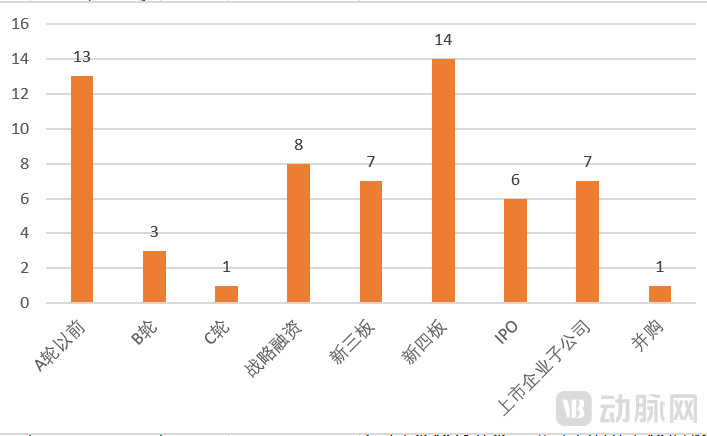
Development Stages of Guangdong Province’s “Specialized, Refined, Differential, and Innovative” SMEs in the Medical Sector (Excluding Non-Public Companies)
In terms of funding rounds, there are six companies at the IPO stage, all of which were established before 2010, indicating that established enterprises hold a significant position in the capital market.
21 companies chose to list on the NEEQ or Regional Equity Markets, 16 of which are medical device enterprises. Meanwhile, 17 of these companies were established before 2010, having cultivated their respective niche sectors for over 12 years, and two of them are nationally recognized “Little Giant” firms specializing in sophisticated and innovative technologies.
Companies’ growing preference for listing on the New Third Board or New Fourth Board reflects the state’s continued efforts to bolster support for small and medium-sized enterprises (SMEs). In November 2021, the Beijing Stock Exchange (BSE) officially commenced trading. On par with the Shanghai and Shenzhen stock exchanges, the launch of the BSE is undoubtedly one of the most significant developments in China’s capital markets in the post-pandemic era. As a result, the BSE has become the primary arena for financing by specialized, refined, distinctive, and innovative “Little Giant” enterprises.
The National Equities Exchange and Quotations (NEEQ) was established to address the financing difficulties faced by small, medium, and micro enterprises. It is understood that companies nurtured and strengthened within the NEEQ’s Innovation Tier and Base Tier are encouraged to pursue listing on the Beijing Stock Exchange (BSE). Meanwhile, the transfer mechanism remains in place, allowing mature BSE-listed companies to transfer their listings to the Main Board, the STAR Market, or the ChiNext Board in accordance with respective listing requirements, or to seek overseas IPO financing opportunities.
The establishment of the Beijing Stock Exchange, coupled with national policy support for “specialized, refined, distinctive, and innovative” enterprises, has provided a tailwind for regional four-board markets, further promoting equity trading and financing for micro, small, and medium-sized enterprises.
Therefore, specialized and sophisticated enterprises choose to list on the New Third Board or New Fourth Board based on their own strategic considerations. On one hand, they can benefit from certain policy preferences; on the other hand, listing helps enhance their brand visibility and facilitates easier access to financing. Furthermore, standardized management and regulatory oversight contribute to the long-term stable development of these enterprises.
Finally, as shown in the figure, there are only four companies at the Series B to Series C stage, among which two are national-level “Little Giant” enterprises specializing in refined, distinctive, and innovative fields, and three were established after 2010. This suggests that young innovative enterprises grow rapidly, have a strong need for capital support, and are relatively more likely to attract investor interest.
Medical Device Companies Lead the “Gap,” with Medical Equipment Accounting for Half the Market
In recent years, driven by robust policies promoting the localization of high-end medical devices and continuous innovation and upgrading of domestic proprietary technologies, Guangdong has achieved remarkable results in the medical device sector.
Data show that during the 13th Five-Year Plan period, Guangdong had a total of 4,368 medical device manufacturing enterprises, accounting for approximately 15% of the national total and ranking first in China; there were 147,396 medical device distribution enterprises, representing about 17% of the national total; and the total industrial output value of the medical device industry ranked among the highest in the country.
In 2021, Guangdong Province had a cumulative total of 25 innovative medical devices approved by the national authorities, ranking second in China; the Guangdong Provincial Medical Products Administration directly approved 1,717 Class II medical devices, ranking first in China; the province currently holds 11,083 Class II medical device registration certificates, accounting for 15% of the national total and ranking second in China.
Guangdong Province’s leading position in the medical device sector is also reflected in the specialized, refined, distinctive, and innovative (SRDI) healthcare industry landscape.
An analysis of the specialized segments of 109 medical “specialized, refined, distinctive, and innovative” enterprises in Guangdong Province from 2020 to 2021 reveals that these companies can be broadly categorized into medical devices, pharmaceutical manufacturing, biotechnology, general health, new drug research and development, and other fields.
Among them, medical device-related companies took the absolute top spot with 61 firms, followed by 23 pharmaceutical manufacturing enterprises, including 11 traditional Chinese medicine (TCM)-related companies and 7 active pharmaceutical ingredient (API) suppliers.
Further along are biotechnology companies, primarily focused on genetic testing and precision oncology diagnosis and treatment; in the broader health sector, there are manufacturers of home-use medical devices such as electronic blood pressure monitors and glucose meters, as well as companies in the medical aesthetics and dental care industries; finally, there are new drug R&D enterprises, with a predominant focus on oncology and autoimmune diseases.
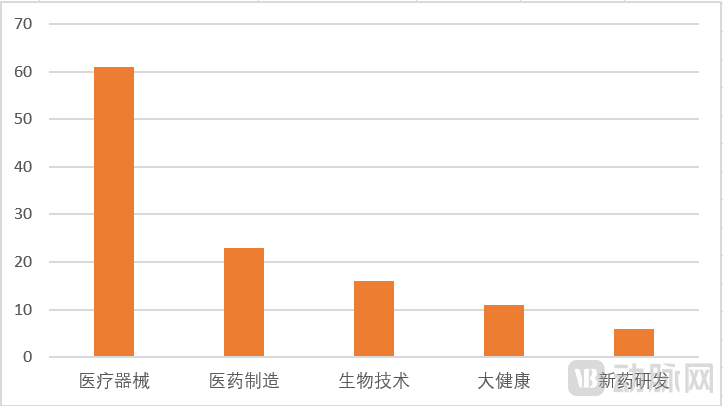
Overview of "Specialized, Refined, Differential, and Innovative" SMEs in Guangdong Province's Medical Sector
A further analysis of the distribution across sub-sectors of the medical device industry reveals that 30 companies, accounting for a significant 50%, specialize in medical equipment and instruments. They are closely followed by 16 companies focused on raw materials for in vitro diagnostic (IVD) reagents. Next are companies in the consumables segment, with those specializing in cardiovascular and cerebrovascular interventional medical devices numbering nearly the same as those producing disposable medical consumables.
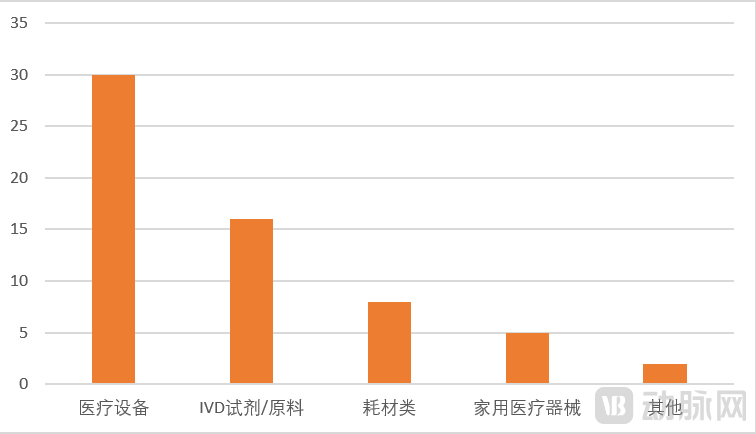
Niche Segments of “Specialized, Refined, Differential, and Innovative” Medical Device Enterprises in Guangdong Province
In addition, among the 61 medical device companies, 13 are national-level “Little Giant” enterprises, accounting for more than half of the 23 national-level “Little Giant” enterprises in the medical sector. This also confirms the characteristics of these companies: they have been deeply engaged in niche fields for many years, were established early, possess strong capabilities, and have the growth potential to become hidden champions or single-product champions.
Remarkable Achievements in Cultivation: Number of Fourth-Batch “Little Giant” Enterprises Ranks Second Nationwide
According to the fourth batch of national-level specialized, refined, distinctive, and innovative “Little Giant” enterprises announced by the Ministry of Industry and Information Technology, the number of companies in this batch has expanded to 4,328, approaching the combined total of the first three batches. The nationwide total of such “Little Giant” enterprises has now reached 8,997.
The fourth batch of specialized, refined, distinctive, and innovative “Little Giant” enterprises spans all 31 provinces, municipalities, and autonomous regions across China, with Guangdong Province ranking second in the number of such enterprises, totaling 448.Shenzhen is home to 169 “Little Giant” enterprises, ranking fourth among cities nationwide.
“Little Giant” enterprises are the elite among specialized, refined, distinctive, and innovative small and medium-sized enterprises (SMEs). The emergence of manufacturing single-product champions and hidden champions signifies internationally leading production technologies or processes, with their niche products ranking among the top globally in market share.
Guangdong’s continuous emergence of “Little Giant” enterprises is fundamentally attributable to its mature market environment and an ecosystem conducive to their growth.
First, Guangdong took the lead in China to establish the “Guangdong Model” of “Digital Government + FinTech,” launching the Guangdong SME Financing Platform. By the end of 2021, the “SME Finance” platform had covered all 21 prefecture-level cities in Guangdong Province, serving over one million enterprises.
Secondly, Guangdong’s favorable market environment and well-functioning market mechanisms enable small and medium-sized enterprises (SMEs) to gain a competitive edge in niche segments, achieving higher market shares through innovation and mastery of key core technologies.
In addition, Guangdong has implemented supporting policy measures in areas such as financing facilitation, patent services, and management consulting to foster the growth of small and medium-sized enterprises (SMEs), thereby creating favorable conditions for these SMEs to scale up and become “Little Giant” firms.
In line with the targets set by the Ministry of Industry and Information Technology, China aims to cultivate 100,000 provincial-level “Specialized, Refined, Differential, and Innovative” (SRDI) small and medium-sized enterprises, 10,000 SRDI “Little Giant” enterprises, and 1,000 manufacturing single-champion enterprises by 2025.
We anticipate that, as policies are progressively implemented and the tiered cultivation system becomes increasingly mature, more “specialized, refined, distinctive, and innovative” (SRDI) Little Giant enterprises will emerge, providing a continuous stream of momentum for the high-quality development of China’s industries.