

Cellesce Ltd IPO Prospectus: Pioneering Scalable Production of Patient-Derived Tumor Organoids for Drug Discovery

Cellesce
Organoid Developer
In the development of new drugs for cancer patients, extracting living tissue from patients and cultivating tumor-derived organoids in vitro has emerged as a novel approach to reduce R&D costs and improve the accuracy of early-stage drug prediction. Although tumor organoids hold promising application prospects, their cultivation and production currently rely solely on manual methods, leading to issues such as inconsistent quality and variable sizes within the same batch. Therefore, establishing standards and achieving scalable production are critical.
UK-based Cellesce is conducting research on tumor organoids, aiming to provide innovative solutions for their large-scale production through its proprietary patented technology.
Cellesce, founded in 2013, leverages expertise in biochemistry and bioprocess engineering from the University of Bath, as well as cell and organoid biology from Cardiff University, to develop organoids, with a focus on the research and development of Patient-Derived Organoids (PDOs).
Currently, Cellesce has completed two rounds of financing. The second round was a seed round led by the Development Bank of Wales in 2018.
Cellesce boasts a robust management and R&D team. The current CEO, Victoria Marsh Durban, studied cancer genetics at Cardiff University, focusing on the development of gastrointestinal cancer models. She subsequently completed her postdoctoral research at the University of California, San Francisco (UCSF), investigating targeted therapies for malignant melanoma. In 2016, Victoria joined ReNeuron as Principal Investigator and Head of Cell Biology. Three years later, she joined Cellesce as Chief Scientist and became the company’s CEO in 2021.

John Allbrook is the Chairman of the Board of Cellesce. He has served in leadership roles at multinational corporations, private equity firms, and publicly listed companies across the financial services, business services, and technology sectors, accumulating extensive experience in operations management. Previously, he was the Chief Executive Officer of GoIndustry plc, a publicly listed provider of asset sales and valuation services. Subsequently, he spent ten years at GE Capital, where he focused on building robust financial, strategic, human capital, and technological foundations to drive the company’s profitable growth.

An experienced R&D team has laid the foundation for Cellesce to carve out a differentiated path in the organoid sector. In early-stage screening of new drug compounds, the current standard practice involves using suspended cultures of cancer cell lines to predict efficacy. However, this approach often fails to accurately forecast actual clinical outcomes in tumor patients, ultimately causing many promising drug candidates to fail to achieve clinically meaningful endpoints in early cell-based assays or animal model studies.
The emergence of patient-derived organoids (PDOs) will provide optimized solutions for predicting patient responses to novel oncology drugs and for drug screening, thereby yielding more authentic drug efficacy data. PDO tumor organoids offer numerous advantages: they can be directly established from biopsy tissues obtained from patients in various disease states; they mimic the structure of the source organ or tissue, replicating pathological conditions found in both normal and diseased states; furthermore, these organoids are self-assembled from adult stem cells, exhibit a three-dimensional (3D) architecture, and comprise multiple cell types.
Leveraging these advantages, Cellesce has developed and patented a unique bioprocess for expanding human-derived normal or tumor organoids, enabling diverse applications such as drug discovery and organ-on-a-chip development.
Currently, organoids can only be grown and expanded through manual culture methods. This time-consuming and labor-intensive approach poses a significant challenge to organoid technology, as it results in the production of small quantities of organoids with inconsistent sizes, thereby limiting their applicability in high-throughput applications and their widespread adoption in new drug development by large pharmaceutical and biotechnology companies.
To address this challenge, Cellesce has developed and patented its second-generation bioprocess. Compared withCompared with manual processes, PDO yield has been significantly increased. Furthermore, by leveraging online sensors and real-time monitoring technologies, Cellesce can achieve better control over the production process, ensuring precise culture conditions, thereby increasing yield, controlling organoid size, and reducing batch-to-batch and user-to-user variability.Cellesce’s significant transformation of existing manual PDO culture methods enables the widespread use of organoids in the early stages of drug discovery.
Leveraging Cellesce’s proprietary development process, the company is continuously refining its product pipeline.Currently marketed products include:Colorectal cancer organoids, breast cancer organoids, and normal “healthy” intestinal PDOs (including colon and duodenum); for these products, Cellesce offers a range of assays and ready-to-use, cryopreserved PDOs in vials.Among its products under development, Cellesce already covers PDO models for the pancreas, lung, ulcerative colitis, inflammatory bowel disease, duodenum, and familial adenomatous polyposis.
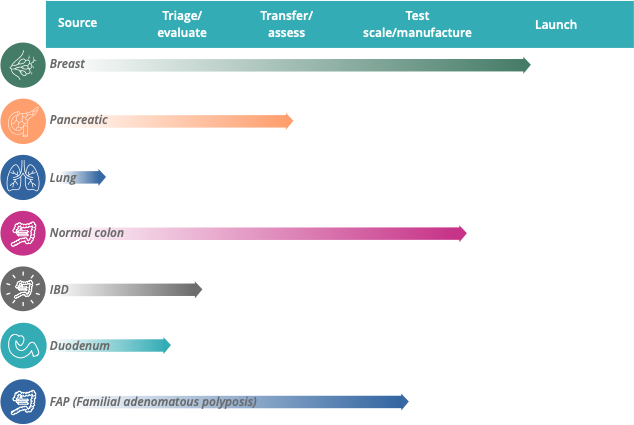
Building on its existing and pipeline products, Cellesce offers a range of services, currently including: PDO process scale-up and manufacturing for large-scale processing and production; custom development to establish, develop, and manufacture specific PDOs for clients; establishment of PDO biobanks to expand access to high-quality PDOs from the Hubrecht HUB Organoid Biobank; exploration of application scenarios, including organ-on-a-chip, high-throughput compound screening, 3D image analysis, and complex in vitro assays in immuno-oncology; and PDO R&D, with Cellesce’s intellectual property covering novel bioprocesses and bioreactor applications. Meanwhile, Cellesce is actively seeking collaborations and looks forward to establishing partnerships with companies that have access to patient samples.
Cellesce’s unique product development processes and comprehensive service system have facilitated R&D collaborations with multiple institutions. In 2018, Cellesce partnered with the National Physical Laboratory (NPL), the UK’s national metrology institute, to image and analyze colorectal cancer organoids, aiming to establish new standards for 3D organoid imaging. This collaboration enabled Cellesce to develop a rapid, quantitative, morphometric imaging method for validating and comparing batches of organoids, thereby providing a consistent quality standard for the adoption of organoid models in the pharmaceutical industry.
In 2019, Cellesce partnered with Repositive, a UK-based online platform for genomic data discovery, to jointly explore cancer models and advance the screening of novel drug compounds. Repositive has developed a web-based integrated solution that helps researchers identify cancer models derived from human tumors. Through controlled data access on the Repositive platform, Cellesce can gain insights into the most popular models and connect with both new and existing customers.
In the same year, Cellesce partnered with Hubrecht Organoid Technology (HUB) to leverage its proprietary bioprocessing technology and jointly expand breast cancer organoid development. The collaboration aimed to confirm the genetic and phenotypic stability of breast cancer organoids and explore early tumor characteristics.
In 2021, Cellesce collaborated with Cardiff University on research that employed 3D image analysis to assess organoid size and cell count. This technology enables the quantification of changes in organoid morphology, such as size and shape, and can detect subtle cellular alterations induced by drugs, thereby facilitating a deeper understanding of the morphological characteristics of 3D patient-derived organoid (PDO) models and their underlying cellular biological mechanisms.
In the future, PDOs will become a powerful tool for improving the efficiency of new drug development and enhancing the efficacy of cancer treatments. Cellesce’s exploration of PDO organoids is ongoing; the company will continue to pursue patent inventions and filings, aiming to establish itself as a global leading industrial manufacturer of organoids.