

TIGIT Target Makes a Comeback: From Big Pharma Retreat to Next-Gen Bispecifics Led by AstraZeneca and Akeso

Gilead Sciences
Innovative Drug Developer, Distributor

GSK
Pharmaceutical R&D Manufacturer
BeOne
Developer of Molecular Targeted and Immune Anti-Tumor Drugs

TIGIT could arguably be considered an exceptionally unique entity in the field of cancer immunotherapy.
Once, it was a promising target that major pharmaceutical companies were willing to invest heavily in acquiring. However, with a series of Phase III clinical trial failures by giants such as Roche, GSK, Gilead Sciences, and Merck & Co.,This once highly sought-after rising star in cancer therapy has, at one point, become a R&D black hole.
However,As of 2026, the story of TIGIT is not over.Leveraging the impressive clinical data on TIGIT/PD-1 bispecific antibodies presented at this year’s ASCO and a novel, differentiated multi-target molecular design, TIGIT is ushering in a new chapter.

The Comprehensive Collapse of Monoclonal Antibodies
TIGIT was once the chosen one in the field of immunotherapy, hailed with the halo of "the next PD-1,"A Hot Sector Bet on by Global Pharmaceutical Companies.
In 2020, Gilead Sciences partnered with Arcus to acquire domvanalimab; in July 2021,GSK invests$625 millionThe upfront payment introduced iTeos'Belrestotug; in December of the same year, BeOne Medicines partnered with Novartis to co-develop ociperlimab, with a potential total value exceeding$2 billion…
As a pioneer in the TIGIT field, Roche’s tiragolumabIt even led global R&D efforts at one point. This drug isFirstGranted Breakthrough Therapy Designation by the FDA(BTD)anti-TIGIT molecule, indicated for first-line treatment in combination with atezolizumab for metastatic non-small cell lung cancer (NSCLC) with high PD-L1 expression and no EGFR or ALK genomic tumor aberrations (NSCLC)。
The designation of BTD is based on positive data from the Phase II CITYSCAPE study,Tiragolumab Combination TherapyORR and PFS were both superior to atezolizumab monotherapy. Especially in the population with PD-L1 TPS ≥50%, the combination therapyORR reached 66%, while the ORR of atezolizumab monotherapy was only 24%.
Based on this, Roche has mapped out an extensive development landscape for tiragolumab, covering multiple indications including lung cancer, esophageal cancer, and cervical cancer, advancing 10 pivotal clinical trials, with a cumulative investment ofApproximately $6 billion。
However, Phase III clinical data shattered this dream and quickly cooled the fervor.
In 2022, the first global Phase III clinical trial targeting TIGIT failed. The SKYSCRAPER-02 study, evaluating tiragolumab in combination with atezolizumab and chemotherapy as first-line treatment for extensive-stage small cell lung cancer, did not meet its co-primary endpoints of progression-free survival (PFS) and overall survival (OS). In the same year, againstFirst-line NSCLC with High PD-L1 ExpressionSKYSCRAPER-01 Study Setbacks Again: PFS Misses Primary Endpoint, OS Also FailsFinal analysis in 2024; subsequently, multiple pivotal studies including SKYSCRAPER-06, -04, and -07 failed consecutively, and Roche in 2025ClearedAll Clinical Trials of Tiragolumab.
Roche’s setback is not an isolated case, 22025The Global TIGIT Monoclonal Antibody Landscape Experiences a Collective Retreat. In April, BeOne Medicines announced the termination of clinical development of ociperlimab for lung cancer; in May, GSK and iTeos abandoned the development plan for belrestotug based on the latest interim analysis results from GALAXIES Lung-201 and GALAXIES H&N-202; in December, Gilead Sciences’ domvanalimab failed to demonstrate an overall survival (OS) benefit in the Phase III STAR-221 study targeting gastric/esophageal cancer, marking a disappointing end.
As TIGIT monoclonal antibody programs at pharmaceutical companies worldwide draw to a close, the golden era of TIGIT as a single-target therapeutic agent is nearly declared over.

The First Chapter of the Bispecific Antibody Era
However, it is the monoclonal antibody that has failed, not the target itself. Bispecific antibodiesIts differentiated design brings a novel breakthrough strategy to the TIGIT target, further unlocking its therapeutic value.
At the 2026 ASCO Annual Meeting, Zelixir Biopharma announced for the first time the combination of the PD-1/TIGIT bispecific antibody ZG005 with bevacizumabFirst-Line Treatment for Advanced Hepatocellular CarcinomaPhase II clinical data.
Compared to the established standard regimen of sintilimab plus bevacizumab,ZG005 The risk of disease progression or death was reduced in the 20 mg/kg group and the 10 mg/kg group, respectively.65% and 59%,ORR reached40.6%and 38.7%, all higher than the standard treatment group(ORR=34.4%); DCRs were respectively90.6% and 90.3%(Control group: 75.0%)。
In fact, this was not the first time ZG005 had appeared on the international stage. As early as the 2025 ASCO Annual Meeting, Zai Lab had already disclosed data on ZG005 forCervical CancerTherapeutic potential. In patients who have not previously received immune checkpoint inhibitor therapySecond-line and aboveAmong cervical cancer patients, the 20 mg/kg group(N=22)ofConfirmed ORR of 40.9%, with median PFS exceeding 11 months; whereas inFirst-lineIn patients with cervical cancer, the 20 mg/kg group(N=28)the unconfirmed ORR was as high as 82.1%, DCR reached96.4%。
According to Soochow Securities’ estimates, the peak domestic sales of ZG005 for just two indications—cervical cancer and liver cancer—are expected to reachRMB 3 billion。
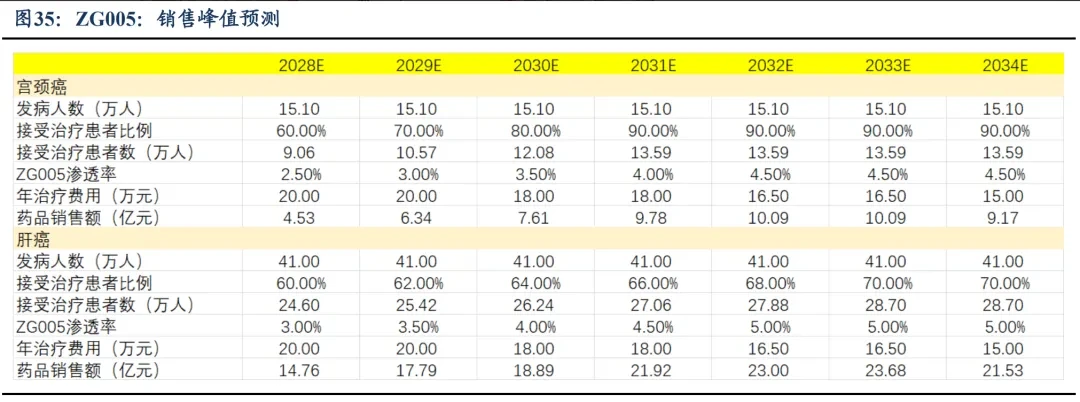
Screenshot source: Soochow Securities
In addition to Zeling Pharmaceuticals, pharmaceutical giants are also involved in the development of TIGIT/PD-1 bispecific antibodies.
AstraZeneca is also developing Rilvegostomig,in multiple high-incidence cancer types, including biliary tract cancer, liver cancer, NSCLC, gastric cancer, and endometrial cancer, all at onceLayout established12 Phase III TrialsClinical trials. Such a large-scale bet is, in itself, the strongest endorsement of this technological pathway.
At the 2026 ASCO Annual Meeting, AstraZeneca presented updated data from the Phase II GEMINI-Hepatobiliary trial evaluating rilvegostomig in combination with chemotherapy for advanced biliary tract cancer. The results showed that, with a median follow-up of 16.2 months, the overallMedian OS was 16.8 months;The 18-month OS rate was 44.8%.. The median OS exceeded 13 months in all subgroups.
AlthoughRilvegostomig'sPhase III Clinical TrialConcentrated completion will not be achieved until 2029–2031, but one thing is certain: the story of TIGIT bispecific antibodies has only just begun with its first chapter.

Beyond the New Frontiers of PD-1
If the rise of ZG005 and Rilvegostomig proves that TIGIT is on the PD-1 axis"Redemption」, then it is evident that global pharmaceutical companies areUnlocking More Possibilities for TIGIT.
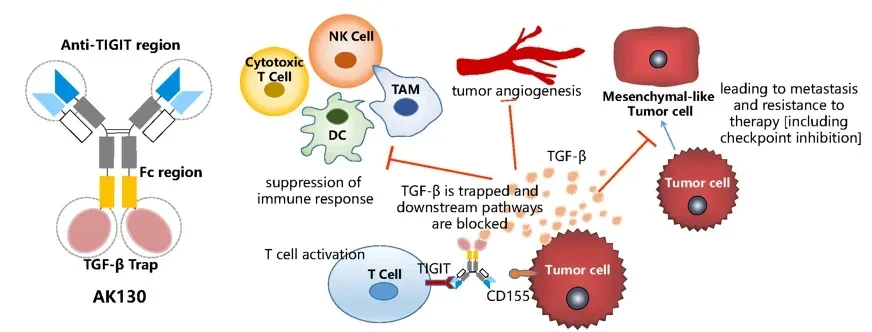
Akeso has incorporated TIGIT and TGFβ into a single molecule, creatingThe Only One WorldwideIn DevelopmentTIGIT/TGFβ Dual-Target Antibody Fusion ProteinAK130, which is also Akeso’s first innovative dual-target antibody fusion protein drug.
Mechanistically, AK130 activates T-cell immune responses through dual blockade of TIGIT and TGF-β, reduces TGF-β-mediated immunosuppressive activity of regulatory T cells (Tregs), thereby achieving enhanced antitumor efficacy. Notably, AK130 eliminates antibody-dependent cellular cytotoxicity (ADCC) by engineering the Fc region of an IgG4 backbone antibody.(ADCC)and Complement-Dependent Cytotoxicity(CDC), which precisely reflects the core lessons learned from the era of IgG1-type TIGIT monoclonal antibodies.
Meanwhile, Akeso will combine AK130 with its flagship productIvonescimabUsed in combination, to「IO 2.0 + IO 2.0」combination strategy, officially launched the treatment with AK130 in combination with Ivonescimab in 2025Advanced Pancreatic CancerPivotal Phase II Study(AK130-202), with trials expected to be completed in 2028.
At the 2026 ASCO, AK130Advanced Biliary Tract CancerofEarly clinical data makes its debut. InAmong all evaluable patients,AK130 in Combination with IvonescimabORRwas 18.2%, and the DCR was 77.3%; 45 mg/kg Q3W(Recommended Phase 2 Study Dose, RP2D)GroupORR was 25.0%, and DCR was 68.8%.; among patients who achieved disease control, 85.7% exhibited significant tumor regression; all patients in the 10 mg/kg and 30 mg/kg groups achieved stable disease.
Huiyu Pharmaceuticals has developed aPD-1/TIGIT/IL-15 Tri-specific Antibody Fusion ProteinHY07121, on the one hand, supplements the number of effector cells by inducing the expansion of immune stem cells; on the other hand, it enhances anti-tumor effects by reversing the function of exhausted T cells, partially overcoming immune resistance. It is expected to provide more treatment options for tumor patients with disease progression after immunotherapy. Currently, the Phase I/II clinical trial of HY07121(NCT06639256)Progress is being made steadily.
However, Zeltgen Pharma did not place all its bets on TIGIT with ZG005, but instead developed another global first-in-classLAG-3/TIGIT Bispecific AntibodyZGGS15, preclinical data show that in combination with anti-PD-1 monoclonal antibodyTumor inhibition rate can reach 95.8%,and lacks ADCC/CDC activity. Currently published Phase I data show that,ZGGS15 monotherapy demonstrated favorable tolerability, safety, and antitumor efficacy, showing promise in combination with other anticancer therapies(such as PD-1 or PD-L1 inhibitors)Combination therapy achieves a favorable synergistic and enhanced antitumor effect.
Conclusion
From the comprehensive failure of monoclonal antibodies to the flourishing development of multi-target antibodies, the story of TIGIT precisely embodies the ultimate philosophy of innovative drug R&D:This path leads nowhere, but it does not mean the other shore is unreachable.
Indeed,Currently, the positive data for multiple innovative TIGIT drugs worldwide still largely stem from early-stage clinical trials. Subsequent large-scale Phase III clinical trials and commercialization remain significant challenges. Nevertheless, it is undeniable that the story of TIGIT is far from over.By fractionationSubstructure optimization, innovative target combinations,A new chapter begins.
Editor:Evening