

Acrogenic Biotechnologies: Empowering the Organoid Industry as a 'Water Seller' Through Foundational Biomaterial Innovation
Organoids represent a multidisciplinary field. In recent years, a significant achievement in the rapid development of organoid technology has been the application of biomaterials to construct organoids that maximally mimic in vivo structures and functions. As we envision the prospects of organoids, it is important to note thatExtracellular matrix and biomaterial scaffolds, as foundational technologies, are critical to the industry's development. High-quality, controllable extracellular matrix materials can enhance the cost-effectiveness, accuracy, and reproducibility of organoids.thereby delivering improved application outcomes.
Founded in 2018, Acrogenic Biotechnologies (now known as Dingsheng Biotechnologies Co., Ltd.) specializes in the research, development, and production of novel biomaterials, particularly extracellular matrix materials that support high-density three-dimensional growth of adherent mammalian cells in vitro and organoid construction. As a company distinguished by its strong integration of industry, academia, and research, Acrogenic’s core technology is AccuraMatrix, a novel biological scaffold with independent intellectual property rights.
Aogno, with its lean structure and strong emphasis on technological value, has achieved efficient translation of innovations in the field of precision medicine. Within just a few years, it has established collaborations with more than 20 major hospitals and research institutions, providing a range of scientific research support services, including druggability assessment, organoid development, and patient-derived xenograft (PDX) model establishment.
Recently, VCBeat’s New Medicine channel interviewed Dr. Yang Dazhi, Chief Scientist at Organo. With a multidisciplinary background spanning clinical medicine, materials science, molecular developmental biology, oncology, and tumor pharmacology, Dr. Yang shared his insights into the fundamental drivers of organoid technology and its prospects for industrialization.
Transforming Patents into Applications: Becoming the Industry’s “Water Seller”
Yang Dazhi graduated from the Department of Clinical Medicine at Capital Medical University. In 1997, he went to the United States to pursue doctoral research in molecular developmental biology, completing his degree in 2003. He then joined the National Cancer Institute as a postdoctoral fellow and scientist. Eight years later, he moved to the Centers of Research Excellence in Science and Technology, where he engaged in research in materials science and tissue engineering.
During his tenure at the U.S. National Advanced Technology Research Center, Yang Dazhi secured two patents: one for a drug prototype targeting metabolic disorders and another for a novel bio-scaffold material. Believing that research only holds value when translated into practical applications, he was inspired to launch a startup based on these patented technologies.
Many scientists strive to balance their dual identities when launching startups, but Yang Dazhi ultimately chose to commit to entrepreneurship full-time. “I jumped in without hesitation, only to realize later that once you’re in, there’s no turning back.”
This mindset is closely tied to the United States’ mature industry-academia-research ecosystem and its well-established chain for intellectual property commercialization. In the U.S., there is a clear distinction between “research” and “R&D”: the former addresses scientific questions and is conducted by basic or clinical research institutions, while the latter targets market-driven technological pain points and is carried out by companies. Bridging these two stages are numerous specialized attorneys who facilitate the conversion of patent achievements into commercial applications, and universities typically maintain dedicated “Intellectual Property Offices.”
Yang Dazhi’s startup team has also engaged “IP lawyers” to safeguard the company’s patent applications. “We develop reagent consumables and application service products through the R&D of new biomaterials and the expansion of their applications. The profits generated from product sales are then reinvested into R&D, creating a self-sustaining cycle for our foundational technology company.”
Thus was born “Aogenuo,” a company embodying the integrated model of industry, academia, and research. Yang Dazhi aspires to build an asset-light, technology-intensive enterprise with efficient commercialization capabilities. Rather than spanning the entire industrial chain, he prefers to position himself as a “water seller.”
“Biomaterials are the foundation and key to establishing in vitro and in vivo models, culturing stem cells and primary cells in vitro for in vivo implantation therapy, and producing synthetic therapeutic endogenous proteins and protein complexes using cells in vitro,” said Yang Dazhi. “We focus on the upstream sector, breaking through bottlenecks in foundational technologies. While we capture only a portion of the value, we provide our R&D-driven technical products to downstream industries, allowing them ample profit margins. This approach helps strengthen and expand the industry. Ultimately, by relying on downstream enterprises to continuously expand their market presence and scale, we will foster a robust industry ecosystem.”
Pursuing the "Highest Realm" of Extracellular Matrix Materials
Why Are Materials Critical?
The extracellular matrix (ECM) is crucial for enabling cells to grow in three dimensions and even form tissue-like structures in vitro. The ECM can form a complex scaffold that supports, connects, and protects the cells growing within it, while also regulating intercellular communication and migration. Therefore, ECM materials play a vital role in establishing a stable microenvironment suitable for cell growth, allowing cells to self-organize, differentiate into various functional types, and develop structures of diverse morphologies. When cell clusters grown in vitro exhibit functions and structures similar to those of their corresponding organs in vivo, they are referred to as “organoids.”
Traditional extracellular matrices and methods for organoid culture are categorized into several major types: hydrogels, solid scaffolds, nanofibers, and microfluidic chips formed by combining three-dimensional culture with microfluidics technology.
A significant issue with synthetic hydrogels, solid scaffolds, and nanofibers is that their physicochemical properties are fixed; consequently, they can only support the optimal culture of one specific cell type, while other cell types struggle to grow within these materials, leading to suboptimal practical applications.
Matrigel, produced by Corning Incorporated in the United States, has undergone more than 40 years of research and development to become the most versatile, technically mature, and widely used extracellular matrix for three-dimensional culture of mammalian cells, accounting for 75% of the entire market.
However, as an extracellular matrix, Matrigel’s hydrogel state restricts cell mobility during organoid formation. External colloidal pressure induces cellular stress responses, leading to eversion of the basal layer and involution of the functional layer. Furthermore, its animal-derived origin raises concerns regarding biosafety, while the complex biological composition of Matrigel results in batch-to-batch variability, thereby compromising the accuracy and reproducibility of organoid construction.
Compared with Matrigel, synthetic scaffolds are considered the “rising stars” among materials for organoid culture. Over the past two decades, numerous synthetic scaffolds have been developed using synthetic polymer methods. The mechanical, physical, chemical, and biological properties of various synthetic scaffolds can be tailored and optimized according to cellular requirements, thereby maximizing the mimicry of the in vivo environment and maintaining cell differentiation, function, and proliferation.
“We aim to develop a series of synthetic extracellular matrix materials and biological scaffolds with exceptional universality,” said Yang Dazhi. “The pinnacle of extracellular matrix materials lies in their ability to support the large-scale, efficient, and low-cost culture of various human primary cells and stem cells in vitro by highly mimicking the in vivo environment, thereby achieving industrialized production of human cells. Furthermore, these large-scale 3D in vitro cultures of human cells can be leveraged to produce endogenous proteins and protein complexes for repairing human tissue injuries and treating diseases. Procollagen, which can be directly utilized by the human body, is one such example.”
AccuraMatrix, a core technology with independent intellectual property rights launched by Organo, is dedicated to enhancing universality and meeting the needs of in vitro culture for various mammalian cells. It has been successfully applied in organoid culture, stem cell expansion, drug screening, and tumor recurrence monitoring.
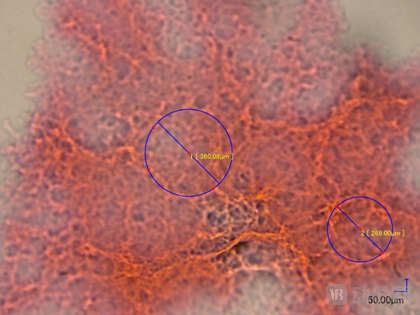
AccuraMatrix (Eosin Staining) under 80X Stereomicroscope
According to the introduction, AccuraMatrix can adjust parameters such as fiber length, pore size, material density, structural rigidity, and the type and distribution of surface charges during synthesis. This effectively provides a stable microenvironment required for the in vitro culture of various human primary cells and stem cells, ensuring efficient intercellular communication, free migration and reorganization of different cell types, effective exchange of nutrients, and removal of cellular metabolic waste.
Beyond Market Cultivation, Organoids Require Industrialized Solutions
The organoid industry boasts broad application prospects. However, alongside favorable policies and technological advancements has come intense speculative hype, with academic papers proliferating rapidly and companies of various types expanding their businesses into the organoid sector. In reality, the organoid industry is still in its market cultivation phase.
Juergen A. Knoblich, Scientific Director of the Institute of Molecular Biotechnology of the Austrian Academy of Sciences, once described organoids as follows: “If an organ is likened to a properly assembled car, then an organoid is like a car with its engine on the roof, transmission in the trunk, exhaust pipe facing forward, and tires pointing upward. With such a car, we can study the principles of how the engine works, but it is still a long way from being truly drivable.”
For the organoid industry,First, the technology still needs continuous improvement.Drug screening and drug sensitivity testing for cancer patients are currently among the most common applications of organoids, yet they remain in the phase of technical validation. Once organoid technology establishes industry standards and is ultimately incorporated into clinical guidelines for cancer diagnosis and treatment, it will formally emerge from the “gray area” and gain broader recognition from downstream customers and end-users. Such commercial legitimization will drive industry growth and prosperity.
Second is market “education,”Enable more researchers and clinicians to adopt organoid technology, thereby establishing standards, building momentum, and even driving its inclusion in medical insurance coverage, thus steering the organoid industry onto a path of standardized development.
Current customers of organoid products are primarily laboratories or individuals at universities, hospitals, and research institutions, as well as pharmaceutical companies. The key to these products lies in their scalability and industrialization; stability levels and production costs are critical competitive advantages for organoid companies. However, a current constraint on the organoid industry is “resource limitations.” Due to technological and material constraints, it is difficult for organoid companies to develop sustainable, systematic platforms independent of clinical samples.
Ogno aims to provide more scalable and standardized solutions.After obtaining solid tumor specimens from patients, AccuraMatrix technology enables rapid in vitro expansion of tumor cell pools and library construction. By implanting the cultured cells into animals to establish patient-derived xenograft (PDX) models, a PDX bank can be created through serial passaging in mice. This approach facilitates the rapid, cost-effective, and highly reproducible establishment of a high-throughput anticancer drug screening platform for both in vitro and in vivo applications. Such a platform not only provides clinicians with optimal personalized medication regimens but also offers a multi-case drug screening and testing platform for anticancer drug development that does not rely on clinical sample resources.
Another example is the in vitro culture of circulating tumor cells (CTCs). Although CTCs are present in very low numbers in the blood of cancer patients, they hold significant importance for detecting tumor recurrence and establishing models of tumor metastasis and drug resistance. Using AccuraMatrix technology, CTCs can be cultured and expanded in vitro while preserving their cellular heterogeneity. Analysis of these expanded CTCs enables the prediction of a patient’s susceptibility to recurrence, metastasis, and drug resistance, thereby guiding decisions on early intervention therapies. Furthermore, anticancer drug sensitivity screening and big data analytics can be conducted using cultured CTCs and CTC-derived patient-derived xenografts (CTC-PDX), helping to identify more effective anticancer drugs for patients.
It is worth noting that this approach—obtaining CTCs through non-invasive liquid biopsy and leveraging cultured, proliferated CTCs along with CTC-derived patient-derived xenografts (CTC-PDX) to establish in vitro and in vivo models and platforms for tumor metastasis and drug resistance—can significantly reduce the difficulty of acquiring tumor samples, holding substantial significance for the development of novel oncology drugs.
Currently, Organo has established close collaborative relationships with more than twenty major hospitals and research institutions, including Johns Hopkins University, Tsinghua Changgung Hospital, the Cancer Hospital of the Chinese Academy of Medical Sciences, Beijing Anzhen Hospital, the U.S. National Cancer Institute, and the University of Florida College of Medicine, providing a range of scientific research support services such as drugability assessment, organoid development, and patient-derived xenograft (PDX) model establishment.
Regarding the development of the organoid industry in China, Yang Dazhi expressed optimism: “Organoids are used in clinical applications and involve clinically related technologies and assays; China possesses policy, resource, and industrial advantages.”