

A Century of U.S. Technology Commercialization: A Policy Turnaround of Innovation and Continuity
In 1893, brothers Charles Duryea and Frank Duryea purchased an old four-wheeled carriage at a fair and spent two months tinkering with it in their garage, installing a single-cylinder gasoline engine. From this starting point, the Duryea brothers inventedAmerica's First Automobile。
In 1969, NASA sent Armstrong to the moon, taking the“One giant leap for mankind”。
Perhaps the Duryea brothers could never have imagined that, in just seventy short years, Americans would not only build high-performance automobiles but also send humans into space. Over those seven decades of effort, beyond scientific progress, what mattered more was the nation’s resolve to marshal its full resources toward achieving a singular goal.
Such determination is often manifested through policy. The moon landing was a result of policy,The Breakthroughs in the Field of Technology Transfer in the United States Also Benefit from Policies。
Prior to World War II, the U.S. federal government did not regard supporting science and technology as a primary responsibility; rather, such support was ancillary, aimed at fulfilling the missions of government agencies. Consequently, during that period, the United States enacted virtually no policies concerning the commercialization of research outcomes, and patent licensing activity remained sluggish, with only sporadic one or two cases per year.
By 1968, Japan’s economy had experienced substantial growth, driven in part by the supply of military-industrial materials, briefly surpassing West Germany to become the second-largest economy in the capitalist world. The erosion of its technological edge prompted feelings of threat and unease in the United States, leading the federal government to prioritize scientific and technological innovation.
Since 1980"The Bayh-Dole Act"Since its promulgation, the United States has intensively introduced nearly 30 policies on technology transfer and commercialization over the past half-century. The implementation of these key policies has brought about numerous breakthroughs in U.S. scientific research.

As can be clearly seen from the figure above, the number of patent licenses in the United States showed a significant upward trend from 1944 to 2019. Notably, there were three distinct fluctuations in 1980, 1992, and 2007. When compared with the timing of the issuance of U.S. policies related to technological innovation, these fluctuations coincide precisely withThe Bayh-Dole Act, the Small Business Technology Transfer Enhancement Act, and the America COMPETES Actcoincides with the release time.
Behind what appears to be mere coincidence lies a web of intricate connections. How exactly did these laws reverse the United States’ predicament of “underperforming students”? It all begins with the world-renowned Bayh-Dole Act.
Getting Started: Overtaken by Japan, the “Global Hegemon” Status Is at Risk
If one were to identify the catalysts that spurred the early development of technology transfer in the United States, Japan would certainly be “on the list.”
In the 1970s, influenced byThe Vietnam War and the Fourth Middle East WarThe impact has shifted the U.S. economy from a period of robust growth to one of hardship, with economic stagnation and inflation acting as two stumbling blocks that have left the United States faltering.
This period marked the deepest trough in the U.S. economy, yet it was a crucial phase for Japan’s economic takeoff. Beginning in 1960, Japan’s economy showed consistent improvement, driven by a series of factors including an abundant labor supply, increased government investment in talent development and education, and the implementation of industrial policies aimed at promoting industrial upgrading. At one point, Japan surpassed Germany to become the world’s second-largest economy.
Beyond steel, computers, and chips, what poses the greatest perceived threat to the United States isAutomotive Manufacturing Industry. Japan forced the three major U.S. automobile manufacturers, which had once dominated global industry, to surrender one after another. In 1979, Japan exported 4.5 million vehicles, nearly 2 million of which were sold in the United States, while U.S. automobile sales in Japan totaled only 15,000 units.
In the late 1970s, the renowned Harvard scholar Ezra F. Vogel published his seminal monograph, *Japan as Number One*, which caused a tremendous sensation across various sectors in the United States. The data presented in the book indicated that Japan had surpassed the United States in multiple industries, signaling that the U.S. had lost its overall technological and economic advantage.
Setbacks across multiple industries have inevitably left the United States with a sense of decline. To revitalize its economy and technological development, debates within the U.S. Capitol have remained heated well into the night.
Spring had just arrived in 1980, and a slight chill still lingered in Washington.Birch Bayh and Robert DoleCarrying a brown paper bag, they stepped through the doors of the Capitol. Before entering the Capitol, they were merely obscure figures among the many senators; but after handing over the brown paper bag, they had legislation named after them—"The Bayh-Dole Act"(Bayh-Dole Act)。
Before becoming politicians, Birch Bayh and Robert Dole were distinguished attorneys. Through casual conversations with a friend who taught at a university in Indiana, they learned about the state of academic research: regardless of researchers’ efforts, any scientific and technological achievements resulting from government-funded research belonged to the government.
This came as a surprise to them—After all, few people remain loyal to endeavors that yield no return on their efforts.If all researchers are unable to receive their due compensation, how many will continue to dedicate themselves to scientific research in this era of economic downturn?
Upon reviewing the legal codes, they discovered that the United States has never enacted specific statutes dedicated to the translation of scientific research achievements; occasional references were merely cursory.
How Can Researchers Be Motivated to Engage in Scientific Research Projects?
Driven by this question, they visited multiple universities and finally diagnosed the “cause” of the sluggish translation of U.S. scientific research achievements—The government possesses a vast array of scientific and technological achievements but lacks the capacity to transform them into applied technologies or realize their commercial value; meanwhile, institutions capable of commercializing research outcomes are unable to access these government-held scientific achievements.
This is precisely the key issue that the Bayh-Dole Act seeks to address.
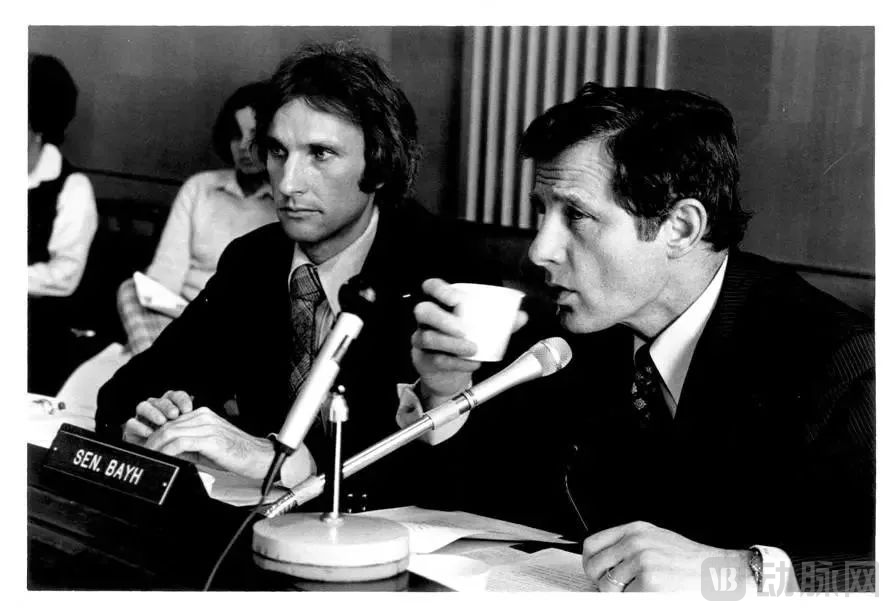
1980, Senator Birch Evans Bayh (right) at the Bayh-Dole Act hearings
In 1980, Senator Birch Evans Bayh (right) participated in the hearings on the Bayh-Dole Act. After extensive deliberations in Congress, the Bayh-Dole Act was successfully enacted in 1980, becoming the first national intellectual property policy in the United States and a globally recognized classic in technology transfer policy.
The Bayh-Dole Act clarifies the ownership of technological inventions developed with federal funding, providing a foundational framework for the establishment of U.S. federal laws on intellectual property management and protection.
Its promulgation enabled inventors at universities and research institutions to profit from their scientific achievements, greatly incentivizing researchers to pursue more projects with market potential. The emergence of more “high-tech” innovations applicable to the market naturally accelerated capital flow in the United States, contributing to the gradual recovery of the U.S. economy.
The enactment of the Bayh-Dole Act greatly stimulated the innovative drive of researchers. Universities, hospitals, national laboratories, and other nonprofit institutions across the United States almost overnight becameHotbed of Technological Innovation, innovative scientists have established their own companies based on their inventions.
Meanwhile, an increasing number of “incubators” have sprung up like mushrooms after rain, striving to identify the most promising “golden eggs.” With the involvement of professionals, the maturity of the U.S. research commercialization market has improved significantly; in the year the Bayh-Dole Act was enacted alone, the volume of technology transfers in the United StatesFirst time breaking through double digits。
The success of the Bayh-Dole Act prompted many politicians to take an active interest in technology transfer. In 1980 alone, the United States enacted three laws related to technology transfer, with this momentum lasting for a decade. These laws laid a solid foundation for academic researchers to pursue innovative inventions. However, scientific research is not confined within university walls; to unleash greater innovative potential, startups have become the second frontier for scientific research.
Growth: Inflation, Unemployment, War… Americans Can Breathe a Sigh of Relief
At the start of 1987, then-U.S. President Ronald Reagan entered the House Chamber in the U.S. Capitol to deliver his State of the Union Address to a joint session of Congress for the sixth time.
In his previous five State of the Union addresses, inflation, unemployment, and the situations in Iran and Afghanistan occupied a significant portion of his remarks. This time, Americans needed a respite; President Reagan focused extensively on how the United States could prepare for the 21st century, with enhancing national “competitiveness” and advancing the nation’s scientific and technological capabilities emerging as the central themes.
By then, the Bayh-Dole Act had been in effect for eight years, and those young innovators of that era had already established their own enterprises with policy support.
TheseSMEsThey have naturally become the mainstay of independent innovation in the United States, and how to mobilize small and medium-sized enterprises (SMEs) to commercialize R&D products has emerged as a new imperative of this era.
However, it soon became apparent that the Bayh-Dole Act was no longer a “panacea” for this stage. After all, the Bayh-Dole Act addressed the issue of ownership rights to scientific and technological achievements, whereas most enterprises at the current stage are already beneficiaries of this legislation. The barrier preventing these achievements from reaching the market is not a lack of “rights.” In other words, U.S. innovation requires new legislation.
For enterprises,Financial Strength Provides the Confidence to Conduct Scientific ResearchThus, in 1992, the Strengthening Small Business Technology Transfer Act was enacted to specifically fund small businesses in achieving technology commercialization.
Why Does the Bill Include the Word “Strengthen”? Because This Is Not the First Time the U.S. Has Taken a Scalpel to Corporate Innovation. As Early as 1982, Congress Passed"Small Business Innovation and Development Act", but the main content of this bill is to allow the federal government"Send money": Stipulates that federal agencies are required to allocate a certain proportion of their funding to support technology transfer.
However, the Small Business Innovation Development Act has a glaring loophole: it mandates government funding for corporate innovation research projects but fails to clearly define which enterprises are eligible for such grants. Consequently, since the enactment of the legislation, no shortage of companies have engaged in predatory talent poaching under the guise of innovation to defraud the government of its subsidies.
Over time, this legislation instead became a tool for some “unscrupulous companies” to profit, doing little to promote technology transfer. The federal government provided funding but saw no results, and naturally was unwilling to continue playing the role of the “sucker.” Consequently, in 1992, Congress passed the Strengthening Small Business Technology Transfer Act, which established clearer criteria for profitable enterprises, enabling the government to target its corporate funding more effectively.
The core provision of the "Strengthening Small Business Technology Transfer Act" is"STTR Program". This initiative shares the same core principles as the “SBIR Program” under the Small Business Innovation Development Act—A direct financial assistance program specifically designed to facilitate the transfer of technology from research institutions to small businesses.However, compared to “SBIR,” it introduces competition among enterprises.
“The STTR Program” stipulates that any federal department with research and development (R&D) funding exceeding $1 billion must allocate 0.15% of such funding as an R&D fund to support technology transfer projects and technological innovation collaborations between small businesses and non-profit research institutions.
This appears to be a request for appropriations from the federal government, but in reality, the focus is on restricting the eligibility of funding recipients:Only small businesses that establish partnerships with the federal government are eligible for this grant.
In the United States, small businesses seeking to collaborate with federal government agencies must submit applications to five entities—the Department of Defense, the Department of Energy, the Department of Health and Human Services, the National Aeronautics and Space Administration, and the National Science Foundation—and obtain approval from all five.
Rigorous, multi-tiered selection and an unwavering commitment to excellence have significantly elevated the quality of U.S. scientific research during this phase. American innovation has moved beyond the development of small household appliances—such as washing machines and vacuum cleaners—that merely enhance daily convenience, and is now advancing into high-performance computing and communications, biotechnology, and new materials research.
In the second year after the release of the "Strengthening Small Business Technology Transfer Act," which was 1993, the number of technology transfers in the United States doubled.Threefold, marking a historic high in volume and also the year when the number of U.S. statistical technology transfer projects began to see its largest increase.
Having reaped the benefits, the U.S. government amended and supplemented the "Small Business Technology Transfer Enhancement Act" in 2000, extending the statutory expiration date of the Small Business Innovation Research (SBIR) program to September 30, 2008.
Propelled by the Small Business Technology Transfer Act, countless small enterprises have embarked on scientific research endeavors. Leveraging their market insights, coupled with government funding support and policy preferences, the number of technology transfer outcomes in the United States has surged a hundredfold from its initial sparse beginnings, demonstrating remarkable growth momentum.
But the U.S. government, still wary of a repeat of the “Japan as Number One” fiasco, remained dissatisfied with this outcome and spared no effort in its push into the 21st century.
Maturity: High-Tech Prowess Is the Source of Americans’ Sense of Security
As the bells of the twenty-first century rang, the American people remained immersed in the prosperity and stability of the late 1990s, preparing for what President Reagan had described as “entering the twenty-first century.”
But this stability did not last long. In 2001, an airplane crashed into the World Trade Center in New York, shattering Americans’ sense of security. The United States immediately adjusted its policies:Counterterrorism and national security are its top priority; sustained economic growth comes second; and maintaining and improving the quality of life for its people ranks third.
In response to the “War on Terror,” the United States has elevated its emphasis on information security, health security, and related fields to an unprecedented level. While increasing financial investment in scientific research, the U.S. has simultaneously imposed numerous restrictions to prevent the leakage of cutting-edge technologies. For instance, journals that showcase advanced American scientific and technological achievements, such as Infection and Immunity, Journal of Bacteriology, and Journal of Virology, have been classified as “dangerous publications” and suspended.
Three years after the 9/11 attacks, the United States has not diminished its emphasis on science and technology in the slightest. In its 2004 research report titled “Science for the 21st Century,” the U.S. National Science and Technology Council emphasized that “science is a critical element in safeguarding the nation’s future security and prosperity, improving public health, and enhancing quality of life, and it has always been a national priority.” Then-U.S. President George W. Bush also stated, “Science and technology have never been more indispensable to national defense and the economy than they are today.”
Under the mobilization of national leaders, a series of major research and development initiatives, collectively known as the “U.S. Innovation Foundation,” were launched with great momentum. Transforming scientific achievements into national interests and safeguarding America’s status as the sole superpower have become the highest national will of the United States.
One year after the launch of the “American Innovation Initiative,” various data indicate that the effectiveness of technology transfer has shown little improvement. The core issue in U.S. technology transfer has shifted from a “reluctance to transfer” to a “lack of transferrable assets.” Fundamentally, this stems from a shortage at the source of innovation.
In October 2005, the U.S. National Academies released the report *Rising Above the Gathering Storm: Energizing and Employing America for a Brighter Economic Future*, which for the first time posited that the United States was encountering“Talent Crisis”. Compared with other countries, the United States has a very low proportion of graduates in science and engineering majors, and the quality of students in primary and secondary education is poor; some states are even facing a shortage of teachers for basic education.
Schools are the cradles of talent, and talent is the driving force behind innovation. Some scholars have inferred that if the United States fails to improve the quality of its education, the country’s “talent crisis” will likely impact its technological development over the next four decades.
But the government only wants to see quick results; taking forty years to cultivate talent is simply too slow. In response to the call to “translate scientific achievements into national benefits,” politicians have continued to direct their reform efforts toward the commercialization of research outcomes.
In 2006, then-U.S. President George W. Bush revived the concept of “American Competitiveness,” originally proposed by President Reagan 19 years earlier, as he began his State of the Union Address. He put forward initiatives aimed at maintaining America’s competitive advantage."American Competitiveness Initiative"。
However, the American Competitiveness Initiative’s aggressive tilt of policies and resources toward the physical sciences sparked discontent among researchers in other fields, even triggering large-scale protests by scientists in the biomedical sciences.
In January 2007, Congress convened as usual. Amidst the “continuing resolution,” lawmakers in suits clashed over the U.S. fiscal year 2007 budget, with the Speaker of the House ultimately making the final decision to sacrifice the already controversial American Competitiveness Initiative.
Yet the Bush administration did not abandon this plan; after multiple revisions, it shifted from a “crude and blunt” funding approach to a focus on talent. In 2007, the American Competitiveness Initiative was revamped as"America COMPETES Act"identity.
The “America COMPETES Act” skillfully shifted the focus to improving education quality, garnering a wave of public goodwill; it also changed “appropriations” in the “American Competitiveness Initiative” to “authorizations,” thereby mitigating conflicts over interests and facilitating smooth passage through both the House and the Senate.
Although the America COMPETES Act appears, on the surface, to be an education-focused bill, a closer examination reveals that its core emphasis lies in promoting the translation of research findings.
The America COMPETES Act places special emphasis on educational grants, raising the funding levels for scholarships designated for undergraduate and graduate students majoring in mathematics, science, and engineering who aspire to become teachers, from the original$1 million to $20 million per year。
This policy has attracted many highly educated young people to take up teaching positions. According to statistics, from the enactment of the America COMPETES Act to 2017, over a decade, the number of teachers in the United States increased by65%This has also directly improved the quality of education in the United States, providing a steady stream of talent as a “reserve force” for innovation.
Of course, the America COMPETES Act did not abandon support for scientific research; the federal government continued to use the Act to provide certain support to technology transfer offices. For instance, the Bush Administration established the “Mathematics and Science Education Partnerships” program at the National Science Foundation (NSF), named in alignment with a similar initiative by the Department of Education, and allocated multiple grants to the NSF under the guise of educational initiatives.
Under the funding of the America COMPETES Act, technology transfer agencies such as the NSF and NIST (National Institute of Standards and Technology) have beenOver 7 Yearsthus achieving a doubling of funding, faster than the 10-year timeline projected by the "American Competitiveness Initiative."
Meanwhile, the emphasis on education and talent development in the America COMPETES Act inadvertently fostered the emergence of more innovative scientific researchers, directly accelerating the advent of America’s “research boom.” Ten years after the enactment of the America COMPETES Act, the number of scientific research translation outcomes in the United States grew by thousands annually, firmly establishing the country as the undisputed global leader in the field of technology transfer.
Epilogue
In the history of the United States,“Continuity” and “Innovation”They appear to be mutually reinforcing. This characteristic is also reflected in the policies issued by the United States.
U.S. laws on the commercialization of research outcomes have undergone continuousInnovation, a process of continuous refinement that has consistently targeted the pressing challenges of each era. From the initial Bayh-Dole Act to the Strengthening American Innovation and Small Business Technology Transfer Act, regulations have become increasingly detailed and their enforcement progressively stronger. Yet the focus has always remained on the backbone of U.S. innovation.
Yet, amid the reforms, we can also observe U.S. policy’s“Continuity”, the shadow of previous legislation is evident in every new act. From the SBIR program to the STTR program, while further promoting the establishment of close collaborative relationships between small businesses and universities or research institutions and facilitating the integration of innovation resources, funding support for small and medium-sized enterprises has been retained.
To break the ice, policy must lead the way. Amidst the surging enthusiasm for translating scientific research achievements in China’s healthcare sector, we anticipate the swift introduction of a Chinese version of the Bayh-Dole Act. Just as it revitalized the U.S. research market in the 1980s, such legislation would truly overcome industry bottlenecks and establish a standardized chain spanning from basic research to achievement translation and ultimately to industrial application.Achieve the Great Leap from “Made in China” to “Intelligently Made in China.”