

VisualDx Files IPO Prospectus: Leveraging AI-Powered Clinical Decision Support to Advance Global Health Equity

VisualDx
Clinical Decision Support System Developer
The rapid advancement of medical technology and the swift updating of medical knowledge have brought new solutions to disease treatment. However, has the dissemination of evidence-based medicine concepts kept pace with this speed? The limitations of healthcare standards, the lengthy cycle of medical education, and the lag in updating medical knowledge have become urgent challenges for healthcare systems worldwide.
According to statistics, approximately 44,000 to 98,000 people die annually in the United States due to medication errors, about 1.3 million people are harmed, and the resulting economic losses amount to approximately $17 billion to $29 billion.According to relevant data, the outpatient misdiagnosis rate in China is approximately 50%–60%, while the inpatient misdiagnosis rate is around 30%.
With the advancement of digital health, Clinical Decision Support Systems (CDSS) have emerged as a critical breakthrough in addressing the aforementioned challenges. It typically takes 5–10 years to train a clinician; however, if physicians can effectively leverage CDSS, they can rapidly enhance their diagnostic and therapeutic capabilities, accelerate training progress, and thereby reduce misdiagnoses, missed diagnoses, and doctor-patient disputes in primary care settings.
Dermatologist-Led Startup’s CDSS Platform Achieves Global Reach
Founded in 1999, VisualDx is a provider dedicated to developing image-based clinical decision support systems (CDSS) for dermatology. By integrating medical imagery with search engine technology, VisualDx has developed CDSS solutions tailored to diverse user groups. This system effectively helps clinicians improve diagnostic accuracy and can be utilized to train medical students in evidence-based medical reasoning.
VisualDx boasts the world’s largest medical image database for dermatology, offering more than 46,000 high-resolution images for reference. The database covers a wide range of classic and rare cases and is updated in real time.United StatesOver half of theMedical schools and more than 2,300 hospitals worldwide、ClinicInstitutions such as Harvard University, Yale University, and Mayo Clinic have all selected VisualDx as their standard professional medical resource platform. The system has also been adopted by numerous Chinese universities, including Shanghai Jiao Tong University, Sun Yat-sen University, and Central South University.
Art Papier, Co-founder and CEO of VisualDx, is an Associate Professor of Dermatology and Medical Informatics at the University of Rochester. He also serves at the National Institutes of Health (NIH) Center for Research on Skin Diseases, where he oversees the comprehensive development of the dermatology lexicon.
His academic experiences made him realize that doctors are not omnipotent; they cannot memorize the specific details of every case, nor can they possibly know all the symptoms associated with every disease. After working at a primary care clinic, Papier gained deeper insights: primary care physicians often struggle even with disease diagnosis, which is one of the key reasons why the misdiagnosis rate in the United States is as high as 40%.
Papier believes that it is imperative to develop an image-based CDSS platform to help physicians achieve more timely and accurate diagnoses. Meanwhile, he also hopes that this tool can transform traditional medical education methods and serve as a training instrument for evidence-based medicine.
VisualDx: Collaborating on Over 100 Medical Projects, Improving Diagnostic Accuracy by 18%
VisualDx, in collaboration with Vaseline, a brand under Unilever, and the healthcare platform Hued, has established an online database called “See My Skin” for people of color. This enables VisualDx to make diagnostic assessments based on different skin tones. Physicians can not only obtain case information by viewing images but also search for patient symptom descriptions to compare corresponding images, thereby making accurate diagnoses.
During use, physicians can set skin tone preferences and continuously upload images of dermatological conditions across diverse skin tones, thereby further enriching the VisualDx database. Additionally, the platform offers a feature to search for medications and view their adverse reactions, providing information such as images and treatment guidelines in the search results. To facilitate the dissemination of medical and health knowledge, VisualDx also provides handout materials for readers.
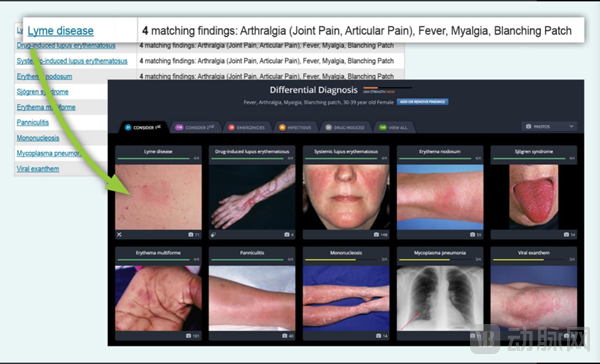
Platform Search Engine Source: VisualDx Official Website
In addition to aiding clinical diagnosis, VisualDx serves as a training tool for evidence-based medical reasoning in medical schools. Users can input collected patient symptoms or medical history into the system, which then guides them through a visual differential diagnosis of the condition, providing information such as probabilistic analysis of diagnostic outcomes, case descriptions, and confirmatory steps.VisualDxCollaborated with medical education institutions on over 100 healthcare projects, increasing the diagnostic accuracy rate by 18%.
Due to the various expert content and rich clinical features provided by VisualDx, it has also been selected by the Accreditation Council for Continuing Medical Education (ACCME). In accordance with ACCME’s accreditation requirements and policies, VisualDx is authorized to provide CME credit certification.
In 2006, VisualDx launched Skinsight.com, a public-facing health website focused on dermatological conditions and powered by its database. The site provides images and treatment plans for more than 200 of the most common skin conditions, allowing users to identify and learn about specific disorders through its search engine functionality.
In 2018, VisualDx also launched Aysa, an AI-powered assistant. This mobile app is primarily designed to monitor skin health and assist in diagnosis.Aysa integrates the expertise of over 47,000 professionals and more than 100 million health searches to address users' skin concerns.
Project IMPACT: Reducing Medical Disparities and Enhancing Diagnostic Capabilities
People more commonly hear about healthcare equity, which focuses primarily on patients’ access to medical care. In contrast, health equity refers to the fundamental premise that all individuals—regardless of where they live—must have a baseline level of health in order to survive, develop, learn, and work. Pursuing health equity aligns with the mainstream values of today’s world.
From an equity perspective, health equity encompasses equitable access to health opportunities, equitable health conditions, and equitable health outcomes. However, for a long time, medical diagnosis for people of color has been extremely challenging due to incomplete collection of medical information and uneven levels of regional healthcare development.
According to statistics, the cure rate for skin cancer is 93% among White patients, compared to only 71% among people of color. Dark-skinned images account for merely 4.5% in medical textbooks, indicating significant underrepresentation in medical literature and curricula. Consequently, nearly all clinicians have not received adequate training to diagnose diseases in patients of color.
To address this issue, in 2020, VisualDx, the Society of Clinical Dermatology (SOCS), and the NEJM Group organized a webinar to discuss structural racism in medicine, disease patterns in darker skin types, and culturally competent care. Following a positive response from over 30,000 registrants across nearly 100 countries, VisualDx launched Project IMPACT in 2021. The project aims to raise awareness and advance evidence-based medicine, reduce medical disparities, enhance clinicians’ ability to accurately diagnose conditions in skin of color, and improve health equity.
 Project IMPACT Source: VisualDx Official Website
Since its launch, Project IMPACT has benefited 1.5 million healthcare professionals and students worldwide, and has garnered support from founding members such as the Skin of Color Society (SOCS) and the NEJM Group. Project IMPACT currently comprises ten partner organizations, including the AAD, the NMHA, and the American Medical Women’s Association.
To most people, VisualDx appears to focus on dermatology care, resembling a specialty disease diagnosis and treatment system. However, grounded in the concept of vision-based evidence-based medicine, VisualDx is capable of building a platform that encompasses symptoms and diagnostic protocols for all diseases. Currently, in addition to dermatological conditions, VisualDx includes images related to infectious diseases, immune-mediated diseases, metabolic disorders, nutritional deficiencies, and psychiatric disorders.
It is precisely based on the comprehensive recognition of VisualDx’s products and initiatives that NASA andInstitute for Translational Space Health ((TRISH) has awarded funding to VisualDx twice, aiming for the development of a medical diagnostic system designed for space travel. This system is expected to support the diagnosis of 89% of health conditions encountered by astronauts.
Current Status of AI-Assisted Diagnosis of Skin Diseases in China
According to statistical data, China currently has only slightly over 20,000 dermatologists, while the incidence rate of skin diseases exceeds 90%, resulting in a severe shortage and uneven distribution of dermatology professionals. Particularly in primary care and remote areas, the rates of initial diagnosis and confirmed diagnosis of skin conditions are very low, necessitating greater allocation of resources to these grassroots levels, along with specialized guidance and clinical support.
Dermatology is a morphology-dependent discipline, and skin imaging serves as a critical tool for diagnosing dermatological conditions. The diagnostic approach has evolved from initial visual inspection to the use of magnifying tools, and further to the integration of artificial intelligence, continuously reducing misdiagnosis rates. By leveraging AI technology, clinicians can rapidly identify lesions, accelerate model training, enhance diagnostic efficiency and accuracy, and help address the shortage of medical professionals.
Currently, the main companies in China developing AI-assisted diagnostic products for dermatology include VoxelCloud, Yongliu Technology, Dingshi Zhihui, and Hangzhou Xiaofu Technology, as well as Youmai Technology and Ruiqi Software, which are developed in collaboration with hospitals and universities such as the Second Xiangya Hospital of Central South University, China-Japan Friendship Hospital, and Nankai University.