

Beijing's Medical 'Specialized, Sophisticated, Distinctive, and Innovative' Industry Atlas: The Nation's Leading Hub for Cultivating National-level 'Little Giants' and Aggregating Next-generation Medical Technology Innovation

TINAVI
Orthopedic Surgical Robot Developer
When it comes to "Specialized, Refined, Differential, and Innovative" (SRDI) enterprises, Beijing is undoubtedly a force to be reckoned with.
As the city that has incubated the largest number of specialized, refined, distinctive, and innovative small and medium-sized enterprises (SMEs) and a national-level hub for cultivating “Little Giant” firms, Beijing has cumulatively incubated 590 national-level specialized, refined, distinctive, and innovative “Little Giant” enterprises, ranking first among all cities in China.
From 2019 to 2022, Beijing released a total of 13 batches (covering three years) of recognized lists for 5,261 “Specialized, Refined, Differential, and Innovative” SMEs (with the fourth batch in 2022 being a provisional list). According to statistics from VCBeat, 500 healthcare companies were included in these lists.
What Are the Characteristics of Beijing’s “Specialized, Refined, Differential, and Innovative” Medical Enterprises? Why Has Beijing Become the Leading City in Cultivating National-Level “Little Giant” Firms? This Article Categorizes and Analyzes 500 Companies to Provide a Glimpse into the Development Landscape of Beijing’s “Specialized, Refined, Differential, and Innovative” Medical Industry.
590 National “Little Giant” Enterprises, Ranking First Among All Cities in China
Since the beginning of this year, “specialized, refined, distinctive, and innovative” (SRDI) enterprises have become a frequently cited buzzword, with relevant support policies issued by both local and central governments.
According to the official website of the Beijing Municipal Bureau of Economy and Information Technology, a “five-in-one” work system encompassing “policy, services, funding, innovation, and environment” has been established to better support and cultivate Beijing’s “Specialized, Refined, Differential, and Innovative” (SRDI) enterprises, thereby comprehensively strengthening the cultivation and services for SRDI small and medium-sized enterprises.
In terms of policy, the "Several Measures of Beijing Municipality on Promoting the High-Quality Development of 'Specialized, Refined, Differential, and Innovative' Small and Medium-Sized Enterprises," issued at the end of 2021, introduced 16 measures across six aspects. These measures provide tailored support policies for such SMEs, covering technological innovation, transformation and upgrading, supply chain coordination, brand building, market expansion, listing services, and financing needs.
In terms of cultivation mechanisms, establish a "pyramid-shaped" tiered cultivation system for "Specialized, Refined, Differential, and Innovative" (SRDI) enterprises to create a pattern of rolling development and tiered nurturing. Continuously optimize the certification standards for SRDI enterprises, accelerate entry into the management database through "self-nomination + discovery" methods, adopting quarterly open calls, big data discovery, and intelligent review processes.
In terms of financing services, we collaborated with six financial institutions to launch the “Specialized, Refined, Differential, and Innovative Loan.” As of the end of March 2022, a total of 1,336 loans with maturities of less than one year had been disbursed, amounting to RMB 5 billion, with an average interest rate as low as 3.6%. We established the “Specialized, Refined, Differential, and Innovative” Growth Fund, focusing on investing in enterprises in sectors such as information technology application innovation, semiconductors, and healthcare. We actively promoted the “Four Major Projects” for these enterprises—namely, IPOs, tier upgrades, listings, and pipeline development—to streamline their access to public markets. To date, more than one-eighth of the companies listed on the Beijing Stock Exchange have been supported through these initiatives.
In terms of resource coordination and support, leverage the roles of new-type R&D institutions, public-interest patent pools, and innovation consortia to establish a collaborative innovation model wherein leading enterprises in the industrial chain define the challenges and small and medium-sized enterprises (SMEs) provide the solutions. Support “specialized, refined, distinctive, and innovative” SMEs in achieving technological breakthroughs in niche sectors, enabling them to become “single-event champions” and “specialized suppliers.”
Meanwhile, dedicated service managers and financial advisors are assigned to enterprises to provide timely localized services covering policies, funding, talent acquisition, land use, and public amenities.
Furthermore, the emergence of the Beijing Stock Exchange has become the most significant landmark event in the capital market in recent years, opening up a new frontier for financing by specialized, refined, distinctive, and innovative small and medium-sized enterprises.
The Beijing Stock Exchange is positioned to vigorously support innovative small and medium-sized enterprises (SMEs), particularly those recognized as “Specialized, Refined, Differential, and Innovative” (SRDI) firms and hidden champions. Finance should facilitate technological innovation, and Beijing itself boasts a large number of SRDI SMEs, which have become a highlight of its economic and social development.
Supported by a series of specialized policies and targeted services, Beijing has cumulatively fostered 590 national-level “Little Giant” enterprises specializing in refined, distinctive, and innovative fields, ranking first among all cities in China.
In response to the successful accreditation of “Specialized, Refined, Differential, and Innovative” (SRDI) enterprises and “Little Giant” firms, various districts in Beijing have rolled out targeted incentive measures. These are summarized as follows:
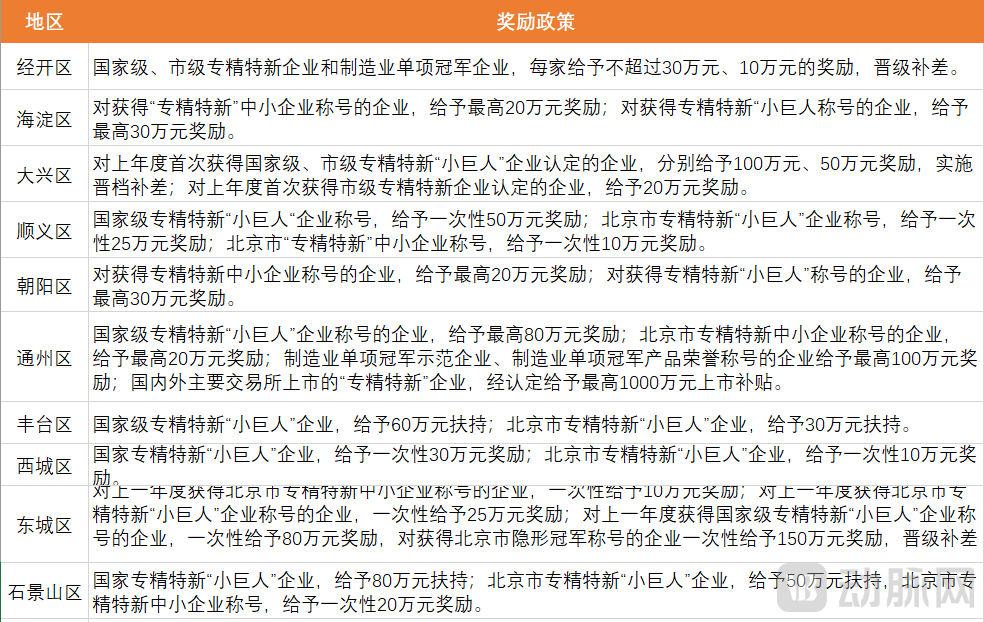
Reward Policies for “Specialized, Refined, Differential, and Innovative” Enterprises in Beijing’s Districts (Incomplete Compilation)
Medical Sector Accounts for 9.5% of Specialized, Refined, Differential, and Innovative (SRDI) Enterprises; Haidian District’s “Little Giants” Achieve Outstanding Results
According to data from the Beijing Municipal Bureau of Economy and Information Technology, between 2020 and 2022, Beijing released 13 batches of recognized “Specialized, Refined, Differential, and Innovative” (SRDI) small and medium-sized enterprises, totaling 5,261 companies. Among these, 500 were medical-sector SRDI enterprises, accounting for 9.5% of the total.
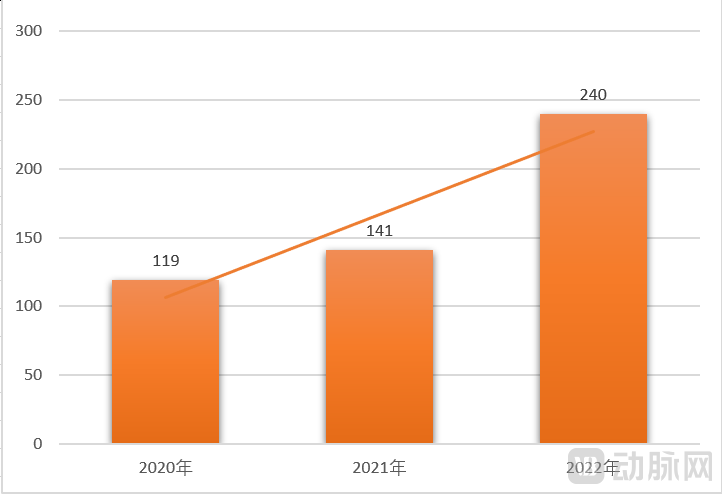
The Number of "Specialized, Refined, Differential, and Innovative" SMEs in Beijing's Medical Sector Shows an Upward Trend
From 2020 to 2022, the number of “specialized, refined, distinctive, and innovative” (SRDI) small and medium-sized enterprises in the medical sector in Beijing showed an increasing trend, rising from 119 in 2020 to 141 in 2021, and reaching 240 in 2022.
Among these 500 “specialized, refined, distinctive, and innovative” medical enterprises, 68 are national-level “Little Giant” enterprises, accounting for 13.6%.
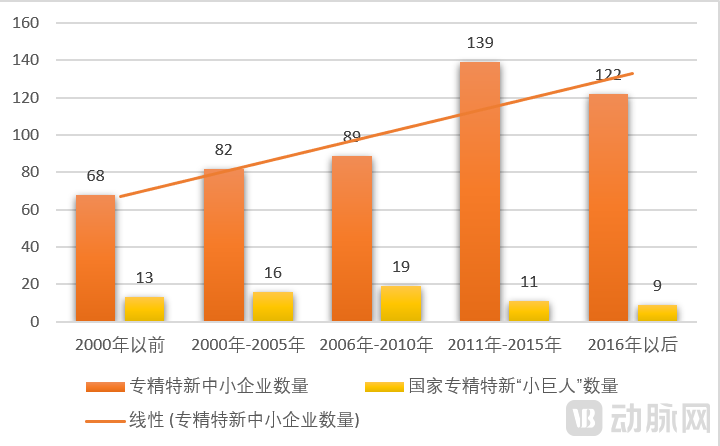
Establishment Time of Beijing's "Specialized, Refined, Differential, and Innovative" Medical Enterprises
In terms of establishment date, the average age of Beijing’s medical “Specialized, Refined, Differential, and Innovative” (SRDI) enterprises is approximately 10–15 years. The largest number of these firms, totaling 139, were established between 2011 and 2015, while 122 were founded after 2016, ranking second. This indicates that Beijing’s medical SRDI enterprises are generally relatively young.
Correspondingly, the average age of national-level specialized and sophisticated “Little Giant” enterprises in the healthcare sector is approximately 15 years, with the largest number—19 companies—established between 2006 and 2010.
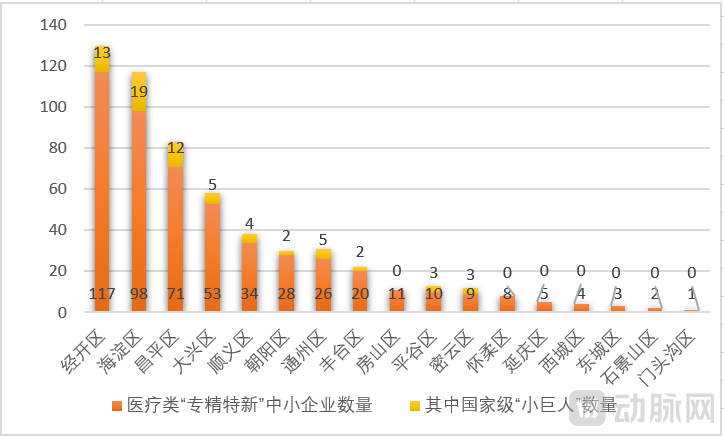
Regional Distribution of Beijing’s “Specialized, Refined, Differential, and Innovative” Medical Enterprises
In terms of regional distribution, two areas are worthy of attention: Haidian District and the Beijing Economic-Technological Development Area.
First, the Economic-Technological Development Area has the largest number of medical “specialized, refined, distinctive, and innovative” SMEs, with 117 enterprises, followed by Haidian District in second place with 98. In terms of the number of national-level “Little Giant” enterprises in the medical sector, Haidian District ranks first with 19, closely followed by the Economic-Technological Development Area with 13.
An analysis of the underlying reasons reveals that Haidian District has long been a primary driver of technological innovation in China. Its absolute advantages in the number of invention patents and listed companies have helped it become the premier hub among “Little Giant” enterprise clusters. In 2021, Haidian District ranked first among all prefecture-level cities and districts nationwide in terms of valid invention patents held by specialized, refined, distinctive, and innovative “Little Giant” enterprises, while the number of listed companies in the district has consistently remained at the top nationally for many years.
The Economic-Technological Development Area has also been accelerating the incubation and expansion of “Specialized, Refined, Differential, and Innovative” (SRDI) enterprises through various policies. It is reported that the Development Area signed cooperation agreements for innovation-linked development with the three major Science Cities, completing 162 technology transfer projects from these cities in 2021 alone. Meanwhile, by establishing special funds for technological innovation and expanding the Financial Services Alliance, the area provides financial support to SRDI enterprises, helping cultivate a large reserve of future SRDI companies and providing a continuous source of momentum for industrial innovation and development.
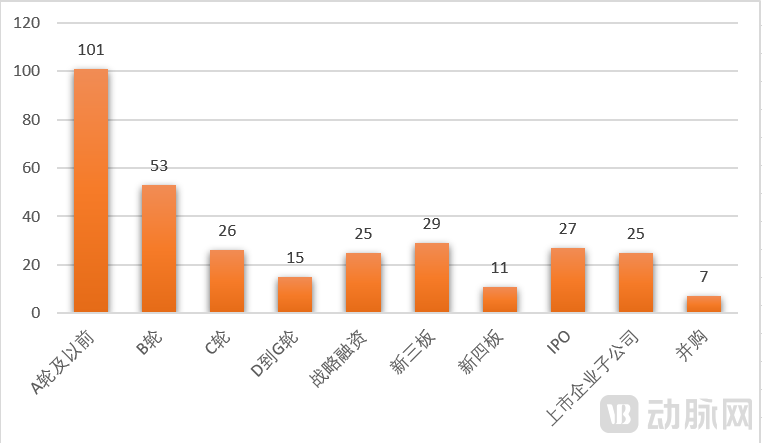
Financing Rounds of Beijing’s “Specialized, Refined, Differential, and Innovative” SMEs in the Healthcare Sector (Excluding Companies with Undisclosed Data)
In terms of financing rounds, early-stage companies accounted for the largest proportion. There were 101 companies at Series A or earlier stages, of which 56 were established after 2015.
Examining the focus areas of early-stage companies, most are concentrated in gene-related testing, drug development, innovative medical devices, and AI healthcare. There are 79 companies at Series B and C stages, with the majority being medical device enterprises.
There are 27 companies in the IPO stage, of which 19 were established before 2010. Among these, 11 are national-level “Little Giant” enterprises, representing mature companies with strong competitiveness.
The number of companies listed on the NEEQ and regional equity markets stands at 40, with data remaining impressive. This stems from the Beijing Stock Exchange (BSE), which officially commenced trading in November 2021. Its launch is regarded as one of the most significant events in China’s capital market in the post-pandemic era, opening up a new frontier for financing by specialized, refined, distinctive, and innovative “Little Giant” enterprises.
Prior to the official launch of the Beijing Stock Exchange (BSE), many small and medium-sized enterprises (SMEs) listed on the National Equities Exchange and Quotations (NEEQ) faced challenges such as poor equity liquidity and difficulties in securing direct financing. The policy dividends brought by the BSE have injected fresh vitality into the NEEQ market, further accelerating the pace of financing for companies listed on the NEEQ.
Focusing on molecular diagnostics, CGT, and AI healthcare, with prominent “high-end, precision, and advanced” characteristics
By categorizing and analyzing 500 specialized, refined, distinctive, and innovative (“Little Giant”) medical enterprises in Beijing, we found that their areas of focus are primarily concentrated in molecular diagnostics, innovative drugs, pharmaceutical manufacturing, medical consumables and implantable devices, internet healthcare, and AI-enabled healthcare.
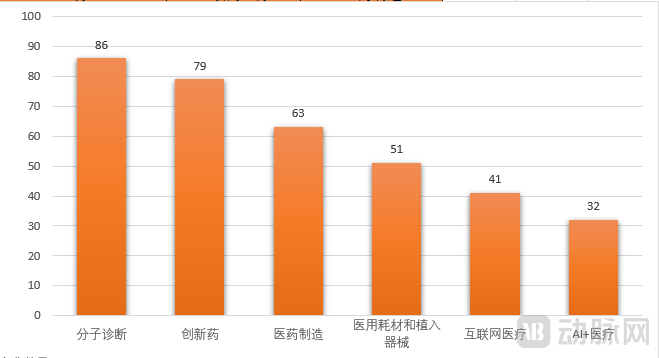
Beijing’s “Specialized, Refined, Differential, and Innovative” Enterprises in the Medical Sector
Among them, 233 medical device-related companies broke through the competition, accounting for nearly half of the total. This group includes 86 in vitro diagnostics (IVD) companies, primarily focused on molecular diagnostics; 51 companies specializing in medical consumables and implantable devices; followed by those in medical equipment, instruments, and surgical robots.
Among the 51 companies specializing in medical consumables and implantable devices, those focused on cardiovascular and cerebrovascular interventional devices are the most numerous, with 21 companies, followed by 18 companies dedicated to orthopedic implants and artificial joints.
23 pharmaceutical manufacturing companies ranked second, including 11 traditional Chinese medicine-related enterprises and 7 active pharmaceutical ingredient (API) suppliers.
In this classification of enterprises, we found that Beijing’s “Specialized, Refined, Differential, and Innovative” (SRDI) medical companies generally have a short history of establishment, possess highly advanced technological layouts, and demonstrate outstanding performance in cross-disciplinary digital healthcare sectors such as “Internet + Healthcare” and “AI + Healthcare.”
By examining the specialized focus areas of “Specialized, Refined, Differential, and Innovative” enterprises, Beijing’s industrial layout logic in the healthcare sector becomes readily apparent.
According to the "Beijing 14th Five-Year Plan for Building an International Science and Technology Innovation Center," Beijing will make every effort to promote the construction of a high-end economic structure, supporting the leading development of the next-generation information technology and pharmaceutical health "dual-engine" industries.
In the pharmaceutical and health industry, efforts will be focused on three major areas: innovative drugs, new medical devices, and new health services. We aim to build leading advantages in novel vaccines, next-generation antibody drugs, cell and gene therapies, and domestically produced high-end medical equipment, promoting the parallel development of pharmaceutical manufacturing and health services.
This aligns perfectly with the specialized focus of “Specialized, Refined, Differential, and Innovative” (SRDI) enterprises in the healthcare sector, further demonstrating their mission to empower the transformation and upgrading of traditional industries, facilitate quality improvement and efficiency enhancement, and ultimately drive industrial development toward the SRDI model.
According to the Beijing Municipal Bureau of Economy and Information Technology, Beijing is accelerating the cultivation of a tiered ecosystem of “Specialized, Refined, Differential, and Innovative” (SRDI) enterprises and promoting their high-quality development. The city aims to have 500 national-level SRDI “Little Giant” enterprises, 1,000 municipal-level SRDI “Little Giant” enterprises, and 5,000 municipal-level SRDI small and medium-sized enterprises by the end of the 14th Five-Year Plan period.
Innovation is the soul of “specialized, refined, distinctive, and innovative” (SRDI) enterprises, while emerging industries represent the landscape of the future. Cultivating SRDI enterprises holds significant importance for promoting the innovative development of small and medium-sized enterprises (SMEs), optimizing industrial, supply, and innovation chains, overcoming key core technologies, and resolving “chokehold” challenges.
Supporting the cultivation of “Little Giant” enterprises further signifies injecting advanced production technologies or processes into industries, continuously enhancing innovation capabilities, and driving industrial progress. We look forward to the robust growth of China’s specialized, refined, distinctive, and innovative (“SRDI”) enterprises, as they strive to become single-product champions in their respective niche sectors, take center stage on the international arena, and emerge as a force to be reckoned with.