

Major Advancements in Digital Therapeutics: NMPA Launches Classification Guidelines and IEEE Initiates Global Standard Development

Weimai
Digital Health Service Platform Provider

SLANHEALTH
Digital Therapeutics CDMO and Full-process Service Developer
As the National Day holiday begins, people who have worked hard for most of the year are winding down. However, sentiment within the digital therapeutics industry may be particularly buoyant—after all, several announcements made before the holiday could mark a milestone for digital therapeutics.
On September 26, the National Institutes for Food and Drug Control (NIFDC) posted a brief news item on its official website, which subsequently drew industry attention.
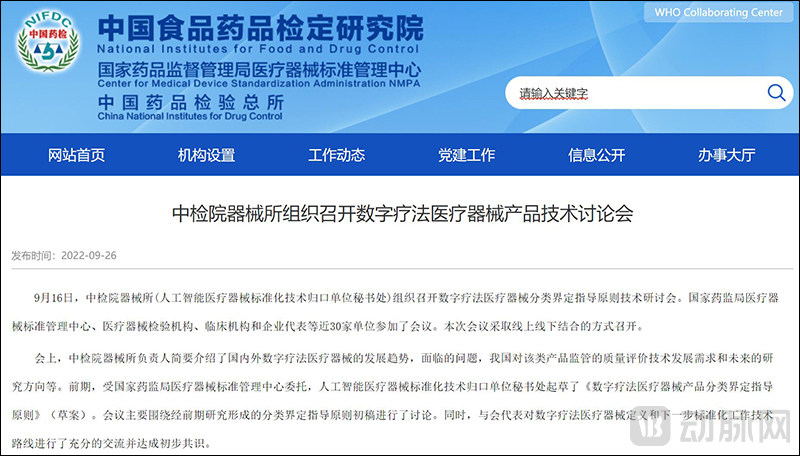
Based on the brief news introduction titled “NIFDC’s Institute of Medical Devices Organizes a Technical Discussion Meeting on Digital Therapeutics Medical Device Products,”On September 16, the Institute of Medical Device Control of the National Institutes for Food and Drug Control (NIFDC), which serves as the secretariat for the Standardization Technical Committee on AI Medical Devices, convened a technical seminar on the guiding principles for the classification and definition of digital therapeutics medical devices. Nearly 30 entities participated, including the Center for Medical Device Standardization Administration of the National Medical Products Administration (NMPA), medical device testing institutions, clinical institutions, and enterprise representatives.。
NIFDC-Related News (Screenshot from the NIFDC Official Website)
With the continuous advancement of technology, new medical device products are constantly being introduced. Among these, some emerging products do not have corresponding categories within the existing medical device classification system, or they span multiple existing product categories, making it difficult for regulatory review agencies to determine their specific classification in practice. Against this backdrop, guidelines for classification determination have been developed, primarily to guide the assessment of the regulatory attributes and regulatory categories of products, particularly emerging ones.
Artificial intelligence, which is currently flourishing, also went through this stage of development. At that time, regulatory frameworks for medical AI software were still imperfect; in particular, the classification and definition of AI software were ambiguous, encompassing both scenarios where it was regulated as a medical device and where it was not.
This has led to some “gray-area” practices in the approval of AI-based medical devices.
For example, prior to 2020, although some medical device products submitted for registration incorporated deep learning algorithms as aids, the term “Artificial Intelligence” was not used as a key element in their regulatory submissions. Therefore, even though these Class III medical devices were supported by algorithms such as deep learning and machine learning, they were approved through standard regulatory pathways and cannot be classified as AI-based medical software.
In April 2021, the National Medical Products Administration (NMPA) released the “Guiding Principles for the Classification of Artificial Intelligence-Based Medical Software Products” (Draft for Comments). In July of the same year, after soliciting and incorporating feedback from various stakeholders, the NMPA issued the official “Guiding Principles for the Classification of Artificial Intelligence-Based Medical Software Products.” Six months later, in March 2022, the NMPA further released the “Guiding Principles for the Registration Review of Artificial Intelligence Medical Devices.”
These guidelines have standardized and regulated the review of AI-based medical devices. Companies can adhere to the corresponding requirements during the R&D phase, thereby avoiding unnecessary detours.
The development of digital therapeutics bears significant similarities to that of artificial intelligence. Digital therapeutics fall under the category of Software as a Medical Device (SaMD), yet there is considerable controversy regarding their sub-classification. For instance, depending on specific circumstances, debates persist over whether digital therapeutics should be regulated as Class III or Class II medical devices, and whether certain types of software medical devices qualify as digital therapeutics. Much like the regulatory ambiguities encountered during the approval process for AI-based medical devices, numerous "gray-area" cases exist. Therefore, there is an urgent need to clarify the principles for classifying and defining digital therapeutics.
According to VCBeat, the meeting on the 16th primarily focused on the "Guiding Principles for the Classification and Identification of Digital Therapeutics Medical Devices" (Draft), which had been previously drafted by the Secretariat of the Technical Committee for Standardization of AI Medical Devices.This indicates that stakeholders have largely reached a consensus on recognizing digital therapeutics as an emerging category of medical devices, and the corresponding standard-setting processes have been initiated. This is highly significant for digital therapeutics, which previously lacked explicit official recognition.
However, according to VCBeat's understanding from sources,The industry has raised numerous concerns regarding the current Draft, with controversies surrounding issues such as product classification and evidentiary basis.。
“For instance, there is ongoing debate over whether disease management qualifies as digital therapeutics, and if so, what criteria it must meet. If the classification is too lenient, it could lead to a ‘bad money drives out good’ scenario,” a source told VCBeat.
At the “Academic Forum on the Promotion and Implementation of Artificial Intelligence Medical Device Standards and Quality Evaluation” held on September 29, experts from the National Institutes for Food and Drug Control (NIFDC) delivered a public address on technical issues pertaining to digital therapeutics products, offering insights into official perspectives.
During the presentation, relevant experts also shared their views on “disease prevention, management, and treatment” as included in the definition of digital therapeutics. The expert argued that the definition of “disease management” remains open to discussion. Perhaps using “disease control” would better align with the regulatory definition of medical devices.
Meanwhile,Experts have also provided a definition of digital therapeutics, namely “medical device products that provide patients with evidence-based interventions to achieve the treatment (prevention, diagnosis, and control) of diseases.” Among these, the core function of digital therapeutics should be treatment, while prevention, diagnosis, and control should be classified as secondary functions.。
Description of the Definition of Digital Therapeutics in a Public Speech by Experts from the National Institutes for Food and Drug Control (Screenshot from Live Video Broadcast)
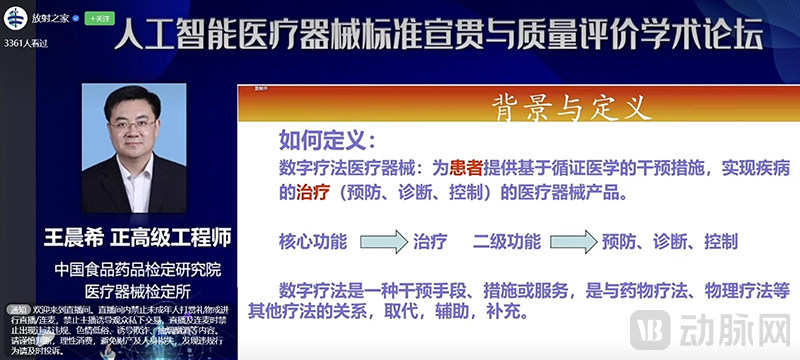
Furthermore, the expert provided additional insights regarding the corresponding characteristics, proposing quality attributes for digital therapeutics products: Digital therapeutics should be treatment and intervention methods based on medical models, with patient data as the input; in terms of intervention methods, they should feature real-time human-computer interaction and provide personalized intervention and treatment plans; regarding product risk levels, the primary determinants should be the product’s indications and algorithm maturity.
According to sources, the Guidelines for the Classification and Definition of Digital Therapeutics were originally scheduled for release by the end of this year or early next year. However, due to numerous points of contention, further discussions and revisions may be required.
Based on the previous timeline for AI-related regulations, it took nearly a year from the release of the Draft for Comments on the Principles for Classification and Determination to the final issuance of the Guiding Principles for Registration Review. This means that even if the Draft for Comments on the Principles for Classification and Determination is released by the end of this year as originally planned, the corresponding Guiding Principles for Registration Review will not be issued until late 2023 at the earliest.
No sooner had one wave subsided than another arose. Just as the industry was still digesting the news regarding the classification guidelines for digital therapeutics, another announcement emerged on September 29: The Institute of Electrical and Electronics Engineers (IEEE) established a Digital Therapeutics Working Group and officially began recruiting domestic and international experts to participate in drafting its standards.
IEEE Project Proposal for Standards on Digital Therapeutics
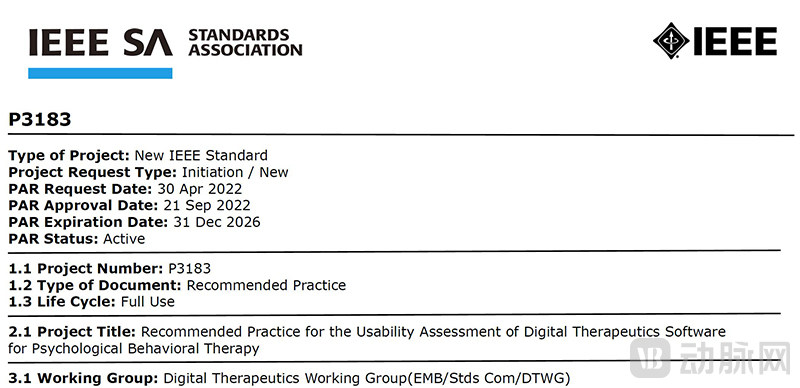
This meansThe First International Standard for Digital Therapeutics Has Been Officially Established。
IEEE wields significant influence in the fields of electrical and electronic engineering, computer science, and other technologies, and has achieved notable success in developing standards for these domains. Among its most renowned contributions are the IEEE 1394 and IEEE 802 series of standards.
The IEEE Standards Association Board of Governors is a key organization within the IEEE involved in standards development. Its primary responsibilities include encouraging and coordinating the development and revision of IEEE standards, approving the initiation of IEEE standards projects, and reviewing them to ensure consensus, due process, openness, and balance.
Professor Zhong Daidi, a member of the IEEE Standards Association Board of Governors and Deputy Dean of the College of Bioengineering at Chongqing University, confirmed to VCBeat that the application for initiating the digital therapeutics standards project had been approved, and introduced to VCBeat the corresponding procedures for IEEE standard development.
The first step is to submit a proposal for standards project initiation. According to IEEE regulations, any individual or entity may initiate a project, but each project must be reviewed and supported by an IEEE Standards Technical Committee. Subsequently, the project can only be launched after the Project Authorization Request (PAR) is approved by the New Standards Committee under the IEEE Standards Association.
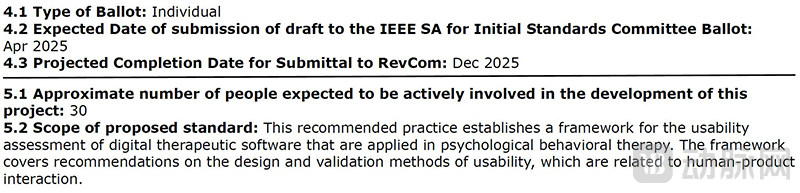
Currently, the Digital Therapeutics Standards Working Group is at the stage where the project has been approved and established, with the standard number 3183.According to the project proposal, this standard primarily aims to establish a corresponding framework for digital therapeutics applied in the treatment of psychiatric and behavioral disorders, requiring the participation of 30 experts.
Explanation of the Standard Vision in IEEE Project Proposals
The second step is to establish a standards working group and complete the development of the draft. Upon formation of the standards working group, it is necessary to establish corresponding bylaws, under which the development of the standard text will be conducted under the leadership of the chairperson. The drafting of the standard will be completed within the working group through convening meetings and undergoing multiple rounds of revision and refinement.
The third step is peer review voting. The submitted draft standard must undergo continuous revision and voting until the approval rate reaches 75% with no new opposing votes cast, thereby completing the standard development process. It is then submitted to the Standards Board for approval and publication. “This is a lengthy process; the higher the level of attention a standard receives, the more feedback it garners during peer review. Generally, it takes at least two years,” explained Professor Zhong.
“Digital therapeutics have garnered significant global attention. Some international organizations began discussing digital therapeutics as early as around 2015, and there are already multiple digital therapeutics industry alliances in Europe and the United States. In addition, IEEE standards focus on engineering and technology, which still maintain a certain boundary with medical services,” added Professor Zhong.
Undoubtedly,Although it is still early for the draft standard, IEEE’s involvement will undoubtedly provide a strong boost to the industry.。
Since the formulation of standards requires participation from all sectors of the industry, with unified implementation achieved through coordination and compromise, standards can be regarded as a catalyst for industry development. By establishing standards, technical compatibility and interoperability among various parties are often facilitated, enabling enterprises to clarify corresponding requirements at the initial stage of research and development.
Frankly speaking, whether it is the NIFDC’s Guiding Principles for the Classification and Definition of Digital Therapeutics or the initiation of IEEE standardization projects, there is still a considerable way to go before final standards are established. Nevertheless, this at least signifies that digital therapeutics have gained initial recognition. The establishment of these frameworks will provide guidance and reference for the digital therapeutics industry, thereby further promoting its development.
VCBeat will continue to closely monitor developments and provide first-hand coverage. We also welcome insights and news tips from industry professionals.