

Six Science-Driven Unicorns with Combined Valuation Over $10 Billion Emerge from Lab-to-Market Translations in China’s Biotech Sector
Today, we will focus on unicorns with a single positioning: the commercialization of scientific research achievements, specifically referring to unicorn enterprises that have emerged from laboratories in the medical field.
According to the newly released "2021 Global Unicorn List," 16 biotech unicorn companies from China made the list, among which we have analyzedThere are a total of six unicorn enterprises incubated from scientific and technological achievements., with a total valuation exceeding RMB 10 billion.
This is no easy feat. Entrepreneurship is, at its core, a process of natural selection where only the fittest survive. For scientists who are often unfamiliar with business operations, launching a company requires overcoming numerous formidable challenges.
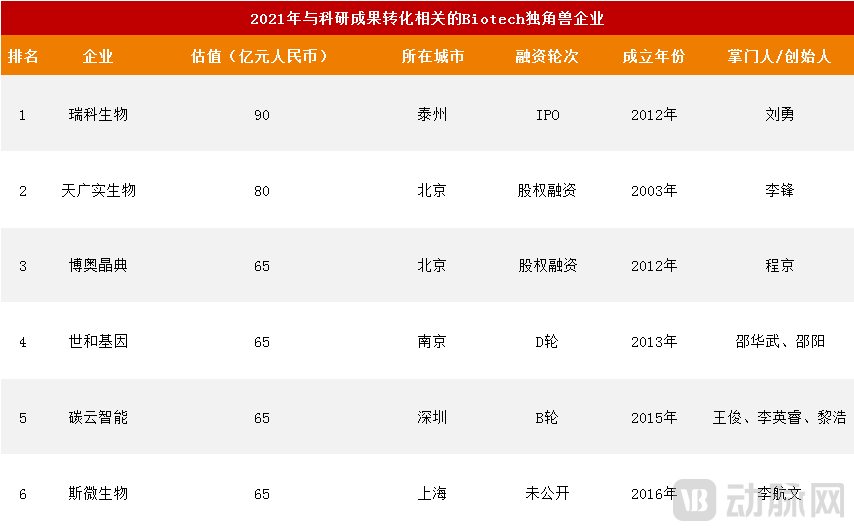
In this regard, we will analyze these six unicorn companies involved in the commercialization of scientific research achievements.Sketching Their Shared Portrait, and we hope it will serve as a reference for scientists who are currently launching startups or preparing to do so.
Reasonable Team Building: Combining Research and Commerce
A qualified startup team consists of two types of roles: scientists and business professionals, who represent scientific research capabilities and enterprise management capabilities, respectively.
The first role is a scientist., scientists are among the founders of these six unicorn companies. In fact, armed with tangible technological achievements, scientists who launch their own ventures can rapidly enhance industrial competitiveness. Moreover, leveraging their abundant scientific and technological resources, they are better positioned to translate high-quality innovative outcomes into real-world productivity.
withReco Biotechas an example. Liu Yong, the company’s founder, is a scientist deeply engaged in HPV vaccine research. Before establishing Recombin Biologics, he worked at the Chinese Center for Disease Control and Prevention (China CDC), where he served as the lead person responsible for HPV vaccine development. This experience enabled Liu to leverage his scientific expertise to strategically develop and commercialize an HPV vaccine pipeline, with a particular focus on the R&D of REC603, a nine-valent HPV vaccine that is poised to become the first domestically produced nine-valent HPV vaccine in China.
In addition, the company has assembled a research team characterized by combined academic research backgrounds and CDC work experience. The Chief Medical Officer, Zhang Jianhui, previously served as a professor at the CDC and held key leadership positions at leading global vaccine companies such as Sanofi and Merck & Co. The Chief Scientist, Hong Kunxue, was a research scholar at the University of California and Duke University in the United States; upon returning to China, he has been continuously engaged in vaccine R&D at the CDC.
Overall, Recomb Biologics’ core team, led by Liu Yong, boasts extensive industry experience, with most members having around 20 years of expertise in vaccine R&D. Their background, particularly including experience at the Chinese Center for Disease Control and Prevention (CDC), has better equipped these scientists to align with national priorities in vaccine development. As a result, since its inception, Recomb Biologics has rapidly emerged as one of the most competitive players in China’s HPV vaccine industry, attracting significant interest from investors.
But in reality, having scientists alone is far from sufficient for entrepreneurship. This is because, during the process of translating scientific research into practical applications, the primary value of scientists lies in overcoming technical bottlenecks and achieving breakthroughs in cutting-edge technologies. Therefore,The operational management of corporate commercialization requires a second role, namely business talent.
As business elites, they are more familiar with market and industrial layouts and can further expand the company's business. Therefore, we found that in these six unicorn companies, the addition of business talent can quickly help enterprises get on the right track.
We fromiCarbonXAn analysis of its development history reveals that while Dr. Li Yingrui leads technological R&D at iCarbonX, Wang Jun—leveraging his extensive business experience and his pivotal role in guiding BGI Genomics to its IPO—serves as the core leader in the company’s actual operations, driving regional expansion and industrial layout.
In 2016, Wang Jun led his team in corporate expansion, partnering with local governments to establish subsidiaries in the European island nation of Malta and in Israel. The company also acquired Imagu Visual Technology Ltd., an Israeli artificial intelligence firm, leveraging its image understanding technology to support the subsequent development of a digital life ecosystem. Through the establishment of subsidiaries and strategic acquisitions, iCarbonX successfully launched its flagship “MiHealth™” platform.
Leveraging the “Miwo™” platform, Wang Jun initiated strategic business expansion by forging partnerships with multiple stakeholders to diversify its service portfolio. From 2018 to 2019, iCarbonX joined forces with Orient Financial and Dachen Foods to enter the precision nutrition sector, and signed strategic cooperation agreements with entities such as the Zhuhai Municipal Government and BSI Group. These collaborations enabled the company to offer a suite of services encompassing six key business areas, including precision exercise, precision skincare, precision nutrition, and a health app development support platform.
From the perspective of team formation, the inception of a startup requires scientists to contribute a “promising idea,” which stems from their accumulated expertise in the technical domain. During the entrepreneurial process, scientists need to partner with business professionals to bridge their gaps in commercial acumen.
Focusing on Cutting-Edge Technological Fields, Specializing in Hard Tech
Through further analysis, we found that these six unicorn companies are focusing on cutting-edge technological fields such as “artificial intelligence,” “mRNA drugs,” “gene technology,” “molecular diagnostics,” and “synthetic biology,” all of which fall under the category of hard tech.Not only does it have a high technical barrier, but it also has clear application scenarios.。
In fact, hard technology serves as the foundational logic behind the emergence and development of these six unicorn companies. In terms of specific sectors, there are three companies focused on innovative biologics, two specializing in in vitro diagnostics, while CarbonCloud leverages its AI advantages to build an intelligent platform for delivering healthcare services.
Unicorns choose the hard technology track mainly for the following two reasons:
First,"Hard tech" features high technological barriers; once R&D is successful, it will bring substantial returns to the enterprise.. Taking in vitro diagnostics as an example, the upstream sequencing equipment sector of molecular diagnostics features extremely high barriers due to technology and patents; currently, only a few players, such as MGI Tech and Berry Genomics, have entered the Chinese market.
Entering the In Vitro Diagnostics IndustryBoao JingdianLeveraging a comprehensive molecular detection system, the company developed the world’s first deafness gene microarray, creating its flagship product—the Neonatal Hereditary Deafness Gene Detection Kit—and rapidly expanding its market presence. By 2021, BGI Genomics had screened over 5 million newborns nationwide using this microarray-based screening.
Next, the popularity of application scenarios for hard technologies enables companies to seize industry opportunities.
“Becoming a Unicorn” states: “The key to being a unicorn lies not in disruption, but in innovation—continuously meeting the needs of users (customers).” Therefore, focusing on unmet clinical needs has become the true strategic positioning for enterprises.
Take mRNA drug (vaccine) technology, one of the most lucrative sectors today, as an example. In terms of market size, the mRNA vaccine market holds immense potential; the global market for mRNA drugs is projected to reach $5.12 billion by 2025. From an investment perspective, financing in China’s mRNA sector amounted to $1.361 billion in 2021.
As one of the earliest companies in China to lay out mRNA new drug research and developmentSmiVax, having currently advanced more than 20 R&D pipelines covering mRNA vaccines for infectious diseases and cancer vaccines. Among these, the second-generation mRNA vaccine against SARS-CoV-2 variants is under intensive development. Stepping into this high-growth sector, Stemirna announced in June 2021 the successful completion of a new funding round totaling RMB 1.2 billion, with participation from leading investors such as Sequoia Capital China and WuXi AppTec, bringing the company’s valuation to RMB 6.5 billion.
Therefore, in addition to human capital, enterprises require robust technological capabilities. These technologies must not only establish high barriers to entry that are difficult for competitors to replicate, but also align with market demands to capture the largest possible market share.
Prioritize R&D speed and enrich the product pipeline
In martial arts, speed is the ultimate advantage. In the race to capture market share, speed has become the critical factor.
Therefore, it is crucial to accelerate the R&D process and develop first-in-class innovative products by adopting a “two-pronged” strategy. Specifically, unicorns should combine collaborative development with other pharmaceutical companies with independent in-house R&D, thereby injecting fresh vitality while safeguarding their proprietary R&D capabilities.
withTianGuangShi Biologicsas an example. By collaborating with Keymed Biosciences, Biocytogen, InnoCare Pharma, Hengrui Medicine, and Beta Pharma to jointly develop projects, we have established a collaborative network that spans the entire process of drug research and development to commercialization, covering the “preclinical stage–clinical stage–commercialization stage.”
Specifically, in the preclinical stage, relying on its ADCC (antibody-dependent cell-mediated cytotoxicity) enhancement antibody platform, TianGuangShi entered into an agreement with ConnoMed to jointly develop a CD47 antibody, MIL95. In the clinical stage, it collaborated with InnoCare Pharma to jointly conduct clinical trials of MIL62 and ICP-022 for the treatment of hematologic malignancies. Finally, leveraging Hengrui Medicine’s mature marketing promotion and sales network, it aims to accelerate the commercialization process of its products.
As of now, Tian Guangshi has established extensive external collaborations based on its antibody R&D platform and developed a differentiated product pipeline, including six drug candidates in clinical stages and six representative preclinical drug candidates.

Figure: TianGuangShi Bio’s Clinical-Stage Product Pipeline (Source: Official Website)
Among them, MIL62, a third-generation anti-CD20 antibody developed by TianGuangShi, is the first and only anti-CD20 antibody in China to enter Phase III registration trials, giving it a certain advantage in capturing market share.
Furthermore, an analysis of the product pipeline reveals that the company prioritizes coverage across multiple high-potential candidates. In the oncology sector, TianGuangShi RuiKe has established five pipelines: MIL62, MIL93, MIL95, MIL97, and MBS301. The company’s strategic rationale centers on aggressively capturing the domestic lymphoma market while simultaneously expanding into the solid tumor market.
Overall, these six unicorn companiesPrimarily based on in-house R&D, supplemented by collaborative R&D with other enterprises, accelerate its R&D pace and enrich the pipeline layout to capture market share as rapidly as possible.
Steady Financing Pace
The normal operation of startups requires the impetus of fundraising.
In practice, fundraising often accompanies the growth of startups, and milestone achievements frequently serve as the impetus for additional investments from a broader base of investors. Under normal circumstances,Startups complete a round of financing within an average of one to two years.
The fundraising process of unicorns is no exception; since its establishment in 2016,StemiRNAA total of six financing rounds were completed, averaging one round per year.
In fact, during the early stages of fundraising, team influence and narrative appeal are particularly prominent. Scientist founders symbolize cutting-edge technology and high-level scientific research excellence. As capital investors tend to focus more on “betting on the team,” companies founded by scientists often secure funding rapidly at this stage.
However, in subsequent financing rounds, investors’ focus on corporate development has taken precedence. They place greater emphasis on corporate milestones and market-based valuation assessments. Milestones allow investors to gauge a company’s growth and progress, while market valuations provide insight into its future prospects.
On January 4, 2021, SteadyMed Therapeutics’ mRNA-based COVID-19 vaccine project was approved to commence clinical trials. In March 2021, the company completed its Phase I clinical trial, becoming the second domestic enterprise to independently develop a vaccine. These two milestones significantly bolstered the company’s development. In June of the same year, SteadyMed Therapeutics secured RMB 1.2 billion in financing and further accelerated the clinical research of its COVID-19 vaccine.
Of course, this is one side of capital selecting unicorn enterprises; conversely, unicorn enterprises are also selecting capital.
UnicornsGreater emphasis on integrating financial capital with industrial capital, thereby not only securing financial support but also empowering enterprises with growth-oriented resources, including assistance in talent acquisition, international cooperation, product registration, and clinical trials.
AtTianGuangShi BiologicsDuring its financing rounds, the company not only secured investments from diverse capital sources such as Qianshan Investment, CITIC Securities, and Harvest Fund Management, but also received investment from Hengrui Medicine. Furthermore, it entered into a commercialization partnership with Hengrui Medicine for the third-generation anti-CD20 antibody MIL62 in the Greater China region, leveraging Hengrui Medicine’s established marketing and sales network to accelerate the commercialization of MIL62.
Finally, by profiling these six unicorn companies, we have identified team, technology, product portfolio, and financing pace as key drivers of corporate development. Specifically, the team and technology set the strategic tone for the enterprise; through collaboration between scientific experts and business professionals, companies select technological fields with high translational value and strong growth potential. Furthermore, a robust product pipeline and a steady financing rhythm enable investors to track the company’s progress and make informed market assessments.
In fact, only by evaluating multiple dimensions—including the team, technology, product portfolio, and financing—during the commercialization of scientific research achievements can entrepreneurial risks be minimized, paving the way for gradual growth into a unicorn company.