

Qianglian Zhichuang Submits IPO Prospectus Following Global First AI-Assisted Intracranial Aneurysm Treatment Software Approval

Union Strong
Developer of Artificial Intelligence-Assisted Diagnosis and Treatment Systems
Recently, Union StrongSelf-developedWorld's FirstProductUKnow®Intracranial Aneurysm Surgical Planning SoftwareApprovedNational Medical Products Administration (NMPA)Innovative Medical Device Class III Registration Certificate. It is reported that,This is the world's firstFundsRegistration Certificate for Class III Medical Devices in the Field of AI-Assisted Aneurysm Treatment。
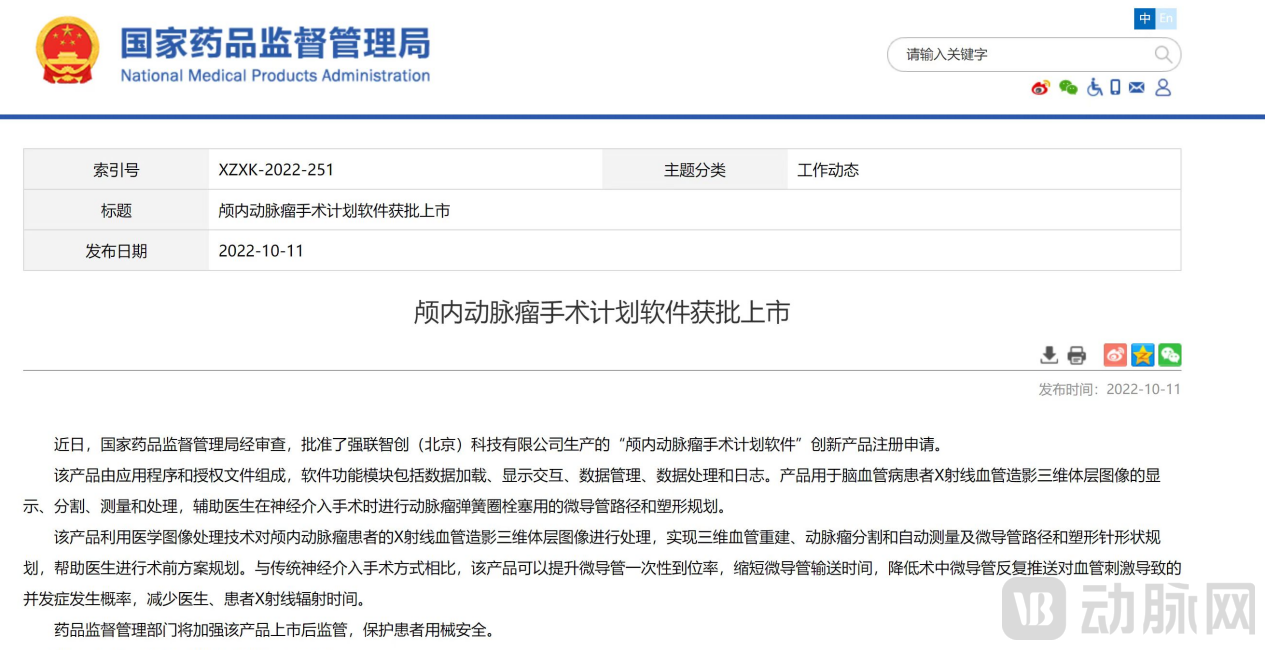
Previously, UKnow®The surgical planning software for intracranial aneurysms was approved to enter the NMPA’s Special Examination Procedure for Innovative Medical Devices in 2021. The current approval of its Class III medical device certificate signifies that the National Medical Products Administration has recognized the product’s safety, efficacy, and innovativeness, and also meansMedical AI for the First TimeEnterNeurointerventionTreatment Phase, to further drive the development of the neurointerventional industry.
Data shows that UKnow®As a key project under the National 13th Five-Year Plan for Scientific and Technological Innovation, specifically within the Major Special Project on Prevention and Control of Major Chronic Non-communicable Diseases, the intracranial aneurysm surgical planning software is an original Chinese product and a global first. It has been granted multiple invention patents both domestically and internationally. This software is designed for the display, segmentation, measurement, and processing of 3D volumetric images from X-ray angiography in patients with cerebrovascular diseases, assisting physicians in planning microcatheter pathways and shaping for coil embolization of aneurysms during neurointerventional procedures.
Professor Zhang Hongqi, Director of the Department of Neurosurgery at Xuanwu Hospital of Capital Medical University and Chairman of the Neurointerventional Committee of the Chinese Medical Doctor Associationstated: “Physicians with professional medical training, leveraging UKnow®“With the assistance of surgical planning software for intracranial aneurysms, less experienced physicians can rapidly acquire expertise, effectively narrowing the gap with seasoned specialists. Meanwhile, the combination of experienced surgeons and intelligent software support enables more precise and optimal surgical outcomes. This product provides valuable assistance to both senior and junior physicians, delivering clear patient benefits, enhancing treatment safety, and offering substantial support to clinical practice.”
Professor Gu Yuxiang, Deputy Director of the Hongqiao Campus of Huashan Hospital Affiliated to Fudan University and Vice Chairman of the Neurointerventional Committee of the Chinese Medical Doctor Associationstates: “UKnow®Surgical planning software for intracranial aneurysms can effectively enhance the safety and efficacy of aneurysm surgery, shorten the learning curve, and significantly support the professional development of primary-care and early-career physicians. This facilitates the adoption of aneurysm surgery in primary hospitals, enabling more patients to receive high-quality care. In the long term, AI technology will provide clinicians with new perspectives and safer, more effective surgical assistance. The future integration of additional artificial intelligence and robotic technologies into clinical practice will accelerate the advent of the era of automated surgery.
Since 2020, more than 30 medical AI products have received Class III certification. However, an undeniable fact remains: medical AI is still rarely used in clinical practice, and its commercialization faces numerous challenges.
For Union Strong, which has just obtained the Class III medical device certification for its AI technology, it also faces a common industry challenge—commercialization.
According to VCBeat, the commercialization of medical AI products faces difficulties due to two main reasons. First, the healthcare industry involves human life and safety, leading to greater caution in adopting new technologies and models; thus, clinical penetration and application require a longer period. As an innovative technology with a relatively short development history, medical AI still requires exploration of viable business models.
Second, early AI products had certain limitations and failed to gain widespread recognition from key stakeholders, including physicians, hospitals, patients, and medical insurance providers. Among previously approved medical AI products, those for AI-assisted diagnosis in medical imaging were the most prevalent. This is because imaging data are readily accessible and easier to process, making related products simpler to develop and approve. However, such products have not addressed critical clinical pain points, resulting in low clinical acceptance.
Furthermore, previously approved medical AI products have exhibited homogenization in both technological pathways and product portfolios, with nearly all focusing on radiology applications, resulting in intense competition. In contrast, the recently approved UKnow® Intracranial Aneurysm Surgical Planning Software is a highly innovative product with significant competitive barriers, developed and refined by Union Strong through deep understanding of surgical scenarios and consumables, in collaboration with renowned neurosurgery experts, including Professor Zhang Hongqi’s team at Xuanwu Hospital of Capital Medical University and Professor Gu Yuxiang’s team at Huashan Hospital Affiliated to Fudan University. Closely aligned with actual clinical needs and addressing critical pain points, the product currently faces no competitors.
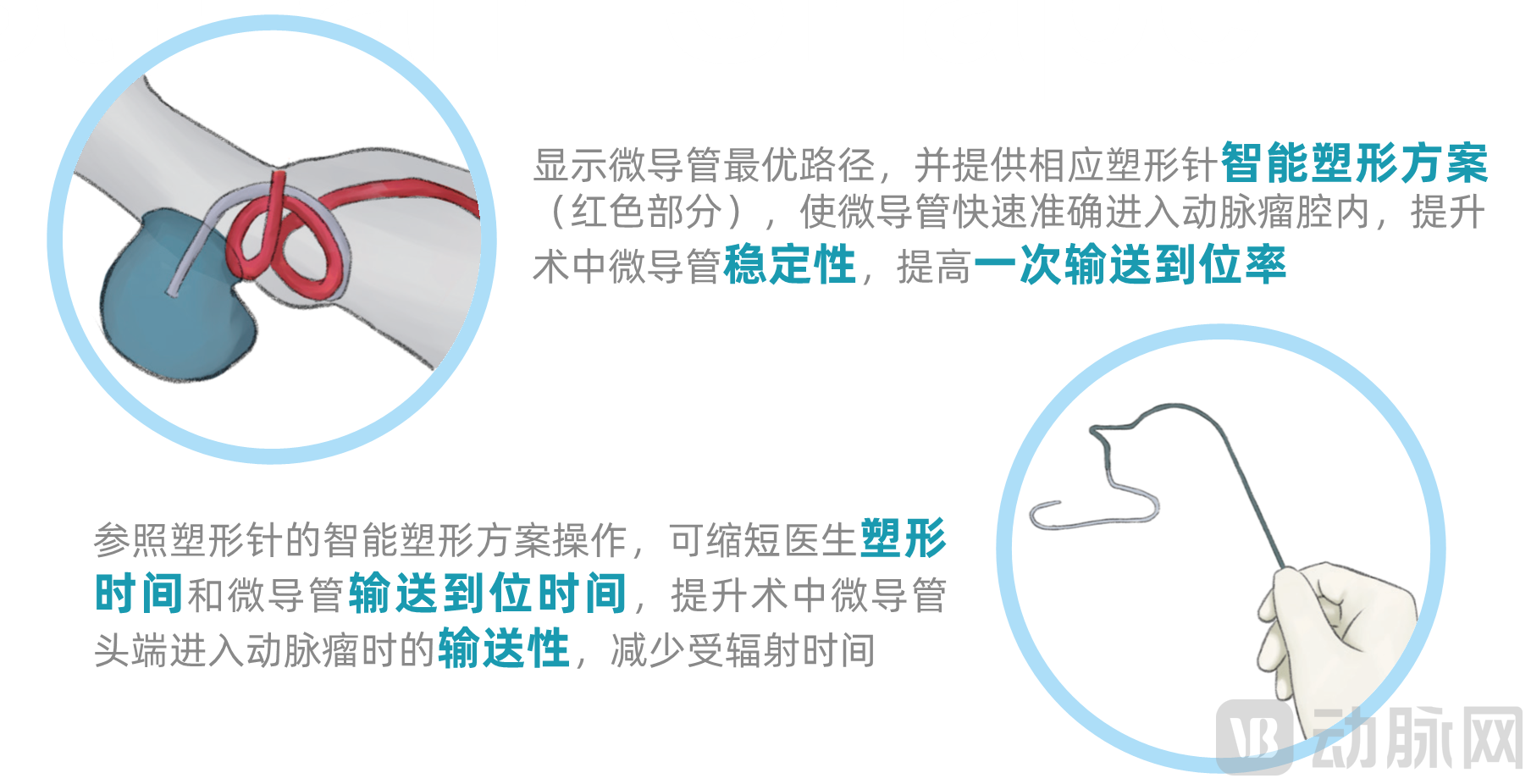
(UKnow® Intracranial Aneurysm Surgical Planning Software Product Schematic)
Meanwhile, UKnow®Intracranial Aneurysm Surgical Planning Software isFirst-in-classEntryNeurointerventionTreatment and Decision-Making Phasemedical AI products offer greater clinical value and higher clinical acceptance than earlier AI solutions for assisted screening and diagnosis.
In addition, thisThe software truly demonstrates the disruptive potential of medical AI.,It significantly reduces the difficulty of neurointerventional procedures, enabling primary-care physicians and junior doctors to successfully perform more advanced and complex surgeries with the assistance of this product. This is expected to disrupt the traditional master-apprentice teaching model and transform the learning and professional development trajectory of neurointerventionalists.
On September 20, the Hunan Provincial Healthcare Security Administration issued the "Notice on Regulating the Use and Charging Practices of Surgical Robot-Assisted Operating Systems." It stipulates that if a surgical robot-assisted operating system serves only for surgical planning, its auxiliary value shall be reflected in the surgical procedure price, and no separate billing item shall be established. Based on this, some industry insiders have concluded that surgical planning software cannot be charged separately, marking a complete failure of its commercialization.
In fact, this document was issued to address issues such as the itemized billing of surgical robot procedures, mandatory service bundling with charges, and other related problems, thereby standardizing the fee structure for surgical robots.
Qin Lan, Chairman of Union Strong, stated, “According to this document, products that do not have a tangible impact and value on surgical outcomes will not be eligible for separate billing. AndProducts that demonstrate intraoperative efficacy and achieve superior clinical outcomes will be encouraged for use.。”
On May 10, the “14th Five-Year Plan for Bioeconomy Development” released by the National Development and Reform Commission (NDRC) stated that intelligent decision-support knowledge models and algorithms should be developed to provide decision support for disease diagnosis and treatment. It also called for advancing AI-assisted diagnosis and treatment, supporting the development of applications such as AI-based medical imaging auxiliary diagnosis, pathological subtyping, and physiological signal analysis. This demonstrates the state’s supportive stance toward medical AI and its encouragement of innovative development in this field.
In addition, the National Healthcare Security Administration has also supported the application of innovative medical devices and stated thatVolume-Based Procurement Is Not Currently Implemented for Innovative Medical Devices. This not only safeguards the rights and interests of innovative products but also promotes their application and development.
As an innovative product that received approval through the Green Channel for Innovative Medical Devices in 2021,UKnow®With its significant clinical value and scientifically sound business model, and supported by national policies, the surgical planning software for intracranial aneurysms is poised for rapid clinical adoption and successful commercialization.
Notably, with the product’s regulatory approval and successful commercialization, it is expected to spearhead new developments in the medical AI industry. This will encourage more medical AI companies to focus their R&D efforts on products that address critical clinical pain points and deliver genuine clinical value, thereby enabling an increasing number of enterprises to expand the application of AI technology from auxiliary screening to key stages such as diagnosis, treatment, and follow-up.
As the mainstream approach for treating intracranial aneurysms, neurointerventional surgery is highly challenging and demands greater expertise from operators.
Through nearly two decades of clinical practice observations and in-depth exchanges with clinical experts, Union Strong has identified that the widely recognized bottleneck technical challenge in neurointerventional procedures is microcatheter shaping. Addressing this pain point will significantly reduce the difficulty of such surgeries.
It is understood that, in terms of microcatheter shaping, physicians can only rely on the naked eye to identify the optimal working angle and perform traditional point-to-point two-dimensional measurements manually. They must depend on personal experience to mentally visualize both the microcatheter shaping plan and the mandrel shaping strategy, and then manually execute mandrel shaping and microcatheter heat setting based on this mental planning, resulting in a complex operational procedure.
Among these, the virtual shaping phase severely tests a physician’s spatial imagination; the manual measurement phase is subjective and limited to two-dimensional measurements, resulting in a steep learning curve and high operational difficulty for beginners.
In response, Union Strong has developed specialized software for surgical planning of intracranial aneurysms. First, the product allows imaging data to be imported into the software for three-dimensional reconstruction to display the patient’s cerebrovascular images, facilitating physician review.
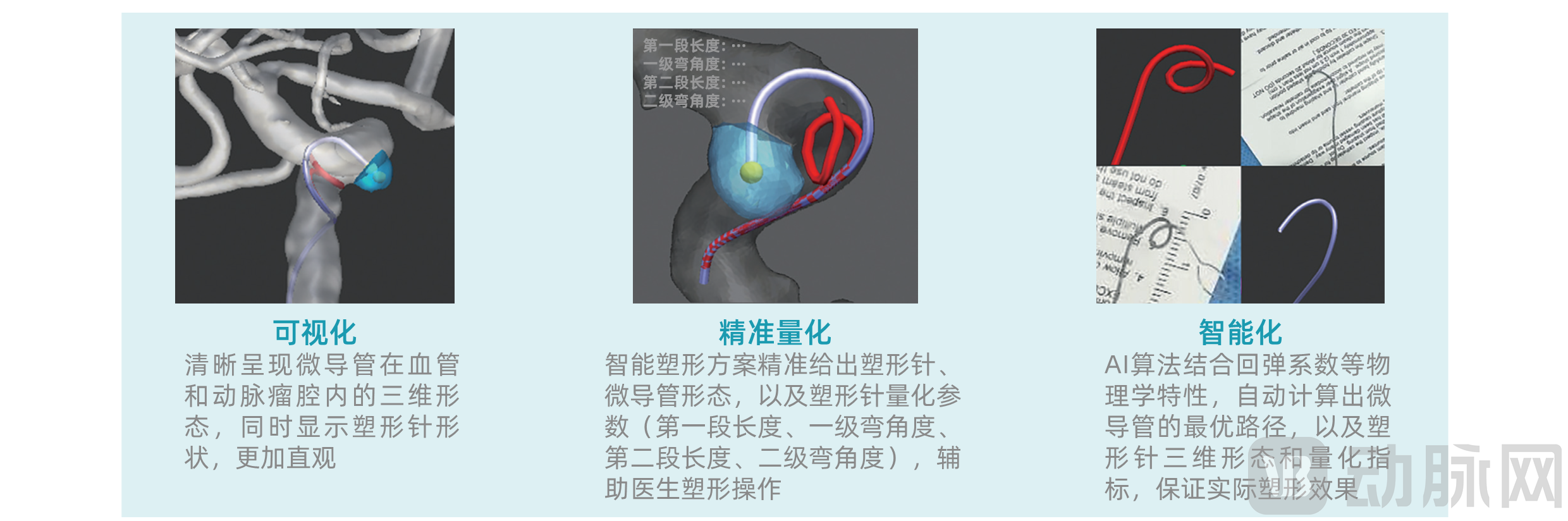
(Schematic of UKnow® Intracranial Aneurysm Surgical Planning Software)
Secondly, the product provides automated measurement of various three-dimensional morphological parameters for cerebrovascular structures, including key metrics such as aneurysm major axis, minor axis, width, height, volume, inflow angle, neck diameter, and parent artery diameter. This assists physicians in precisely understanding the anatomical morphology of the lesion. Real-world studies of this 3D automated measurement algorithm have demonstrated that its accuracy, consistency, and reproducibility are significantly superior to those of manual 2D measurements.
Finally, based on the three-dimensional anatomical morphology of the patient’s lesion, this product calculates the optimal microcatheter pathway and provides quantitative metrics for the length and angle of each curved segment. Meanwhile, it recommends corresponding shaping needle protocols tailored to the recoil characteristics of microcatheters from different manufacturers.
In addition to this software, Union Strong has also launched UMate-Shape.®Automatic forming terminal device, capable of automatically completing the core surgical step of shaping needle formation, thereby achievingAutomated Surgical Planning + Automated Intraoperative Guidance + Automated OperationFull-Pathway Intelligent Surgical Solution.
On August 14, Professor Gu Yuxiang from Huashan Hospital Affiliated to Fudan University released information about UKnow at the 19th China Cerebrovascular Disease Forum.®Clinical Trial Results of Intracranial Aneurysm Surgical Planning Software. Its superior clinical efficacy has garnered unanimous recognition from the attending experts.
In clinical trials, UKnow is used®The intelligent group was assisted by intracranial aneurysm surgical planning software, while the manual group followed traditional conventional operational protocols. Clinical results showed:In key evaluation metrics such as the first-pass success rate of microcatheter placement, the success rate of microcatheter placement within 5 minutes, the time to successful microcatheter placement, and microcatheter stability,Smart Teamwere all significantly superior toHandmade Group。
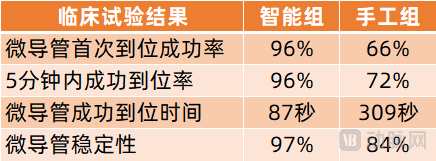
The experimental results indicate that UKnow®Surgical Planning Software for Intracranial Aneurysms Can Deliver Significant Clinical Benefits.For PatientsAI-assisted surgery enables more precise microcatheter placement, shorter positioning time, and fewer delivery attempts. These improved procedural outcomes translate into better clinical benefits for patients, including lower recurrence rates, reduced radiation exposure time, and fewer intraoperative complications.
A more detailed analysis of the clinical trial results revealed significant differences among physicians with varying levels of experience in terms of the “success rate of one-time microcatheter placement within 5 minutes.” In the manual group, the success rate was 75% for physicians with more than five years of independent surgical experience, compared to only 50% for those with less than five years.
Fortunately, UKnow®Intracranial aneurysm surgical planning software enables surgeons with varying levels of experience to perform procedures at a higher standard, offering particular benefits to less experienced physicians.
Clinical results show that, with the assistance of the software, physicians with less than five years of independent surgical experienceSuccess rate increased from 50% to 94%. Physicians with more than five years of experience, leveraging their extensive expertise, are able to tackle more difficult and complex cases with the assistance of this product, andSuccess Rate Increased from 75% to 96%。
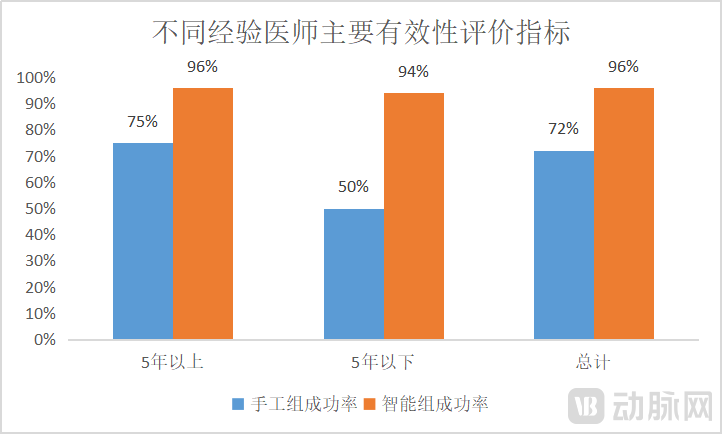
As can be seen:AtUKnow®With the assistance of surgical planning software for intracranial aneurysms, surgeons with varying levels of experience have demonstrated significant improvements in operative proficiency, with no significant differences in success rates, thereby achieving a qualitative leap in overall surgical outcomes.
For Physicians, based on comprehensive clinical data, the use of UKnow®Intracranial Aneurysm Surgical Planning Software: Enhancing surgical proficiency and patient survival rates, reducing operative time and radiation exposure. This product enables experienced surgeons to better manage complex cases, while allowing junior and mid-level physicians to independently treat both simple and complex cases.
Additionally, UKnow®Intracranial aneurysm surgical planning software has significantly enhanced the standardization of surgical procedures and lowered the learning curve for highly complex operations. Therefore,It will also generate significant value for primary-level hospitals.
In China, county-level hospitals capable of performing interventional aneurysm treatment remain a minority. However, with UKnow®With the implementation and promotion of surgical planning software for intracranial aneurysms, primary care physicians will be able to master surgical techniques more quickly and easily. This holds significant value for patients with acute stroke who have a limited therapeutic time window.
For society,UKnow®The surgical planning software for intracranial aneurysms increases the supply of qualified physicians and improves access to high-quality medical care. Primary healthcare institutions will be able to provide higher-level treatment for stroke patients, helping to truly realize the goal of “managing serious illnesses within the county.” Meanwhile, as primary care capabilities improve, more patients with unruptured aneurysms can receive treatment locally, reducing non-medical expenses such as travel and accommodation associated with seeking care elsewhere, thereby alleviating the societal burden.
From a macro perspective, UKnow®Surgical planning software for intracranial aneurysms addresses genuine clinical pain points, delivering substantial value to physicians, patients, hospitals, and society at large, thereby truly demonstrating the disruptive impact of medical AI on the healthcare industry.
UKnow®Surgical planning software for intracranial aneurysms primarily targets this condition, which is associated with high rates of mortality and disability.
Data shows that intracranial aneurysms refer to abnormal bulges in the arterial blood vessels within the brain, and they are a significant factor in triggering hemorrhagic stroke.
If an intracranial aneurysm has not ruptured, it may be asymptomatic, or it may compress adjacent brain tissue, causing symptoms such as eye pain, visual changes, or unilateral facial numbness. Once an intracranial aneurysm ruptures and bleeds, the mortality rate is as high as one-third, and the mortality rate for rebleeding exceeds one-half. Therefore, intracranial aneurysms are referred to as "ticking time bombs in the brain."
Data show that there are approximately 40 million patients with intracranial aneurysms in China. From 1990 to 2017, stroke, represented by intracranial aneurysms, remained the leading cause of death in China, with an overall mortality and disability rate exceeding 60%. Given the large patient population and the severity of the disease, the diagnosis and treatment of intracranial aneurysms will create substantial market opportunities.
For intracranial aneurysms, current treatment options include surgical clipping, coil embolization, and flow diverter implantation. Among these, coil embolization is a minimally invasive procedure applicable to most types of aneurysms, boasting the widest range of applications and commanding the largest market share.
In 2020, the penetration rate of neurointerventional procedures for hemorrhagic stroke conditions such as intracranial aneurysms exceeded 62% in the United States, whereas it was only 9.1% in China, indicating substantial room for growth.。
As the country with the highest lifetime risk and greatest disease burden of stroke, China is promoting the construction of a stroke prevention and control system to accelerate the development of the neurointerventional industry.
On one hand, imaging technologies are rapidly innovating and integrating with artificial intelligence (AI), significantly enhancing their accessibility and convenience. Driven by factors such as the development of stroke prevention and control systems, the growth of the health checkup industry, and heightened public health awareness, an increasing number of residents will opt for cerebrovascular disease screening, which will substantially raise the detection rate of intracranial aneurysms.
On the other hand, the country is promoting the establishment of stroke centers to improve the accessibility of neurointerventional procedures. With policy support and other measures, the number of hospitals and physicians capable of performing neurointerventional surgeries is expected to continue rising. Meanwhile, as technologies such as automation and intelligence advance, the learning curve for operators will gradually steepen less, enabling more physicians at primary-care hospitals to master neurointerventional techniques.
Driven by the growing unmet clinical needs of patients, the expansion of neurointerventional medical resources, and improved accessibility to healthcare services, endovascular procedures for treating intracranial aneurysms are poised for rapid adoption. This widespread uptake of interventional techniques will, in turn, accelerate the promotion and application of surgical planning software for intracranial aneurysms.
EstimatedUKnow®The intracranial aneurysm surgical planning software will rapidly capture the market as a flagship product in the medical AI industry, leading its development.。
In fact, in addition to this product, Union Strong has also developed an integrated intelligent diagnosis and treatment platform for a wider range of acute and chronic cerebrovascular diseases, providing patients with cerebrovascular conditionsFrom automated screening to precise diagnosis,Treatment Decisions toSurgical Planning and Intraoperative Assistance、Postoperative Follow-upofEnd-to-End AI Products and Services。
To advance stroke prevention and treatment in China, Union Strong has leveraged its product strengths to establish strategic partnerships with companies such as GE Healthcare and iKang Group.
For example, Union Strong collaborates with GE Healthcare to provide its UGuard AI diagnostic system for ischemic stroke.®, and jointly launched the first AI-powered neurointerventional angiography system to empower primary-care hospitals; in partnership with iKang Group, applied AI technology to health check-ups to enable early screening, prevention, and treatment of cerebrovascular diseases, nipping stroke in the bud.
As Union Strong delivers greater value to patients, physicians, hospitals, and partners, it will accelerate its own growth, with increasingly broadening prospects.