

RevBio Files IPO Prospectus: Pioneering Bio-Inspired Bone Adhesive Tetranite from Ocean to Space

RevBio
Bone Adhesive Developer
Human health relies on the advancement of medical technology, which is inextricably linked to the development of biomedical materials and devices.
Biomedical materials refer to new high-tech materials used for diagnosing, treating, repairing, or replacing damaged tissues and organs, or for enhancing their functions. They form the foundation for research on artificial organs and medical devices. Biomedical materials can be classified into restorative materials, tissue engineering materials, medical membrane materials, tissue adhesives, and suture materials, among others. To date,More than 1,000 biomaterials have been extensively studied, and dozens are widely used in clinical practice., covering a broad range of fields in materials science.
According to MarketsandMarkets data, the global market size for biomedical materials is projected to increase from $170.9 billion in 2016 to $300 billion in 2020, with a compound annual growth rate (CAGR) of 6%, significantly outpacing the growth rate of the global medical device market during the same period. Biomedical materials account for approximately 40%–50% of the global medical device market share. Even amid a global economic downturn, biomedical materials remain one of the few sunrise industries maintaining rapid growth.
The report shows that,The market size of biomedical materials in China has grown from RMB 65 billion in 2011 to RMB 480 billion in 2021, achieving more than a sevenfold increase.Among novel medical materials, medical adhesives for “wound closure” have gained significant popularity.
According to QYR statistics and forecasts,The global market sales of medical bioadhesives reached $350 million in 2021 and are projected to reach $560 million by 2028.Ethicon, 3M, B. Braun Melsungen AG, Baxter International, and Henkel are key players in the global medical adhesive market.
In the booming market for medical bioadhesives, what sets RevBio apart with its focus on bone adhesives? Can its developed bone adhesive secure a foothold in this competitive arena?
Former Stryker Executives Lead Startup, Holding Core Technological Inventions
RevBio is a biotechnology company founded in 2014, formerly known as LaunchPad Medical. Headquartered in Massachusetts, the company specializes in the development of bioadhesives for bone and is currently commercializing Tetranite, an injectable, self-setting, osteoconductive bioadhesive biomaterial. In September 2022, RevBio announced that it had received a Phase I Small Business Innovation Research (SBIR) grant from the National Institute on Aging (NIA), part of the U.S. National Institutes of Health (NIH), to explore the use of Tetranite in treating vertebral compression fractures. To date, RevBio has completed 17 funding rounds, raising a total of $30.3 million.
Brian Hess is the founder and CEO of RevBio, graduating from the University of Wisconsin-Madison with a degree in Mechanical Engineering. Before founding RevBio, heAt the orthopedic giant Stryker Corporation (Stryker OrthoBiologics) served as Project Engineer, developed and launched HydroSet, a commercially successful synthetic bone substitute that served as the key prerequisite for the realization of Tetranite technology. During this period,Invented the patented technology for Tetranite biomaterials. Later, as Chief Technology Officer at InVivo Therapeutics, he led the R&D organization in developing a Class III biomaterial that received FDA approval. Brian holds more than 12 patented inventions and is a member of the MIT Alumni Organization and the UW-Madison Alumni Association.
George Kay currently serves as the Chief Scientific Officer at RevBio. He holds a D.M.Sc. and an M.Sc. in Oral Biology from Harvard University and is a member of the American Board of Oral Implantology. For over 30 years, George has served as a clinical faculty member at Harvard School of Dental Medicine, primarily teaching prosthodontics and periodontology. He has been actively involved in clinical and scientific research in materials science and dental implants, holding multiple patented inventions.
RevBio aims toRevolutionizing Orthopedic Repair MethodsIn 2020, when changing its name, RevBio adopted the tagline “transforming bone repair” to define its focus on developing products for dental and orthopedic applications, reflecting the team’s direction and determination.
RevBio, a team composed of scientists, engineers, and clinicians, has developed Tetranite, a bioadhesive with broad applications in bone repair, from an organic protein synthetic. As a MassChallenge awardee, RevBio has secured more than 10 grants and holds multiple patents, and is currently conducting two human clinical trials for Tetranite. Currently, no product with comparable efficacy has received FDA approval on the market.
Elevating Adhesion, Osteoconductivity, and Biocompatibility to New Heights
In 2010, American marine biologists discovered some unusual stones in the waters off California, and within these stones, they found a type of worm known as the sandcastle worm (sandcastle worm). These stone structures are "apartments" inhabited by the worms, constructed by cementing shell fragments and sand grains together with a "glue" secreted by specialized organs in their heads.
This “glue” is protein-based, incorporating phosphates, amines, and molecules containing adhesion promoters that remain stable even in water. Scientists have discovered thatThe “apartment”-binding technique of sandcastle worms may inspire human exploration of bioadhesives.
There are two main types of clinical bone adhesives. One is PMMA bone cement, also known as polymethyl methacrylate cement (PMMA), which is a room-temperature self-curing adhesive composed of a powder and a liquid component. As the most widely used medical adhesive,PMMA is an inert material that cannot form an organic chemical interface with host bone tissue. Its clinical application is also limited by heat generation during polymerization, the cytotoxic effects of monomers, and restricted working time.
Another type is CPC bone cement (calcium phosphate cement), also known as calcium phosphate bone cement. It is commonly used for root canal filling and alveolar bone repair, exhibiting good degradability and certain biocompatibility.However, its adhesiveness and strength are relatively poor., which has directly impacted the clinical application of CPC. So, is it possible to develop a bone adhesive that combines good performance with biocompatibility?
RevBio believes this is possible. Drawing inspiration from the marine sandcastle worm, RevBio bioengineered the protein “glue” secreted by the worm to develop Tetranite. Tetranite canCures within minutes in an underwater environment and significantly enhances bone-to-bone adhesion strength.According to measurements,Tetranite’s adhesive strength is 10 times that of CPC bone cement and 7.5 times that of PMMA bone cement.
Tetranite is adaptable to wet environments and possesses properties such as osteoconductivity and biocompatibility. Currently, leveraging Tetranite technology as the foundation for a novel regenerative bone adhesive platform, RevBio has established multiple product pipelines.
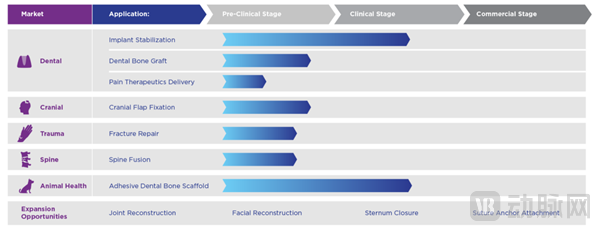 Product Pipeline Source: RevBio Official Website
Tetranite is an injectable, self-setting material that will reduce the duration and complexity of medical procedures,Holds promise for application in the field of minimally invasive surgery (MIS), improving patient outcomes by reducing care time and lowering healthcare costs.. When used to bond bone fragments together or to secure metal implants to bone, Tetranite can withstand separation forces. Given its structural properties, RevBio is continuing development to enhance the fixation strength of existing metal implants, as well as to explore the possibility of its standalone use.
Although RevBio believes that its novel fracture repair technology can be applied to a wide range of medical applications,such as oral and maxillofacial, craniofacial, orthopedic, and neurosurgical specialties, but to find a fast track to market for Tetranite, RevBio started with the specialties of dentistry and animal orthopedics. Currently, Tetranite has FDA approval to conduct multiple clinical studies and initiated its first-in-human trials in 2019. Although it has not yet received FDA clearance, it has secured funding support and approvals from multiple government agencies.Human clinical trials and animal orthopedic clinical trials of Tetranite have been conducted in the United States, Europe, and other regions.
Board the ISS National Laboratory to Conduct In Vivo Research Experiments
In March 2021, RevBio announced that it would conduct in vivo experiments aboard the U.S. National Laboratory on the International Space Station (ISS National Lab). The study will investigate whether Tetranite retains its osteoconductive properties and efficacy in a microgravity environment characterized by significantly impaired bone density and new bone tissue regeneration. The experiment is funded by CASIS (Center for the Advancement of Science in Space) and MassChallenge. Previously, RevBio had received a NASA research grant.
RevBio’s first International Space Station experiment was an in vitro study focusing on the response of bone cells to Tetranite. The second experiment conducted here is an in vivo study that will use Tetranite to treat 40 mice with artificially induced bone defects, while a control experiment will be carried out on Earth to examine differences in osteoporosis healing between the microgravity environment of outer space and the terrestrial environment. This experiment is scheduled to begin in October 2022.
Giuseppe Intini, the principal investigator of this experimental study, believes thatIf it can be demonstrated that this material promotes bone repair in space, it may be possible to develop new approaches for treating osteoporosis and enhancing fracture healing on Earth.. This aligns with RevBio’s slogan—revolutionizing the way bone repair is performed.
In recent years, research on bioactive bone adhesives in China has also achieved new breakthroughs. In 2020, Professor Qiu Dong’s research group at the Institute of Chemistry, Chinese Academy of Sciences, proposed a bioactive glass composite porosity strategy to facilitate the use of cyanoacrylate adhesives for internal fixation of fractures, thereby promoting fracture healing. Bioactive glass exhibits excellent osteoconductivity and osteoinductivity, capable of promoting bone tissue regeneration.
In 2022, Suzhou Jiuxin Medical Technology Co., Ltd. in China announced the invention of a new type ofBiodegradable Adhesive Protein Raw MaterialsProduction and Bioengineering: Phosphorylation Process Breakthrough in Bone Adhesive Technology for Wet Environments; Commercial-Scale Production of Required Raw Materials Now Achieved. The company claims that this technology enables reduction of general and comminuted fractures within 30 seconds, shortens clinical surgical time for metal fixation by 70%, and accelerates healing speed by approximately 30%. The first product, “Jiuxin Bone Glue,” has been launched.