

Nanomics: Leveraging Nano-Omics to Revolutionize Next-Generation Proteomics and Nanomedicine Delivery

Nanomics
Developer of AI Proteomics High-Throughput Automation Technology Platform
In June 2022, the prestigious British academic journal Nature Reviews Clinical Oncology, with an impact factor as high as 65, published a review article that formally introduced the academic term “Nano-omics” in the English-language context.
Nanomics refers to the rational design and development of a new generation of bio-nanomaterial libraries with specific biological functions, by integrating high-throughput experimental data with artificial intelligence algorithms. It investigates their interactions with genomes, proteomes, cell lines, and tissues, and is applied in multiple cutting-edge fields such as proteomics, biomarker discovery, gene drug delivery, liquid biopsy, and early cancer screening.
As early as April 2021, a company named Nanomics (Chinese name: Luomi Life Sciences) was registered and established in Hangzhou, China.
Nanomics is the world’s first company known to propose a platform-based enterprise offering upstream tools and comprehensive solutions for the bioeconomy industry, centered on nanomics.The company focuses on “nanomics-proteomics” interactions and has independently developed the Kepler Pro platform, which integrates artificial intelligence with nanomics technology.TMBy applying nanomics to proteomics, it has achieved deep mining of thousands of proteins on a single technical platform, ultra-high sensitivity at the femtogram level, and an ultra-wide detection range spanning eight orders of magnitude in abundance.Propelling the global proteomics industry into the NGS era.
Building on this foundation, the company further conducts in-depth vertical research into the interactions among “nanomaterials–proteomics–cell lines–tissues.”By applying nanomics to gene drug delivery, we have established a comprehensive system encompassing high-throughput library construction of nanodelivery vectors, in vitro and in vivo targeted screening, and nanodrug discovery.Propelling gene therapy from the "blind box" phase into the era of programmable drugs.
What Makes Nanomics So Compelling? What Progress Has Nanomics Made in the Commercialization of Nanomics? Recently, VCBeat held a conversation with Dr. Wu Hao, Founder and CEO of Nanomics.
Pioneering the Industrialization of Nanomics to Advance Experimental Science
From Hypothesis-Driven to Dual-Wheel Driven by Experimentation and Data
Although the specific term “nanomics” was only formally established in 2022, its theoretical foundations and methodologies have been extensively studied by academia for decades, and its industrial applications are beginning to emerge, akin to synthetic biology. For instance, companies such as Grail, Guardant, and Freenome are utilizing nanomaterials to capture cell-free DNA (cfDNA) from plasma. Dr. Wu Hao previously founded a liquid biopsy company in Chicago that employs nanoparticles to capture circulating tumor cells (CTCs) in blood. However, these studies have all proceeded from hypotheses to develop individual nanomaterials, without incorporating the omics-based big data mindset.
Nanomics is the world’s first company to apply “-omics” principles, or a “big data” approach, to nanomaterials. By leveraging high-throughput experimental data and artificial intelligence algorithms, the company discovers bio-based nanomaterials, establishes databases for both bio-based nanomaterials and omics data, and successfully applies these bio-based nanomaterials in multi-omics research.
Wu Hao holds a Ph.D. in nano-soft matter from the Pritzker School of Molecular Engineering at the University of Chicago, where he studied under Matthew Tirrell, a world-renowned expert in bio-based nanomaterials and a member of three U.S. national academies.The doctoral research project, funded by the U.S. Materials Genome Initiative, leverages high-throughput experimentation and algorithms to develop next-generation functional bio-based nanomaterials.Over 10 years of experience in nanotechnology, drug delivery carriers, and soft matter physics.
Prior to returning to China to found Nanomics, Dr. Wu Hao had separatelyIncubating hard-tech companies at the renowned U.S. venture capital firm ARCH Venture Partners, andAI Unicorn Develops Deep Learning Model for Cancer Diagnosis. These cross-industry and interdisciplinary research and work experiences have accustomed Dr. Wu Hao to approaching problems from a cross-sectoral perspective.
Dr. Wu Hao stated, “Around 2015, neither AI algorithms nor experimental techniques had advanced to their current level, which hindered the industrialization of nanomics.” With technological advancements in recent years, the timing has matured for translating nanomics into industrial applications. Consequently, Dr. Wu Hao founded Nanomics in 2021.Dr. Le Shen, Co-Founder of the Company, holds a Ph.D. in Molecular Pathology from the University of Chicago and has over 20 years of experience in multi-omics research., the company has thus formed an interdisciplinary team of “Nanomaterials Group + Multi-Omics Biology.”
Dr. Wu explained the significant enhancement that omics thinking has brought to experimental science as follows: “For a long time, experimental science has been hypothesis-driven, with luck playing a major role. Many findings were accidental discoveries, resulting in low reproducibility and even lower translation rates, leading to a severe disconnect among industry, academia, and research.”Currently, academia and industry are exploring new research paradigms focused on standardized, high-throughput data generation, algorithmic data analysis, and the use of analytical insights to guide experimental design.”
This is also the underlying reason why AI for Science has garnered such widespread attention from both academia and industry worldwide in recent years.
“The Human Genome Project is a classic example of the data-driven paradigm. Guided by this data-centric mindset, we integrate high-throughput experimentation with advanced algorithms to build a library of bio-based nanomaterials and analyze their application across diverse scenarios, thereby enhancing experimental efficiency and success rates. This represents a revolutionary shift in experimental science, enabling the discovery of an increasing number of novel materials and their rapid translation into industrial applications, including biopharmaceuticals and diagnostics, synthetic biology, new energy, agriculture, and medical aesthetics.”
In recent years, under the wave of innovation in AI for Science, the Keplerian research paradigm, which discovers laws through data-driven approaches, has begun to attract increasing attention and gained favor among numerous researchers.Nanomics Develops Universal Kepler ProTMTechnical Platform: Aiming to Serve as the Foundational Tool for Multiple Frontier Hard-Tech Domains, Including High-Throughput Proteomics, De Novo Protein Sequencing, Biomarker Discovery, Nanodrug Carrier Delivery, Directed Enzyme Evolution, and Synthetic Biology.
Leveraging its nanomics technology platform, Nanomics enters the market through upstream proteomics tools and extends into high-throughput library construction and formulation screening for nanocarrier delivery.
Advancing Proteomics from the PCR Era to the NGS Era
Proteomics refers to the large-scale study of protein characteristics, including protein expression levels, post-translational modifications, and protein-protein interactions. It aims to achieve a comprehensive and holistic understanding of processes such as disease pathogenesis and cellular metabolism at the protein level, and is currently being applied in various specialized areas, including drug discovery, early cancer screening, companion diagnostics, and immunotherapy.
Currently, the world's top 20 large pharmaceutical companies are all using proteomics to discover new biomarkers and targets.U.S. early-screening giant Exact Sciences has just acquired a proteomics company; Illumina also announced its entry into the proteomics field last year; InterVenn, founded by Carolyn Bertozzi, the recent Nobel Laureate in Chemistry, launched the world’s first AI- and proteomics-based ovarian cancer diagnostic product in 2021.
According to Cowen Equity’s industry research data, the global proteomics market reached $28 billion in 2021, with a growth rate exceeding 10%. It is widely recognized within the industry as a vast, untapped market in the field of precision medicine, following genomics.
However, protein enrichment methods remain the core bottleneck constraining the development of proteomics.Conventional techniques can only capture a few to dozens of proteins at a time, with abundance spanning 2–4 orders of magnitude. There is an urgent industry need to simultaneously capture thousands of proteins from a single sample, with abundance spanning 10 orders of magnitude. However, even the most sensitive mass spectrometry methods currently available cannot achieve this.
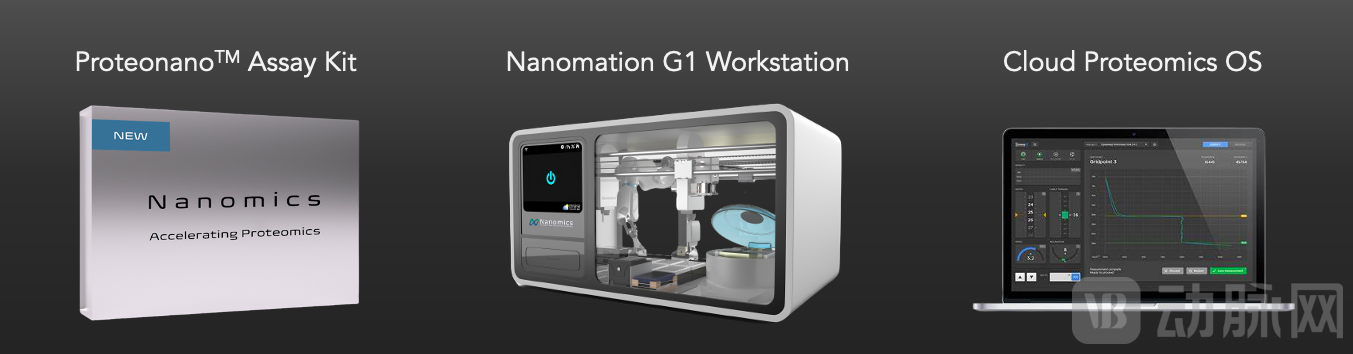
Nanomics’ High-Throughput Proteomics Product Portfolio
Nanomics has developed deep proteome enrichment kits, high-throughput sample pre-processing workstations, and deep learning-based data processing methods, forming a comprehensive product matrix that covers the entire workflow from protein enrichment and automated pre-processing to protein identification and biomarker discovery.
The company’s proprietary nano-affinity probes deliver nearly 300-fold enrichment and depletion efficiency for plasma proteins, overcoming the most challenging step in protein enrichment. Currently, this technology enables deep enrichment of thousands of proteins across more than eight orders of magnitude, covering 2,000 signaling pathways, thereby substantially meeting the industry’s urgent demand for high-throughput, deep, unbiased, and cost-effective proteomics.
“Analogous to genomics, this is equivalent to propelling proteomics from the PCR era into the NGS era.”Dr. Wu Hao stated.
Advancing Gene Therapy Delivery: From a “Black Box” to the Era of Programmable Drugs
Building on the “nano-proteome” interaction map, Nanomics further constructs a “nano-proteome–cell line–tissue” framework. This framework elucidates how nanomaterials further interact with different cells (such as immune cells) and organ tissues, thereby entering the realm of nano-delivery vectors for gene therapy.
Whether it involves RNA therapies, gene editing, or cell therapies, large-scale production and high-throughput screening of suitable nanocarriers are essential.However, how gene therapy vectors interact with the human body remains a black box.The protein corona profile adsorbed on the surface of nanocarriers may be the key to unlocking this black box.For instance, apolipoprotein E (ApoE) plasma proteins adsorbed onto the surface of lipid nanoparticle (LNP) can specifically bind to low-density lipoprotein receptor (LDLR) on hepatocytes, thereby conferring liver-targeting capability to LNPs.
LNP carriers typically consist of four components, with each component comprising dozens to hundreds of molecules, theoretically yielding hundreds of millions of possible formulation combinations. Conventional approaches remain confined to exploring a very limited design space, and many formulations have already been patented.For novel RNA structures and sequences, the efficient preparation of nanodrug carriers with controllable size and uniform distribution, as well as the screening of new formulations to overcome the limitations of liver targeting, represent critical pain points and urgent needs in the industry.
In 2021, the National Medical Products Administration issued three major guidelines on Quality Control of Nanomedicines, directly generating substantial industry demand at the top-level design stage.
To this end, Nanomics has built a comprehensive product matrix for the library construction and screening of nano-delivery carriers., including (1) using the Meona nanoprinterTMA high-throughput library preparation platform centered on a benchtop nano-carrier printer, capable of high-throughput production at 20 mL/min of highly uniform nano-carriers (PDI ~0.1); (2) Meona NanosizerTMMorphological Characterization Platform, capable of precisely characterizing sub-nanometer-scale carrier structures and internal RNA morphology, (3) meona fingerprintTMNanocarrier Surface Plasma Protein Corona Fingerprinting Characterization Platform, and (4) meona barcoderTMA DNA-Encoded Nanocarrier Platform for In Vivo Tracking and High-Throughput Screening.
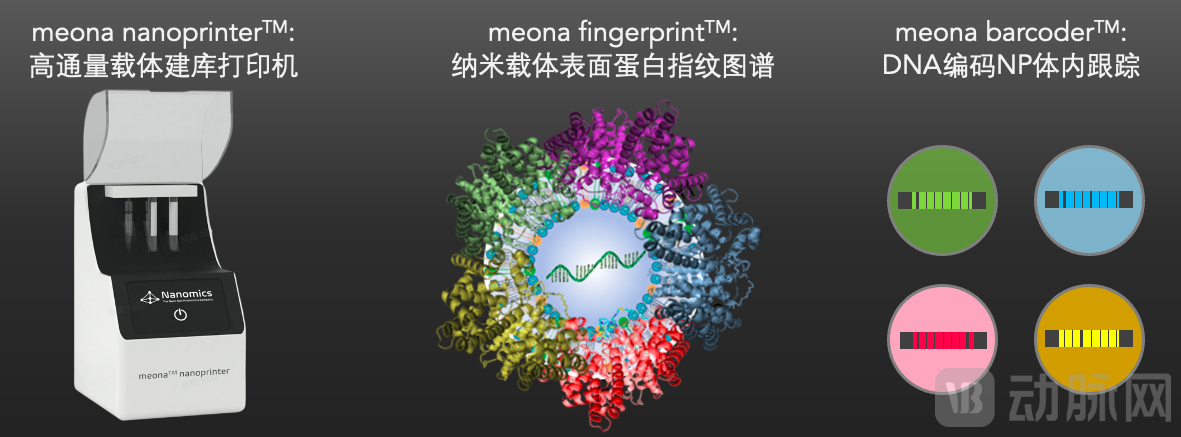
Nanomics’ Product Matrix for Nanocarrier Delivery Services
Dr. Wu Hao stated that leading gene therapy companies in Europe and the United States, including Moderna, Pfizer, AstraZeneca, BioNTech, Beam Therapeutics, and Verve Therapeutics, have long been leveraging similar technologies to develop landmark RNA drugs and gene-editing therapies.We aim to provide comprehensive support to pharmaceutical companies, especially Chinese enterprises, in accelerating the development of programmable gene therapies with global impact.
The Company Is Advancing Rapidly and Will Focus on Expanding Production Capacity in the Future
Over the past six months, Nanomics has experienced rapid growth, establishing an interdisciplinary technology platform, developing two core business lines, and launching six products and services. The company has already attracted numerous clients seeking its expertise and has formed strategic business partnerships with enterprises across its upstream and downstream supply chains.
ButDr. Wu Hao acknowledged that the company is currently accelerating efforts to enhance its delivery capabilities.Next, Nanomics will focus on proteomics and nanocarrier delivery, build new production workshops to expand capacity, and strengthen its BD and marketing teams to accelerate scaling and commercialization.
Regarding the market opportunities at hand, Dr. Wu Hao stated: “The global proteomics market remains highly competitive with an unsettled landscape, while nanomedicines are accelerating the transformation of future therapies. Chinese companies have a significant opportunity to achieve global leadership in the upstream tools market.
How to expand China’s position in the global industrial chain may represent the next wave of significant dividends for a new generation of Chinese companies built on hard technology.”