

Rivanna Medical Files IPO Prospectus: AI-Powered Accuro Platform Demonstrates Over 100% Improvement in Spinal Anesthesia Success Rates

Rivanna Medical
Medical Imaging Technology Developer

National Institute of Health
National Institutes of Health
As a mature anesthetic technique, epidural anesthesia has been widely used in labor analgesia, thoracic surgery, orthopedic surgery, organ transplantation, and surgeries related to chronic pain management. Epidural anesthesia involves injecting medication into the epidural space using an epidural needle. Therefore, accurate positioning of the needle within the epidural space is crucial.
In the United States, 20 million procedures involving neuraxial anesthesia (epidural and spinal) are performed annually. However, some studies report failure rates for spinal anesthesia as high as 30%. Among the contributing factors, the precision of needle placement is one of the most critical determinants.
On August 16, 2022, Rivanna Medical, a U.S. medical imaging device company, published an article in the journal *Ultrasonics* presenting its latest research findings: the company’s flagship technology, Accuro, provides real-time identification of anatomical structures, reduces puncture time, and predicts needle trajectory and the distance from the skin to the target site during epidural catheterization in morbidly obese parturients.
As a handheld ultrasound device based on automated 3D navigation technology, Accuro can significantly improve the safety and efficiency of epidural and spinal anesthesia, while being no larger than a typical smartphone.It is estimated that Accuro currently has a potential market of $1.1 billion in the United States.
For epidural anesthesia, inaccurate puncture can lead to many serious consequences, even endangering the patient's life. The most common complication is post-dural puncture headache (PDPH), with an incidence rate exceeding 50%. Due to the influence of pregnancy, the incidence of PDPH in women is two to three times higher than in men. In addition to PDPH, failed needle placement may also cause spinal cord injury, paralysis, or the development of epidural hematoma and abscess.
In current clinical practice, the most common method for detecting the position of a needle in the epidural space is based on loss of resistance (LOR). However, this method cannot accurately predict the depth of the needle.Without image guidance, the failure rate of the LOR technique is as high as 53%.
Many current imaging systems utilize modalities such as fluoroscopy and ultrasound; however, they each have their own limitations. For example, due toFluoroscopy has limited resolution and contrast., making it difficult for operators to distinguish between different tissue layers anterior to the needle tip. Systems utilizing ultrasound guidance are often accompanied byBulky equipment and complex operation methods, thus requiring extensive operator experience. It is precisely these issues that have hindered their widespread adoption in epidural and related neuraxial anesthesia.
To improve the success rate of intraspinal canal puncture and reduce the number of puncture attempts, an effective imaging technique is urgently needed.
Rivanna, founded in 2010 and headquartered in Charlottesville, Virginia, specializes in medical imaging technology that combines the advantages of ultrasound with the bone-imaging capabilities of X-ray to provide precise image guidance, thereby reducing the risk of repeated needle punctures during anesthesia.
In 2016, Rivanna received a $1.5 million grant from the National Institute of Biomedical Imaging and Bioengineering (NIBIB), part of the U.S. National Institutes of Health (NIH), to conduct clinical trials on its flagship technology platform, Accuro.
Accuro is a pocket-sized ultrasound system that uses specialized algorithms to automatically detect the spinal midline, epidural depth, and trajectory.
Compared with traditional landmark-based techniques, the Accuro automated spinal navigation system significantly improves the accuracy of epidural and spinal anesthesia punctures.
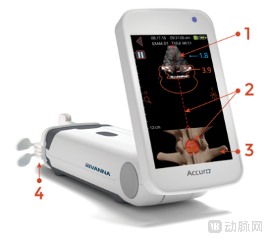
Accuro
Image source: Rivanna official website
Using Multi-Frequency BoneEnhance image reconstruction technology, bone tissue contrast is increased by more than 5–10 times.
Use the midline (red dashed line) and crosshair indicator to identify the ideal puncture site.
Automatically identify the epidural space using AI-powered SpineNav3D image recognition technology, with a success rate exceeding 94%.
Use the Accuro Locator needle guide to accurately mark the needle insertion site on the skin surface or provide real-time needle guidance. It reduces the time between scanning and needle insertion, and allows operators to rescan after the initial puncture, thereby minimizing the risk of infection and motion artifacts.
Clinical evidence demonstrates that Accuro’s automated epidural guidance technology can improve the first-attempt success rate, reduce the number of needle insertions and procedure time, and significantly enhance patient satisfaction with pain management.
At the 2017 annual meeting of the Society for Obstetric Anesthesia and Perinatology, Rivanna presented the results of their trial. Conducted at the University of Virginia Medical Center, the trial compared the success rates of conventional spinal anesthesia with Accuro-guided spinal anesthesia. The trial found thatUnder the guidance of Accuro, the first-attempt success rate of spinal anesthesia performed by residents with experience in spinal anesthesia for patients with a high body mass index increased by more than 100%.
In the second clinical trial conducted at Stanford Medicine, Accuro imaging technology successfully identified the optimal location and depth for epidural anesthesia administration. The trial also statistically determined that,Accuro identified appropriate spinal interspaces for needle insertion in 94% of patients.
In 2021, Rivanna conducted a randomized controlled trial (RCT) at Shanghai First Maternity and Infant Hospital in China, enrolling 80 obese pregnant women scheduled for elective cesarean delivery. The results showed thatCompared with traditional palpation of bony landmarks, the Accuro guidance technology increased the first-attempt success rate from 40% to 72.5% and reduced the incidence of paresthesia from 45% to 7.5%.
Furthermore, patients with severe scoliosis undergoing conventional spinal anesthesia typically experience multiple puncture attempts, prolonged procedure times, and an increased incidence of complications. In a trial conducted at Rutgers New Jersey Medical School, Accuro successfully identified the bony landmarks and the optimal intervertebral space for anesthesia administration in a pregnant patient with severe scoliosis.
Rivanna has also equipped Accuro with auxiliary devices to address current market pain points and enhance the practicality of the Accuro system.
To enhance residents’ procedural experience during their residency, Rivanna has developed the TRUE-VIEW Training Models. These models replicate the authentic anatomy of the spinal canal, allowing users to visualize the spine and the relative position of the Accuro device through transparent, tissue-mimicking materials, thereby facilitating image-guided neuraxial anesthesia training with Accuro.
Additionally, Rivanna has designed the Accuro Trolley, a cart dedicated to storing the Accuro system. Its two spacious baskets, located at the upper and lower levels, allow physicians to keep all Accuro consumables in a single, easily accessible location. A 10,000 mAh portable power bank integrated under the trolley’s cover ensures the Accuro device can be charged at any time.
Will Mauldin, Chairman and CEO of Rivanna Medical, earned his Ph.D. in Biomedical Engineering from the University of Virginia, where he also served as an Assistant Research Professor in the Department of Biomedical Engineering. He currently holds more than 60 publications and patents. After completing his doctorate, Will sought to leverage his expertise in medical ultrasound technology to reduce the failure rates of epidural and spinal anesthesia. To this end, he founded Rivanna Medical and recruited his former graduate student, Kevin Owen, to lead product development.

Will Mauldin
Image source: Rivanna official website
Initially, they lacked sufficient facilities and funding, so early development took place in Kevin’s attic. Will used a tow hitch and hot glue to create a functional ultrasound scanning system, which served as the prototype for Accuro. They then tested it on a deer spine model using materials obtained during a hunting trip, providing proof of concept and preliminary data that secured Rivanna’s first round of external funding.
In 2011, Rivanna secured private seed investment, enabling Will and Kevin to rent office space and hire the company’s first employees.
Subsequently, Rivanna secured several rounds of funding to sustain its growth. On June 1, 2015, Rivanna announced that Accuro had received FDA 510(k) clearance and would commence commercialization. At the time, John A. Williams, President and CEO of Rivanna, stated, “Accuro has numerous clinical applications, and we believe it is a disruptive, industry-transforming device platform technology.”
To date, Rivanna has attracted over $90 million in funding by advancing its product technology.This includes a $65 million contract signed with the Biomedical Advanced Research and Development Authority (BARDA) in 2021, as well as multiple grants from the NIH for the company’s various technologies at different clinical stages.
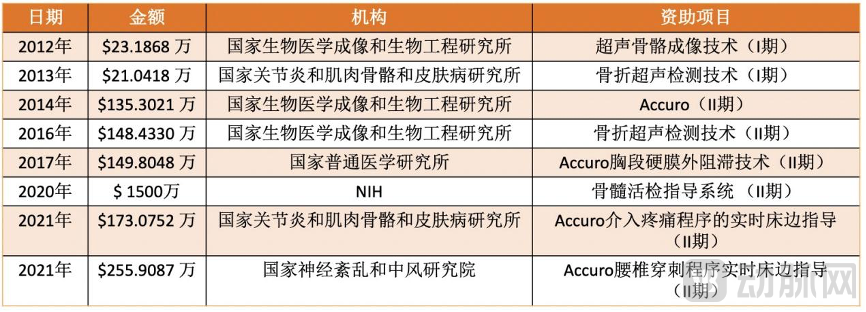
NIH Funding History for Rivanna
Source: Rivanna Official Website
Due to the increase in collaboration and acquisition strategies, as well as the continuous launch of products by market participants,The global market for disposable epidural anesthesia devices was valued at USD 1.0565 billion in 2022, with a projected compound annual growth rate (CAGR) of 10.3% from 2022 to 2028.
In terms of product type, epidural needles dominated the market for single-use epidural anesthesia devices in 2018, driven by the development of advanced equipment by market participants. A representative product is Accuro from Rivanna Medical.
Furthermore, market participants are increasingly adopting inorganic growth strategies, such as acquisitions and partnerships, which will drive the growth of the global single-use epidural anesthesia devices market from 2022 to 2028. For example, in January 2019, Omeq Medical Ltd. partnered with Pharos Medical, a Chinese medical device manufacturer and distributor, to introduce Omeq’s smart epidural devices into the Chinese epidural market.