

3D Bio Therapeutics Files for IPO Following World’s First Successful 3D-Bioprinted Ear Implant

3D bio
Regenerative Medicine and Device Developer
In the 20th century, two landmark medical advances emerged that had a profound impact on public health and life expectancy: vaccines and antibiotics. In the 21st century, a third major advance—regenerative medicine—has arisen. Reportedly, given the potential of stem cell therapy, some researchers and clinicians have dubbed regenerative medicine the “Third Medical Revolution.”
Regenerative medicine refers to the use of theoretical methods from biology and engineering to create tissues and organs that have been lost or functionally impaired, enabling them to possess the structure and function of normal tissues and organs.Regenerative medicine heralds a new era in which medicine will advance toward the reconstruction, regeneration, “manufacturing,” and replacement of tissues and organs., offering new hope for addressing many of the medical challenges facing humanity, such as the treatment of autoimmune diseases, malignant tumors, Alzheimer’s disease, Parkinson’s disease, and various types of tissue and organ injury.
According to statistics from the Alliance for Regenerative Medicine (ARM), financing in the regenerative medicine sector reached $23.1 billion in 2021, with 1,308 companies worldwide actively developing products in this field. Furthermore, according to Statista,In 2021, the global regenerative medicine market was valued at approximately USD 16.9 billion and is projected to reach USD 95.5 billion by 2030, representing a CAGR of 21.22%.
The concept of regenerative medicine is relatively broad, with numerous avenues of exploration. Currently, the three major directions being pursued in regenerative medicine include: replacing damaged tissues through transplantation of cell suspensions or aggregates; implanting bioengineered artificial tissues or organs produced in the laboratory to replace native tissues; and inducing regeneration of injured tissues through pharmacological interventions.
With the advent of 3D printing technology, this technique has been introduced into the field of regenerative medicine, evolving into 3D bioprinting. 3D bioprinting is a novel technological approach that uses computer-aided three-dimensional models as “blueprints” and specialized “bioinks” to fabricate artificial organs and biomedical products.
Currently, 3D bioprinting technology has been widely applied in the fabrication of human organs, such as the heart, liver, and eyeball. Numerous companies both domestically and internationally are dedicated to developing this technology for clinical applications. Data shows thatIn 2021, the market size of China's 3D bioprinting industry reached RMB 4.249 billion.
Globally, although multiple biotechnology companies have entered the field, only one company has successfully performed a clinical transplant of a 3D biotech-engineered ear. This company is 3D Bio Therapeutics (hereinafter referred to as “3D bio”).
Cornell University: Mentor and Mentee Co-Found a Startup
3D Bio is a clinical-stage biotechnology company founded in 2014 and headquartered in New York, USA. It specializes in regenerative medicine and device development, with the aim of supporting the implantation of living tissues and organs. Leveraging its patented 3D bioprinting technology, 3D Bio provides structurally and functionally intact, safe living tissue implants that can be custom-designed for patients on demand. The company has successfully completed the world’s first clinical human trial of 3D-printed ears.
Daniel Cohen is the Co-Founder and CEO of 3D Bio. He holds a Ph.D. in Mechanical Engineering from Cornell University, with minors in Biomedical Engineering and Electrical Engineering. At Cornell, he specialized in 3D bioprinting technology and has authored numerous publications and patents in this field. After graduation, he worked at McKinsey & Company for four years, where he learned how to commercialize technology projects. Prior to founding 3D Bio, he also co-founded American PAPR, a medical device manufacturing company.
Hod Lipson is the co-founder of 3D Bio and holds Ph.D. degrees from the Technion – Israel Institute of Technology, the Massachusetts Institute of Technology, and Brandeis University. He taught at Cornell University for 14 years and currently continues his academic career in Mechanical Engineering and Data Science at Columbia University.HodThe Ph.D. has published more than 300 papers and authored the first comprehensive book on 3D printing, “Fabricated: The New World of 3D Printing” (Chinese title: “3D Printing: From Imagination to Reality”).
Lawrence Bonassar, another co-founder of 3D Bio, holds a Ph.D. in Materials Science and Engineering from the Massachusetts Institute of Technology. After serving on the faculty at the Center for Tissue Engineering at the University of Massachusetts Medical School for five years, he joined Cornell University in 2003 as a professor of biomedical and mechanical engineering. He currently alsoTissue Engineering、3D Printing and Additive Manufacturing、Biofabricationserves on the editorial boards of several academic journals. Additionally,Lawrence also serves on the boards of directors of the International Society for Biofabrication and the Orthopaedic Research Society.
Successful Transplantation of the World's First 3D-Bioprinted Ear
Leveraging 3D bio’s proprietary technology platform, it is possible to print living tissue implants that meet FDA requirements for therapeutic manufacturing. This technology platform includes: a 3D bioprinter (GMPrint), bioink (ColVivo), a dedicated cell culture system, and an implantable protective shell (Overshell Technology). 3D-printed living tissue implants can be used to treat various conditions, including congenital defects, trauma, and post-surgical injuries.
June 2022,3D bio Announces Completion of World’s First 3D Bioprinted Ear Transplant, with No Signs of Rejection Observed Three Months Post-SurgeryThis transplantation procedure utilizes AuriNovo, an ear implant designed by 3D bio for patients with grade II–IV microtia.
Microtia is a congenital malformation characterized by an abnormally small, misshapen, or completely absent external ear. It not only impairs hearing but also has significant psychological impacts on children. According to statistics from the U.S. Centers for Disease Control and Prevention (CDC), the incidence of microtia ranges from 1 in 10,000 to 1 in 2,000.
During this transplantation procedure, 3D bio first performed a biopsy on the patient’s microtia remnant, harvesting 0.5 g of cartilage to isolate chondrocytes, which were then cultured and expanded using its proprietary cell culture system. The bioink ColVivo was mixed with the cultured chondrocytes, and the GMPrint 3D bioprinter was used to print the cells into the shape of the patient’s normal ear, forming the ear implant AuriNovo. Finally, AuriNovo was secured at the patient’s ear site using the Overshell Technology process.
Currently, AuriNovo is conducting a Phase 1/2a study under the FDA’s Investigational New Drug (IND) program, aimed at evaluating the preliminary safety of AuriNovo and collecting efficacy data related to technical aspects, as well as preoperative and postoperative outcomes. The study is expected to take up to five years to complete long-term follow-up.
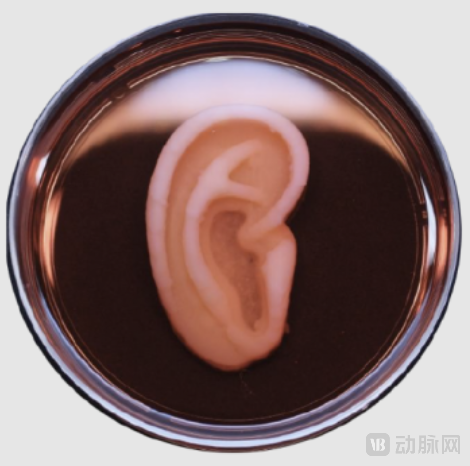
AuriNovo Image source: 3D bio official website
The manufacturing process of AuriNovo incorporates several elements of the company’s technology platform.
·3D Bioprinter (GMPrint)
GMPrint incorporates multiple patented technologies, including AI-based print path planning algorithms, shear paths for optimizing composite materials and geometries, sterile workflow designs, and a proprietary motion system capable of achieving precise ultra-high acceleration. These patented technologies enable ultra-high throughput (>10 million cells per minute) to print biological tissues that comply with cGMP standards.
· Bioink (ColVivo)
ColVivo is a therapeutic-grade bioink designed for therapeutic applications in 3D bioprinting. ColVivo meets cGMP manufacturing standards while preserving the biorheological properties essential for 3D bioprinting, enabling the fabrication of living implants in bioprinters after mixing with viable cells.
·Dedicated Cell Culture System
3D bio has developed a proprietary cell culture system to ensure that extracted cells remain viable throughout the printing process and rapidly expand to reach sufficient quantities.
· Implantable Overshell Technology
Overshell Technology aims to provide a method of structural support for biological implants, facilitating patients’ tissue regeneration processes. This is achieved through 3D-printed thermoforming technology using bioabsorbable polymers. The structure conforms to the surface geometry of bioprinted tissues, serving as an exoskeleton for biological tissue implants.
Currently, 3D bio's research on 3D bioprinting of biological tissues is focused on the field of cartilage reconstruction.Building on this foundation, 3D bio has expanded its R&D pipeline into neurosurgical areas such as degenerative disc disease and herniated discs, as well as organ system fields including liver failure and kidney failure.
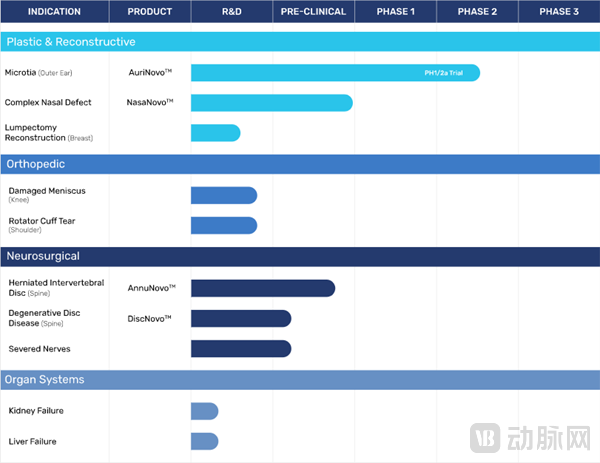 R&D Pipeline Source: 3D bio Official Website
3D Bioprinting in Medical Applications
The advancement of healthcare has been bolstered by technological innovations, with the emergence of 3D bioprinting making customized repair of bodily organs possible. 3D bioprinting has become the foundation for personalized biomedical devices, tissue-engineered skin, cartilage, and bone, as well as functional bladders.
3D bioprinting has four main levels in medical applications: The first level involves non-biocompatible materials, such as those used for medical models or in vitro medical devices. The second level requires biocompatibility, allowing entry into the human body but without degradation, such as permanently implanted ceramic teeth. The third level involves materials that are degradable and can stimulate the body’s self-repair mechanisms, yet cannot overcome the limitations of self-repair, such as certain bone adhesives that accelerate wound healing.
The fourth layer isUsing active cells and extracellular matrix as materials, with cells as the intervention unit, to construct novel tissue and organ grafts, ultimately achieving tissue and organ transplantation.This is also why the 3D bioprinted implants mentioned in this article represent a truly modern technology.
In the field of 3D bioprinting, Organovo, an early commercial pioneer, has partnered with multiple major corporations to focus on developing bio-organoids for drug toxicity assessment and efficacy screening, thereby addressing the challenges associated with in vitro simulation in drug development. Several companies both domestically and internationally are also dedicated to the commercial development of 3D bioprinting, including CollPlant, CYFUSI, and leading Chinese technology firms such as Nuopu Regenerative Medicine, Blue Light Inno, Janus Biotech, and Medprin Regenerative Medical Technologies.
With the continuous advancement of biomaterials and technological capabilities, the 3D bioprinting market has sustained rapid growth. It is foreseeable that 3D bioprinting will continue to evolve across multiple niche sectors, including customized organ-on-a-chip systems, skin fabrication, facial reconstruction, multi-organ drug screening, and the creation of 3D vascular networks. According to relevant reports, the global 3D bioprinting market size is projected to reach RMB 18.339 billion by 2027, with an estimated compound annual growth rate (CAGR) of 27.6% from 2021 to 2027.