

Dr. Jianzhong Huang, FACS: Pioneering 'Dual-Function Catheter + Tumescent Anesthesia Needle' to Lower the Barrier for Minimally Invasive Varicose Vein Treatment
At the end of 2018, Huang Jianzhong left the United States, where there were approximately two thousand physicians specializing in venous disorders.
“I am merely one in two thousand; my departure would have little impact on them. However, by returning to China, I can impart advanced minimally invasive techniques and concepts for varicose veins to young doctors in the country, thereby benefiting more patients.” This was Huang Jianzhong’s original aspiration in returning to China.
In fact, this original aspiration is widely needed in China. A survey conducted by scholars in 2018 across 29 provinces and municipalities in China found thatTwo-thirds of varicose vein cases are still treated with traditional surgical methods. This treatment modality carries high risks and is associated with numerous complications, significantly impacting patients' postoperative recovery.
In contrast, Europe and the United States largely adopt minimally invasive approaches for treating varicose veins—namely, endovenous thermal ablation combined with foam sclerotherapy performed under local tumescent anesthesia in an outpatient setting. Huang Jianzhong stated that in the United States, the treatment of varicose veins has become entirely minimally invasive, with inpatient surgical procedures rarely employed anymore. AndIn China, formal minimally invasive treatments are only offered by some teaching hospitals in coastal and developed regions.。
Differences between China and other countries have also raised many questions: What are the advantages of minimally invasive treatment for varicose veins? What factors limit the adoption of minimally invasive treatments in China? And how large is the future market potential for minimally invasive treatments in China?
To find the answer,Subject to the 2nd Biomedical High-Value Patent Project Selection Activity of “Science and Technology Innovation China”at the invitation of, VCBeat’s Orange Bureau had the honor of interviewingProfessor Huang Jianzhong: An Expert in Minimally Invasive Treatment of Varicose Veins, he was onceDirector of Clinical Research, FDA-Registered Clinical Trials, USA, currently still validU.S. Surgical Medical License, forFellow of the International College of Surgeons (U.S. Division),Category A Foreign Expert, State Administration of Foreign Experts Affairs of China, currently serving asChief Physician, Department of Interventional Radiology and Hemangioma, Guangzhou Women and Children's Medical Center。
Professor Huang Jianzhong has contributed to the popularization and development of minimally invasive treatment for varicose veins,Pioneered the “Novel Dual-Use Catheter” and the “Tumescent Anesthesia Needle,”Further improving surgical success rates, this approach spares patients the pain of multiple punctures while enhancing the efficiency of minimally invasive surgery. The application of this patent lowers the technical threshold, paving the way for standardized and normalized minimally invasive treatment of varicose veins.。
Not only minimally invasive, but also standardized.
Varicose veins are a common chronic disease. Data show that the number of people with varicose veins in China reached 399.4 million in 2019, accounting for 28.5% of the total population, and is expected to reach 476.6 million by 2030.
While in the United States, Dr. Huang Jianzhong interacted with many Chinese patients who had traveled abroad for varicose vein treatment. They jokingly remarked, “Dr. Huang should bring minimally invasive varicose vein treatments back to China, so that people there realize open surgery is no longer necessary.”
A casual remark stuck with Huang Jianzhong, and during subsequent meetings and exchanges with domestic peers, he gained a clearer understanding of the differences in treatment philosophies between China and other countries.
Huang Jianzhong stated, “No bed is as good as one’s own. If patients can return to their own beds at home on the same day their surgery concludes, they can not only avoid nosocomial cross-infections but also sleep more soundly and recover more quickly.”
In fact, minimally invasive treatment for varicose veins carries low risk, enables rapid recovery, and requires neither hospitalization nor general anesthesia. It is incision-free and leaves no scars, while significantly reducing the risks of nosocomial infections, edema, nerve injury, and deep vein thrombosis. Furthermore, when patients learn that this is a day-case procedure—allowing them to get out of bed immediately after surgery, bathe, and resume normal activities by the next day—their psychological anxiety about the operation is alleviated. This leads to improved compliance and tolerance, ensuring timely treatment and preventing complications.
However, as mentioned at the beginning of the article, the penetration rate of minimally invasive treatment for varicose veins in China remains relatively low. Huang Jianzhong believesThe lack of standardized and simplified procedures for minimally invasive treatments is the most significant pain point, which is also one of the reasons why such treatments have not been widely adopted in China.。
He drew an analogy with cameras: “Three or four decades ago, only professional photographers used cameras; but since ‘point-and-shoot’ cameras streamlined the photographic process, ordinary people have also been able to realize their desire for casual, on-the-spot photography.”
As an industry expert who has performed over 11,000 minimally invasive surgeries for varicose veins, Huang Jianzhong has long sought to standardize the minimally invasive treatment process. “Ideally, we should develop an operational model as user-friendly as a point-and-shoot camera, enabling physicians to easily perform minimally invasive procedures, thereby improving therapeutic outcomes and reducing complications.”
“Dual-Lumen Catheter + Balloon Anesthesia Needle”: Lowering the Threshold for Minimally Invasive Procedures
The core of minimally invasive treatment for varicose veins is thermal ablation of the main trunk combined with chemical ablation of the branches.Thermal ablation exhibits potent efficacy, capable of destroying and occluding main trunk vessels; as a fluid agent, sclerosant can more readily reach various branch vessels. The combination of these two modalities achieves superior ablation outcomes.
However, both domestically and internationally, it is common practice to perform multiple separate punctures to inject sclerosing agents into abnormal branch veins after conventional endovenous thermal ablation. Huang Jianzhong pointed out, “After ablation of the main trunk, venous branches undergo spasm, increasing the difficulty of puncture. There is a risk that the sclerosing agent may inadvertently extravasate outside the vascular lumen or even enter arteries, leading to complications such as surrounding tissue damage, including skin necrosis and arterial embolism.”
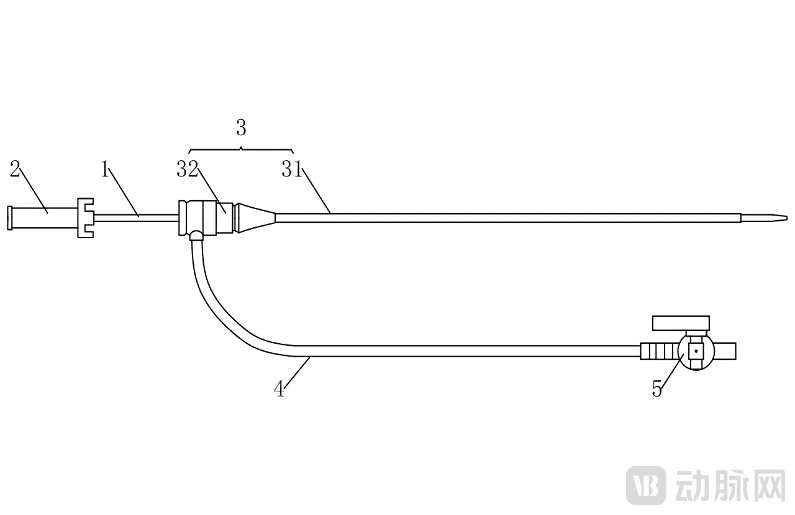
Schematic Diagram of a Novel Dual-Use Catheter for Minimally Invasive Surgery of Varicose Veins
1. Dilator, 2. Handle, 3. Introducer Sheath, 31. Sheath, 32. Connector, 4. Side Arm, 5. Three-Way Stopcock
To address this challenge, Huang JianzhongPioneered the Dual-Use Catheter for Minimally Invasive Varicose Vein Surgery, including a dilation catheter with both ends open; the dilation catheter is sheathed by a hollow vascular sheath, and a side branch tube is connected to one side of the vascular sheath.
A guidewire inserted through a puncture needle is used to advance the vascular dilator together with the vascular sheath into the main trunk of the vein; the vascular dilator is then withdrawn, leaving the vascular sheath in place within the venous lumen; subsequently, a laser fiber, radiofrequency catheter, or microwave catheter is introduced through the vascular sheath to perform endovenous thermal ablation therapy, thereby occluding the refluxing varicose vein trunk.
Furthermore, the sclerosing agent is injected into the vascular sheath originally positioned within the main venous trunk. Under ultrasound guidance, compression is then applied to facilitate the dispersion of the agent from the main trunk into multiple diseased tributaries requiring closure, thereby achieving simultaneous ablation of multiple refluxing branches.
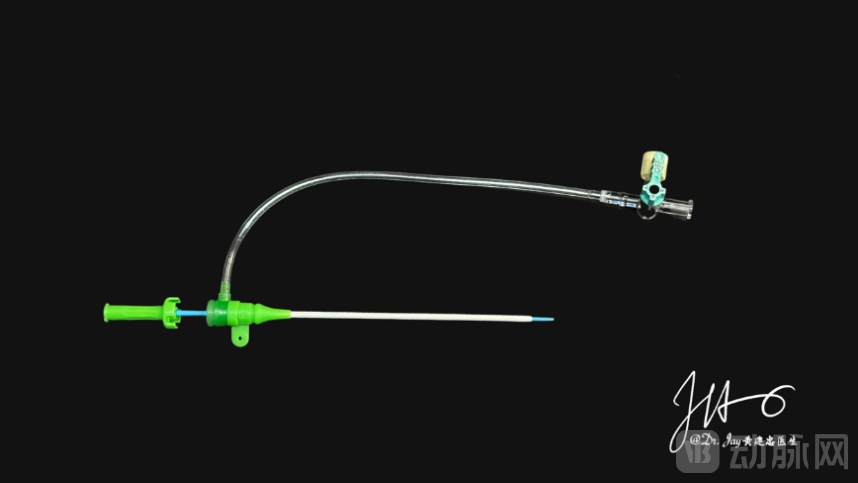
Physical Image of the Novel Dual-Use Catheter
“This approach effectively hitches a ride on the main vessel ablation procedure. By slightly modifying the catheter already placed in the target vessel and adding a side port for drug injection, the process becomes safer and more aligned with minimally invasive requirements,” said Huang Jianzhong. “It eliminates the need for additional multi-point punctures, thereby reducing trauma and lowering the risk of complications such as accidental extravasation of sclerosing agents or their inadvertent entry into arteries. This makes minimally invasive treatment safer, more precise, and more efficient.”
As of September 2022, preliminary results from 403 surgical procedures using dual-lumen catheters indicated that:396 cases of treated venous vessel closure; 2 cases of pigmentation, with no complications such as skin necrosis, blisters, hematoma, or deep vein thrombosis.。
Furthermore, tumescent anesthesia is particularly crucial in minimally invasive endovenous thermal ablation for varicose veins. This technique avoids the risks associated with general anesthesia, reduces surgical contraindications, enhances venous closure efficacy, and minimizes complications such as nerve injury and postoperative pain.
However, there is currently no injection needle specifically designed for tumescent anesthesia either domestically or internationally; lumbar puncture needles have been used as substitutes. However, lumbar puncture needles are straight, which not only makes the injection of tumescent anesthetic fluid inconvenient and imprecise but also increases the risk of puncturing blood vessels and inadvertently damaging laser optical fibers previously placed within the vessels. This can even lead to severe medical incidents, such as fiber breakage and retention within the patient’s body.
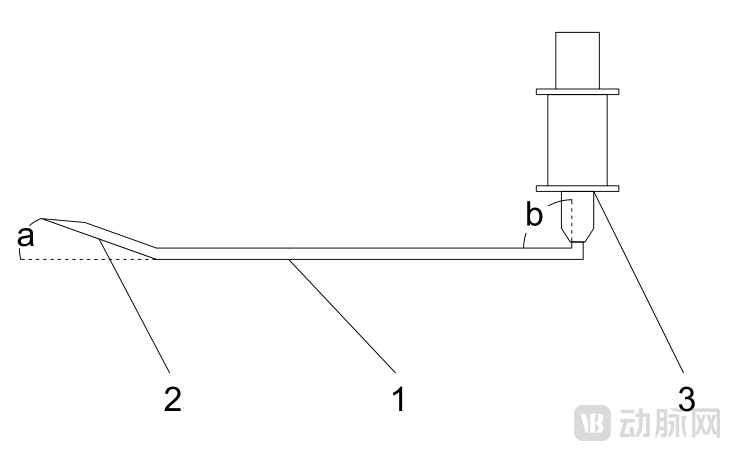
Schematic Diagram of Tumescent Anesthesia Needle
1. Needle shaft, 2. Needle tip section, 3. Needle hub, a. First bevel angle (10-20°), b. Second bevel angle (85-95°)
In response, Huang Jianzhong further developedSpecialized Tumescent Anesthesia Needle. By incorporating a first inclination angle between the needle shaft and the needle tip, and a second inclination angle between the needle shaft and the needle hub, this tumescent anesthesia needle effectively enhances the precision of tumescent anesthetic injections.
The second tilt angle b can be bent to 90°, allowing the operator to easily align with the target. The first tilt angle a can be adjusted to 15°, ensuring that the needle’s advancement direction is parallel to the blood vessel, thereby preventing secondary accidental injury to the vessel and any laser optical fiber previously placed within it.
Therefore, under ultrasound guidance, the operator can conveniently and accurately place the tumescent anesthesia needle beneath the vascular adventitia, allowing the injected anesthetic solution to surround the target vessel, thereby fully achieving the effects of local anesthesia, vascular compression, and thermal insulation.
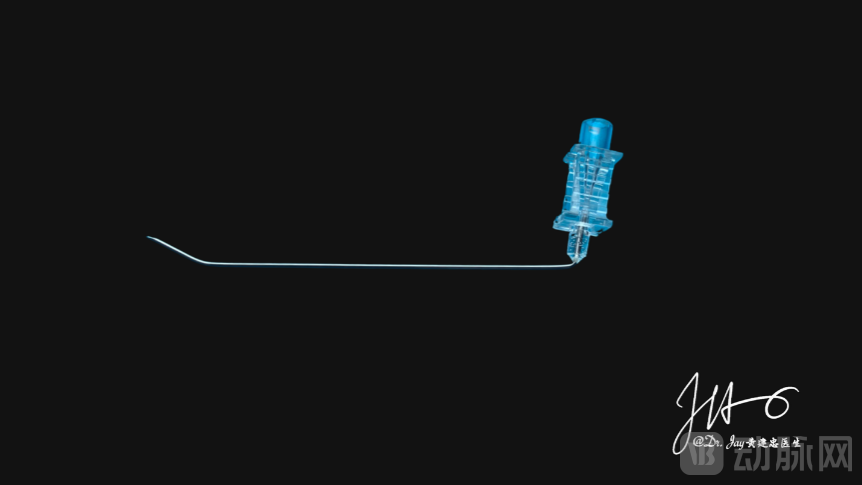
Photograph of a Tumescent Anesthesia Needle
Preliminary results from the use of tumescent anesthesia needles in 516 surgical cases as of September 2022 indicate:Vascular occlusion was achieved in 511 treated cases; there were 3 cases of pigmentation and 2 cases of skin numbness at the medial malleolus (all resolved within two months), with no complications such as skin burns or deep vein thrombosis.
Currently, dual-type catheters and tumescent anesthesia needles for minimally invasive varicose vein surgery have already been included inIt has been trialed by numerous hospitals across China, including major Grade 3A institutions such as Guangzhou Women and Children’s Medical Center, Shenzhen Second People’s Hospital, the Third Affiliated Hospital of Guangzhou Medical University, and Guangdong Provincial People’s Hospital, as well as many primary care facilities, receiving positive feedback.It is reported that the project “Application of Tumescent Anesthesia in Thermal Ablation for Lower Extremity Varicose Veins,” led by Professor Huang Jianzhong, has received funding from the Ministry of Science and Technology of China.
How to promote this technology nationwide, so that more doctors and patients can benefit from it, is Huang Jianzhong's most pressing concern at the current stage.
However, Huang Jianzhong, who has been engaged in clinical work for many years, is not adept at project commercialization.Seeking partners in industry and investment for preferred collaborative relationships to jointly promote and market.。