

Oxford Nanopore: The British Pioneer Reshaping the Sequencing Landscape Through Nanopore Innovation
Oxford Nanopore Technologies
DNA Sequencing Product Developer
To some extent, the concept of nanopore sequencing emerged even before SBS sequencing technology.
In 1989, Professor David Deamer of the University of California, Davis, had a sudden inspiration while driving: incorporating protein channels into the membranes of liposomes, thereby creating channels capable of accommodating single nucleotides. He hypothesized that each type of nucleotide might produce a characteristic ionic current blockade as it passed through the channel.
This concept was later formally proposed by Professor Hagan Bayley. However, prior to 1991, Professor David Deamer’s ideas had neither been substantiated nor discussed with others. This changed in 1991 with a visit from Dan Branton of Harvard University.
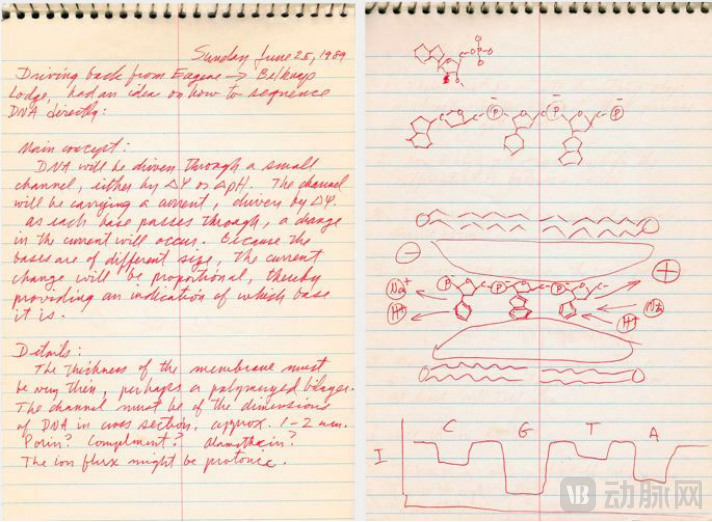 Professor David Deamer’s notes from 1989. Image source: Oxford Nanopore official website
In 1991, after concluding his tenure at the University of California, Davis, Professor Dan Branton continued to pursue research on the concept of nanopore sensing. The following year, he and David Deamer reached an agreement to conduct the research with Harvard University as the lead institution. At that time, the research team also included Professor Church and Professor Baldarelli.
In 1993, the research team conducted their first experiment at NIST under Kasianowicz. Subsequently, they received NSF SGER funding and continued their research at the University of California, Santa Cruz, the NIH, and Harvard University.
By 1996, Dan Branton, David Deamer, and colleagues had published the concept of nanopore sequencing for the first time in PNAS. The paper indicated that the length of nucleotide strands could be measured using nanopores embedded in lipid bilayer membranes. Furthermore, with further improvements, this method could, in principle, enable high-speed, direct sequencing of DNA or RNA sequences. The following year, Professor Mark Akeson joined the research team, and a year later, the technology was patented.
Meanwhile, in the second year of the 21st century, Hagan Bayley, Professor of Chemical Biology at the University of Oxford, described nanopore sensors in the journal Nature Nanotechnology. When single-stranded DNA (ssDNA) molecules pass through a nanopore, they induce changes in electrical current, enabling the discrimination of 1–30 nucleotides using this experimental approach.
In 2005, with funding from IP Group, Professor Hagan Bayley and his partner Spike Willcocks co-founded Oxford Nanopore. A few months later, Gordon Sanghera joined as CEO.
In its early stages, the company engaged in extensive industry-academia-research collaborations with Professors Hagan Bayley, Dan Branton, Dave Deamer, and Mark Akeson, focusing on nanopore structures based on representative proteins. These studies laid the groundwork for the subsequent technological research and development at Oxford Nanopore Technologies.
CEO Gordon Sanghera previously worked at a company developing blood glucose sensing products. His arrival brought the company technical expertise in integrating biology with electronics, laying the foundation for its future commercial development.
In 2008, John Milton and Clive G. Brown also joined the executive team. Both had previously worked at Solexa, a sequencing instrument company specializing in sequencing-by-synthesis, which was acquired by Illumina in 2006.
During this phase, Oxford Nanopore primarily focused on research and development in chemistry and electronics. Breakthroughs in these two areas made high-throughput nanopore sensor research a reality and ultimately enabled the commercial production of nanopore sequencers. Oxford Nanopore also evolved from single-channel chips to 4- and 9-channel sensor chips.
Around 2010, Oxford Nanopore began integrating a series of long-read sequencing studies it had funded. Key among these were research on mutant nanopores with the ability to discriminate nucleotides (from the Bayley laboratory) and research on enzymes capable of controlling DNA translocation through nanopores (from the Akeson laboratory). In the summer of that year, Oxford Nanopore first combined these two lines of research, achieving nanopore-based DNA sequencing for the first time in 2011.
The company also underwent significant changes in scale during this period. In 2009, it relocated to the Oxford Science Park, with Lord Drayson, the UK Minister for Science and Innovation, presiding over the inauguration ceremony. By 2011, the company had added another 7,000 square feet of office space at the Oxford Science Park and opened a new office at the University of Cambridge.
At the AGBT conference in February 2012, Oxford Nanopore Technologies presented nanopore sequencing data for the first time and outlined the hardware and software underlying the GridION and MinION systems. In the following months, the company began preparing for the debut of its first sequencing system—the handheld MinION device.

MinION, image from the Oxford Nanopore official website
In spring 2014, the company launched the MinION Access Programme (MAP), under which early-access users could receive a refundable deposit of $1,000. In the following months, research findings based on the MinION began to appear in academic journals, and Oxford Nanopore optimized and improved the product’s performance and workflows based on feedback from early-access users.
In May 2015, Oxford Nanopore convened the first Nanopore Sensing Conference, bringing together users of its MinION technology. The event featured 20 speakers, and Oxford Nanopore gathered feedback from participants in the MAP program regarding a range of technological applications. By the second Nanopore Community Meeting in 2016, three research groups had already presented human genome sequencing data generated using the handheld MinION device.
They established the so-called Nanopore Community through this conference and began the commercialization of MinION.
In 2018, the company also launched MinIT, a companion device for the MinION. Equipped with GPU technology, MinIT optimizes rapid base calling and data analysis, serving as either a replacement for or a supplement to laptops. Given that nanopore sequencing uniquely enables real-time data transmission, MinIT supports the ever-increasing speed and capabilities of the MinION through enhanced computational power.
The second-generation portable MinION device was launched in March 2020. The MinION Mk1C integrates sequencing and analysis with a screen, offering an all-in-one portable and handheld sequencing device.
Products launched during this period also include PromethION and SmidgION.
In October 2014, Oxford Nanopore Technologies unveiled the concept of its benchtop sequencer, PromethION, at the ASHG annual meeting. Users can select the number of samples and nanopores for specific experiments, accommodating sequencing needs for both single and multiple samples. By 2020, the PromethION had achieved a throughput of over 7 Tb of sequence data per run using 48 flow cells.

PromethION 24/48, image from Oxford Nanopore
SmidgION made its debut in 2016, marking the world’s first introduction of the concept of a smartphone-based sequencer.
At the November 2018 Nanopore Community Meeting, Clive Brown mentioned in his speech that the company was developing a new product, R10. This is a new nanopore with a longer channel, enabling higher-precision sequencing.
After 2016, Oxford Nanopore Technologies began to intensify its market efforts. The GridION X5 single-molecule sequencing system was launched in February 2017 and began shipping in May of the same year.
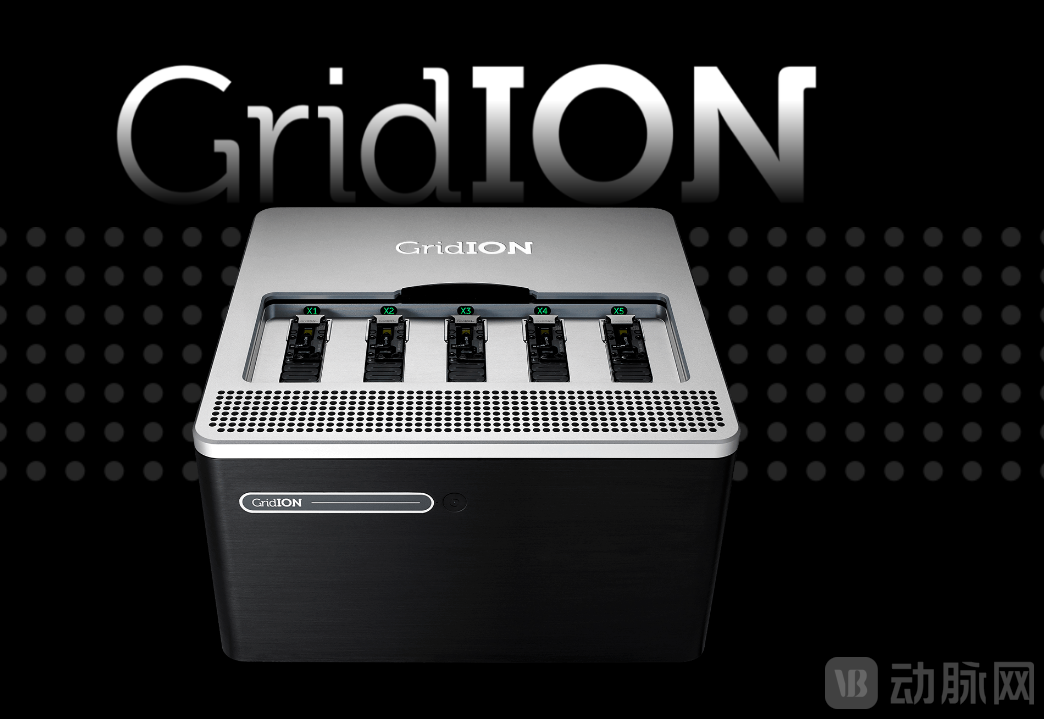
GridION, image from the official Oxford Nanopore website
That year, the company also launched the GTEx RNA sequencing solution, enabling direct, real-time RNA sequencing. In 2018, a paper on nanopore direct RNA sequencing was published in Nature Methods, introducing methods for direct sequencing of long-chain RNA without the need for reverse transcription or amplification.
Although conceptually recognized and attended to by the academic community, the error rate of nanopore sequencing has been criticized. Over a long history, Oxford Nanopore Technologies has consistently improved its technology. It was not until the Fourth Nanopore Community Meeting in 2018 that CTO Clive Brown introduced several upgrades to nanopore technology to nearly 600 attendees, aiming for higher precision, easier-to-use formats, and greater sequence data output.
Algorithmic advancements have kept pace with upgrades in sequencing technology. The performance of PromethION in customer hands has begun to climb, with each flow cell generating over 100 Gb of data per run (PromethION is designed to operate up to 48 flow cells on demand). A team at the University of Nottingham also achieved continuous DNA sequence reads of 2.3 Mb using the MinION device.
In terms of accessories, with the continuous increase in production of MinION/GridION and PromethION, Oxford Nanopore has released the “Rev D” flow cell, enabling the generation of up to 30 Gb of sequence data on a single MinION flow cell. The price of the MinION flow cell is only $500, making sequence data increasingly accessible.
Starting this year, PromethION transitioned from the early access phase to commercialization. Also in 2018, Oxford Nanopore entered the Chinese market for the first time and began its global business expansion.
In July 2019, Oxford Nanopore Technologies’ new production facility in Harwell, Oxfordshire, became operational. In recent years, driven by the growing demand for nanopore products, sales have increased two- to threefold. The facility is designed to support rapid production expansion, incorporating numerous automated processes to ensure smooth and consistent manufacturing.
Unlike the mainstream large-scale sequencers on the market, Oxford Nanopore’s products are more portable, aiming to achieve “anytime, anywhere” sequencing. In 2019, they launched a “field kit,” which eliminated the need for lyophilization and cold-chain logistics in sample processing and transportation, enabling scientists to perform sequencing in remote areas as well as in laboratories. The introduction of this product marked another step forward in Oxford Nanopore’s goal of “anytime, anywhere” sequencing.
However, Oxford Nanopore’s use cases have previously been limited to scientific research, and the company has not yet entered the clinical sector.
It was not until March 2022 that Oxford Nanopore Technologies’ platform was first deployed in regulated clinical settings, specifically for Huntington’s disease testing in the United Kingdom and infectious disease testing in Switzerland.
Amid the global COVID-19 pandemic, Oxford Nanopore Technologies seized the opportunity. In early 2020, its technology was deployed to monitor the coronavirus outbreak. As the technology gained widespread adoption worldwide, it has since been utilized by researchers in more than 70 countries.
LamPORE COVID-19 Test is Oxford Nanopore’s first diagnostic method, which received CE marking for in vitro diagnostic use in October 2020. In a study conducted by teams across the UK involving more than 23,000 samples, LamPORE was demonstrated to have high accuracy in detecting SARS-CoV-2. The study showed that both swab and saliva samples achieved sensitivity and specificity greater than 99.5%.
Although its application in clinical settings remains limited at present, Oxford Nanopore has achieved an initial entry from the research market into the clinical market.
Since its inception, Oxford Nanopore has achieved product commercialization at an exceptional pace without relying on mergers and acquisitions. From the perspective of technology transfer and translation, this is a remarkable achievement. Meanwhile, its commercial footprint will continue to expand.
However, the development of Oxford Nanopore has been fraught with crises along the way, beginning with its deteriorating relationship with Illumina.
In February 2016, Illumina simultaneously filed lawsuits with the U.S. International Trade Commission and the U.S. District Court for the Central District of California, accusing Oxford Nanopore of infringing its U.S. Patent Nos. 8,673,550 and 9,170,230. These patents pertain to the application and commercialization of MSP nanopores and related technologies by relevant companies and institutions. As the owner of these two patents, Illumina has exclusively licensed the technology to the University of Alabama at Birmingham Research Foundation and the University of Washington. Illumina stated that the litigation would primarily target Oxford Nanopore’s MinION and PromethION systems.
This was not the first time the two companies had faced off in court. As early as 2009, during their collaboration, they engaged in litigation over the commercialization of Oxford Nanopore’s exonuclease-based nanopore sequencing strategy. As the losing party, Oxford Nanopore abandoned the use of this exonuclease-based nanopore sequencing approach in its MinION and PromethION systems, which also led to the termination of the commercial agreement between the two companies.
Ultimately, the two parties reached an out-of-court settlement in 2016, with Oxford Nanopore Technologies agreeing to cease exporting or selling products containing amino acid sequence nanopores and to destroy its existing inventory.
Next is the increasingly fierce competition in the sequencing market. Illumina dominates the majority of the market, while Element and Ultima, backed by the Broad Institute, are emerging as strong contenders. In the Chinese market, MGI Tech has risen to prominence and embarked on its global expansion. In the field of long-read sequencing, PacBio, after its proposed merger with Illumina was terminated, acquired a company called Omniome and began integrating long- and short-read sequencing technologies.
This may be the most prosperous era for the sequencer market, with China, the UK, and the US forming a tripartite balance of power amidst vigorous competition. However, several short-read sequencing companies have yet to reap benefits in the long-read sequencing sector, which may currently constitute Oxford Nanopore’s advantage.
In the field of nanopore sequencing, Oxford Nanopore was the first mover. Oxford Nanopore is positioned more as a biotechnology company; unlike Illumina, it has not expanded through mergers and acquisitions. It has independently managed the entire process from R&D outcomes to product development, manufacturing, and commercialization.
If SBS-represented second-generation sequencing technology remains the de facto ruler, then Oxford Nanopore is the leader of next-generation technologies. For startups engaged in translating scientific research achievements into innovative applications, Oxford Nanopore’s experience and development path may offer more valuable lessons.