China's Brain-Computer Interface Receives National医保 Pricing at One-Sixth of U.S. Costs, Marking Commercial Inflection Point
Neuracle
Developer and Manufacturer of Brain-Computer Interface Systems and Related Equipment

Just now, the medical insurance pricing for brain-computer interface was announced.
Musk SaysMass production is scheduled for 2026.FollowingMarchNational Medical Products AdministrationPublishApproval Document,NowBrain-Computer InterfaceThe pricing has also been released.。
On April 22, the National Healthcare Security Administration released a report titled "New Technology Price Project Pricing Implementation Helps Scale Innovative Technologies and Products" article, the content writes:

Currently,Most provinces in China have established government-guided prices for brain-computer interface-related services. The cost for invasive brain-computer interface implantation ranges between 6,000 to 6,600 yuan per session, while the fitting fee for non-invasive brain-computer interfaces is around 960 yuan., effectively stabilizing the market return expectations of innovative enterprises.
It is reported that,Invasive Brain-Computer InterfaceImplantation Fee, Uniform Range Across ChinaRMB 6000-6600/timeProvinces such as Sichuan, Hubei, Zhejiang, Jiangsu, and Guangdong have implemented standards concentrated around 6,500 yuan. The cost for invasive extraction is priced synchronously at approximately 3,000-3,200 yuan per session, aligning with the full-process charge closure of the surgery.
Non-invasiveAdaptation Fee Inclusive Pricing,About960 RMB/time, Zhejiang and other places have incorporated it intoClass B medical insurance, patients only pay 10% out-of-pocket, less than a hundred yuan.
In the medical device industry, there is an iron rule: without official pricing, even the best products can only circulate in trials. Hospitals dare not accept them, patients dare not use them, and medical insurance cannot cover them. With government-guided pricing, the entire chain can truly function.——Hospitals have charging basis, enterprises have income expectations, and patients have price transparency.

Regulators Intentionally Suppress Prices, PositioningInclusive Healthcare
What can 6,600 yuan do? The cost of consumables for a spinal surgery can easily reach tens of thousands, and the cost of a joint replacement ranges between twenty to fifty thousand yuan. However, the implantation fee for an invasive brain-computer interface is less than 7,000 yuan, which is almost considered a low-cost item in the surgical system.。InstructionsRegulators are intentionally controlling prices.。
MoreoverMuskTheNeuralink GoalsSetPrice$5,000 (approximately 36,000 RMB)The device itself, plus the cost of specialized robotic surgery, actually amounts to tens of thousands of dollars.
Non-invasive device:EEG Headband Worn on the Head,Single Training Fee960 yuan, once or twice a week. This price is similar to personal training sessions, affordable for the average person.
For treatment programs that require repeated sessions, such as stroke rehabilitation and neuromodulation training,The price threshold of 960 yuan is already low enough to basically not affect patient decision-making.After Class B medical insurance reimbursement in Jiangsu, the self-payment is less than100 yuan.
The current medical insurance pricing for brain-computer interfaces clearly states that it must be done.Inclusive Healthcare: Rebuilding Hand Function for Spinal Cord Injury Patients Within the Medical Insurance System,Make it affordable for everyone。

Chinese Players in Brain-Computer Interface
Neuracle,NEO Global Launch,This is the world's first legally commercialized invasive brain-computer interface medical device.
Another line of Tsinghua is"Beijing Brain No. 1", jointly developed by the Beijing Institute of Brain Science and Brain-like IntelligenceCoreMindThe development follows the 128-channel epidural scheme. With 10 implants, there have been zero severe side effects, and paraplegic patients who have been paralyzed for five years are now able to stand and walk with the aid of crutches. The more advanced "BrainTwo" is under development, featuring 512 channels directly inserted into brain tissue, and the information transmission rate in animal experiments has already matched that of Neuralink.
NeuroTiger TechnologyThe approach is fully implantable.——Fully implanted, fully wireless, full-function. They have just completed the second clinical trial on a 29-year-old art teacher with high-level paralysis. One month after the surgery, she was able to control hand grasping through thought, independently eat, and draw. With a 50-millisecond full-link delay and BCI-FES technology bypassing the damaged spinal cord to directly stimulate muscles, the results were quite impressive.
Non-invasive, Xiangyu MedicalFromBegan layout in 2016, independently developing brain-computer interface chips and acquisition equipment;Vishee MedicalHolding dozens of patents related to EEG;Lepu MedicalThrough its subsidiary Neuracle, a "mind-control rehabilitation training" closed-loop is created; Yan Mountain Technology collaborates with Huashan Hospital on a large-scale brainwave model, achieving real-time decoding of Chinese language with single-sentence inference in less than 0.5 seconds.
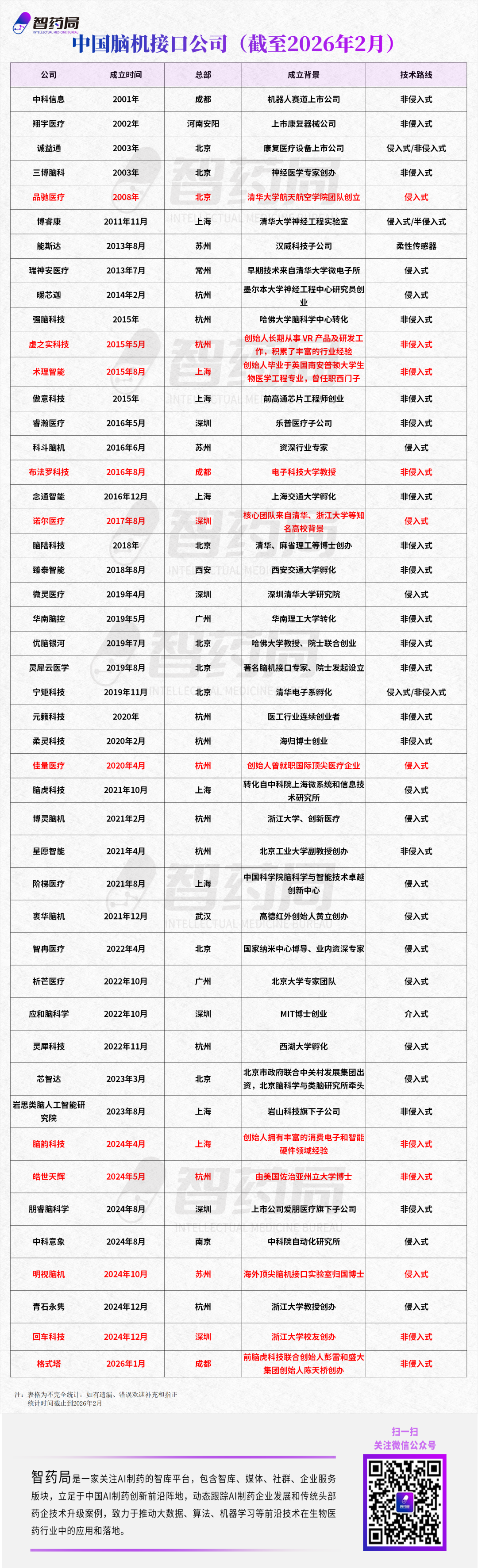
How Far Has the Frontier Reached: Faster Than Imagined, Further Than Expected.StandingLooking back at the timeline of April 2026, the progress of brain-computer interface technology has been faster than most people expected.
The number of channels in invasive solutions is rapidly increasing. Neuracle and North Brain One are taking the semi-invasive route.128 channels have already achieved stable and reliable motor function reconstruction. The fully invasive solution from Neuracle has realized a 50-millisecond-level thought-action closed loop in human subjects.
Changes at the chip end are equally noteworthy.。China-produced 40/65nm brain-computer interface dedicated chips have achieved commercial use, with invasive solutions making breakthroughs toward 512-1024 channels. Breakthroughs in power consumption, integration, and AI integration have enabled devices to be made smaller, with longer battery life and more accurate decoding.
The story at the clinical end is more moving. NeuracleNEO has completed 36 implantations, accumulating nearly 8,000 days of safe operation with zero serious adverse events. Some subjects have even observed a neuroplasticity effect – their original hand function is also recovering.
Brain-computer interface is moving towards clinical accessibility.
-Recommended Reading-