

Dr. Miao Chuanwang of Shandong Cancer Hospital Develops Murine Esophageal Cancer Cell Line NCCE2 to Advance Targeted Therapy Research
In recent years, the incidence of esophageal cancer has shown a severe upward trend; however, its precise pathogenesis remains incompletely elucidated, and effective clinical therapeutic strategies are currently lacking.
It is reported that, globally, the incidence and mortality rates of esophageal cancer both rank among the top ten. InGLOBOCAN 2020The released data show that there were over 600,000 new cases of esophageal cancer worldwide, with more than 370,000 deaths, resulting in a mortality rate exceeding 50%.
In the face of clinical treatment dilemmas for esophageal cancer,Dr. Miao Chuanwang, Shandong Cancer HospitalIt was stated that research on the treatment of esophageal cancer is currently immature, mainly due to the lack of suitable cell models, especially mouse-derived tumor cell lines.
Therefore, Miao Chuanwang constructedA Mouse-Derived Esophageal Cancer Cell Line, NCCE2, It is reported that the model established this time has huge potential applications for esophageal cancer research, that is, the NCCE2 cell line model can be used to explore the pathogenesis of esophageal cancer and find new strategies for treatment.
At the invitation of the “Innovation China” Second Biomedical High-Value Patent Project Selection Activity,VCBeat Orange BureauWe were honored to interview Dr. Miao Chuanwang. Chengguo Bureau has compiled and edited the interview transcript to help readers gain insights into NCCE2 and its research process.
Construction of NCCE2 in a VAV2 Gene-Deficient Mouse Model
In previous experiments, under the guidance of his mentor, Academician Lin Dongxin, Miao Chuanwang integrated copy number amplification and high-expression data from 94 esophageal cancer cases, demonstrating that the guanine nucleotide exchange factorVAV2 is an amplified and overexpressed oncogene。
Miao Chuanwang has elucidated the oncogenic characteristics of VAV2 from both functional and mechanistic perspectives. Functionally, high expression of VAV2 is associated with radioresistance, and extensive experimental evidence demonstrates that VAV2 is a potential driver gene influencing resistance to radiotherapy. Mechanistically, VAV2 may affect the efficacy of radiotherapy through DNA damage repair-mediated pathways.
Furthermore, through pathological tissue and clinical data analysis of 31 esophageal cancer patients, Miao Chuanwang discovered that VAV2 can serve as a biomarker for radiotherapy resistance to predict short-term treatment outcomes in these patients. It is understood that patients with high VAV2 expression in tumor tissues exhibit poorer responses to radiotherapy.
Based on the above research, Miao Chuanwang in subsequent cell linesIn the construction of NCCE2, the first consideration is this type ofVAV2 gene knockout transgenic mouse model.
In fact, in the field of targeted gene editing research, Cas9, a technology crowned with the Nobel Prize, has become highly mature and is widely applied.
Therefore, in the experiment constructing gRNA for the VAV2 gene in C57 mice, Miao Chuanwang also employed Cas9 technology. He guided the Cas9 protein to cleave the DNA double strand at specific sites targeted by the crRNA guide sequence. The resulting double-strand breaks were then repaired via the non-homologous end joining (NHEJ) mechanism, leading to deletions or insertions of varying lengths at the break sites, thereby achieving knockout of the VAV2 gene through frameshift mutations.
Miao Chuan revealed to Orange Fruit Bureau that the experiment was not yet over after the successful knockout of the VAV2 gene. He still needed to breed the mice extensively to establish a line of VAV2-deficient transgenic mice, and thenEstablishment of an Esophageal Cancer Model: Endogenous Development of Cancer Cells in the Murine Esophagus
To achieve this objective, Miao Chuanwang began administering the carcinogen 4-nitroquinoline 1-oxide (4NQO) to mice to induce esophageal cancer. Specifically, 6–8-week-old VAV2-deficient transgenic mice were given 4NQO solution for 16 consecutive weeks. After discontinuation of treatment, the mice were maintained for an additional 12 weeks before being euthanized and dissected to examine tumor formation in the esophagus.
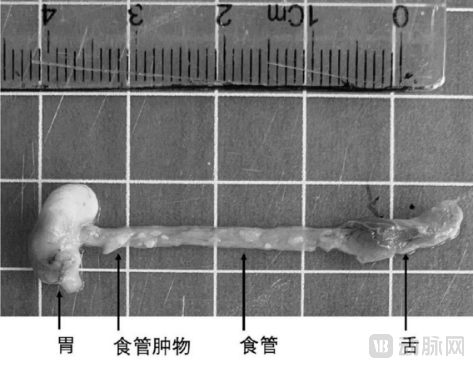
Figure: Gross image of 4NQO-induced esophageal cancer in mice
“Isolating the esophagus from mice and establishing tumor cultures is an extremely challenging task, as the murine esophagus is very small—even thinner than a toothpick—and the resulting tumors are also minute,” explained Miao Chuanwang.
After excising the newly formed esophageal tumors from mice, Miao Chuanwang placed them upside-down in a cell culture incubator using a specially formulated culture medium. He then selected monoclonal populations and continued stable cell culture for several months to stabilize the cellular phenotype. Comparative experiments with NCCG1 (wild-type mouse tumor cells) were conducted to assess VAV2 expression levels in the cells.
Thus, the mouse-derived esophageal cancer cell line was successfully established, and Miao Chuanwang named it NCCE2.
Stable NCCE2 Expression, Superior to Commercially Available Cell Lines
Currently, in the field of basic research, the application of esophageal cancer cell lines is stillKYSE Series and TE Seriesas the main focus.
As imported products, these two types of cell lines were introduced to China from Japan by Chinese scientists in the last century and have been widely promoted domestically. To date, Chinese scientists have regarded them as the primary choice for esophageal cancer research. In fact, these two types of cell lines have two major drawbacks in practical use: one is the loss of certain characteristics of the original tumors, and the other is the risk of contamination in many laboratories.
Compared with the former two, NCCE2 exhibits superior cellular characteristics.
First, in terms of proliferative capacity, Miao Chuanwang conducted assays using the CCK-8 kit—a highly sensitive reagent that indirectly reflects the number of viable cells—and found that the NCCE2 cell culture plates exhibited a visually apparent yellow color. By measuring the optical density (OD) at 450 nm with a microplate reader and comparing the results with the proliferative capacity of existing esophageal cancer cell lines, proliferation curves for different cell types were plotted.
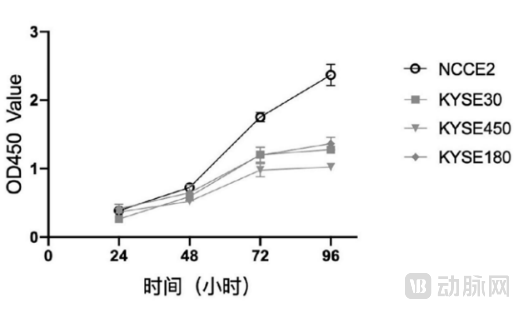
Figure: Comparison of the proliferative capacity between NCCE2 and commercially available cell lines
By comparing the figures, we observe that compared with the KYSE cell line,After 48 hours, the growth capacity of the NCCE2 cell line diverged from that of the other groups, with the difference becoming increasingly pronounced.
Next is the colony formation assay. Miao Chuanwang maintained the cells in a single-cell suspension and performed cell counting. Subsequently, using 6-well plates, 2 mL of complete culture medium was added to each well, and cells were seeded at an equal density per well. After 18–24 hours, different treatments were applied according to the specific experimental protocol, and the cells were continued to be cultured for 10–14 days.
Statistical analysis revealed that the top three wells of the 6-well plate were seeded with 500 cells per well, while the bottom three wells were seeded with 250 cells per well, indicating thatNCCE2 Exhibits Plate Colony-Forming Ability。
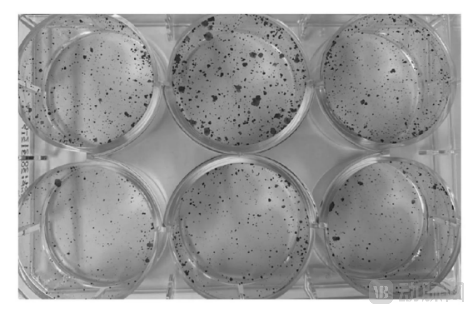
Figure. Results of the colony formation assay for NCCE2
Finally, cell migration capacity was assessed using Transwell inserts as the primary experimental apparatus to evaluate the invasion, migration, and chemotactic capabilities of NCCE2 cells. During the experiment, Miao Chuanwang added 150 μL of serum-free culture medium to the upper chamber and 500 μL of complete culture medium containing serum to the lower chamber. After microscopic observation and photography, software-based quantification of tumor cells adherent to the membrane surface revealed thatTumor cells migrate chemotactically toward nutrients and adhere to the membrane of the lower chamber.
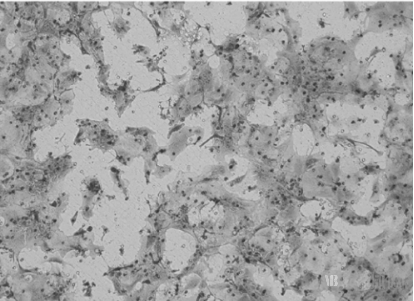
Figure. Microscopic images of cell morphology in the Transwell assay
Establishment of Cell Models and Intent for Patent Assignment
“My interest lies in developing more cell models capable of addressing clinical challenges.” This is the inner conviction of Miao Chuanwang. As a clinician, he frequently witnesses patients grappling with dilemmas such as targeted therapy resistance, chemotherapy resistance, and immunotherapy resistance.
Therefore, in future planning, Miao ChuanwangPrioritize Cell Line Modeling. With patients' informed consent, their cells are obtained to establish chemotherapy-related and immune-related cell lines, thereby addressing more practical clinical issues.
Miao Chuanwang also told Chengguo Bureau that, in addition to NCCE2, he has constructedHuman Esophageal Cancer Cell Line NCCE1andMouse Gastric Cancer Cell Line NCCG1, can be directly applied to important research such as anti-tumor drug screening and new drug development, andSeeking a suitable company for transfer.
How can patent assignment be achieved? Miao Chuanwang believes there are three key points: First, policy and research support to alleviate researchers’ concerns, allowing them to focus on their research work. Second, patent application; intellectual property is the core of outcome protection and a crucial factor in promoting commercialization, including the rationality of subsequent benefit distribution. Third, technology promotion, enabling more companies and investors to see and understand the technology.
In addition to focusing on translational work, he is also constructing cellular models of targeted drug resistance and further investigating the VAV2 gene, having already identified targets associated with immunotherapy resistance.
Finally, when we talk about the original intention, Miao Chuanwang's sentence "A Doctor, and a Scientist”, which reminds me of “To Cure Sometimes, To Relieve Often, To Comfort Always."this medical proverb."
Admittedly, as a physician, he primarily provides comfort and assistance to patients; yet, as a scientist, he is dedicated to transforming that “sometimes.”
*References:
Miao Chuanwang. Functional Study of RICTOR in Gastroesophageal Junction Cancer and VAV2 in Esophageal Cancer [D]. Beijing: Beijing Hospital, 2022.
Lin Dongxin, Wu Chen, Miao Chuanwang, Liu Weiling, Xi Yiyi, Liu Yachen, Lin Ai, Zhong Ce, Zhang Shaosen. A tumor cell line with VAV2 gene deletion [P]. Chinese Patent: ZL202110668444.2, 2021.08.31.