

Pluri Announces IPO Filing to Advance Its Proprietary 3D Cell Expansion Platform for Multi-Line Stem Cell Therapies
Pluri
Cell Therapy Developer
Since 1999, when the U.S. journal Science ranked stem cell research as the top scientific achievement of the year, cell therapy has emerged as a pivotal technology in the advancement of precision medicine.
Cell therapy offers three major advantages: high selectivity, high local concentration, and personalized customization. As of 2021, there were 2,073 cell therapy regimens in clinical use (or under clinical investigation) worldwide, representing a 38% increase from 2020. According to incomplete statistics from VCBeat’s clinical pipeline database, more than half of the pipelines are concentrated among leading companies, such as Athersys and Mesoblast, covering over 140 diseases, primarily focused onMusculoskeletal DisordersandTreatment of Hematologic Diseases。
According to an analysis by LeadLeo Research Institute, the market size of cell therapy in China (valued at cost) is projected to increase from RMB 1.3 billion in 2021 to RMB 16.2 billion in 2025, representing a compound annual growth rate (CAGR) of 87.9%. With an increasing number of cell therapy products expected to gain approval in the future, the market size is anticipated to reach RMB 58.4 billion by 2030, with a CAGR of 29.2% from 2025 to 2030.
With the rapid advancement of life sciences and medicine, cell therapy has made significant progress in multiple fields, including oncology, inflammation, tissue regeneration, and anti-aging. Several self-developing companies, such as Baxter and Talaris Therapeutics, have secured substantial investments, marking a period of robust growth for the cell therapy sector. In 2021, a total of 33 financing rounds were completed; although the total amount was lower than that of 2020, it still reflects increased capital attention to startups in this field.
China’s cell therapy sector started relatively late, but with the rise of integrated pharmaceutical outsourcing services, the imminent approval of domestically produced CAR-T therapies, and a growing number of clinical trials, the cell therapy industry chain demonstrates high growth potential.
So, in a highly growth-oriented sector, how can one accurately position themselves, gain a firm foothold, and achieve steady development? The Israeli regenerative medicine company Pluri (formerly known as Pluristem Therapeutics) has provided its own answer.
Pluri is a clinical-stage regenerative medicine company founded in Israel in 2003, focused on developing cell therapies for a broad range of diseases using placental cells and its 3D cell expansion platform. Its pipeline targets multiple inflammatory and ischemic indications, including peripheral artery disease, muscle injury, preeclampsia, and graft-versus-host disease.PluriIt is also currently the only company that uses 3D bioreactors to manufacture large quantities of placenta-derived cell products., has now rung the opening bell and listed on the NASDAQ.
Shai Meretzki is the founder of Pluri and formerly served as its Chief Executive Officer and Chief Technology Officer. Meretzki holds a Ph.D. in Biotechnology from the Technion – Israel Institute of Technology.Over 20 years of experience in the biotechnology industryDuring his time at university, Meretzki joined Polyheal to oversee biochemical R&D. Two years later, he founded Pluri and served as its CEO and CTO for five years.
As a serial entrepreneur, Meretzki subsequently founded Polyol Biotech, an innovative biotechnology company developing active compounds, and BonUs Therapeutic, a biotechnology company focused on cell therapy, which is listed on the Tel Aviv Stock Exchange (TLV). During this period, Meretzki also served as Chairman of BIOLOGICAL INDUSTRIES (BI), a biotechnology company dedicated to cell therapy.
Yaky Yanay is the current Chief Executive Officer and President of Pluri. A graduate of the Technion – Israel Institute of Technology, he is a Certified Public Accountant in Israel. Yaky brings extensive financial management experience to his role; prior to joining Pluri, he served as Chief Financial Officer at Elbit Systems. He has been with Pluri since 2006. Additionally, Yaky is a former Co-Chairman and Board Member of the Israel Advanced Technology Industries (IATI), the largest life sciences and high-tech industry association in Israel.
Currently, Pluri boasts a specialized organizational structure and a diversified product development pipeline.In 2016, Chinese VC firm Zheshang Venture Capital (ZSVC) invested $30 million in it. As of 2022,PluriThe financing amount has reached $162.5 million.
The primary sources for stem cell cultivation in cell therapy include embryos, placental tissue, adipose tissue, and other isolated sources. Among these, placental tissue is known as the "stem cell bank" and represents a valuable biological resource.As an “immune-privileged site,” placental tissue offers advantages such as ease of extraction, high content of placental mesenchymal stem cells, and low requirements for histocompatibility matching, making it a widely applicable source of stem cells for cell therapy.Pluristem utilizes purified adult stem cells derived from the placenta.
Pluri utilizes its proprietary 3D cell expansion platform (PLX Bioreactor) to produce its flagship product, PLacental eXpanded (PLX) cells,The platform has met the standards of regulatory agencies such as the FDA, EMA, and PMDA.
The 3D Cell Expansion Platform (PLX Bioreactor) provides cells with a 3D environment similar to that of the human body, in which cells rapidly expand while maintaining their health and potency. ItsThe efficiency is 70 times higher than that of conventional integrators.To enable the commercial-scale production of large volumes of high-quality cell products, the 3D cell expansion platform is integrated into an automated, sterile cell manufacturing facility. Furthermore, this facility is housed within a 500-square-meter cleanroom to support clinical trials and meet initial commercial demands following market approval.
PLX cells are a placenta-derivedPossesses immunomodulatory propertiesof mesenchymal stem cells (MSCs), which can secrete soluble biomolecules such as cytokines, chemokines, and growth factors without the need for matching,Stimulate the body's own regenerative mechanisms through paracrine and endocrine pathways to promote the healing of damaged tissues.. Additionally, PLX cells induce the immune system’s natural regulatory T cells and M2 macrophages, reversing excessive immune activation.
PLX cells canUsed to address issues such as inflammation, muscle injury, blood disorders, and radiation exposure.Based on this, Pluri has developed several clinical development programs.
PLX-PAD cells are Pluri's first PLX product, applied in the treatment ofMuscle Injury Following Hip Fracture Surgery, End-Stage Peripheral Artery Disease (PAD), and Chronic Graft-versus-Host Disease (cGvHD)etc.
Femoral neck fractures are the most common type of hip fracture, with annual treatment costs in the United States ranging from $10 billion to $15 billion, influenced by population aging,Mortality rate is as high as 20%.
The end-stage manifestation of peripheral artery disease (PAD) is critical limb ischemia (CLI), which leads to intermittent claudication, ischemic rest pain, ulcers, and gangrene in the lower extremities, severely impairing patients' quality of life and potentially resulting in amputation or death. PAD is a common circulatory disorder,It is estimated that 202 million people worldwide suffer from this condition, with approximately 20% of the elderly population affected by symptomatic and asymptomatic PAD.
Graft-versus-host disease (GvHD) is a postoperative complication of hematopoietic cell transplantation (HCT). Chronic graft-versus-host disease (cGvHD) typically occurs around 100 days post-transplantation, and it is estimated thatBy 2023, the GvHD market size will exceed $500 million.。
PLA-PAD can release factors in response to chemical signals from tissues damaged by muscle trauma or inflammation, triggering the body's repair mechanisms, stimulating tissue renewal and differentiation, and modulating immune system inflammation, thereby demonstrating significant regenerative potential.
Clinical study data from several of PLA-PAD’s disease pipelines have demonstrated favorable trial results.
Data from two Phase I clinical trials indicate that PLA-PAD cells are safe and potentially effective for the treatment of end-stage peripheral artery disease (PAD).Data from a previously conducted animal model study demonstrated that PLX cells exhibit potential therapeutic efficacy for neuropathic pain and muscle injury when administered locally, while systemic administration shows potential efficacy for inflammatory bowel disease, multiple sclerosis (MS), and stroke.
Phase III Study Results of PLX-PLD for the Treatment of Muscle Injury Following Hip Fracture Surgery Show That, Although the Trial Has Not Yet Reached Its Primary Endpoint, Compared with the Placebo Control Group,Patients receiving PLX-PAD therapy showed a significant increase in hip abduction strength (HAS) of the legs (n=120).
Preclinical studies indicate that,PLX-PAD Cells May Alleviate cGVHD Symptoms. Currently, Phase I/II clinical trials are being conducted by the Tel Aviv Sourasky Medical Center (Ichilov Hospital).
PLX-R18 cells canPromotes the proliferation of all blood cell types (white blood cells, red blood cells, and platelets) by stimulating the regeneration of damaged bone marrow.. Currently, it is mainly indicated for the treatment of bone marrow deficiency, bone marrow failure caused by acute radiation syndrome (ARS), and other hematologic indications.
Results from the Phase I clinical trial of PLX-R18 showed that, among 21 patients who had undergone hematopoietic cell transplantation (HCT),Mortality rate decreased from 29% to 18% over 12 months, with increased levels across all three blood cell lineages(platelets p<0.001, hemoglobin p=0.01, neutrophils p=0.15).
Currently, due to the potential of PLX-R18 in restoring incomplete hematopoietic function after hematopoietic cell transplantation (HCT) and in the treatment of acute radiation syndrome (ARS),The FDA has granted it orphan drug designation.With support from the National Institute of Allergy and Infectious Diseases (NIAID), a division of the NIH, Pluri has completed multiple studies on PLX-R18 for acute radiation syndrome (ARS). Furthermore, Pluristem has entered into a collaborative agreement with Fukushima Medical University in Japan to jointly explore the potential of PLX-R18 for treating ARS and gastrointestinal (GI) conditions.
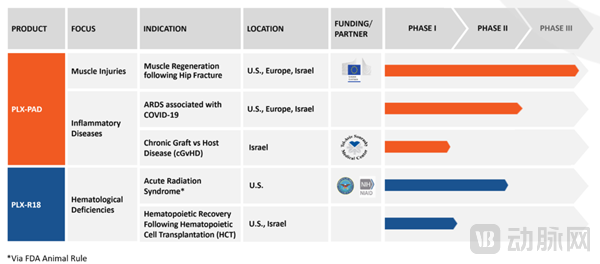 Progress on Selected Development Plans Source: Pluri Official Website
PLX-Immune consists of cells induced by tumor necrosis factor-alpha (TNF-α) and interferon-gamma (IFN-γ), which can transiently alter the cellular secretion profile.
PLX-Immune has been evaluated in preclinical studies to investigate its effects on human cancer cells. The results indicate that,PLX-Immune Demonstrated Antiproliferative Effects Against 45% of Cancer Cells, it exhibits potent inhibitory effects against more than 50 types of cancer cells, including those of breast cancer, rectal cancer, renal cell carcinoma, liver cancer, and skin cancer.
Another preclinical study in female mice bearing human triple-negative breast cancer (TNBC) demonstrated that weekly intramuscular (IM) injections of cells significantly reduced the mean tumor size in the treatment group compared to the untreated group (P=0.025), with 30% of mice achieving complete tumor regression after treatment.
In addition to the above, Pluri is developing a treatment for acute respiratory distress syndrome (ARDS) associated with COVID-19. According to public reports,Six high-risk coronavirus patients receivedPluriThe survival rate was 100% following clinical treatment with the company’s stem cell products.. It has currently received approval from the Israeli Ministry of Health, and patient recruitment for Phase II clinical trials of COVID-19 has begun in Israel, in accordance with the protocol approved by the German regulatory authority, the Paul Ehrlich Institute (PEI).
In 2019, with funding from NASA’s ARIA program, Pluri and NASA’s Ames Research Center jointly launched the “Therapeutic Stromal Cells for Health in Space” initiative, aimed at preventing and evaluating the potential of PLX cell therapy to prevent and treat medical conditions arising during space missions, including indications related to blood, bone, muscle, brain, and heart.
The three major medical challenges astronauts face during long-duration space exploration missions are muscle atrophy, bone loss, and radiation exposure. During 5–10-day flights, muscle atrophy can reach up to 20%; for longer missions, astronauts experience a monthly decline in bone mineral density of 1–2%. PLX cells have the potential to facilitate muscle regeneration and to protect and regenerate the hematopoietic system following radiation exposure, making PLX cell therapy a promising approach to mitigating the persistent adverse effects of space travel on the human body. This project received the 2019 NASA ARIA Innovation Award.
Given the multi-scenario application potential of PLX cell therapy, Pluri and the Abu Dhabi Stem Cells Center (ADSCC),kENUP Fund, Cha Biotech, Thermo Fisher Scientific, Chart Industries, andU.S. Department of Defense (DOD) Armed Forces Radiobiology Research Institute (AFRRI)andNational Institutes of Health (NIH)signed a strategic cooperation agreement with institutions such as VCBeat to establish collaboration in the clinical development and commercialization of the PLX cell series.
In January 2022, Pluri and Tnuva, Israel’s largest food producer, became strategic partners to jointly launch a new company, “NewCo.” NewCo will receive an exclusive global license to Pluri’s proprietary intellectual property for the development of cultured meat, with the goal of launching its first fresh meat product in 2023.
In July 2022, the company announced its name change from Pluristem Therapeutics to Pluri, to emphasize its use of 3D cell expansion technology beyond healthcareNew Strategies for Developing Cell Products Across Multiple Industries, Including Food Technology, Agricultural Technology, and Biological Agents. 3D cell expansion technology enables the large-scale, low-cost expansion of high-quality human, animal, and plant cells.