

Imbed Biosciences Files for IPO Following Breakthrough with Microlyte Matrix in Reducing Surgical Site Infections to 0% Within 34 Days

National Institute of Health
National Institutes of Health

WISC Partners
An investment institution providing working capital to investors and entrepreneurs

WEDC
Investment Company

Imbed Biosciences
Medical Device Developer
On February 15, 2022, Imbed Biosciences (Imbed), a developer of tissue repair therapies, and federal contractor Spartan Medical jointly announced that Imbed’s Microlyte Matrix portfolio of wound dressings would be included in the contract between Spartan Medical and the U.S. Department of Veterans Affairs (VA). Under the agreement, any VA hospital may order any quantity of Microlyte Matrix products based on demand.Its services will cover 1,300 medical institutions and over 9 million veterans.
Clinical trials have demonstrated that Microlyte Matrix can eradicate contact bacteria hidden in crevices, significantly reduce the incidence of surgical site infections in high-risk patients, and decrease the use of antibiotics and opioids. It is estimated that this will save the government billions of dollars in healthcare costs. Consequently, many studies recommend using Microlyte Matrix as the primary antimicrobial dressing in standard care protocols for complex wounds.
To date, Imbed Biosciences has raised a total of $14.5 million across 12 rounds of financing.Major investors include the National Institute of Arthritis and Musculoskeletal and Skin Diseases (NIAMS), part of the U.S. National Institutes of Health (NIH), and the Wisconsin Economic Development Corporation (WEDC).
Postoperative wound infection is relatively common in surgeries involving skin incisions, with most cases occurring within 30 days after surgery; this is also known as surgical site infection (SSI). According to incomplete statistics, the incidence of SSI after surgery is approximately 1%–3%. SSIs account for about 15% of all hospital-acquired infections and 35%–40% of hospital-acquired infections among surgical patients.
In the United States, 6.5 million patients are affected by this type of chronic wound,Its weekly treatment costs are 2 to 6 times higher than those for healing acute wounds.Annual treatment-related costs in the United States exceed $25 billion.
Chronic wounds are generally characterized by stalled healing or deterioration, often accompanied by increased exudate or odor, and present with clinical signs of infection. Management strategies for such complex wounds vary widely but typically include the administration of systemic antibiotics, as well as wound debridement and cleansing to control infection, remove necrotic tissue, and reduce bacterial burden.
However, debridement is insufficient to eradicate all bacteria from the wound surface and may even lead to bacterial regrowth from within the wound bed interstices. Therefore, to reduce the use of systemic antibiotics, many clinicians employ various topical antimicrobial agents and dressings. Nevertheless, this approach remains significantly flawed. Due to their short residence time in the wound, topical antimicrobials require repeated application, necessitating frequent dressing changes by patients.
In addition, antimicrobial wound dressings containing high levels of antimicrobial agents, such as silver and iodine,It may cause high-grade cytotoxicity, thereby impairing wound healing.Patients with underlying comorbidities (e.g., diabetes, vascular disease, etc.) face a higher risk of infection.
Microlyte Matrix is an electron-beam sterilized, ultra-thin absorbent polymer matrix dressing. This synthetic matrix contains no human- or animal-derived tissues or cells, thereby eliminating the risks inherent to allogeneic products. It can cover the disordered surface chemistry of the wound bed,and provide a template for cells to promote granulation tissue formation and wound healing.
Microlyte Matrix is primarily composed of an absorbable polymer—polyvinyl alcohol (PVA)—featuring a multi-layered polymer surface coating. This is a highly safe material commonly found in the ingredients of pharmaceuticals, cosmetics, and personal care products. In Microlyte Matrix,PVA is primarily used to create and maintain a moist environment for wound healing., remove nonviable tissue from the wound (autolytic debridement), thereby alleviating pain, accelerating neovascularization, and preventing tissue dehydration.
Therefore, Microlyte Matrix provides a complete combination of synthetic wound matrix and moisture management to promote the healing of acute and chronic wounds. Additionally, Microlyte Matrix contains a small amount of antimicrobial silver (50–100 times less than traditional methods) to prevent microbial colonization within the matrix.
The components of Microlyte Matrix either slough off from the wound during healing or are naturally eliminated from the body. This means that Microlyte Matrix disappears once the patient’s wound has healed.
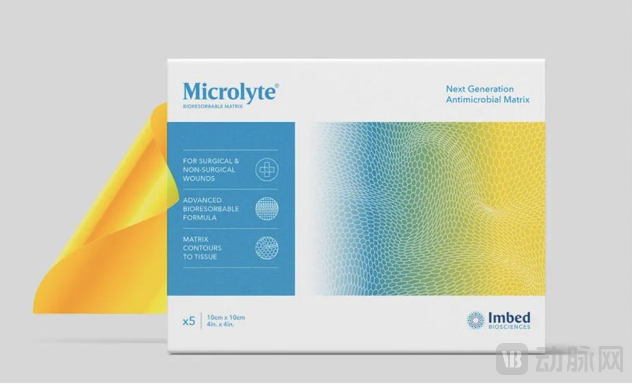
Microlyte Matrix
Image source: Imbed official website
In 2020, Imbed Biosciences conducted a clinical study at the tertiary care center of Mission Hospital to evaluate the efficacy and tolerability of its product. The study enrolled 32 patients receiving wound care at the Mission Hospital Wound Healing and Hyperbaric Center, whose wounds included venous stasis ulcers, diabetic foot ulcers, postoperative surgical wounds, burns, and chronic, non-pressure lower extremity ulcers. These wounds had shown minimal response to prior treatments involving antibiotics and conventional antimicrobial dressings.
Following treatment with Microlyte Matrix, 72% of wounds showed significant improvement within 3 weeks, with an average reduction in wound area of 66%; 91% of wounds achieved complete healing (i.e., full re-epithelialization) or significant improvement within 12 weeks, with an average reduction in wound area of 73%.
Meanwhile, the patient experienced no discomfort, pain, or other adverse reactions. The results indicate that,Direct application of this novel bioabsorbable matrix to the wound surface is not only safe and well-tolerated, but also helps improve most complex chronic wounds that are stalled or deteriorating.
In October 2021, Imbed Biosciences announced the clinical evaluation results of Microlyte for the prevention of surgical site infections (SSI) in high-risk patients. In this study, the subjects were diabetic patients who had undergone foot and ankle surgery, with an overall SSI rate of 13%. By using Microlyte Matrix deep within the incision, this rate decreased to 6.5% within 3–5 days;The SSI rate was 0% within 10–34 days.
“Microlyte is a cost-effective, antimicrobial, bioabsorbable wound matrix, and as this study demonstrates, it is also an effective tool against SSIs,” said Dr. Michael J. Schurr, Co-Founder and Chair of General Surgery at Imbed Biosciences.
Ankit Agarwal, a co-founder of Imbed Biosciences, earned his Ph.D. in Chemical and Biological Engineering from Iowa State University, specializing in medical devices, biotechnology, drug delivery, gene therapy, biomaterials, and nanotechnology.
In 2010, Agarwal joined the University of Wisconsin for postdoctoral research, during which he co-founded the medical device company Imbed Biosciences and led the development and commercialization of patented technologies for soft tissue repair and regeneration. Additionally, Agarwal is currently one of the 13 distinguished postdoctoral entrepreneurs recognized by the Ewing Marion Kauffman Foundation in the United States, holds more than ten patents and patent applications, and has won multiple national and international business plan competitions.

Ankit Agarwal
Image source: Imbed official website
In 2019, Imbed Biosciences completed a $4 million Series A equity financing round, led by Formidable Asset Management with participation from WISC Partners and other investors. The funds were allocated to support the commercialization of the Microlyte Matrix wound dressing.
In November 2020, Imbed won the Annual Innovation Award from Defense Tech Connect for Microlyte and presented its Microlyte Matrix technology at the Defense Tech Connect Summit.This award is designed to recognize organizations or enterprises that have made significant contributions to U.S. national defense, and it is conferred exclusively upon innovative technology platforms ranked within the top 15%.(Scored by the review committee).
Studies have shown that due to suboptimal care conditions, the infection rate among military personnel following battlefield injuries exceeds 30%, which can lead to septic shock or death. Microlyte Matrix not only eradicates bacteria hidden within biofilms but also features high portability and ease of use. Consequently, Microlyte Matrix has become an indispensable tool for military combatants at the point of injury, during evacuation, in hospital operating rooms, and throughout long-term clinical care.
On November 10, 2021, Imbed Biosciences announced that it had received funding from the Military Infectious Diseases Research Program (MIDRP) of the U.S. Army Medical Research and Development Command (USAMRDC).A grant worth approximately $2 million. These funds will be used to develop solutions for preventing combat wound infections following blast and burn injuries.
With the general growth of the animal health market, the global animal wound care market is projected to reach a value of $1.5 billion by 2025. North America dominates the global market, having accounted for 32% of revenue share in 2020. In Canada, approximately 41% of households own more than 8 million dogs and over 8 million cats. Meanwhile, Canada has implemented regulatory measures to address antimicrobial resistance caused by the overuse of antibiotics.
After more than a decade of research and testing, Imbed has launched MicroLyte Vet, a dressing designed for animal wounds. Its composition is similar to that of the MicroLyte Matrix, and it is indicated for the treatment of partial- and full-thickness pressure ulcers, first- and second-degree burns, abrasions, lacerations, and surgical wounds.
On January 25, 2020, Imbed Biosciences announced that it had entered into an exclusive distribution agreement with Jorgensen Laboratories (Jorvet). Under the agreement, Imbed will distribute its animal health product, MicroLyte VET, to veterinary hospitals and clinics in the United States and Canada.
Jorvet boasts an experienced sales team that maintains close collaborations with nearly all veterinary distributors in North America. In addition to integrating MicroLyte VET into Jorvet’s extensive North American distribution network, this partnership will also see Imbed Biosciences and Jorvet co-host regular veterinary educational webinars to share the latest tools available for advanced wound care.
On April 14, 2021, Imbed Biosciences announced that MicroLyte Vet had been launched in the Canadian market through McCarthy and Sons Service. This collaboration represents an extension of the exclusive distribution partnership between Imbed and Jorvet in North America.
McCarthy & Sons Service is a full-service veterinary marketing, supply, and distribution company. Its team of distribution representatives is well-versed in surgical and wound care products, covers all of Canada, and has experience introducing innovative products to the Canadian animal health market.
With the support of such a mature distribution company,Imbed Biosciences expects MicroLyte Vet to rapidly capture the Canadian market.Agarwal said, “The Canadian market represents an excellent opportunity for the growth of our veterinary product line and is a vital component of our animal health partnerships in North America.”