

Percutaneous Ventricular Assist Device (pVAD) Emerges as the Next Frontier in the Battle Against Heart Failure
Heart failure is the terminal stage of cardiac disease progression, with a five-year mortality rate as high as 30–70%, earning it the designation as “the final battlefield in the field of cardiovascular disease.”
Data indicates that many cardiac diseases and chronic conditions can lead to heart failure. For instance, cardiovascular diseases such as myocardial infarction, coronary atherosclerosis, myocarditis, hypertension, aortic stenosis, valvular insufficiency, and congenital heart disease are fundamental causes of heart failure, while respiratory tract infections, arrhythmias, and exacerbation of underlying heart disease serve as precipitating factors.
According to the "Report on Cardiovascular Health and Diseases in China 2021," there are approximately 330 million patients with cardiovascular diseases in China, including 11.39 million with coronary heart disease, 2 million with congenital heart disease, and 245 million with hypertension. Based on this large population of cardiovascular disease patients, there are an estimated 10.67 million heart failure patients in China, while the global number of heart failure patients is nearly 30 million. The number of heart failure patients is expected to continue growing as life expectancy increases for patients with heart disease, diabetes, and other conditions, and as the aging population deepens.
Clinically, heart failure refers to a syndrome in which cardiac pumping function is impaired due to various causes, resulting in cardiac output that fails to meet the basic metabolic demands of systemic tissues. It is primarily characterized by congestion of tissues and organs, such as venous blood stasis caused by inadequate emptying of venous return from the heart, and insufficient arterial perfusion.
Based on the onset and progression of heart failure, it is classified into early-stage, progressive-stage, and end-stage phases. Statistical data indicate that among hospitalized patients with heart failure, those with end-stage heart failure account for approximately 5%, while the remaining 95% consist of patients experiencing acute exacerbation of chronic heart failure or initial acute episodes.
In terms of treatment, clinical practice primarily manages heart failure through lifestyle modifications, pharmacological therapy, and surgical intervention. However, lifestyle modifications and pharmacological therapy can only alleviate symptoms and cannot cure the disease.
In terms of surgical treatment, heart transplantation is currently recognized as the only effective intervention for patients with end-stage heart failure. However, due to the limited number of donors, the global volume of heart transplants has grown slowly, with only approximately 5,000 procedures performed worldwide each year, failing to meet the substantial demand from patients.
To address the shortage of donor hearts, numerous companies have emerged in the market to develop artificial hearts. These permanently implantable ventricular assist devices (VADs) can meet the treatment needs of patients with end-stage heart failure when heart transplantation is not feasible or donor hearts are scarce. However, their widespread adoption is hindered by the complexity of the surgical procedures and high costs. Furthermore, permanently implantable VADs are primarily indicated for only about 5% of patients with end-stage heart failure.
For the larger cohort of patients with early-stage and advanced heart failure, who account for 95% of cases, temporary percutaneous ventricular assist devices have emerged in the international market in recent years. For instance, percutaneous ventricular assist devices (pVADs), such as catheter-based cardiac pumps, have been widely adopted overseas due to their minimally invasive nature, low complication rates, and ease of operation.
Driven by the urgent needs of heart failure patients and innovative advancements in science and technology, both clinical experts and advisory experts agree that:Percutaneous Ventricular Assist Device (pVAD)will become the next major trend, entering a golden decade of rapid development。
Recently, the project “Research on Miniature Interventional Artificial Heart Technology and Prototype Development,” led by Professor Zhang Xiwen of Tsinghua University as the principal investigator, was approved for funding under the Key Special Project on “Diagnostic and Therapeutic Equipment and Biomedical Materials” of the National Key R&D Program of the Ministry of Science and Technology.
Zhang XiwenProfessor“An interventional cardiac catheter pump is an assistive device that can be implanted into the human body via minimally invasive interventional techniques and partially or fully substitutes for the heart’s blood supply.”Depending on the location of the power unit, interventional cardiac catheter pumps can be classified into those with an integrated motor and those with an external motor.。”
Currently,The Impella series of percutaneous heart pumps, the only ones globally to receive FDA clearance, all utilize integrated motor technology., developed by Abiomed, primarily includes different models such as Impella CP, Impella 5.0, and Impella 2.5.
Abiomed’s financial report shows that its revenue reached $1.032 billion in 2021, with the Impella product series accounting for 95.42% of sales. Among all Impella products, Impella CP contributed 77% of sales revenue, making it the most widely used product.
In addition to the aforementioned products, Abiomed is also developing the Impella ECP system.
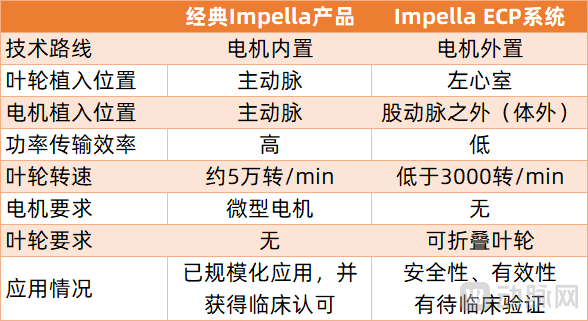
Data show that the Impella CP system, Impella 5.0 system, and Impella 2.5 system have received FDA approval, and areThe classic Impella product adopts the built-in motor technology route; it is still in the research and development stage.ImpellaThe ECP system adopts an external motor technology architecture.。
Products with different technological approaches also operate on different principles. Taking the Impella CP and Impella ECP systems as examples, the Impella CP system has been clinically validated and is widely used in clinical practice. Its working principle is as follows: The impeller and power unit (motor) are delivered via the femoral artery to the ascending aorta, while the catheter is advanced into the left ventricle, with its inlet positioned in the left ventricular outflow tract and its outlet located in the ascending aorta. When the axial-flow pump at the catheter tip operates, it draws blood from the left ventricle and delivers it to the ascending aorta.
Based on the aforementioned principles, the Impella CP system can increase cardiac output, reduce blood stasis, and improve arterial perfusion; by aspirating blood from the left ventricle, it directly reduces left ventricular pressure and volume, decreases ventricular work, and lowers myocardial oxygen consumption.
In contrast, the Impella ECP system operates by positioning an impeller within the left ventricle, while the drive unit (motor) is located externally to the femoral artery (extracorporeal), connected to the impeller via a flexible drive shaft. During operation, the catheter aspirates blood from the left ventricle and delivers it into the aorta.
Data shows that the Impella ECP system is a product that Abiomed began developing in 2014. It was designed as the world’s smallest percutaneous heart pump, with the sheath and pump measuring only about 3 millimeters in diameter and achieving a peak flow rate of more than 3.5 liters per minute. However, after eight years of development, the Impella ECP system remains in the research and development stage.
The slow progress is due to numerous R&D challenges associated with the externally motorized interventional cardiac catheter pump.
First, for interventional cardiac catheter pumps with an integrated motor design, the impeller is positioned 0.1–0.15 mm from the motor, enabling more efficient power transmission. In contrast, for interventional cardiac catheter pumps with an external motor design, the impeller is located in the left ventricle while the motor resides outside the femoral artery; the considerable distance and vascular tortuosity result in lower power transmission efficiency. Consequently, products utilizing the external motor design impose extremely stringent requirements on the flexible drive shaft that connects the impeller to the motor.
Second, the externally motorized interventional cardiac catheter pump places the motor outside the body, providing strong power. However, factors such as transmission distance, flexible drive shafts, and impeller operating space limit its effective power delivery. If the impeller speed exceeds 3,000 RPM, it may damage large blood vessels, and the flexible drive shaft risks direct fracture. In contrast, products with an internally integrated motor can achieve rotational speeds of up to 50,000 RPM. To ensure adequate flow support at speeds below 3,000 RPM, externally motorized devices require larger impellers. However, due to the limited diameter of the vascular lumen, they must employ foldable impellers, which present a high technological barrier.
In fact, Abbott had previously developed the HeartMate PHP, a device featuring an externally mounted motor. However, despite overcoming technical challenges related to flexible drive shafts and foldable impellers, Abbott halted the trial registration of this product in 2021. The reason was that the device failed to meet the needs of its intended patient population due to a reduction in impeller speed at the end of the procedure.
Therefore, there is currently no externally motorized interventional cardiac catheter pump on the market, and such products still require clinical validation. On the other hand, internally motorized products have been used in over 235,000 cases globally, with their clinical safety and efficacy already validated, making them classic and mature interventional cardiac catheter pump products.。
Given the urgent needs of the vast number of heart failure patients in China and the innovative development of science and technology, it is imperative to develop an interventional cardiac catheter pump with independent intellectual property rights. However, there is no consensus among industry players on whether to adopt a built-in motor or an external motor technical route.
Professor Zhang Xiwen stated, “Interventional cardiac catheter pumps with an integrated motor design have demonstrated safety, reliability, and efficacy, gained recognition from clinical experts, and achieved large-scale application, representing mature and successfully commercialized products. In contrast, there is currently no mature commercial product based on the externally mounted motor design for interventional cardiac catheter pumps, and its safety and reliability still require clinical validation.”
Therefore, interventional cardiac catheter pumps with built-in motors are expected to be adopted in clinical practice more rapidly.
As the Impella CP system scales up its application, Dr. Xie Qilian, Chairman and General Manager of Anhui Tongling Bionic Technology Co., Ltd., is also striving to “address heart failure with a single catheter,” having conducted extensive basic research and technological innovation.
According to reports, Dr. Xie Qilian possesses the dual advantages of extensive clinical experience and expertise in scientific research innovation. She completed her postdoctoral fellowship at the National Heart and Lung Institute, Imperial College London. With over 20 years of clinical experience in cardiovascular medicine and critical care, she has led more than 20 scientific research projects, including sub-projects under the National Key R&D Program. Dr. Xie has published over 80 academic papers in domestic and international journals and holds more than 60 invention patents both in China and abroad.
After reviewing the Impella product series, which has been clinically and commercially validated with clear indications, Dr. Xie Qilian decided to leverage her technical expertise and innovative advantages to develop a domestically produced interventional cardiac catheter pump urgently needed for the treatment of patients with acute heart failure, benchmarking against the approved Impella products. Consequently, Dr. Xie Qilian founded Tongling Bionics in 2016, committed to providing globally leading integrated diagnostic and therapeutic solutions for patients with heart failure.
Following rigorous scientific validation and through continuous innovation and technological breakthroughs, Tongling Bionics decisively opted for an independently developed, clinically validated motor-integrated technical route, thereby creating a domestically produced interventional cardiac catheter pump with full independent intellectual property rights. In the process of developing this domestic interventional cardiac catheter pump, Tongling Bionics also overcame the most formidable technical barriers associated with the combination of integrated motor and liquid sealing technologies.
To date, Tongling Bionics has secured more than 160 independent innovation patents, ensuring the originality of its technologies and the security of its patent portfolio.
During the R&D process, the Tongling Bionics team discovered that the classic Impella product series consists of devices approved a decade ago, utilizing technology from that era, which presents certain clinical limitations. Therefore, Tongling Bionics has applied the latest technologies and optimized its products.
For instance, Tongling Bionics has further enhanced hemolysis performance by optimizing the power unit and impeller design, achieving hemolysis indices that significantly surpass acceptable standards. By reducing hemolysis, the therapeutic duration of interventional cardiac catheter pumps can be markedly extended, with current laboratory results demonstrating operational stability for over one month. Furthermore, through structural optimization and careful material selection, the risk of fracture and retention of the interventional cardiac catheter pump within the cardiac chamber is effectively mitigated.
Leveraging innovations in micro-motors, low-hemolysis impellers, liquid seal technology, and novel anticoagulation cooling systems, the interventional cardiac catheter pump developed by Tongling Bionics offers advantages such as low hemolysis, ease of operation, and no risk of in-body fracture, thereby achieving a generational upgrade of interventional cardiac catheter pumps.
Currently, the interventional cardiac catheter pump with a built-in motor developed by Tongling Bionics has completed type testing and is about to commence clinical trials, placing its product development at the forefront in China.
Dr. Xie Qilian stated, “We hope that our interventional cardiac catheter pump, which possesses full independent intellectual property rights, will enter clinical trials as soon as possible. This will break the technological monopoly and product blockade imposed by foreign competitors, enable heart failure patients in China to receive timely treatment, and create greater social value.”