

Battery-free and 0.5mW for 1024 channels: Juno Life Sciences unveils a next-gen fully implantable BCI that outdoes Neuralink

Juno
Developer of Fully Implantable Closed-Loop Brain-Computer Interface Devices
Only when neural signals are no longer interfered with by RF radiation, no longer burned by battery heat, and no longer disconnected due to wireless charging misalignment, will brain-computer interfaces truly enter the safe zone of the brain.
In 2025, seven government departments jointly issued Implementation Opinions on Promoting Innovative Development of the Brain-Computer Interface Industry. In 2026, brain-computer interfaces (BCIs) were included in the Government Work Report for the first time, standing alongside quantum technology and 6G as new strategic growth drivers at the national level. On the trillion-yuan brain science frontier, implantable BCIs are transitioning from laboratories to clinical applications, emerging as a critical battleground that will determine the industry's ultimate landscape and reshape the paradigm of human-machine interaction.
Against this backdrop, Shenzhen Juno Life Sciences Co., Ltd. (hereinafter referred to as Juno) has completely abandoned the traditional paradigm of battery implantation plus RF radiation. Instead, it has built a next-generation fully implantable closed-loop BCI system based on an integrated sensing–transmission–computation–control architecture. This approach directly addresses the three major physical limitations currently facing implantable BCIs worldwide—high-throughput bottlenecks, tissue thermal damage, and power supply longevity concerns—thereby accelerating the deployment and widespread adoption of cutting-edge technologies through Chinese innovation.
The commercialization narrative of implantable brain-computer interfaces has been propelled by Neuralink to a near-science-fiction climax over the past two years. Yet beneath the spectacle, a long-standing issue has persisted in the implantable BCI industry: heat generation and power supply for implants.
Zhang Anguo, CTO and Co-founder of Juno, pointed out in an interview with VCBeat that "traditional implantable brain-computer interfaces face three major physical limitations: high-throughput transmission bottlenecks, the risk of thermal tissue damage, and concerns over power supply and longevity. Although these three intertwined bottlenecks are widely acknowledged within the industry, few have truly attempted to tackle them simultaneously."
Specifically, traditional implantable solutions typically encapsulate the chip and battery together, relying on an external coil for RF power supply and data transmission. Although this approach appears mature, it harbors significant risks: the coils must maintain extremely high alignment precision, as even slight misalignment can cause connection loss; meanwhile, RF radiation and continuous battery discharge generate heat accumulation within brain tissue. Even a temperature rise of just 1 to 2 degrees Celsius may cause irreversible damage to neurons.
Confronted with these three intertwined physical limits, Juno has chosen to restructure its underlying architecture and redefine, around three core components, what a "next-generation" fully implantable closed-loop brain-computer interface system should be.

"Sensing-Transmission-Computing-Control" Implantable Collaborative Closed-Loop Brain-Computer Interface System Architecture Diagram
Image source: Juno
First, remove the in-body battery. Juno's self-developed brain-computer interface (BCI) implant is entirely battery-free, instead employing two power supply methods: wireless energy transmission via its pioneering electroquasistatic (EQS) field communication technology, which utilizes human tissue as a natural conductive medium; and auxiliary power generation by harvesting the body's own weak bioelectric potentials. Li Dongming, Head of Chip R&D, explained, "By using the human body as a conductor rather than air coupling, signal attenuation is significantly reduced, leading to lower power requirements and naturally decreased heat generation, thereby achieving lossless, wireless power delivery and data transmission."
Second, reconstruct the communication link. Traditional radio frequency (RF) signals suffer from extremely high attenuation in air. Juno has opted for the Human Body Communication (HBC) pathway, using subcutaneous tissue as a shared medium for signal transmission, where electric field signals "flow" along the tissue to external receivers. According to disclosures, in implantation scenarios at depths exceeding 5 cm, this approach keeps link loss within 60 dB, which is more than 30 dB lower than traditional RF, and does not require alignment.
Third, introduce an event-driven mechanism. Traditional brain-computer interface (BCI) chips employ "full-quantization sampling," meaning the system operates at full capacity regardless of whether neurons are firing. In contrast, Juno's edge neuromorphic core, based on Spiking Neural Networks (SNNs), directly filters out over 90% of invalid background noise in the analog domain. The analog-to-digital converter is activated only when valid action potential spikes are detected, enabling zero-latency intelligent noise reduction and feedback decision-making. According to Zhang Anguo, this design achieves a data compression ratio of 35 to 73 times.
The combination of these three technologies has ultimately been implemented in a next-generation fully implantable closed-loop brain-computer interface system, achieving a globally leading full-stack integration of parameters such as 1024 channels, a pixel pitch of 36 microns, total chip power consumption of 0.5 milliwatts, and a core volume no larger than a sesame seed. Zhang Anguo emphasized, "Juno has adhered to full-stack independent controllability from the very beginning. Only by having no external dependencies—from electrodes and chips to transcranial transmission and edge algorithms—can we truly break through the bottlenecks."

Multimodal Brain-Computer Interface Chip (1024 Channels)
Image source: Juno
This technological confidence stems from a decade of painstaking refinement and foundational accumulation. The core team at Juno Life Sciences hails from top-tier university laboratories both domestically and internationally, establishing a full-chain closed loop in chip design, bio-communication, and brain-inspired algorithms. To date, the company has completed more than 10 chip iterations—precisely what Zhang Anguo has repeatedly emphasized as the "intergenerational advantage." This is also the core of the next-generation fully implantable closed-loop brain-computer interface system.
If the battery-free approach and EQS communication address "physical safety" concerns, then what Juno Life Sciences truly aims to achieve is "closed-loop intervention." For patients with neurological disorders such as epilepsy and Parkinson's disease, the ideal treatment approach involves real-time monitoring of electroencephalographic (EEG) signals and automatically triggering precise electrical stimulation within milliseconds of detecting abnormal discharges, thereby preventing seizure onset.
However, the implementation of a closed-loop system is far more challenging than "brain reading." EEG signals are inherently weak and highly susceptible to being overwhelmed by motion artifacts such as electromyographic (EMG) and electrooculographic (EOG) artifacts. Moreover, achieving instantaneous end-to-end processing—encompassing acquisition, processing, decision-making, and feedback—requires latency to be controlled at the millisecond level.
Zhang Anguo pointed out, "Traditional cloud-based algorithms suffer from high latency, high power consumption, and privacy leakage risks, making them ill-suited for real-time processing needs. Currently, many brain-computer interface companies perform signal processing on the cloud or edge servers; while this approach is feasible in laboratory settings, it is virtually impractical for patients' daily lives."
To overcome this implementation challenge, Juno Life Sciences' solution is to deploy an edge computing unit based on Spiking Neural Networks (SNNs) on an external wearable hub (wristband or ear patch). SNNs, known as the "third-generation neural networks", are characterized by event-driven processing—computation occurs only when neurons generate spikes, while the system remains silent otherwise. This mechanism is naturally suited to the high sparsity of EEG signals.
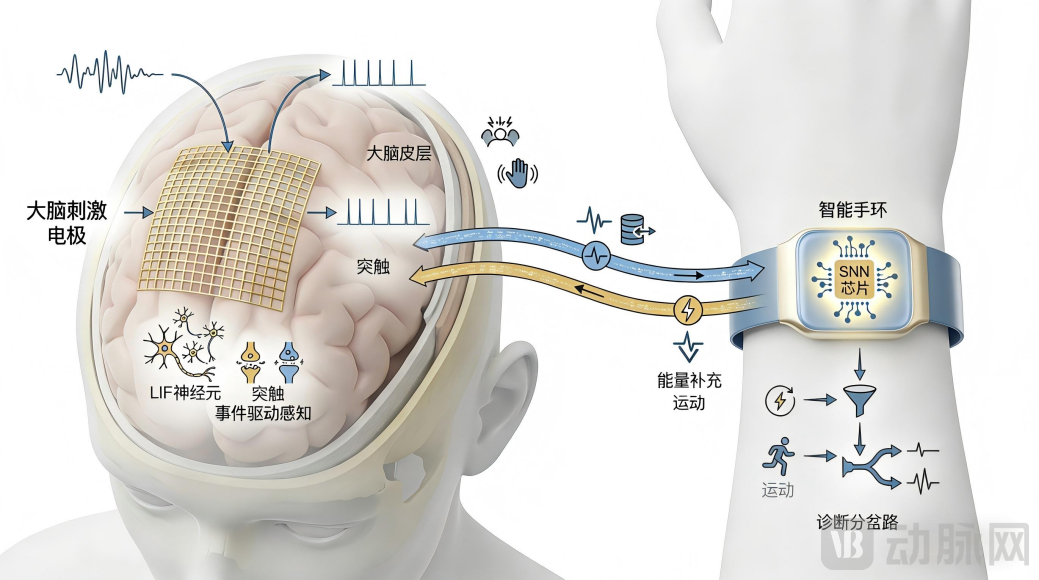
Image source: Juno
Within the Spiking Neural Network (SNN) framework, Juno has further introduced a "spike-based self-attention mechanism," reducing single-channel power consumption to below 10 microwatts. In scenarios involving intense physical activity, the signal-to-noise ratio improves to 18 dB, while logical resource utilization decreases by 60%. Of greater clinical value is its NeuralTree spiking network architecture—unlike the "black box" nature of traditional deep learning, NeuralTree enables real-time backtracking of decision paths and outputs visual heatmaps of specific brain regions and frequency bands to clinicians.
As a brain-computer interface (BCI) innovator founded in 2025, Juno has implemented a four-pronged strategy for its commercialization pathway: Standard System Framework for Implantable BCIs, Standard System Framework for Non-invasive BCIs, Integrated ODM Solution for "Sensing-Transmission-Computing-Control," and Comprehensive Treatment Solutions for Nervous System Disorders.
In serious medical scenarios, Juno has identified epilepsy as its first target indication. "Epileptic seizure signals have distinct characteristics, enabling a relatively faster approval and translation pathway," explained Zhang Anguo. Regarding the implantable approach, the company is seeking collaborations with medical institutions to jointly promote clinical implementation. By integrating its standardized system framework with the clinical expertise and patient resources of healthcare providers, it aims to establish a dual-drive model combining "technology + clinical practice."
Currently, the team has already completed multiple rounds of animal experiments at Colorado State University, the University of Macau, and KU Leuven, preliminarily validating the potential for closed-loop regulation. Li Dongming further revealed, "We recently completed weak signal acquisition in a porcine model. The transition from rodents to large mammals such as pigs signifies that the system's safety has crossed a critical threshold; currently, both the functionality and safety of the product have been successfully verified." Next, Juno will complete large-animal validation within 12 months, advance to primate experiments within 24 months, and initiate human clinical trials within three years—leveraging partnerships with collaborating medical institutions to drive progress.
While steadily advancing the implementation of serious medical scenarios, Juno Life Sciences' second path—leveraging implantable-grade technology to "downshift" into the consumer market—also holds significant strategic potential. "Our implantable chip technology can be rapidly adapted into non-implantable chips for the consumer sector, allowing us to leverage generational advantages to compete in the consumer market. These products will target health monitoring, sleep management, stress regulation, and other scenarios, achieving sales at scale," Zhang Anguo introduced.
What holds greater significance for long-term industrial barriers is Juno's unique design in its position within the industry chain. The brain-computer interface (BCI) industry chain is extremely complex, spanning electrode materials, chip design, communication solutions, algorithm platforms, and clinical validation; virtually no single company can dominate the entire landscape. Juno does not seek to capture all end-product markets, but instead chooses to build a "Sensing-Transmission-Computing-Control" Integrated ODM Solution. Other brain-computer interface (BCI) companies, universities, and hospitals can directly leverage Juno's standardized system framework when developing their own applications, eliminating the need for foundational investments in chips, communication protocols, and algorithms from scratch. This model not only helps Juno secure a more prominent position within the industrial ecosystem but also promises to genuinely advance China's neuroscience and BCI industries as a whole, transitioning from "isolated breakthroughs" to the shared development of systemic foundational capabilities.
At the conclusion of the interview, Zhang Anguo defined Juno's mission as follows: "We aspire to be the global technology definers and clinical implementation leaders in fully implantable, closed-loop brain-computer interfaces (BCIs). Leveraging our next-generation, fully autonomous, full-stack 'sensing-transmission-computation-control' technology, we aim to address critical challenges in the treatment of neurological disorders and serve as a core driver in translating BCIs from laboratory research to accessible, widespread clinical care."