

Is Stem Cell the Next Opportunity for Tissue Regenerative Materials Following Innovations in Aesthetics and Orthopedics?
Previously, when discussing regenerative medicine, most people thought of cutting-edge technologies such as stem cell technology, gene editing, and 3D printing; they envisioned the arduous processes of research and development and regulatory registration, as well as an uncertain path toward industrialization.
In fact, tissue regeneration materials constitute an important branch of regenerative medicine, as scaffold materials are indispensable for tissue regeneration in many cases. Particularly at the current stage, compared with more distant prospects such as live cell therapies and organ regeneration, tissue regeneration materials have achieved tangible commercial progress in markets including medical aesthetics, trauma care, and orthopedics. Moreover, this segment offers greater certainty, with mature Chinese companies such as China Regenerative Medicine International, Zhenghai Biotechnology, MicroPort MedBot (Note: likely referring to MaiPu Medical), Allgens Medical, and Guanhao Biotech already offering established products. Consequently, this niche sector deserves increased attention.
Currently,Biomedical materials are in a critical period of rapid transition from traditional inert materials to tissue-regenerative materials.Industry interest in tissue regeneration materials is also rising rapidly. According to statistics from VCBeat, although large-scale financing and star investment institutions remained heavily concentrated in the field of cell technologies among regenerative medicine companies that secured funding in 2022, the number of financing deals for tissue regeneration materials was no less impressive, potentially ushering in a new peak of development.
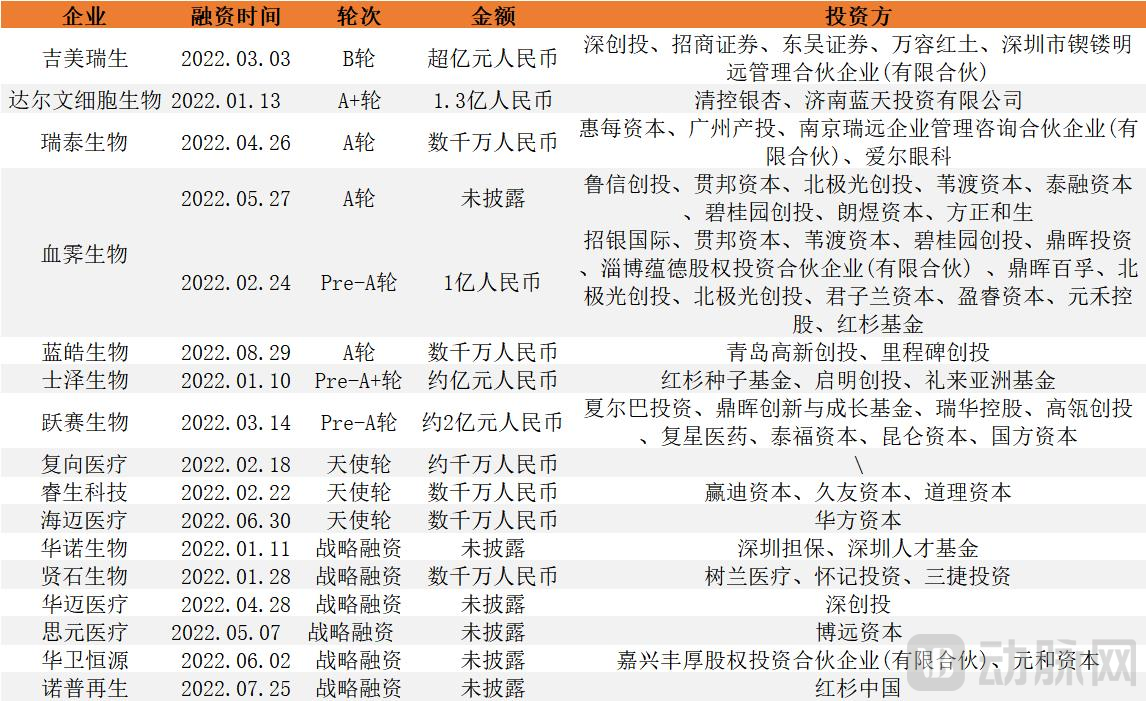
Financing in the Regenerative Medicine Sector in 2022
Biomedical materials are substances used to diagnose, treat, repair, or replace damaged tissues and organs in living organisms, or to enhance their physiological functions. As the foundation for research into artificial organs and medical devices, biomedical materials have become an important branch of contemporary materials science. In particular, with the vigorous development and significant breakthroughs in biotechnology, they have emerged as a focal point for intensive research and development by scientists worldwide.
Among them, biomedical materials are further categorized into three domains: replacement, repair, and regeneration.
Non-degradable implants, such as artificial joints and spinal internal fixation materials, are inert materials that lack the ability to promote tissue growth and regeneration. They serve only to replace native tissues to maintain structural integrity and basic function, falling within the category of replacement.Materials that can promote cell differentiation and proliferation, induce tissue regeneration, accelerate tissue repair, and degrade in the body after the completion of tissue repair are typical tissue regeneration materials., falling within the realm of regenerative medicine.
For example, in orthopedics, traditional metallic implants—such as fixation devices, bone plates, and artificial joints—do not promote bone tissue growth; they serve only a physical role in support and stabilization. In contrast, bioactive bone scaffold materials based on hydroxyapatite or loaded with bone growth factors can effectively promote the healing and regeneration of bone tissue.
The development of tissue regeneration materials is closely related to tissue engineering. In the 1980s, Professor Robert Langer and Joseph P. Vacanti in the United States formally proposed the concept of tissue engineering. In 1988, tissue engineering was officially recognized and defined as an emerging discipline that applies the principles and methods of life sciences and engineering. Based on a correct understanding of the relationship between tissue structure and function in mammals under both normal and pathological conditions, it focuses on researching and developing biological substitutes to repair, maintain, and promote the functional and morphological recovery of various human tissues or organs after injury.
In 1997, the emergence of a human-like ear on the back of a mouse stunned the world. Professor Cao Yilin cultured bovine articular chondrocytes in a petri dish; once the cells had proliferated sufficiently, they were seeded onto an ear-shaped scaffold made of biodegradable biomaterials. The chondrocytes continued to grow and proliferate on the scaffold, resulting in the creation of a bioengineered ear.
This was a landmark event in the global field of regenerative medicine, sparking a rapid surge in enthusiasm for cell therapy and tissue regeneration materials that quickly reached its peak. In particular, when Professor Cao Yilin returned to China in 1999, a wave of research fervor for tissue engineering swept across the country.
However, constrained by extremely high technical barriers, tissue engineering did not achieve another breakthrough until 2010, leading to a significant decline in enthusiasm for related technologies and theories. In recent years, with continuous advancements in technologies such as tissue regeneration materials and stem cells, the field of regenerative medicine has increasingly attracted numerous companies to establish their presence.
Research on tissue regeneration materials has also deepened alongside the development of tissue engineering since the 1990s, although most materials at that time were non-degradable. After 2010, degradable biomaterials have been widely applied in clinical practice, and breakthroughs in animal-derived products from sources such as cattle and pigs have driven the development of tissue regeneration materials.
To date, tissue regeneration materials have become quite abundant.Tissue regeneration materials can be classified into inorganic materials, organic materials, polymeric materials, and animal-derived materials. Inorganic materials include hydroxyapatite and bioactive glass; organic materials include polylactic acid and polyvinyl alcohol, which are primarily used as fixation materials, tissue engineering scaffolds, and cardiovascular stents; polymeric materials include polylactic acid, polyethylene, and polycaprolactone; and animal-derived materials include collagen, chitosan, silk fibroin, and decellularized extracellular matrix.

Classification of Tissue Regeneration Materials
The future development of tissue regeneration materials faces significant challenges,The research and development of innovative materials face significant challenges and barriers, whereas improving existing materials and innovating their applications offer a promising breakthrough. By upgrading and iterating material structures and properties for specific diseases and tissues, superior outcomes in tissue repair and regeneration can be achieved.
Taking extracellular matrix (ECM) materials as an example, the ECM processed via decellularization technology is referred to as acellular matrix. Acellular matrix not only exhibits excellent biocompatibility but also possesses potent endogenous tissue-inductive capacity. It is highly conducive to cell adhesion and proliferation, and it modulates and accelerates the tissue repair process after implantation. Its applications include filling tissue defects, inducing tissue regeneration, repairing damaged tissues, and facilitating integration with surrounding tissues.
Decellularization technology is the core technology for extracellular matrix materials, determining the regenerative performance and indication scope of decellularized matrix materials. Xianshi Biotech employs a new generation of decellularization technology combining “enzyme-assisted techniques + micro-processing,” introducing specific biological enzymes to efficiently remove immunogenic components, with a DNA removal rate exceeding 99%. Meanwhile, by adopting micro-processing technology, the decellularization efficiency is improved by more than 10 times compared to existing standards. Furthermore, a neutral environment is maintained during the decellularization process, causing almost no damage to tissue structure. Consequently, this approach not only fully preserves natural components and structures but also retains a significant amount of active growth factors and bioactive components.
Based on downstream product classification, tissue regeneration materials can be categorized into two major groups: medical devices and pharmaceuticals.
Here, it is necessary to explain the principle of human tissue and organ regeneration. Essentially, tissue and organ regeneration is a coordinated process involving cell growth, differentiation, and changes in tissue morphology. By combining tissue-regenerative materials with the body’s inherent regenerative capacity, human tissue repair and regeneration can be enhanced, achieving superior outcomes. For instance, bone repair and oral restoration materials are developed based on this principle, and such products are typically approved as medical devices.
However, there is a special case: organ tissues such as cardiomyocytes and kidneys are non-regenerative. In such instances, it is necessary to culture cells in vitro using technologies like stem cells and 3D printing, and combine them with tissue regeneration scaffold materials to achieve tissue and organ regeneration. Products involving stem cells are typically submitted for regulatory approval as pharmaceuticals, subject to stringent regulation and approval processes, high costs, and significant challenges in industrialization.
Overall, currentlyIt has become more mature and widespread to develop medical device products by leveraging tissue regeneration materials and the body’s inherent regenerative capacity,This will be a key focus of discussion.
From the perspective of the industrial chain, the supply chain for device-based tissue regeneration products is divided into upstream material design, production, and intermediate development; midstream regenerative medicine devices; and downstream terminal applications. Materials serve as the foundation for the development of regenerative medicine products. Companies conduct material design, synthesis, and raw material production tailored to the needs of different indications, and develop these materials into intermediates such as microspheres, hydrogels, and scaffolds. The midstream segment comprises manufacturers engaged in the research, development, and production of products such as bone cements, medical-grade hydrogels, poly-L-lactic acid (PLLA) fillers (commonly known as "youth restoration injections"), and oral repair membranes. The downstream segment consists of end-user medical institutions.
Throughout the entire industry chain,The development of intermediates is one of the key indicators for measuring a company's differentiated competitiveness.
For example, polylactic acid (PLA) microspheres applied in the field of medical aesthetics rely on microsphere preparation technology as their core, which requires comprehensive consideration of microsphere size, density, and pore structure. Control of microsphere particle size is paramount; excessively large microspheres may cause adverse reactions in the human body, while those that are too small can be phagocytosed by macrophages. Furthermore, microsphere preparation techniques can lead to variations in shape and density. A scientifically optimized ratio must be achieved to ensure the effective and safe performance of their reparative and regenerative functions.
Currently, several tissue regeneration material companies in China, such as China Regenerative Medicine International, Zhenghai Biotechnology, Allgens Medical, Guan Hao Biotechnology, and Medprin Regenerative Medical Technologies, have gone public. Generally, the emergence of listed companies in a niche sector indicates that the market landscape is beginning to take shape. However, the tissue regeneration materials sector is different, characterized by numerous sub-segments and a wide variety of products. Listed companies have primarily achieved breakthroughs in dural substitutes, which are conducive to tissue growth and do not require load-bearing capacity, reflecting a relatively mature technology. According to data from Frost & Sullivan, local brands have captured more than 50% of the market share in the dural substitute segment.There are still vast opportunities in the orthopedics, medical aesthetics, dentistry, and ophthalmology markets beyond the dura mater.
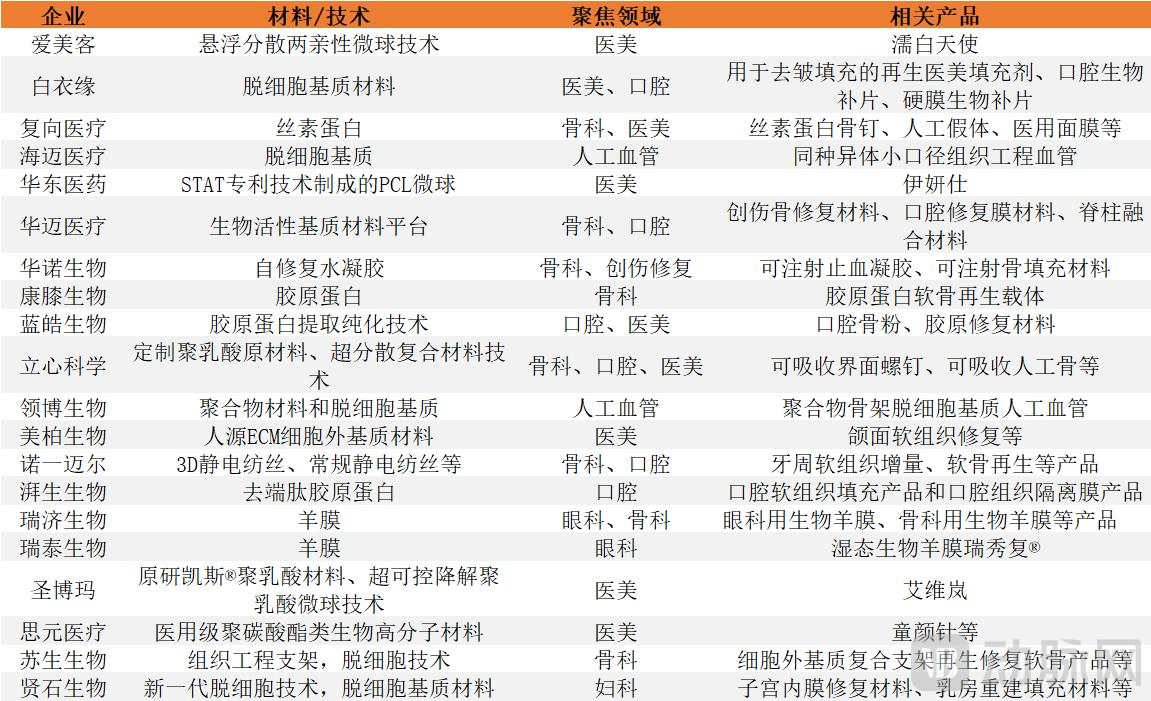
Emerging companies in the field of tissue regeneration materials are making significant investments in medical aesthetics and orthopedics.
Aesthetic Medicine: Multiple Tissue Regeneration Material Products Approved
The medical aesthetics industry has experienced rapid growth in recent years. According to the “Gengmei 2021 White Paper on the Medical Aesthetics Industry,” the domestic market size for medical aesthetics in China was approximately RMB 227.4 billion in 2021, and is projected to reach RMB 264.3 billion in 2022.Upstream dermal fillers in the medical aesthetics industry are undergoing an upgrade and iteration, transitioning from hyaluronic acid to regenerative materials such as collagen, polylactic acid, and poly-L-lactic acid.
Three medical aesthetic dermal filler products for wrinkle reduction, based on tissue regeneration materials, have been approved for market launch in China. They are Ellansé (the “Girl’s Needle”) under Huadong Medicine, Aweless (the “Baby Face Needle”) developed by Shengboma, and Ru Bai Angel (the “Baby Face Needle”) under Imeik. Among these, Ellansé utilizes polycaprolactone, Aweless uses polylactic acid, and Ru Bai Angel employs poly-L-lactic acid. These products have already secured a certain share of the market. Notably, Ellansé has signed cooperation agreements with over 500 hospitals, generating RMB 157 million in revenue in the first quarter of 2022.

Domestically Approved Aesthetic Medicine Products Based on Tissue Regeneration Materials
Furthermore, medical aesthetic products based on tissue regeneration materials such as polyhydroxyalkanoates (PHA), decalcified bone matrix, and acellular dermal matrix are under development, which will cover a broader range of indications. The state is also establishing national standards and innovation material platforms related to Type III collagen and silk fibroin, positioning Chinese enterprises to join the first tier in these novel materials.
Compared with hyaluronic acid, tissue regeneration materials provide a more natural and longer-lasting filling effect, while their safety has been validated. Polylactic acid, for instance, has a decades-long history of clinical application. Its degradation products in the body can be completely metabolized without causing side effects. It has been widely used in surgical sutures, absorbable bone screws, controlled-release drug formulations, and medical aesthetic fillers, with its biosafety fully recognized.
Meanwhile, polylactic acid (PLA) is a chemically synthesized polymer material that can achieve high purity and poses no risk of immunogenicity. Aesthetic medicine fillers developed based on PLA can stimulate the body’s immune system, modulate immune cells, and further induce fibroblasts to upregulate collagen secretion, thereby promoting the regeneration and repair of skin tissue.
For the application of tissue regeneration materials in the field of medical aesthetics, the challenge lies not only in manufacturing processes or product development, but also in regulation and compliance. The risk-benefit ratio is a key focus for medical products, especially since aesthetic medicine products are applied to healthy individuals, which inherently increases risk without an underlying pathological condition; therefore, there must be clear and significant benefits. However, the medical aesthetics industry has certain consumer-driven characteristics, leading to a mixed market quality. Some unapproved tissue regeneration material products are circulating in the market, indicating a need for strengthened regulatory oversight in the future.
Orthopedics: Cartilage Regeneration, a White Space in China, Is a High-Potential Sector
With the accelerating aging of China’s population and the continuous rise in medical demand, the bone repair market in China is expanding steadily. According to data from Medii Research, the Chinese bone repair materials market is projected to reach RMB 9.7 billion in 2023, among which the orthopedic bone defect repair materials segment will account for RMB 5.34 billion, the dental bone implant materials segment will reach RMB 2.60 billion, and the neurosurgical cranial defect repair materials segment will amount to RMB 1.75 billion.
Traditional bioinert biomaterials remain the mainstay of orthopedic implants, while the proportion of tissue-regenerative materials in orthopedic implants is rising rapidly.Bone repair and regeneration materials are similar in composition and structure to human bone tissue. After implantation, human bone tissue grows within the porous structure of the material, forming osseointegration as well as vascularized and innervated structures. As the implanted material gradually degrades and new bone mass continuously increases, the repair and regeneration of bone tissue are achieved.
Cartilage regeneration is a major challenge in the field of orthopedic repair and regeneration.Cartilage is a highly differentiated tissue composed of abundant, highly ordered chondrocytes and extracellular matrix. It lacks sensory, motor, or autonomic innervation and is avascular. Its nutrient supply and waste removal are heavily dependent on synovial fluid. Progenitor cells with self-repair capacity have difficulty reaching the site of injury; consequently, once hyaline cartilage is damaged, its intrinsic repair capability is very limited.
There is an urgent market need for cartilage regeneration products. Regenerative medicine technologies offer hope for cartilage regeneration by seeding high-concentration “seed” cells cultured in vitro onto tissue regeneration materials to form a composite, which is then implanted into the cartilage defect. As the biomaterial degrades on its own, the seeded “seed” cells generate new cartilage to fill the defect.
As can be seen, among regenerative medicine companies deeply engaged in the orthopedic field, most have prioritized cartilage regeneration as their key focus. In October 2022, Susheng Biotechnology’s xenogeneic cartilage extracellular matrix scaffold, characterized by high porosity and strong mechanical properties, facilitates the infiltration of chondrocytes, enabling uniform cell attachment and growth within the scaffold. This effectively promotes the formation of hyaline cartilage and can be accomplished solely through minimally invasive arthroscopic surgery. The company’s research received the Young Scientist Award at the 37th World Congress of Sports Medicine.
Clinical Application of Tissue Regeneration Materials Combined with Living Cells Is a Significant Growth Driver
Beyond aesthetic medicine and orthopedics,There is currently very high anticipation for the clinical application of tissue regeneration materials combined with living cells, and stem cells will be one of the key development directions for some companies in the tissue regeneration materials sector.For example, Susheng Biotech has established a comprehensive clinical-grade system for the preparation and application of stem cells. Building on its composite scaffold products, the company combines stem cell technology to engineer more regenerative artificial "living" tissues, thereby delivering superior repair and regeneration outcomes for severely damaged soft tissues.
Overall, the application of tissue regeneration materials is still in its early stages. In the future, development will continue to focus on two main directions: first, targeting relatively mature fields to replace and upgrade traditional medical materials; for instance, in the medical aesthetics market, products such as "baby face injections" and "maiden injections," which are based on tissue regeneration materials like polylactic acid (PLA) and polycaprolactone (PCL), are replacing hyaluronic acid fillers. Second, exploring untapped markets by developing solutions for major clinical diseases, such as cartilage repair, kidney regeneration, and myocardial regeneration.
We extend our sincere gratitude to Lan Hao Biotech and Nanjing Siyuan Medical Technology Co., Ltd. for their strong support of this article.