

Chinese CPAP Market Leader Y&H Healthcare Surges Overseas Sales 8-Fold, Launches IPO
On June 14, 2021, a recall announcement by foreign media became major news in the ventilator industry.
Due to the health risks posed to users by polyester-based polyurethane (PE-PUR) sound-abatement foam used in certain ventilator devices when improperly cleaned or exposed to high temperatures, Philips recalled or repaired more than 5 million units within a year.
The R&D and sales cutbacks triggered by this incident, coupled with a temporary supply gap in the market, have presented peers with unprecedented opportunities. BMC, a leading domestic player in home non-invasive ventilators and ventilation masks, is among the beneficiaries.
According to the prospectus, BMC experienced a significant decline in revenue in 2020 due to suppressed demand for sleep ventilators during the COVID-19 pandemic. However, in 2021, Philips’ voluntary recall presented BMC with an unprecedented opportunity for overseas expansion. Seizing this opportunity, BMC increased its North American revenue eightfold, from RMB 22 million to RMB 178 million, making North America its largest market.
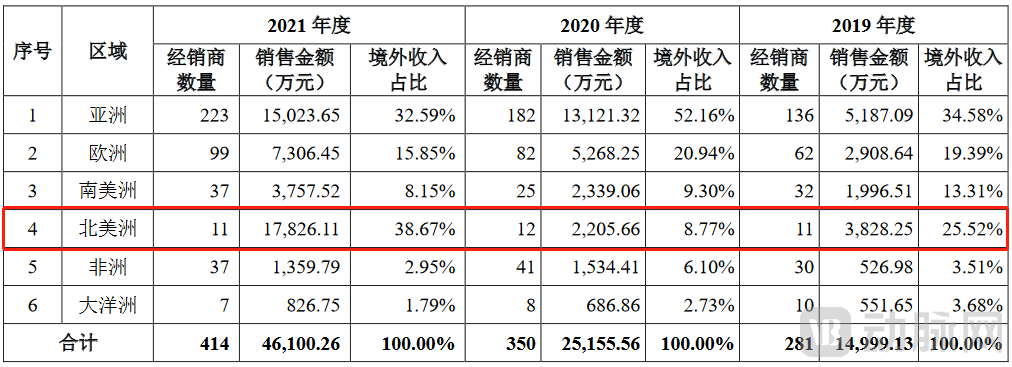 Revenue Distribution by Region for BMC
On November 1, 2022, BMC, a company in its growth phase, took another milestone step. The company will list on the ChiNext board at an issue price of RMB 119.88 per share, officially entering the secondary market.
At this new stage, what are the risks and opportunities for BMC to continue its past success?
Like most domestic medical device companies, BMC has maintained a steady upward trajectory over its 20 years of development, transitioning from refining its presence in the Chinese market to exploring commercialization across multiple global regions. The company has evolved from offering a single sleep monitoring product to developing a diversified sleep and respiratory care ecosystem.
Both of its two major changes occurred after 2020. The first was the Philips recall incident, which reversed the declining demand trend for BMC’s overseas business and drove sustained, rapid growth. The second was the COVID-19 pandemic.
Hypoxia is a common manifestation observed in COVID-19. As patients progress from mild to severe disease, they typically experience a progression from tachypnea to dyspnea, characterized by deep, rapid, and labored breathing, often accompanied by a sensation of chest tightness and severe shortness of breath. Furthermore, hypoxia can lead to cyanosis and is frequently associated with restlessness, anxiety, and diaphoresis.
The impact of COVID-19 has led to a sharp increase in demand for ventilators among hospitals and individuals both domestically and internationally. For patients with mild symptoms, ventilators can provide non-invasive ventilation to ensure adequate oxygenation, while also reducing the workload of healthcare workers and lowering the risk of infection. For critically ill patients, if their condition does not improve or even worsens within a short period (1–2 hours) despite high-flow nasal cannula oxygen therapy or non-invasive ventilation, timely endotracheal intubation and invasive mechanical ventilation should be initiated.
The ongoing pandemic has accelerated the rapid market adoption of ventilators. During March and April, the peak months of the outbreak, the price of a single ventilator surged by tens of thousands of yuan.
The surge in demand for ventilators doubled BMC’s 2020 domestic revenue from RMB 51.87 million to RMB 131.21 million, representing a 118.37% increase, while its gross profit margin rose from 43.24% to 64.87%.
Currently, the level of attention people pay to ventilators has not diminished. Whether it is the concern of ordinary residents about the occurrence of potential diseases, or the preparedness of the public health system for future infectious diseases, both are driving the market to further purchase respiratory products.
As revealed in the prospectus, BMC’s business segments all maintained growth in 2021, with home non-invasive ventilators registering a 22.5% increase, outpacing the industry’s market size growth rate of 15.5%.
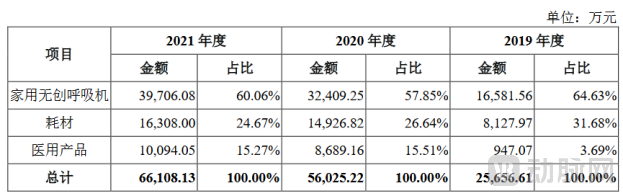
BMC Revenue Composition
Overall, propelled by the synergistic effects of the booming domestic market for home non-invasive ventilators and the substitution opportunities in overseas markets, BMC has entered a fast lane of development.
According to Frost & Sullivan, BMC ranked third in sales revenue in China’s home non-invasive ventilator market in 2020, trailing only the international brands Philips Respironics and ResMed. In terms of export sales revenue for home non-invasive ventilators from China in 2020, the top three domestic companies were BMC (40.5%), Yuwell Medical (35.9%), and Ronxin Medical (19.2%), with BMC capturing more than one-third of the export market share. Following rapid development from 2021 to 2022, BMC’s market share is expected to rise further.
However, despite having established its position in the international market and receiving capital support, BMC still faced skepticism from some institutions during its IPO process.
Some investors believe that BMC has valued itself at RMB 7.672 billion based on a price-to-earnings (P/E) ratio of 56.75x, which appears excessively high compared to the industry average P/E ratio of 33.1x as reported by the China Securities Index Co., Ltd.
Concerns about market capitalization are not unfounded; before BMC can realize its bright prospects, two issues remain to be addressed.
First, there is the issue of patents.
As BMC began to expand into overseas markets, it signaled a direct commercial confrontation with international giants such as ResMed and Philips Respironics.
ResMed was the first to take legal action. In May 2013 and April 2016, ResMed filed lawsuits separately with the U.S. District Court for the Central District of California, alleging that the ventilators and mask products sold in the United States by BMC and 3B Company (BMC’s U.S. distributor) infringed its patents;
In May 2013, July 2013, and April 2016, ResMed successively filed complaints with the U.S. International Trade Commission (ITC) under Section 337 of the Tariff Act of 1930, requesting investigations into alleged unfair competitive practices by BMC and 3B Company in import trade (Section 337 Investigations).
The patent dispute has spread from the United States to Germany and ultimately extended to China. In Germany, ResMed filed patent infringement lawsuits against BMC, alleging that BMC’s nasal cushion masks and ventilators infringed its patents. In China, ResMed initiated legal proceedings against BMC, seeking invalidation of BMC’s patents and claiming patent infringement related to ventilators.
Among the 22 lawsuits filed across three countries over a four-year period, the vast majority were concluded with BMC prevailing or reaching settlement agreements that led to their discontinuation. Only one lawsuit, initiated in Germany, resulted in a loss for BMC, with the court issuing a permanent injunction against the company’s product involved in the case (a home-use ventilator).
In this case, BMC explained that it adopted a passive strategy in response, given that the proceedings concluded on June 14, 2014, less than six months before the expiration of the patent in suit, EP0661071B1 (on November 27, 2014). Therefore, BMC deemed it unnecessary to continue the dispute for those remaining six months.
Although BMC consistently prevailed in court, ResMed’s litigation strategy still slowed BMC’s overseas expansion and forced it to expend significant resources on financial and brand-related matters.
The patent battle was temporarily resolved through a settlement agreement. In January 2017, BMC and ResMed signed an agreement stipulating that, from the effective date of the agreement until December 31, 2021, neither party would initiate any patent challenges, including patent litigation, patent invalidation proceedings, or patent oppositions. Throughout this process, ResMed spent over RMB 35 million on litigation costs in exchange for four years of peace.
Now that the settlement agreement has expired, BMC has also stated that there are no longer any patent disputes with ResMed concerning its core businesses. However, for investors, BMC’s growing overseas operations will still face significant competition, which implies the ongoing possibility of future disputes.
Next is the issue of research and development.
Although BMC has established a distributor network with robust risk resistance both domestically and internationally, the company still has room for improvement in product research and development.
According to the prospectus, BMC’s ventilators rely entirely on externally sourced core components and raw materials, with only the core software developed in-house. Key consumables and their constituent parts—such as scheduling components, safety valves, cushions, and headgear—are also procured from external suppliers.
This implies that the company faces certain risks regarding its technological barriers, with equipment pricing and supply subject to fluctuations in upstream components, thereby making it heavily reliant on supply chain stability.
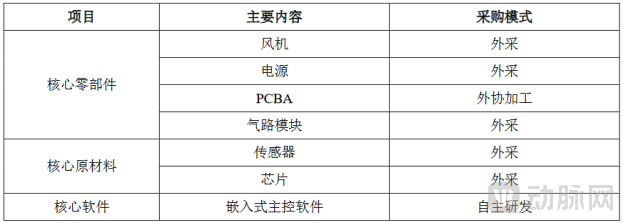
Procurement Models for Core Components, Raw Materials, and Software of Home Non-Invasive Ventilators and Medical Respiratory Diagnostic and Therapeutic Products
According to the primary uses of the funds raised by BMC in 2020, the company will invest RMB 191.04 million in medical device research and development in the next phase, slightly exceeding the RMB 190 million allocated for production line expansion. This may help address, to some extent, the shortcomings currently faced by the company.
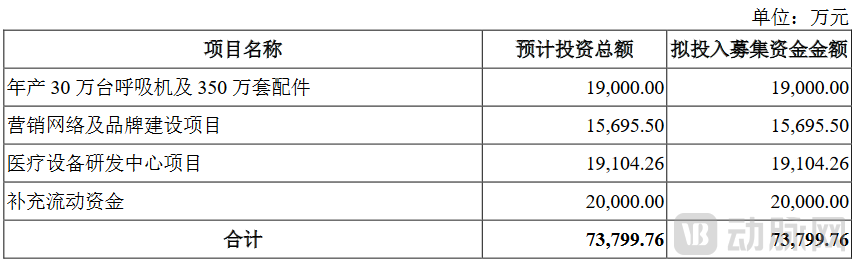 Use of Funds by BMC
Based on BMC’s 2021 production performance, its ventilator installed base has reached 300,000 units, with annual output exceeding 350,000 units. With the influx of new capital, BMC’s production capacity and output are poised for significant further growth.
Where is the newly added production capacity and output directed? Key destinations include overseas markets led by the United States, as well as the domestic consumer (B2C) market.
According to BMC’s prospectus: “The impact of competitors’ product recalls has persisted since 2022, further boosting demand for the Company’s products in the U.S. market. The Company expects its revenue from January to September 2022 to range from RMB 1.018 billion to RMB 1.048 billion, representing a year-on-year increase of 124.43% to 131.04%; net profit attributable to shareholders of the parent company is projected at RMB 262 million to RMB 279 million, reflecting a year-on-year growth of 120.91% to 135.26%.”
In short, BMC will continue to capture the market share left by its competitors, and the partnership with its U.S. distributor, 3B Company, will serve as the primary driver of new revenue growth.
Equally noteworthy are BMC’s achievements in the European market. Over a two-year period, its revenue in this region rose from RMB 29.09 million to RMB 73.06 million. Leveraging its successful experience in the U.S. market, BMC is well-positioned to make further strides in Europe. At that point, the company’s overseas revenue share could exceed 75%.
Consumer-facing health management is BMC’s second growth curve. In BMC’s vision, the company aims to establish itself as the preferred global platform for respiratory health management, completing its transformation from a pure medical device manufacturer into an integrated medical device and internet healthcare enterprise.
BMC’s current market position undoubtedly supports this decision. Coupled with the deepening aging of the population and the expanding prevalence of chronic diseases, there is a growing demand among patients with respiratory conditions for high-quality ventilator products. BMC is highly likely to achieve significant success in the blue-ocean sector of respiratory and sleep health management.
The support of the internet healthcare concept may partly explain BMC’s high P/E ratio, but whether these potential capabilities can be monetized remains to be verified over time.