

China Launches First-Ever Provincial Consortium Procurement for Traditional Chinese Medicine Decoction Pieces with 'Quality-First, Not Price-Cutting' Approach
On October 31, the Traditional Chinese Medicine (TCM) Materials Section of the Sanming Procurement Alliance—namely, the official website of the Shandong Internet TCM (Materials) Trading Center (www.bqex.com)—released the “Joint Procurement Document for TCM Decoction Pieces by the Inter-provincial TCM (Materials) Procurement Alliance under the Sanming Procurement Alliance (Draft for Comments)” (hereinafter referred to as the “Draft for Comments”), initiating a public consultation period. This marks a new phase for the first-ever national joint procurement of TCM decoction pieces, organized by the Inter-provincial TCM (Materials) Procurement Alliance under the Sanming Procurement Alliance and led by Shandong Province. The industry will see the emergence of a new landscape characterized by government-promoted joint procurement and market-oriented transparent procurement. The “quality assurance, grade improvement, and stable supply” model will comprehensively drive the overall upgrading of the TCM decoction pieces industry.
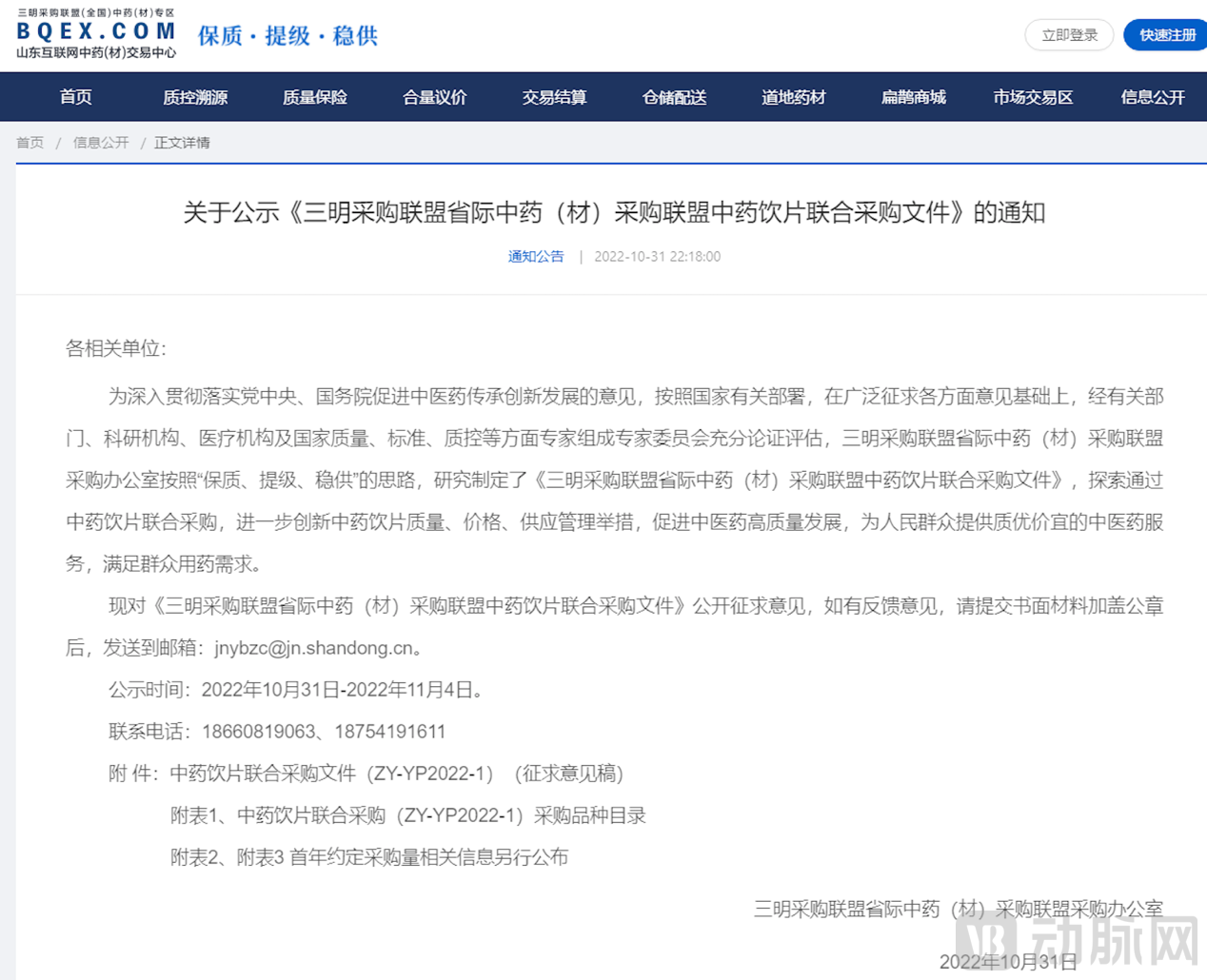
Figure | Draft for Comments on the Joint Procurement Documents for Traditional Chinese Medicine Decoction Pieces
Over Ten Provinces Launch Initial Pilot Program for 21 Types of Herbal Slices, Promoting “Premium Quality at Premium Prices”
In the days leading up to the release of the Draft for Comments, the Information Office of the Shandong Provincial People’s Government held a press conference to introduce policies and initiatives supporting the inheritance, innovation, and development of Traditional Chinese Medicine (TCM) under Shandong’s medical insurance scheme, revealing that China’s first inter-provincial centralized procurement of TCM decoction pieces is imminent. Qiu Bingyu, First-Level Inspector at the Shandong Provincial Healthcare Security Administration, stated that in response to issues such as significant quality variations, high price volatility, unstable supply, and irregularities in the production and distribution markets of TCM decoction pieces, Shandong will take the lead this year in launching China’s first inter-provincial centralized procurement pilot program, initially covering 21 types of TCM decoction pieces with high clinical demand.
According to the "Draft for Comment," regions including Shandong, Shanxi, Inner Mongolia, Jilin, Heilongjiang, Anhui, Fujian, Jiangxi, Hunan, Yunnan, Tibet, Qinghai, Ningxia, Xinjiang, and the Xinjiang Production and Construction Corps will participate in the inaugural centralized procurement of traditional Chinese medicine (TCM) decoction pieces, either at the provincial level or by selected cities. This joint procurement covers 42 specifications across 21 varieties. It is reported that 21 varieties with high demand and reliable supply guarantees were selected as the first batch of pilots for the centralized procurement of TCM decoction pieces. Following the official launch, the scope of varieties and participating regions will be gradually expanded, accelerating the promotion of a broader range of varieties nationwide.
Notably, the Draft for Comments puts forward the core principle of “ensuring quality, upgrading standards, and stabilizing supply,” clarifying that its objective is not merely to reduce prices. The proposed concept of “premium quality at premium prices” will drive high-quality development across the entire traditional Chinese medicine (TCM) industry. We note that, with regard to TCM decoction pieces slated for upcoming centralized procurement, the procurement plan in the Draft for Comments sets forth detailed requirements for supplying enterprises in areas such as quality control, traceability systems, planting bases, authentic production regions, and supply capacity, alongside specifications on execution standards, characteristic descriptions, product coding, and grade classifications. These measures will enhance the market competitiveness of TCM decoction pieces from authentic production regions and high-quality enterprises, thereby fostering the healthy development of the TCM sector under the “premium quality at premium prices” model.
The application process for this joint procurement will be conducted online. All qualification documents must be submitted electronically. Participating enterprises are required to log in to the trading platform (the official website of Shandong Internet Traditional Chinese Medicine (Materials) Trading Center at www.bqex.com) within the specified timeframe to register, obtain a Certificate Authority (CA) certificate, enroll in the program, and upload qualification materials. The shortlisting results and the final selection results will both be published on the trading platform. After qualifying for the bidding phase, enterprises must also submit product samples within the designated period and maintain corresponding drug information, inspection reports, and other documentation on the trading platform for expert review of quality grade compliance.
The joint procurement plan indicates that candidate drugs for selection will be determined through two stages: comprehensive evaluation and competitive bidding. It also establishes a backup supply mechanism and supplementary procurement measures. The pricing and scoring rules fully account for the unique characteristics of Chinese herbal materials as special agricultural products, offering preferential policies to large-scale cultivation bases of authentic (Daodi) herbs. This approach guides standardized and regulated cultivation of Daodi herbs, holding significant importance for enhancing the clinical efficacy of Traditional Chinese Medicine (TCM), ensuring the long-term stability of the TCM industry, and achieving “quality assurance, grade improvement, and stable supply.” Furthermore, it will support the implementation of the national rural revitalization strategy and increase the income of Chinese herbal material growers.
Leverage the advantages of digital platforms to promote “quality assurance, grade improvement, and stable supply”
The Sanming Procurement Alliance is a significant achievement of the Sanming healthcare reform and serves as an important complementary force to national and provincial centralized procurement. In October 2021, the State Council’s Leading Group for Healthcare Reform issued the “Implementation Opinions on Deepening the Promotion of Fujian Province’s Sanming City Experience to Further Reform the Pharmaceutical and Healthcare System” (Guo Yi Gai Fa [2021] No. 2), which explicitly stated that “localities are encouraged to join the ‘Sanming Procurement Alliance.’” In January this year, the Shandong Internet Traditional Chinese Medicine (Materials) Trading Center, acting as the Traditional Chinese Medicine (Materials) Special Zone of the Sanming Procurement Alliance, launched the nation’s first joint procurement of traditional Chinese medicine decoction pieces (including formula granules).
Leveraging the advantages of its digital trading platform, the Shandong Internet Traditional Chinese Medicine (TCM) Materials Trading Center has established five core systems—quality control and traceability, quality insurance, volume-based price negotiation, transaction settlement, and warehousing and distribution—to address industry pain points such as inconsistent cross-regional standards, unstable quality of TCM materials, and significant price fluctuations. By actively promoting the development of a unified national market for TCM material circulation, the center aims to achieve "quality assurance, grade enhancement, and stable supply" of TCM materials across China.
To achieve the goals of “ensuring quality, upgrading standards, and stabilizing supply” in the centralized procurement of processed traditional Chinese medicine (TCM) decoction pieces, it is essential to first establish unified quality standards recognized across regions to address issues related to quality standardization and quality control. Secondly, on the basis of ensuring quality control, the principle of “premium quality at premium prices” should be implemented, rather than pursuing price reductions alone. Meanwhile, it is also necessary to resolve the problem of unstable supply prices for TCM decoction pieces caused by fluctuations in the market conditions of raw TCM materials at the source.
In practice, relying on five core systems and centering on the core demands of “effective quality control” and “high quality at fair prices,” the Shandong Internet Traditional Chinese Medicine (Herbal Materials) Trading Center has adopted a unified operational model encompassing six aspects—warehousing, logistics, quality assurance, inspection, operations, and settlement—thereby achieving full-process quality control and end-to-end quality assurance for traditional Chinese medicine (herbal materials) in terms of quality preservation, grade enhancement, and stable supply.
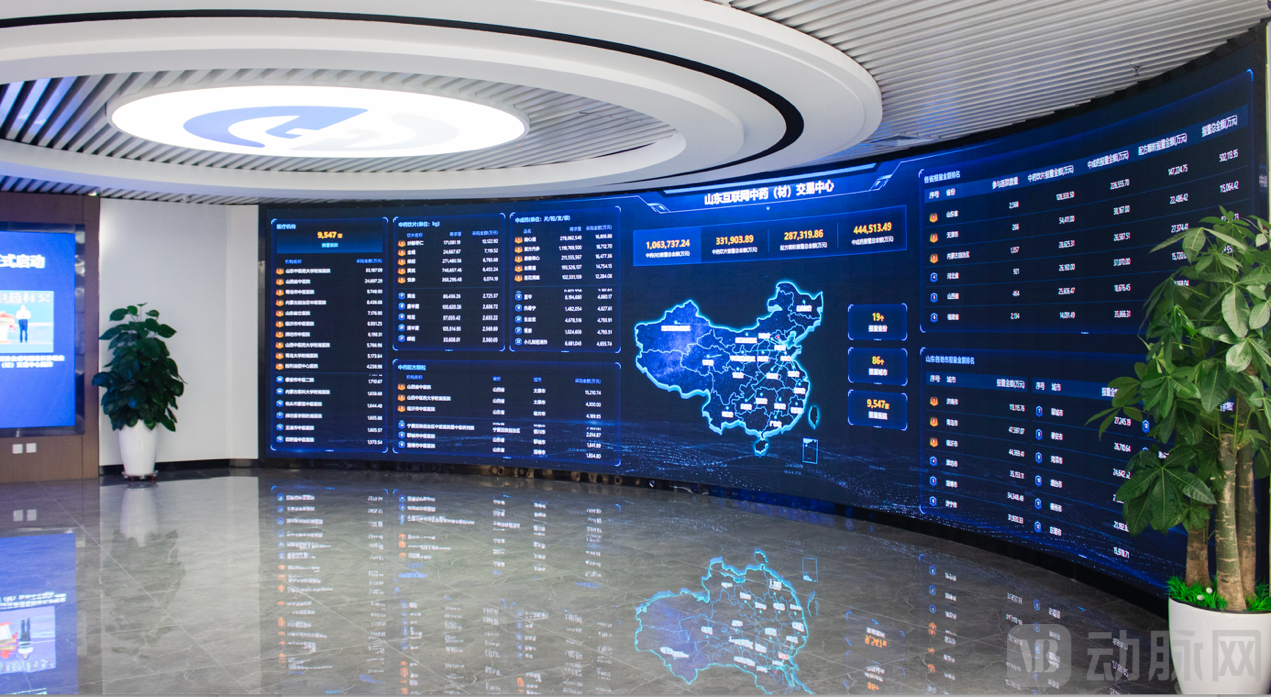
Figure | Shandong Internet Traditional Chinese Medicine (Herbal Materials) Trading Center
On one hand, the Shandong Internet Traditional Chinese Medicine (TCM) Materials Trading Center has formulated and promoted industry-recognized standards for high-quality TCM decoction pieces. Through competitive participation by enterprises, it has selectively established a supply of high-quality, affordably priced TCM decoction pieces sourced from certified planting bases with full-process traceability. Furthermore, measures such as quality insurance and retention sample comparison are implemented to safeguard product quality, enabling centralized procurement of TCM decoction pieces to significantly enhance the quality of selected products while maintaining price stability.
On the other hand, by leveraging the advantages of digital platforms, the Shandong Internet Traditional Chinese Medicine (Herbal Materials) Trading Center connects stakeholders across the upstream and downstream supply chains. It has achieved automated data collection, recording, and monitoring throughout the entire process—from planting and harvesting to processing and decoction piece preparation, and from finished product testing to warehousing—enabling “one-code traceability.” Furthermore, it has established a rational and orderly circulation system aligned with the needs of centralized procurement, attracting reputable insurance, testing, and warehousing logistics institutions to join the trading platform. This will significantly promote the digital transformation of the traditional Chinese medicine (TCM) industry. In the long run, this will have a profound impact on the standardization and high-quality development of the TCM sector.