

China's First Bioartificial Liver Receives IND Approval: HepaCure Plasma Bio-Purification Column by Weizhizhuo Granted NMPA Clearance
On November 1, 2022, Shanghai Weizhizhuo Biotechnology Co., Ltd. (hereinafter referred to as “Weizhizhuo”), a biopharmaceutical technology company specializing in cell therapy and regenerative medicine for liver diseases, announced that the Center for Drug Evaluation (CDE) of the National Medical Products Administration (NMPA) had approved its Investigational New Drug (IND) application (Acceptance No.: CXSL2200373) for clinical trials in China. The application pertains to its independently developed, globally innovative bioartificial liver product—the Plasma Bio-purification Column—for the treatment of acute-on-chronic liver failure (ACLF) caused by chronic hepatitis B and other conditions.
Weizhizhuo’s plasma bio-purification column is a drug-device combination product primarily based on cell therapy and serves as the core component of the bioartificial liver system. This marks the imminent entry of China’s first bioartificial liver product into domestic registration clinical trials. Reportedly, it is also the only bioartificial liver product worldwide to have entered the clinical stage.
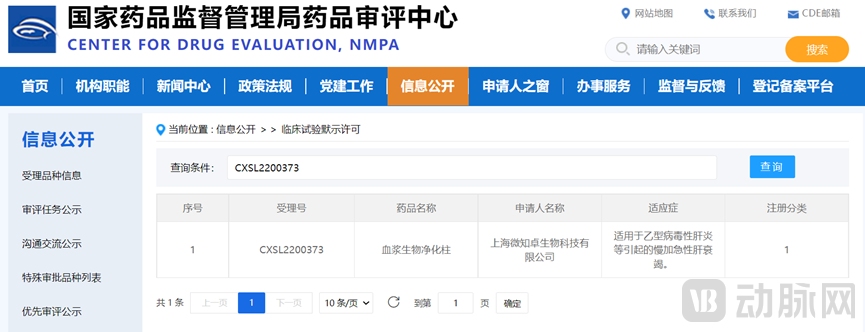
China bears a heavy burden of liver disease, with critical conditions such as liver failure severely impacting public health. Statistics indicate that there are approximately 120 million hepatitis B virus carriers in China, with an estimated annual incidence of over 500,000 new cases of liver failure. Moreover, the 28-day mortality rate for patients with acute liver failure is as high as 50%. The incidence and mortality rates of liver failure are no lower than those of any malignant tumor; however, current clinical treatment options for liver failure remain extremely limited, representing a significant unmet medical need. The bio-artificial liver product developed by Weizhuzhuo holds promise to become the most effective and accessible therapeutic solution for patients with liver failure.
In 2011, Professor Hui Lijian’s team at the Institute of Biochemistry and Cell Biology, Chinese Academy of Sciences, achieved a breakthrough in the in vitro culture technology for “hepatocyte-like cells.” Using internationally leading direct transdifferentiation technology, they converted human autologous fibroblasts into hepatocyte-like cells (hiHep cells) capable of clearing toxins and synthesizing essential human proteins. This research was published in prestigious international journals such as Nature and Cell Stem Cell, and was honored as one of the “Top Ten Scientific Advances in China” in 2011. The project received support from the Chinese Academy of Sciences’ Strategic Priority Research Program, the Hongguang Special Project, the Ministry of Science and Technology’s National Major Special Project, and the Shanghai Innovation Leadership Plan. This technology successfully achieved, for the first time, the transdifferentiation of human fibroblasts into hepatic parenchymal cells and realized large-scale expansion in vitro, making it truly feasible to apply bioartificial liver systems in clinical practice and achieve industrialization. Prior to entering registered clinical trials, more than ten investigator-initiated clinical studies were completed, demonstrating significant efficacy, marked improvement in patients’ conditions, and a substantial increase in survival rates.
Dr. Pan Guoyu, Founder and Chairman of Weizhi Zhuo, stated, “We are delighted that the Investigational New Drug (IND) application for our plasma bio-purification column has been approved by the NMPA, which signifies regulatory recognition and support for innovation. Our team will continue to strive to advance clinical development, bringing hope to numerous patients with severe liver disease.”
Plasma Bio-purification Column (HepaCure Biocolumn, hereinafter referred to as HepaCure) consists of human induced hepatocyte products (human induced hepatocytes, hereinafter referred to as hiHep cells) and a cell cartridge, serving as the core component of the bio-artificial liver system. The main active ingredient in this product, hiHep cells, exhibits a gene expression profile similar to that of human primary hepatocytes and acquires in vitro liver functions, such as the secretion of liver-specific proteins and drug metabolism. hiHep cells maintain the expression of liver genes and in vitro liver functions even after expansion. In clinical use, the hiHep cells within the Plasma Bio-purification Column exchange substances with human plasma via extracorporeal dialysis, thereby purifying the plasma of patients with liver failure and exerting a therapeutic effect.
Liver failure is a severe liver injury caused by multiple factors, leading to significant impairment or decompensation of functions such as synthesis, detoxification, excretion, and biotransformation. It presents as a clinical syndrome characterized primarily by coagulation disorders, jaundice, hepatic encephalopathy, and ascites. In China, the primary cause of liver failure remains hepatitis viruses (particularly the hepatitis B virus), which is also the most common cause of death from liver disease in the country. The clinical presentation is predominantly acute-on-chronic liver failure (ACLF). Liver failure can also be triggered by drugs or hepatotoxic substances (such as alcohol, natural toxins, and synthetic chemical reagents), acute fatty liver of pregnancy, autoimmune liver diseases, and parasitic infections.
Shanghai Weizhizhuo Biotechnology Co., Ltd., established in 2015, is a biopharmaceutical company specializing in cell therapy and regenerative medicine for severe liver diseases. Leveraging internationally leading technologies in cell differentiation and production, the company is dedicated to developing the world’s most advanced innovative biomedical technologies and products to provide superior clinical solutions for patients.