

Wang Hang of Haodf Online: New Opportunities for Pharmaceutical and Retail Enterprises in the Internet Era
On November 1, 2022, Wang Hang, founder and CEO of Haodf.com, was invited to attend the 15th China Health Industry (International) Ecological Conference (Xipu Conference) and delivered a keynote speech at the “High-Level Forum on New Medical Retail.”

This year marks the 15th consecutive edition of the Xipu Conference, themed “Building a Concentric Circle of Patient Value: Dual-Engine Development Driving New Growth in the Health Industry.” The Xipu Conference is a highly forward-looking industry conference in China’s health sector, bringing together leading institutions from mainstream fields such as pharmaceuticals, commerce, capital, R&D, technology, healthcare, health services, and finance and insurance.
Wang Hang analyzed the opportunities and challenges facing the internet healthcare industry from the perspective of its development and value, suggesting that pharmaceutical and retail enterprises should seize new opportunities brought by industry transformation and actively participate in reshaping medical business processes around physicians’ needs.
Below is the full text of Wang Hang’s remarks (abridged):
Thank you for the invitation to the Xipu Conference. This is my first time attending, and I have gained valuable insights. Next, I will share some of Haodaifu’s explorations and reflections in the field of internet healthcare, and discuss the opportunities available to pharmaceutical and retail enterprises during the future integration of healthcare and the internet, as well as throughout society’s broader digital transformation.
Professor Chen Qiulin from the Health Industry Development Research Center of the Chinese Academy of Social Sciences has divided the healthcare industry into three major sectors:
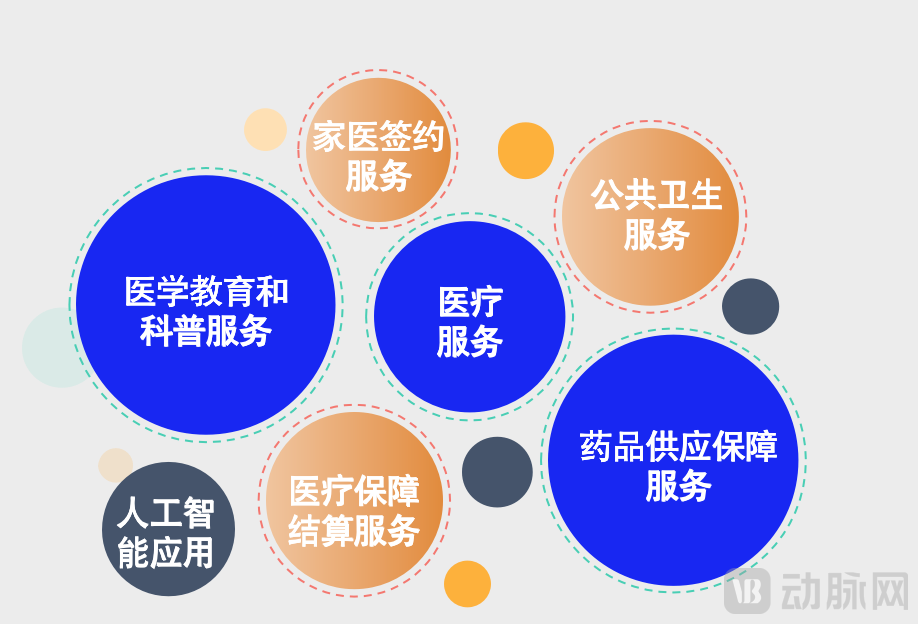
The first major segment encompasses medical education and science popularization services, medical services, and pharmaceutical supply assurance services. While the scope of medical services may appear relatively narrow, it occupies the central position within the entire healthcare industry. However, due to the substantial presence of public welfare-oriented services, its commercial scale is not particularly large. It is imperative to recognize that medical services constitute the core of the entire industry. The whole healthcare sector can be viewed as revolving around medical services, which must therefore be positioned at the core.
The second segment comprises public health services, medical insurance settlement services, and family doctor contract services, which are currently undergoing digital transformation, primarily driven by the government.
The third segment is artificial intelligence applications, which are currently in the early exploratory stage.
Medical services are the core of the entire industry, with physicians as the key operators. Internet healthcare essentially revolves around physicians’ practices, and Haodf Online positions itself as an online workplace platform for physicians.
Internet Healthcare Has Solved Three Key Problems for Doctors:
First, it has enhanced physicians’ organizational capabilities in their professional practice: previously, physicians’ work was entirely dependent on medical institutions; the internet era has granted them significant autonomy, empowered them with diverse resources, and opened up an entirely new career path.
Second, the enhancement of physicians’ capacity to intervene in patient care: Previously, physicians performed medical procedures only within hospital settings; once patients left the hospital, there was no further contact between physicians and patients. With the advent of the internet, physicians’ interventions have extended to pre-hospital and post-hospital phases, encompassing the entire disease course, all care processes, and even the full lifecycle of patients. This is achievable only in the digital and internet era.
Third, physicians’ ability to present themselves to and connect with the market has strengthened. In the past, physicians never directly engaged with the market, as reflected in the adage “physicians do not solicit patients.” The internet era has provided physicians with a unique form of empowerment, enabling them to interface directly with the market and with patients. As a result, their capacity for market visibility and connection has been fundamentally transformed.
Specifically, it encompasses the following six aspects:
First, service upgrades have expanded physicians' care for patients from the "points" of outpatient visits and the "segments" of inpatient stays to a full-process continuum covering pre- and post-hospital care.
Second, patients’ understanding of physicians has evolved. Previously, patients could only consult doctors in person at hospitals; now, they can learn about physicians through online platforms.
Third, physicians’ proactivity has increased significantly. Their approach to managing outpatient services is fundamentally different from before. Previously, they could only wait for patients in the consultation room; now, with an established online professional brand, they can leverage the internet as a gateway to precisely attract and engage patients.
Fourth, the “ammunition” supply has been upgraded. In the past, physicians could only access hospital pharmacies, but in the internet era, they can establish their own pharmacies based on their clinical needs.
Fifth, communication among physicians will become more flexible; two physicians can also form a medical alliance. The mutual referral of patients between physicians is the foundation of the future physician market.
Sixth, income upgrade.
The first indicator is the implementation of two key national regulatory policies in June and September: the Detailed Rules for the Supervision of Internet Diagnosis and Treatment, released on June 9, and the Measures for the Supervision of Online Drug Sales, issued on September 1. These two documents target the two most critical segments within the aforementioned industry landscape—healthcare services and pharmaceutical supply, respectively—marking the entry of the entire industry into a phase of standardized development.
Another key indicator is the proliferation of internet hospitals affiliated with public hospitals. During the pandemic, public hospitals in Shanghai successively issued notices suspending in-person outpatient services, while informing patients that their internet hospitals remained operational. Internet hospitals have thus become a “standard feature” for public hospitals, particularly those at tertiary level or above.
The third bellwether is the call in the Report to the 20th National Congress of the Communist Party of China to “expand the supply of high-quality medical resources and promote their balanced regional distribution,” which will be the most central issue for China’s healthcare industry over the next five to ten years.
These three bellwethers constitute the focal points for the industry’s future development.
From physicians issuing prescriptions online, to pharmacists completing prescription reviews, and finally to the physicians’ own pharmacies, this stage holds immense potential for future innovation. Although physicians have issued the prescriptions,
This landscape encompasses DTP (Direct-to-Patient) pharmacies, a substantial number of hospital-adjacent retail pharmacies, and public hospital pharmacies. Why do public hospital pharmacies continue to exist? The primary reasons are medical insurance reimbursement policies and the availability of in-house hospital preparations. Large platform-level companies such as JD.com, Tmall, and Meituan will also remain significant players. Furthermore, a large number of hospital-adjacent pharmacies will persist, serving as the main component of online open platforms, which presents new opportunities for retail pharmacies. How can hospital-based pharmacies be integrated? Currently, many hospital pharmacies utilize errand-running services, and some hospitals have established direct partnerships with SF Express. This represents a crucial development direction for future retail enterprises, as this approach facilitates access to physicians’ prescriptions.
Having said so much, the main point we wish to convey is that in the future, all industry processes will be reshaped around the core of the healthcare sector—physicians and their work. Although everyone may interpret this industry from different perspectives in the internet era, the central focus remains on restructuring the industry around physicians.
Where physicians face challenges, new opportunities arise for us. In the internet era, the greatest challenge lies in the mismatch between medical services provided by physicians and patient expectations. The internet has cultivated increasingly high user expectations; on Taobao, consumers readily embrace attentive services such as personalized greetings (“Dear”) and free shipping. However, the level of service delivered by the physician community still falls far short of these expectations.
On the internet, patients have two major complaints: one is that doctors do not respond in a timely manner, and the other is that doctors’ responses are too brief. This is essentially an issue of doctors’ time and energy. Whoever can help doctors resolve these two “ultimate complaints” will unlock new opportunities.
What is the true solution? Physicians have already established their brands online, attracting a large number of patients who seek their services and converge around them. At this stage, it is necessary to establish a new team-based workflow, requiring a transformation in how physicians practice. Traditionally, offline consultations were conducted by physicians individually; only top-tier specialists and department chiefs had access to physician assistants. It is unrealistic to expect individual physicians to recruit their own assistants. How can we emulate the U.S. model, where each physician has their own assistant team? This remains the ultimate challenge.
Who will serve as physician assistants? In the United States, major universities offer standardized undergraduate programs for this role. In China, however, the issue of physician assistants cannot be resolved within the public healthcare system; they will inevitably come from outside the system. There is no shortage of suitable candidates for physician assistant roles in the private sector. As we previously discussed, private-domain traffic and the transition of pharmaceutical sales representatives present significant opportunities. We must support physicians by participating in the patient care process, helping them achieve the goal of improving patient satisfaction.
We predict that the ultimate model will be crowdsourcing, with a large number of service personnel participating in the process of doctors serving patients. Only the crowdsourcing model can drive improvements in service satisfaction and expand the scale of high-quality medical services overall, thereby achieving the “expansion of high-quality medical resources” mentioned in the Report to the 20th National Congress of the Communist Party of China, and promoting the expansion of doctors’ service capacity through division of labor.
Participating in the West China Pharmaceutical Conference, I have two suggestions:
First, both industrial and retail enterprises must proactively engage with third-party platforms to be included in physicians’ drug formularies;
Second, professionals should proactively integrate into the physician team. For instance, in the past, physicians and nurses were not trained to adjust ventilators; only engineers from manufacturers possessed this expertise. Consequently, these engineers joined the clinical team. The expansion of such service scales represents a major future scenario, wherein physician service teams will comprise a diverse array of roles, including dietitians, rehabilitation therapists, technicians, pharmacists, and physician assistants, among others.
For all pharmaceutical supply companies, it does not matter if they cannot enter hospital pharmacies or participate in centralized volume-based procurement; as long as they can access physicians’ own pharmacies, they can align with physicians’ prescriptions, which presents a significant opportunity.
What are the challenges? The internet era is an era without privacy, where everything is placed under the spotlight. In the next era, the rationality of physicians’ medication practices will be more subject to public scrutiny, and all internet platforms must adapt to patients’ needs. For instance, Haodf Online has introduced a scoring system for medication rationality because patients demand such metrics. If we do not provide them, other platforms will; those who do will better align with patient needs. In essence, the entire internet platform ecosystem must cater to the needs of patients and end consumers.
Another misconception: Is it necessary for an industrial enterprise to build its own internet hospital?
I do not recommend this approach. Each professional should simply fulfill their responsibilities within their respective domains. Service platforms driven primarily by pharmaceutical sales have no viable future, as such a model inevitably prioritizes meeting sales targets, encouraging physicians to write more prescriptions, and increasing product promotion. Instead, service platforms should make customer satisfaction their sole objective, with all participants focusing on executing their designated roles effectively.
The underlying logic of internet-based healthcare lies in patients’ expectations for high-quality services. Reasonably meeting these expectations for premium medical care is the optimal approach and represents the ultimate goal of all services in the internet era.