

Will Microgravity Labs Become the Next Billion-Dollar Frontier in Life Science Tools?
Recently, the successful entry of astronauts into the Mengtian Lab Module to carry out work has trended on social media. The frequent launches of spacecraft not only demonstrate national strength but also drive the advancement of aerospace technology. During this period, microgravity laboratories originating from space have come into public view as a tool for life sciences research.
Microgravity experiments can address challenges in the biopharmaceutical R&D processImpure Protein Crystals, 3D Cell Cultureand other issues, some experts believe that,Microgravity May Be a Promising Solution for Incurable Diseases. In microgravity, the influence of surface tension increases significantly, the effects of electromagnetic fields are also enhanced, and intermolecular forces play a more prominent role.
Currently, scientists are employing a multidisciplinary approach to continue exploring the effects of microgravity at various structural levels of organisms, including the molecular, cellular, organ system, and whole-organism levels.
So, where do the microgravity experimental environments for drug development come from? Is there potential market space for building microgravity laboratories? This article will start with the development history of microgravity laboratories, review the global development status of microgravity laboratories, and analyze the development prospects of microgravity laboratories in China.
Microgravity refers to an environment in which the apparent weight of a system is significantly less than its actual weight under the influence of gravity. In space, special environmental conditions includeMicrogravity, High Radiation, and High Vacuumetc., with microgravity being the most significant.
During experimental testing on Earth, certain parameters can be treated as independent variables, such as temperature and substrate concentration. These variables can be optimized, and their effects on dependent variables can be measured. However, gravity is a constant: across most of the Earth's surface, the gravitational acceleration is 9.81 m/s². In the drug development process, gravity-induced challenges include insufficient crystal purity, uneven protein structural arrangement, and the limitation of cell cultures to two-dimensional (2D) structures.
In space, the gravitational acceleration is approximately 1×10⁻⁶ m/s², which constitutes a microgravity environment. Generally, observable responses induced by microgravity can be categorized into direct or indirect effects. The direct effects of microgravity includePerceptible Acceleration SignalsorMeasurable Gravity Changes、Deformation (Tension, Bending, and Torsion)orDisplacement of Organs and Organelles, for example, astronauts on space stations experience a monthly bone demineralization rate of 1.7% due to unloading of the lower limb bones.
On the other hand, indirect effects refer toChanges induced by microgravity prior to the onset of direct effects.For example, in liquid culture media for in vitro testing, changes in the extracellular environment of bacterial growth can lead to reduced antibiotic susceptibility or increased toxicity. Both effects have been leveraged in new platforms for drug development.
Currently, microgravity is primarily applied in the following three aspects of drug development.
First, it is used forCell Culture for Predictive Disease Modeling. We know that in a microgravity environment, cells are influenced to alter their growth patterns. Cells cultured on Earth for observation typically expand in two-dimensional (2D) structures, whereas in microgravity, cells can develop into three-dimensional (3D) structures that mirror the architecture found in the human body.
Taking cancer cells as an example, a major reason why they remain difficult to conquer on Earth is that the critical threshold for their spread and growth cannot be determined. In biomedical research, the only way cancer cells sense each other is through mechanical forces, which evolved in a gravitational environment. By placing cancer cells in a microgravity environment, researchers can not only observe them in three-dimensional (3D) structures, but the absence of gravity also holds promise for inhibiting cancer cell division and metastasis.
Furthermore, research on hematopoietic and neural stem cells under microgravity conditions helps elucidate the mechanisms of stem cell proliferation and directed differentiation, which may make curing diseases such as leukemia and Alzheimer's disease no longer a challenge.
Second, it is used forModeling and Observation of Human Organ Diseases. The development of miniaturized, simplified human organ models can identify novel drugs for therapeutic use. In microgravity environments, scientists hope to culture specific adult stem cells to a more mature level, forming three-dimensional organoid structures.
Microgravity also leads to conditions such as immune dysfunction, bone loss, cardiovascular dysregulation, and skeletal muscle atrophy. Research into these microgravity-induced conditions can accelerate progress in chronic disease research, facilitating the analysis and testing of therapeutic interventions in models of accelerated aging or disease.
Third,Direct drug research, analyzing proteins and macromolecules, etc.. By conducting drug experiments in space, new breakthroughs may be achieved. Many molecules can form larger and better-organized crystals under microgravity, which helps scientists study the functions of molecules important to health and disease, such as natural proteins, hormones, or drugs.
Furthermore, microgravity can also be utilized inAdvancing Fluidics and Biotechnology.Microgravity has a significant impact on fluid dynamics, facilitating the study of complex factors associated with biomedical devices involving fluids—particularly at the nanoscale. Therefore, microgravity contributes toImproving Drug Delivery SystemsorHealthcare Diagnostic Tools。
In fact, microgravity is not a novel concept. As early as the last century, major powers began studying microgravity effects to support space exploration. NASA was the first to initiate research on space manufacturing technologies and remains the institution with the most significant research achievements to date. China is the second country to complete experimental validation of manufacturing-related technologies in microgravity environments. The European Space Agency (ESA) and the Russian Federal Space Agency (Roscosmos) have also invested substantial human and financial resources in this field, launching numerous related research projects.
In recent years, an increasing number of researchers have recognized the significant importance of microgravity in achieving scientific breakthroughs. A search conducted in the National Patent Information System for patents with “microgravity” included in the title or abstractThe number of patents surged from 21 in 2000 to 1,116 in 2022.(Data as of November 1, 2022).
When aerospace technology advanced to a certain stage, people began to ponder whether such space-oriented technologies could be transferred back to benefit humanity on Earth and meet human needs. In other words,Conducting research in microgravity environments serves not only space exploration but, more importantly, benefits life on Earth.
In the 1990s, NASA established the Fundamental Space Biology (FSB) program to leverage innovative biotechnologies and pioneer the application of new discoveries to development and exploration on Earth. The program identified cell and molecular biology, microbiology, organismal and comparative biology, and developmental biology as key disciplinary components for studying the effects of microgravity.
Relevant research in China has mainly focused on space-based protein crystal growth techniques and structural biology, space cell and tissue culture technologies, and space biological effects.
There have been numerous experiments in this field, with some progressing from basic research to large-scale commercial applications. International biopharmaceutical giants such as Merck & Co., Eli Lilly, Amgen, and AstraZeneca have all leveraged space platforms for commercial R&D, and a number of start-up biotech companies have also joined in,Biochips (organoids), artificial organs (e.g., artificial corneas, synthetic blood), protein research (antibodies, enzymes, crystallization, etc.), immune cells, cancer therapy, disease models... and other fields have formed vibrant industries.

Of course, these studies first require a microgravity environment. Before entering space, it is necessary to study the space environment, making ground-based microgravity simulation an essential approach.
Generally, microgravity effects are generated in two primary scenarios. The first involves drop towers; many countries have constructed drop towers to produce microgravity conditions, including a 40-meter-tall tower in Haidian District, Beijing, China. The second method is parabolic flight, which can generate microgravity for approximately 20 seconds. Due to the short duration of microgravity exposure in both approaches, conducting biological experiments under microgravity conditions remains challenging.
Therefore, there are two other developing incomplete ground-based microgravity simulation methods: magnetic levitation and the random positioning machine.
Relatively speaking,Bioreactor is a relatively mature microgravity simulation device.。
By leveraging the rotation of a biological clinostat, the direction of gravity acting on an object is continuously altered, preventing the organism from perceiving gravitational effects. The result mimics a gravity-free state, producing phenomena similar to those observed in microgravity environments.
Classified by rotational speed, current bioreactors are mostly single-axis; only NASA and the Australian startup Firefly Biotech have announced the development of dual-axis bioreactors. Currently, ground-based cell culture experiments using bioreactors to simulate microgravity are being widely conducted.
However, ground-based simulated microgravity is not entirely identical to natural microgravity; strictly speaking,Rotating devices do not “simulate” microgravity, but may mimic certain effects of microgravity., for example, by disrupting cellular orientation relative to the gravity vector. Space-related issues are complex and variable, and experimental results are influenced by a multitude of factors.
Studies over the past decade have shown that the effects of microgravity are extensive.Gravity not only affects life processes at the systemic level, but also necessarily at the cellular level.. The extensive effects of spaceflight on the physiology of human lymphocytes, pulmonary germ cell lines, and other cell types have been confirmed, including alterations in reproduction, gene expression, cell signaling, morphology, and energy metabolism.
Under natural space microgravity conditions, gravity-induced sedimentation and convection tend to disappear,Optimal environmental conditions for true three-dimensional cell growth, normal differentiation, and high-density culture, which not only helps improve the utilization rate of the medium and the yield per unit volume, but also facilitates the acquisition of more uniform and pure culture products. These conditions cannot be perfectly achieved by ground-based simulations of microgravity effects.
Moreover, radiation is also a variable in the natural microgravity environment.Under the influence of space radiation, cellular DNA undergoes alterations that confer new properties and capabilities.Therefore, by leveraging microorganisms as well as animal and plant cells, tissues, or whole organisms for drug production, and utilizing space radiation to induce damage or mutations in specific genes, it may be possible to develop more robust biological production systems. This approach could enhance drug yields and even yield candidate drugs that are difficult to produce on Earth.
 Different Methods of Generating Microgravity
Based on these conditions,Protein crystallization, cell culture, and bioseparation have emerged as the three most promising space biotechnologies on the international stage.It is also an important component of space life sciences research and space bio-processing. To realize these space biotechnologies, it is necessary toTo enter a truly natural and suitable microgravity environment。
So, how can we access a truly natural and suitable microgravity environment?
Biological payload becomes the key to solving the problem. Taking software as an example, music software carries and plays music, video software carries and plays videos, while biological payloads are used to carry out biological scientific research.
The function of the biological payload device is to serve biological samples and organisms.Biological samples or organisms are all active,The function of the biological payload device is to ensure that biological samples or organisms can survive normally in the microgravity environment of space by providing them with the necessary environmental conditions., such as appropriate temperature and pressure, along with the corresponding supply of nutrients and waste disposal.
During the experimental phase, certain biological payload devices are capable of adjusting experimental conditions and integrating information monitoring and recording functions, thereby ensuring the smooth conduct of experiments and effective data collection.
Biological payloads represent the most promising and operationally viable application area in the current commercial spaceflight industry.. According to a survey by the McKinsey Global Institute, on the International Space StationOf the more than 3,000 trial-related projects completed to date, over 60% are in the biopharmaceutical sector.
Common biological payload devices includeSpace Science Laboratory, Biological Satellite, Biological Rocket (Suborbital Spaceflight)etc.
Space Science LaboratoryIt is a carrier launched into the space station via rocket for experimental purposes, typically equipped with built-in flight algorithms, temperature control systems, lighting, microscopes, and other devices to meet the requirements of diverse experiments. Providers of such space science laboratories generally offer support in experimental design, payload assembly, and comprehensive equipment and capabilities for successful launch. The laboratories are then delivered to the space station, where astronauts conduct manual experiments or automated operations.
Each space station is also equipped with its own space science laboratory (rack), independently developed by the aerospace center, to directly support experimental payloads delivered to the space station. Currently, the Tiangong space station is outfitted with eight space science experiment racks.
Space science laboratories are hosted not only on space stations but also on various spacecraft platforms, including biosatellites and rockets, featuring diverse types and designs.
Biological SatelliteIt is an artificial Earth satellite used for biological experiments and research, serving as a scientific satellite for space life science studies. Biological satellites generally consist of a service module and a reentry capsule. The service module houses the satellite’s attitude control system, power supply system, and other equipment essential for normal satellite operations. The reentry capsule functions as an unmanned space biology laboratory, equipped with experimental biological samples and recording instruments; it returns these samples to Earth after completing on-orbit experiments.
Biological Rocket (Suborbital Space Flight)Send experimental organisms to high altitudes to study the effects of hypergravity, weightlessness, high-altitude ejection, cosmic radiation, and other factors on the major physiological functions of living organisms.
In drug development,Bioreactors, space science laboratories, and biosatellites are the primary microgravity experimental devices utilized., among which the Space Science Laboratory and biosatellites possess incomparable advantages over clinostats due to their ability to achieve on-orbit flight, thereby attaining a true microgravity environment.
In the development of microgravity laboratories, most projects are initially led or co-led by space agencies, with technical support provided by universities and research institutions. With the launch of NASA’s Low Earth Orbit Economy initiative, innovative enterprises abroad have sprung up in rapid succession, dedicated to providing one or more forms of microgravity laboratory services. In China, however, this sector remains in its incubation stage and has yet to achieve scale.
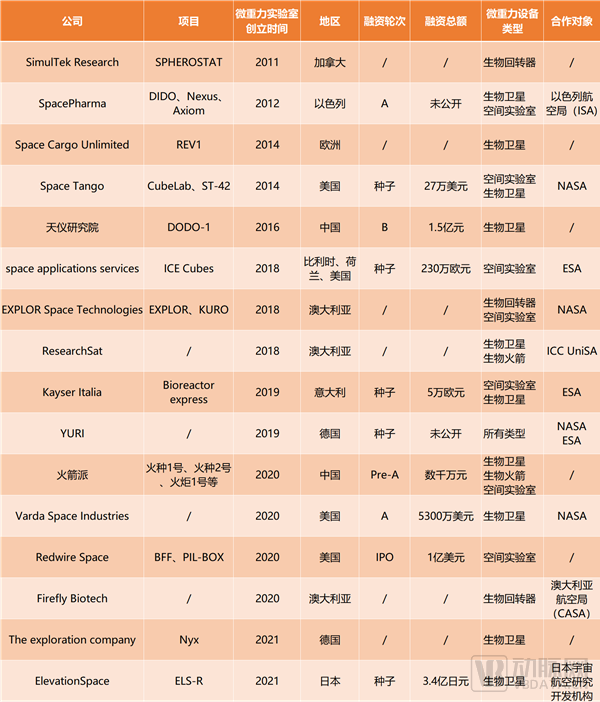 Note: The screening criteria for this table are the completion of one microgravity experiment in the biopharmaceutical field or the existence of publicly announced microgravity laboratory equipment for the biopharmaceutical field.
Some microgravity laboratories have been developed as sub-projects by commercial space companies, most of which collaborate with space agencies to jointly develop biological payload microgravity laboratories.
In the realm of ground-based microgravity simulation, several companies are continuing their explorations. Canada’s SimulTek claims to be able to simulate space environments such as high vacuum and ultraviolet radiation, more closely approximating the experimental conditions on space stations. Australia’s Firefly Biotech has also announced the development of a dual-axis biological rotating wall vessel bioreactor, which simulates microgravity experimental environments at higher rotational speeds.
Firefly Biotech, Space Tango, and SpacePharma have been covered in detail in VCBeat’s previous space medicine series. Here, we begin by introducing YURI, a German company founded in 2019.
YURI offers all seven types of microgravity laboratories, supporting scientific research in fields such as drug development, biotechnology, agriculture, and materials science. Its flagship ScienceTaxi space science laboratory features up to 44 experimental units, compatible with orbital, suborbital, and parabolic flight platforms, enabling real-time monitoring and data recording.
YURI’s Clinostat Bioreactor supports the simultaneous processing of 45 samples. By calculating the optimal rotational speed for experiments, it provides multiple gravity simulation options, including microgravity, Mars gravity, and lunar gravity.
Most notably, YURI has developed specialized experimental hardware tailored to different types of experiments. By conducting experiments through YURI, researchers can customize experimental parameters online and select the appropriate hardware for cells, crystals, plants, fruit flies, or fish. If no existing hardware is suitable, YURI can also provide custom-built hardware based on specific experimental requirements. After the experiment is completed, YURI returns both the data analysis results and the samples to the researchers for further study.
The second company to highlight is Redwire Space, currently the only publicly listed company involved in this sector. Founded by private equity firm AE Industrial Partners, Redwire has pursued a strategy of steady acquisitions. It first acquired satellite components provider Adcole Space and aerospace firm Deep Space Systems, followed by the acquisition of 3D printing specialist Made In Space.
Subsequently, the group also acquired satellite technology company Roccor, engineering services firm LoadPath, modular spacecraft manufacturer Oakman Aerospace, and satellite mechanisms company Deployable Space Systems. According to Redwire, the combined management team brings a total of more than 50 years of space industry experience and has executed over 150 missions. Through these mergers and acquisitions, Redwire has successfully positioned itself among the leading commercial aerospace companies, actively undertaking various projects, including the Space Science Laboratory.
Varda Space Industries, co-founded by SpaceX and Peter Thiel’s Founders Fund, is tasked with establishing a “space factory.” Leveraging SpaceX’s aerospace expertise, Varda Space has secured over $50 million in funding, with its biosatellites supporting microgravity experimental research serving as a key component of its “space factory” strategy.
Rocket (Taicang) Aerospace Technology Co., Ltd., a Chinese company, is also dedicated to the development of biological payload devices and related spacecraft.
At the end of 2021, Rocket (Taicang) Aerospace Technology Co., Ltd. launched China'sThe First Commercial Aerospace Biological Payload Device—"Huozhong-1"“Huozhong-1” aims to provide microgravity services and commercial solutions for near-Earth life science exploration, aerospace biomedical research, and biotechnology experiments. It can be applied in fields such as microgravity cell morphology observation, PCR, and on-orbit detection.
“Spark-1” marks the first step in Rocket (Taicang) Aerospace Technology Co., Ltd.’s establishment of a space science laboratory. In 2022, the company plans to carry out more than six space experiment launch missions, including its planned “Spark-2,” which will support research related to cellular ecology.
Beyond the Space Science Laboratory, Rocket (Taicang) Aerospace Technology Co., Ltd. continues to develop its series of biological satellites. The “Torch-1” satellite supports long-duration on-orbit operations, providing a microgravity environment at ambient temperature and pressure for life sciences R&D. It can be applied to research in microgravity cell morphology, microgravity molecular biology, and other related fields.
Guided by Rocket (Taicang) Aerospace Technology Co., Ltd.’s philosophy of “integrated rocket-satellite systems,” the “Darwin II” launch vehicle platform is also under development. Capable of launching biological payloads—including space science laboratories and biosatellites—“Darwin II” boasts a maximum low Earth orbit (LEO) payload capacity of 500 kg and was scheduled for its maiden flight in 2023.
As a leading enterprise in China for building biological microgravity research platforms, Rocket (Taicang) Aerospace Technology Co., Ltd. adheres to the market-oriented strategy of “defining payloads based on demand, and defining rockets based on payloads.” By leveraging space biology experiments as a key driver for commercialization, the company is building systematic capabilities in aerospace launch and on-orbit services. It enhances launch efficiency through reusable launch vehicles, recoverable satellites, and reusable payload devices.
In November 2022, the Mengtian lab module of the Tiangong space station successfully completed its transposition, marking the completion of the basic “T”-shaped configuration of China’s space station. Among the modules of Tiangong, Wentian is a laboratory dedicated to space life sciences research. Previous statistics indicate that biomedical and pharmaceutical experiments accounted for 60% of all space-based experiments. With the gradual completion of the space station, it is believed that in the near future,Microgravity experiments will become an indispensable experimental approach.。
Although the market prospects for microgravity experiments are becoming increasingly clear, there are few enterprises in China dedicated to building microgravity laboratories, resulting in a significant gap in the current domestic market.
Since 2015, China’s commercial aerospace industry has been experiencing rapid development. According to data from iiMedia Research, the growth rate of China’s commercial aerospace market remained above 20% from 2017 to 2021, and the market size is projected to reach RMB 2.3382 trillion in 2024.
As of the end of 2020, 161 commercial aerospace-related enterprises had been registered, including 48 in satellite manufacturing, 81 in satellite launch services, and 32 in satellite applications. The total industry financing for the year reached RMB 10.369 billion.
In overseas markets, there is a wide variety of products, ranging from ground-based microgravity simulation devices to biological payloads. These products are closely linked with national space agencies around the world, and a competitive landscape has begun to take shape. In contrast, within China, there are relatively few solutions and products dedicated to microgravity laboratories, leaving a significant market gap.
The underlying reasons are twofold: aerospace professionals lack sufficient understanding of the life science fields where their technologies could be applied, while the life sciences industry has an incomplete grasp of microgravity-related experiments. This disconnect results in a lack of deep mutual understanding and effective channels for collaboration between the two sectors. In the past, China’s development in space science was hindered by restrictions imposed under the “Wolf Amendment,” causing microgravity-related research to come to a near standstill and indirectly leading to limited market awareness.
Second, some entrepreneurs believe that the industry faces significant barriers. LandSpace, China’s first commercial aerospace company and the nation’s first private launch vehicle enterprise to obtain all necessary market access qualifications, only secured its security clearance in its third year of operation, enabling it to apply for rocket launch licenses.
In 2021, the Outline of the 14th Five-Year Plan for National Economic and Social Development and the Long-Range Objectives Through the Year 2035 pointed out that China should build a globally covered and efficiently operated space infrastructure for communications and remote sensing, construct commercial space launch sites, and effectively address the critical issue of launch facilities for commercial space rockets.
The aerospace white paper released in the same year also pointed out that “over the next five years, China will leverage space-based experimental platforms such as the Tiangong Space Station, the Chang’e series of lunar probes, and the Tianwen-1 Mars probe to conduct experiments and research in biology, life sciences, medicine, materials science, and other fields under space conditions.”
With the completion of the “Tiangong” space station, domestic companies are gradually entering the field, and market awareness is continuously deepening; microgravity laboratories may become the next frontier in life science tools.