

China's Orthopedic Market Enters the Era of Original Innovation Post-Volume-Based Procurement: Zhong'ao Huicheng's Path to Independent Innovation
Zhongao Huicheng, an innovative company dedicated to the research and development of new materials and new technologies.
It is reported that to address the long-standing issue of foreign dominance over core materials and technologies in the field of high-value orthopedic medical consumables, China’s Ministry of Science and Technology has consecutively established major national special projects for key technological breakthroughs during the 12th and 13th Five-Year Plan periods. Zhongao Huicheng undertook three of these projects and successfully fulfilled its mission through an integrated “industry-academia-research-clinical” collaboration model, developing two new material technologies and commercializing them into products.
Having resolved the two major challenges of friction/wear and osseointegration in the field of orthopedic implant consumables, Zhongao Huicheng has subsequently designed more than ten innovative orthopedic implant products, covering the entire spectrum of orthopedics.
By the end of 2020, developed by Zhongao HuichengWorld's First Titanium Alloy Hip Joint Coated Ball HeadApproved for market launch, this is the world’s first large-sized, lightweight Φ40 metal femoral head. The product possesses fully independent intellectual property rights, covering everything from the design of fundamental material theories to manufacturing process design and the design of key components for production equipment.
Recently,VCBeat and Zhong’ao Huicheng founder Chairman Jin Gong held a dialogue with Li Jie (pseudonym), who first proposed the concept of “full-lifecycle athletic joints.”Jin Gong is an expert in the Ministry of Science and Technology’s expert database for frontier new materials. Li Jie is an orthopedic specialist with over 30 years of experience in clinical practice and scientific research, having witnessed the development of spinal surgery, trauma care, and particularly artificial joint replacement in China.
In the dialogue, Jin Gong and Li Jie shared insights on the path of technological innovation for orthopedic products following centralized procurement.
R&D Must Address Critical Clinical Needs
Drawing on years of clinical experience, Li Jie proposedFull Lifecycle Sports JointThis entirely new concept.
The so-called "full-lifecycle sports-type joint" refers to an artificial joint suitable for middle-aged and young adults, featuring wear resistance, impact resistance, and long-term stability. Its goal is to enable patients to resume normal work and daily life after joint replacement, achieving the effect of a single replacement lasting a lifetime.
In clinical practice, Li Jie frequently encounters cases of artificial joint failure due to limitations in material functionality. This is particularly concerning for middle-aged and young patients, as current artificial joint replacement procedures carry the risk of requiring revision surgery. Currently, ceramic joints, which are the most widely used in clinical settings, have addressed wear resistance issues; however, they pose a risk of impact-induced fracture during physical activity. Therefore, they are not an ideal option for middle-aged and young patients.
In terms of impact resistance, although metal joints are the most pressure-resistant, they still face risks of sensitization and infection caused by metal ions and wear debris, as well as the risk of aseptic loosening induced by polyethylene particles.
Meanwhile, both ceramic and metal joints share a common problem: galvanic corrosion at the head-stem junction due to potential differences between dissimilar materials, which can lead to loosening of the connection and pose a risk of joint failure.
In response to these risks, in 2007, Li Jie proposed to Jin Gong a clinical need for sports-type joints suitable for middle-aged and young adults, which resonated with Jin Gong’s strong interest in independent innovation.
In 2011, coinciding with the launch of new artificial joint projects under China’s 12th Five-Year Plan, Jin Gong established an industry-academia-research-medicine collaborative team led by Zhongao Huicheng, with Li Jie as a core member. “Dr. Li has long been engaged in medical treatment. He identified clinical needs from his practice and was eager to address the existing problems with modern joints. However, the original development of joint products is a complex engineering challenge involving interdisciplinary fields such as materials science, biology, mechanics, and clinical medicine. It also requires new equipment, novel manufacturing processes, and updated testing methods and standards. This is not a project that any single enterprise can complete independently. The national project provided us with the opportunity to bring this product to fruition,” said Jin Gong.
Jin Gong told VCBeat that, throughout the ten-year process of developing new orthopedic products, it has alwaysGuided by the clinical needs identified by orthopedic experts such as Li Jie, we conduct R&D with high translational value.
Innovation Requires Disrupting Traditional Concepts
Fundamentally, the primary factors influencing the service life of artificial joints fall into three categories: issues with the friction interface, problems related to osseointegration of the prosthesis, and the long-term efficacy of the joint itself.
Zhongao Huicheng has proposed solutions in all three areas.
First,On the friction interface, Zhongao Huicheng's original core technology—flexibleTechnology and Process for Hard Superlubricious CoatingsIt can resolve issues with the friction interface of artificial joints, thereby ensuring the long-term service life of the joint itself.
Experimental results showed that the coated Φ40 titanium alloy femoral head was paired with a conventional domestically produced highly cross-linked polyethylene acetabular cup available on the market,After 18 million cycles of wear simulation testing on a joint simulator, examination of the machining marks on the polyethylene acetabular cup revealed negligible wear of the cup liner.(as shown in the figure below). Only when the machining marks on the polyethylene surface are worn smooth does its wear rate become comparable to that of ceramic-on-ceramic bearings (literature reports a wear rate of 0.02–0.1 mm³/Mc for Φ28 ceramic-on-ceramic bearings), which challenges the traditional notion that hard materials exhibit superior wear resistance.

Actually, this is becauseThe articulating friction interface formed by the coated femoral head paired with a polyethylene acetabular cup preserves the impact resistance characteristic of the cartilage-like properties of the polyethylene liner, while ensuring no wear on the liner surface and no structural damage to the polyethylene.thereby achieving long-term service.
Simply put, the inert carbon-based film coating on the metal ball head surface eliminates the release of metal debris and metal ions. The use of homogeneous titanium alloy material for both the head and stem eliminates the risk of taper corrosion and loosening, thereby resolving friction interface issues and ensuring long-term effectiveness of the joint.
Secondly, inAt the Osseointegration Interface, another core technology of Zhongao Huicheng——Sintering Technology and Process for Porous Titanium with Trabecular Bone-like Structure and Matched Mechanical Properties, which can address the issue of osseointegration at the bone-implant interface of artificial joints and also ensure long-term stability of the joint during movement.
Animal experiment results showed that, under the premise of similar pore size and porosity, porous titanium acetabular cups compared with 3D-printed acetabular cups within one month,Bone Ingrowth Volume and Rate of Porous Titanium Acetabular Cups Are Significantly Higher Than Those of 3D-Printed Acetabular Cups, fully demonstrating the inherent structure-inducing effect of this trabecular bone-mimicking structure, thereby rapidly achieving trabecular bone reconstruction.
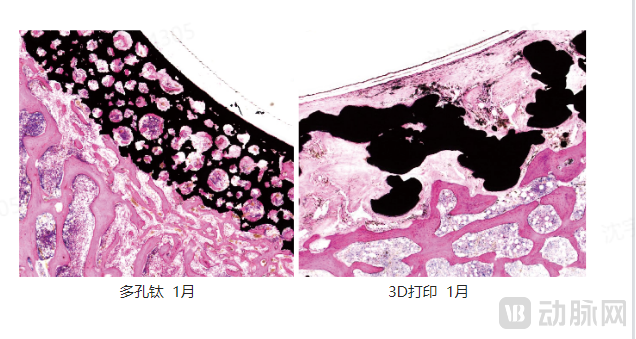
Figure: Comparison of Animal Trials
Meanwhile, due to the femoral stems and acetabular cups manufactured from trabecular bone-mimicking porous titanium materials, inAchieved an elastic modulus that is fully consistent with that of cancellous bone., which eliminates stress shielding at the interface, thereby preventing secondary damage to cancellous bone and damage to the implant itself during movement, thus achieving long-term stability of the artificial joint.
“This is not merely a simple upgrade of artificial joints, but a revolution in the field of arthroplasty, elevating joint replacement from ‘treatment’ directly to ‘cure,’ enabling patients to fully resume their normal work and daily life after surgery,” said Jin Gong.
Innovation Should Endow Products with Entirely New Functions
On September 18, 2021, the results of the national centralized procurement of artificial joints were announced, marking the formal transition of traditional, homogeneous artificial joints from the “ten-thousand-yuan era” to the “thousand-yuan era.” It is widely believed in society that the golden age of orthopedics has come to an end.
“Volume-based procurement demonstrates the state’s resolve to address irregularities in the orthopedic market. It is a beneficial initiative for both the nation and its citizens, effectively eliminating inflated costs in the distribution chain of artificial joints and enabling the public to access genuine, high-value medical services,” said Li Jie, a clinician.
However, for enterprises,The Bid Award Results Are Far from the Endgame of Corporate Competition. In the centralized procurement of orthopedic artificial joints, corporate rankings have undergone a major reshuffle, and companies’ strategic layouts are also set to change. Based on current implementation outcomes, without the introduction of new products, even leading orthopedic companies will lack new profit growth drivers. This has instilled a strong sense of urgency for innovation among the numerous participants in the artificial joint market.
In this regard, Jin Gong appears highly confident. He told VCBeat, “The purpose of national centralized procurement is to encourage innovation, but such innovation should involve genuine functional breakthroughs rather than me-too innovations. Me-too innovation merely enlarges the spoon to compete for the ‘rice in the pot,’ whereas original innovation endows products with new functionalities, ultimately benefiting a broad patient population. From a market perspective, original innovation expands the size of the ‘pot,’ eliminating the need to compete for others’ share within the ‘existing pot.’ If we can firmly hold this enlarged ‘pot’ in our own hands, the ultimate beneficiary will be the nation—a goal that has been evident since the Ministry of Science and Technology initiated its projects ten years ago.”
Jin Gong continued, “During the first two decades—the golden age—of the orthopedics industry, companies raced to expand their market presence. In contrast, we devoted ten years to focused innovation and capacity building, leveraging our advanced materials technology to develop a portfolio of more than ten original innovative products spanning the entire field of orthopedics.”“Over the next two decades, the company will continuously launch new products and significantly reduce the prices of its marketed products to participate in volume-based procurement (VBP), enabling patients to enjoy a high quality of life brought by high-quality products. The Chinese orthopedic market will enter an era of original innovation following VBP.”