

FibriCheck: The $50K-Seed Atrial Fibrillation Detection App That Won Pfizer’s Partnership

FibriCheck
Developer of Prescription Screening and Monitoring Applications

Volta Ventures
Venture Capital Firm

Limburgse Reconversie Maatschappij
Private Equity Investment Firms
In recent years, advances in medical knowledge and the transformation of the internet and other technological devices have provided healthcare companies with abundant resources for researching digital medical devices. In 2017, Qompium, a Belgian digital health company, emerged prominently among its peers; through its business unit FibriCheck, it was recognized by the European Society of Cardiology as the Best Digital Health Company.
FibriCheck, founded in 2014, is the world’s first medically certified (CE Class IIa, FDA-cleared) application capable of remotely detecting irregular heart rhythms, including atrial fibrillation.
In its early days, FibriCheck secured only $50,000 in seed funding. However, to date, it has completed four rounds of financing. The latest round took place in 2020, led by an anonymous investor with £9 million.
Meanwhile, FibriCheck was the champion of the 2017 EIT Health Competition, a beneficiary of the EIT Health Headstart and Bridgehead programs, and the winner of the 2018 EIT Venture Award.
In October 2022, this highly acclaimed app reached a new peak in its development by establishing strategic partnerships with Pfizer and AlTibbi to enter the Central Asian market.
FibriCheck’s founding team comprises outstanding technical experts and seasoned management professionals.
Co-founder Lars Grieten earned his Ph.D. in Biomedical Sciences from Hasselt University in 2011. Co-founders Kobe Leysen and Jo Van der Auwera subsequently obtained their Master’s degrees in Electrical Engineering and Information Technology, and in Biomedical Sciences, respectively, from Hasselt University. Co-founder Bieke Van Gorp brings nearly a decade of experience in financial management.
In 2014, FibriCheck was born out of the close collaboration among four individuals.
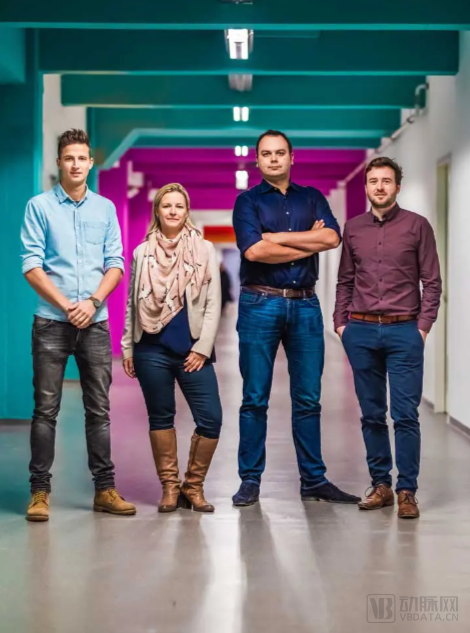
From left to right: Kobe Leysen, Bieke Van Gorp, Lars Grieten, Jo Van der Auwera
The idea behind creating FibriCheck originated from a personal experience of Lars Grieten.
Lars Grieten’s father suffered two strokes, and hospital experts were unable to determine the cause. At that time, Lars Grieten was collaborating with cardiologists at a local hospital on a project aimed at developing a method to detect the underlying causes of stroke; however, it proved extremely difficult to identify the etiology.
Stroke includes ischemic stroke and hemorrhagic stroke, with the vast majority of strokes being ischemic. Nearly 20% of ischemic strokes are caused by atrial fibrillation. Stroke is not always fatal, but survivors often require months or even years to recover. Detecting and monitoring arrhythmias (particularly atrial fibrillation) can help prevent stroke.
Thus, Lars Grieten was determined to overcome the limitations of hospital equipment by addressing the issue through a software solution. The prototype of the FibriCheck digital application was completed at that time.
Lars Grieten’s father began to feel unwell again just a few weeks after his second stroke. At that time, Lars used FibriCheck to monitor his father’s heart rate for two hours. The results indicated that his father had developed atrial fibrillation. Consequently, his father immediately initiated appropriate treatment. Since then, Lars Grieten and his father’s cardiologist have been closely monitoring his heart rhythm through the FibriCheck app.
“This is the power of data. FibriCheck saved my father’s life. I believe the real change we’ve made is building an app that significantly improves quality of life—not just for my father, but for all patients with arrhythmia.”
1Increase the Likelihood of Detecting Arrhythmias
Atrial Fibrillation (AFib) refers to an irregular and often very rapid heart rhythm (arrhythmia) that can lead to blood clots forming in the heart. AFib increases the risk of stroke, heart failure, and other heart-related complications.
The primary challenge with arrhythmias, such as atrial fibrillation, is that they do not always manifest during clinical examinations by cardiologists; instead, they may be intermittent or persistent.Although atrial fibrillation itself is usually not life-threatening, it is a serious medical condition that requires appropriate treatment to prevent stroke. However, due to the intermittent nature of atrial fibrillation, patients often only discover the problem after suffering a stroke.
FibriCheck enables connected, remote patient monitoring without the need for additional hardware. It defines the duration of monitoring based on medical requirements. Patients can perform self-measurements on demand, anytime and anywhere.Therefore, FibriCheck increases the likelihood of detecting arrhythmias while enhancing home-based self-management capabilities, ultimately leading to better outcomes for patients.
2Reduce testing costs
According to statistics from the NHS Innovation Accelerator (NIA), the estimated primary care costs for atrial fibrillation (AF) patients in the UK amounted to $1.435 billion to $2.548 billion for the National Insurance Fund as of 2020. Over the next two decades, the total direct costs of AF covered by the National Insurance Fund are projected to rise further.
From a technical perspective, FibriCheck leverages consumers’ smart devices as its technology platform to deliver its medical applications, rather than establishing a supply chain to provide single-purpose hardware devices. This enables it to offer medical benefits to a broader audience at a significantly lower cost.
If atrial fibrillation (AF) can be detected in its early stages, reducing or avoiding hospitalization, the medical costs associated with AF will be significantly reduced.
3Relying on Smart Devices
Since the release of the first iPhone in 2007, smartphones have been widely adopted globally. The key to their success lies in the respective app stores of Android and iOS, which offer a vast array of downloadable applications. Many of these apps are applicable to the healthcare sector.
These mobile health applications offer solutions to improve healthcare system workflows, such as appointment scheduling, enabling caregivers to retrieve patient data, and assisting patients in managing chronic diseases. Furthermore, mHealth can provide instant health consultations via video calls, offering convenient services to individuals living in remote or rural areas.
The networking of information can also extend to external devices connected to smartphones, such as smartwatches and fitness trackers. These external devices can perform medical functions and subsequently transmit data to mobile devices or the internet.
FibriCheck measurements are performed via smartphone. Users simply place their finger on the smartphone camera for 60 seconds. The app then provides real-time analysis and presents the results in a visual report to support evidence-based (remote) consultations and subsequent medical decision-making.
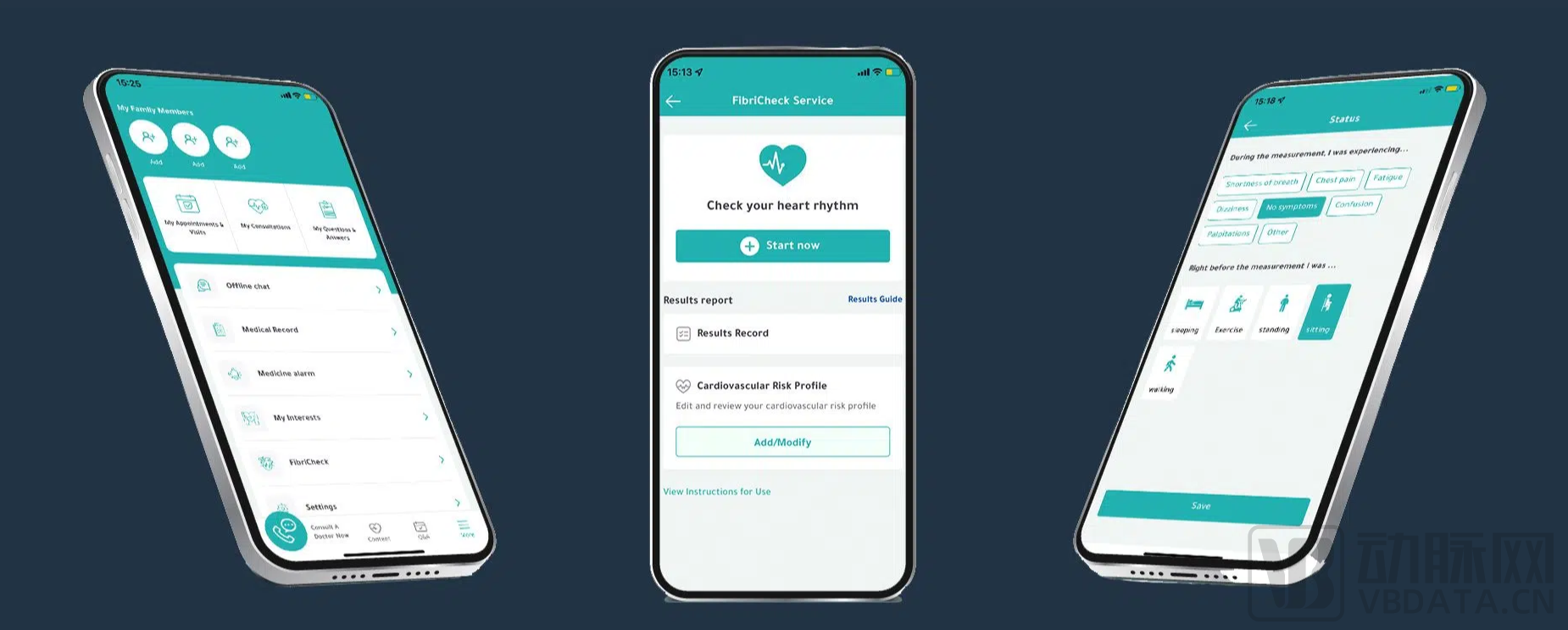 FibriCheck-screens
Heart rate measurement typically employs two techniques: electrocardiography (ECG) and photoplethysmography (PPG). FibriCheck has chosen to integrate the latter into its medically certified applications for smartphones and smartwatches, as ECG alone may fail to detect atrial fibrillation in certain contexts.
PPG focuses on the impact of heartbeats on blood vessels. With each heartbeat, blood is pumped from the heart into the blood vessels. The flow of blood ejected from the heart exerts pressure on the vessel walls. During each heartbeat, the vessel walls undergo brief and slight stretching. Between heartbeats, the diameter of the blood vessels decreases again. At each peak, PPG measures the vasodilation and relaxation caused by the heart's electrical impulses.
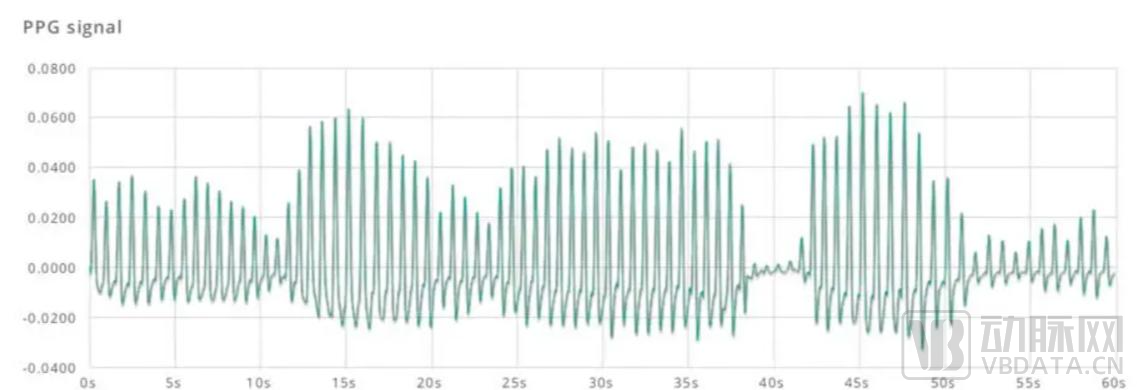
During each peak, PPG measures the vasodilation and relaxation caused by electrical impulses from the heart.
1Optical PPG Sensor
To acquire PPG data, FibriCheck developed an Android smartphone application for the Galaxy S4. This application was written using basic Android, Java, and XML.
First, the program captures raw YUV images from the device camera at a frame rate of 30 frames per second and converts them into individual grayscale values. These values are then filtered and smoothed to obtain preprocessed signals. The filter used is a Butterworth high-pass filter with a cutoff frequency of 0.5 Hz. All filtered and raw data are uploaded numerically in comma-separated format for offline analysis in Matlab.
FibriCheck uses the flash of a smartphone camera or the optical sensor in a smartwatch to illuminate the user’s fingertip or wrist for 60 seconds. The app then measures minute changes in blood volume flowing through dilating and relaxing capillaries, based on the amount of reflected light.
If capillaries are dilated, it indicates a high blood volume. Consequently, a significant amount of light is absorbed by the blood, with only a small fraction reflected back to the camera. If capillaries are relaxed, this implies a lower blood volume, which in turn leads to reduced light absorption.
2Smartphone Camera Detects Irregular Rhythm
Compared with currently popular heart rate applications, FibriCheck offers more advantages by leveraging PPG data collected via smartphone cameras.
"Typically, without the use of external devices, smartphones are unable to detect irregular rhythms or distinguish between normal heartbeats and premature ectopic beats."
FibriCheck’s smartphone-based acquisition and processing algorithms can detect the presence of premature atrial contractions in atrial fibrillation by observing the resulting compensatory pauses, in addition to measuring heart rate during sinus rhythm. The algorithm designed for this study is sufficient for most data analyses.
In addition to technical reasons, optical PPG sensors are also more readily available on smartphones (in developed countries), with a penetration rate of 80%.
In 2020, the world faced the threat posed by the COVID-19 pandemic. This crisis led to a substantial increase in the use of mobile health applications.
During the lockdown, as part of the TeleCheck-AF project (co-launched with EIT Health partner Maastricht UMC+), cardiologists began to use FibriCheck on a large scale for remote consultations and treatment planning, or for remote patient monitoring.
During this period, the hospital contacts atrial fibrillation (AF) patients who have scheduled appointments at the hospital or AF clinic. Patients receive instructions on how and when to use the FibriCheck app. Patients perform heart rhythm measurements at home. Internists conduct online consultations via smart devices and access patients’ measurement reports in real time.
Telecheck-AF (FibriCheck’s Response to Coronavirus Disease) enabled 40 centers across Europe to promptly transition to online consultation mode within less than two months of the pandemic’s onset. Centers such as Bartos and Liverpool became operational in under a day. This model replaced 95% of in-person consultations.
“For the past six years, we have played a pioneering role in the digital health sector. The COVID-19 pandemic has had a profound impact on Qompium. The digital health market is undergoing a comprehensive transition, and over the past year, we have gained a highly accurate understanding of our optimal positioning in the market.”
Since its launch, FibriCheck has helped more than 450,000 people across 43 countries, conducting over 4 million heart rhythm measurements and detecting approximately 40,000 cases of arrhythmia.
Previously, FibriCheck had already signed contracts with companies such as Samsung, Fitbit, and VGZ.
The transformation of the healthcare industry is advancing at a breathtaking pace. In the face of numerous competitors, FibriCheck will focus on achieving two key objectives.
First, it connects to the backend engine services of EMR (a cloud-based big data platform for running large-scale distributed data processing jobs).FibriCheck can automatically perform risk analysis based on demographics, medical history, and biomarkers. High-risk patients will be automatically invited to use FibriCheck. If atrial fibrillation is detected, they will be referred to physicians for further follow-up and clinical management.
The integration of EMR will enhance FibriCheck’s ability to identify relevant cases and significantly reduce healthcare costs in both the short and long term. FibriCheck is currently piloting this feature at two hospitals in Belgium.
Second, develop a "Diagnosis-as-a-Service" model, which involves licensing the FibriCheck PPG algorithm to third parties.For example, by collaborating closely with major wearable device manufacturers to unlock vast amounts of user data.
Currently, the United Kingdom, Germany, and the Netherlands are FibriCheck’s largest markets. In today’s era of booming digital innovation, FibriCheck shows no signs of slowing down.
It will leverage the new €9 million investment to further accelerate the growth of its business units and achieve international expansion. We look forward to FibriCheck bringing its digital screening program to us in the near future.