

Brain Age Gap Predicts Disease Progression in Neuromyelitis Optica Spectrum Disorders and Multiple Sclerosis: A Deep Learning-Based MRI Biomarker
Recently, Professor Liu Yaou’s team from the Department of Radiology at Beijing Tiantan Hospital, Capital Medical University, in collaboration with the teams of Professor Shi Fudong and Professor Zhang Xinghu, published a research paper titled “Brain age gap in neuromyelitis optica spectrum disorders and multiple sclerosis” online in the prestigious neurology journal *J Neurol Neurosurg Psychiatry*. Leveraging 3D MRI brain imaging data from nearly 10,000 healthy individuals, the study employed deep learning algorithms to construct a stable and accurate brain age prediction model. The model was validated across multi-center datasets and applied to patients with neuroimmune diseases, specifically neuromyelitis optica spectrum disorders (NMOSD) and multiple sclerosis (MS). The findings revealed that brain age serves as a biological marker capable of predicting disease progression in patients with neuroimmune disorders, thereby guiding clinical diagnosis and treatment for these patients.
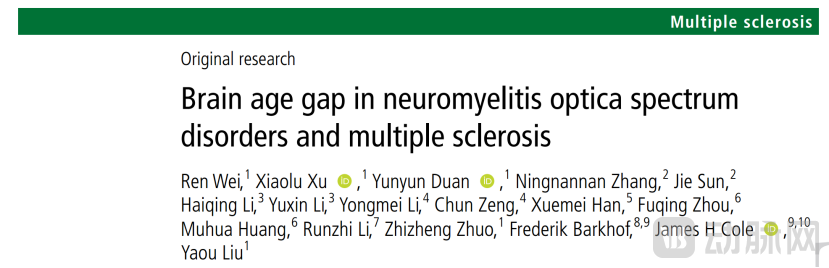
Image source: JNNP
Wei Ren and Xu Xiaolu, physicians in the Department of Neuroradiology at Beijing Tiantan Hospital, Capital Medical University, are co-first authors, and Professor Liu Yaou is the corresponding author.
With advancing age, the structure and morphology of the brain undergo corresponding changes; therefore, brain MRI can be used to estimate the brain’s age, referred to as “brain age.” The “brain age gap” denotes the difference between an individual’s actual chronological age and their estimated brain age.
The team first utilized MRI data from 9,796 healthy individuals to construct a brain age prediction model using deep learning. This model demonstrated stable predictive accuracy when tested on an internal cohort of 462 subjects and an external multi-center cohort of 269 subjects (from five centers). Compared with brain age estimates derived from other methods, the brain age gap obtained via deep learning is characterized by faster processing speed, greater stability, and the ability to provide estimates of uncertainty in brain age prediction. The research team applied this model to 399 patients with neuroimmune diseases, matching each individual’s predicted brain age with their chronological age to calculate the brain age gap. They found that patients with neuromyelitis optica spectrum disorder (NMOSD) had a brain age five years older than their actual physiological age, while patients with multiple sclerosis (MS) had a brain age 13 years older than their actual physiological age. These findings indicate accelerated brain aging in both NMOSD and MS patients, with a more pronounced effect observed in MS. Further correlation analysis between the brain age gap and various clinical indicators revealed a significant association with the degree of patient disability. Survival analysis suggested that the brain age gap can predict clinical progression in neuroimmune diseases.
This study establishes a stable and reliable model for brain age prediction by integrating 3D MRI images with deep learning methods, reveals the characteristics of accelerated brain aging in neuroimmune diseases, and demonstrates that using the “brain age gap” as a biomarker of brain aging can facilitate the early identification of high-risk patients with neuroimmune disorders, thereby guiding subsequent treatment and providing potential imaging biomarkers for the clinical management and research of major brain diseases.

Corresponding Author: Liu Yaou, MD, PhD, Professor, Doctoral Supervisor, Chief Physician; Academic Leader of the Department of Radiology at Beijing Tiantan Hospital, Capital Medical University. His primary research focus is neuroimaging, with a long-standing commitment to the imaging diagnosis and study of major brain diseases. He has published a series of articles in top-tier journals in neurology and radiology, including Lancet Neurology, Immunity, Nature Protocols, Brain, Neurology, Journal of Neurology, Neurosurgery & Psychiatry, and Radiology. He holds positions in multiple international academic organizations and has received numerous international and domestic awards and grants in the fields of neuroimaging and multiple sclerosis.
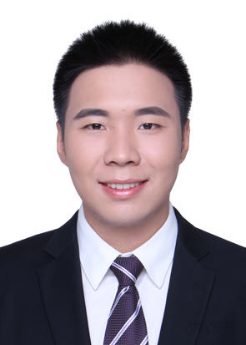
First Author: Wei Ren, M.D., Radiologist at the Department of Radiology, Beijing Tiantan Hospital, Capital Medical University. His primary research interests include the development of deep learning algorithms and the application of artificial intelligence in neuroimaging.
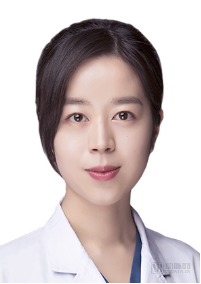
Co-first author: Xu Xiaolu, M.D., Attending Physician in the Department of Radiology at Beijing Tiantan Hospital, Capital Medical University. Her primary research focuses on imaging diagnosis and research related to neuroimmune diseases. She has published multiple SCI-indexed papers as the first or co-first author, includingNeurol Neuroimmunol Neuroinflamm,Journal of Neurology, Neurosurgery and Psychiatryetc.