

Amazon Care Shuts Down: Another Setback for Tech Giants in Healthcare

Amazon
International E-commerce Website
Amazon Care, once hailed as Amazon’s most important innovation in healthcare, has announced its closure by the end of the year. The internet tech giant has once again stumbled in the healthcare and wellness sector.
For Amazon, the failure of Amazon Care may not be so hard to accept. After all, in 2018, the Haven project jointly launched by Amazon, JPMorgan, and Berkshire Hathaway—the “big three”—quickly announced its failure, marking Amazon’s first setback in the healthcare sector.
Perhaps by reviewing the three-year journey of Amazon Care, we can identify the pitfalls that internet tech giants, represented by Amazon, tend to encounter when entering the healthcare and wellness sector.
Amazon, which started as an e-commerce business, has long sought to expand into the healthcare and wellness sector. This strategy underpins its acquisition of PillPack to drive pharmaceutical retail through partnerships with pharmacy benefit managers (PBMs), the formation of Haven—a self-insurance venture for employers—in joint venture with Berkshire Hathaway and JPMorgan Chase, and the launch of its online healthcare service, Amazon Care, during the pandemic.
Amazon Care was first established in 2019, following Amazon’s acquisition of the health technology startup Health Navigator. In the same year, Amazon launched online medical services as an internal pilot program at its Seattle headquarters, aiming to provide employee- and family-centered healthcare. The service was subsequently expanded to cover all Amazon employees in Washington State, and later extended its telehealth offerings to all employees across the United States.
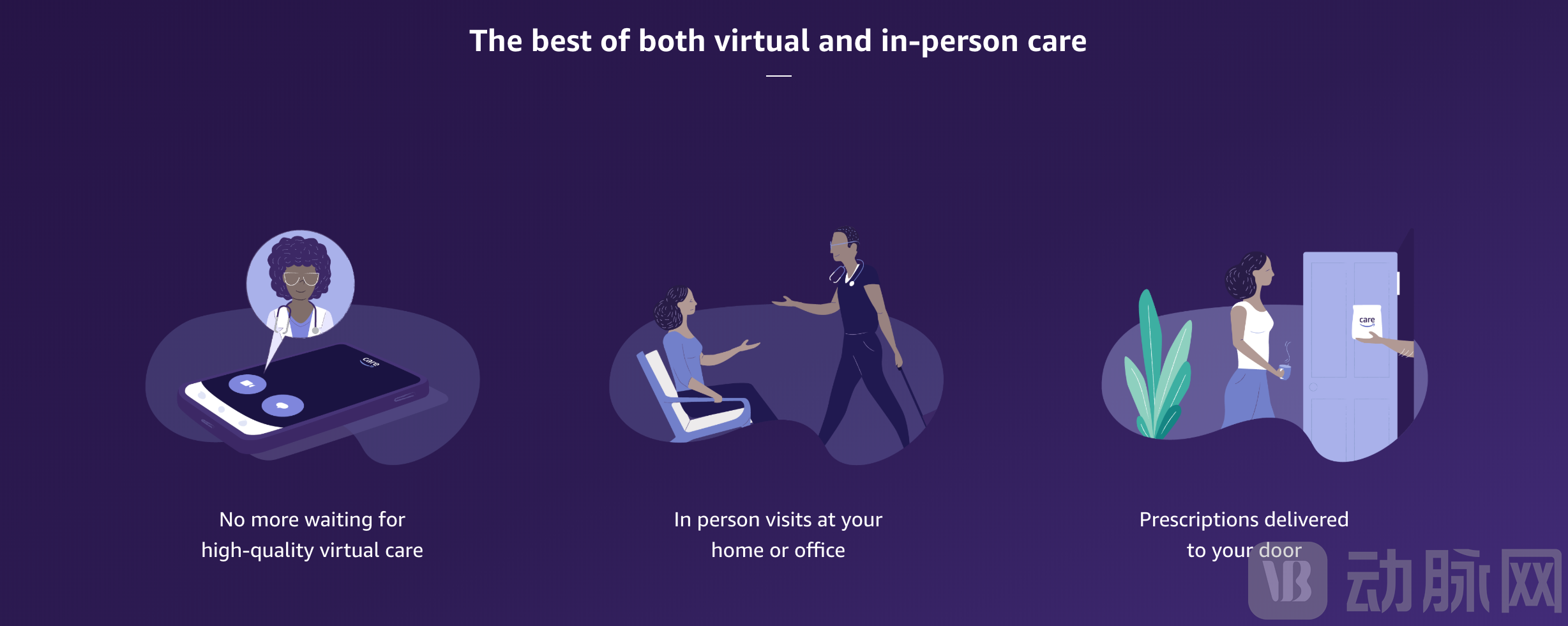
Amazon’s Description of the Amazon Care Service, Source: Official Website
Amazon Care’s medical services are primarily divided into two categories. The first is online consultation and nursing care, which allows employees to connect with professional healthcare providers for consultations via the Amazon Care app at any time and within a short period. Compared to the lengthy process of scheduling offline appointments and waiting in examination rooms, the ability to contact a doctor immediately from home is regarded as Amazon Care’s greatest advantage. The second category is in-person, face-to-face services. When issues arise that cannot be resolved through remote consultations, Amazon Care dispatches medical professionals to patients’ homes for additional care and also provides services such as delivering prescriptions to patients’ designated pharmacies.
Amazon Care’s business model reveals the changes Amazon aims to implement. Historically, Amazon’s business model was built on a foundation centered on consumer-facing (C-end) traffic. However, years of exploration have demonstrated that the healthcare sector is a payer-driven, enterprise-facing (B-end) market. Consequently, from its initial launch, Amazon Care targeted corporate clients as its primary customer base. This approach marks a significant departure from Amazon’s previous business model.
According to public information, multiple companies, including Silicon Labs, TrueBlue, Whole Foods, and Hilton, have signed up for Amazon Care, making the service available to their employees.
Amazon has also spared no effort in promoting Amazon Care. This inside-out innovation mirrors the process by which Amazon incubated its cloud computing services, which ultimately lived up to expectations by evolving from an internal need into a major revenue pillar.
Dr. Kristen Helton, one of the heads of Amazon Care, also stated publicly, “Patients are tired of the existing healthcare system that does not put them first. Our patient-centric services will change this. In the future, we will provide urgent and primary care services to patients across China.”
In other words, Amazon aims to reshape the U.S. healthcare market.
Yet, just three years later, with its bold proclamations still ringing in our ears, Amazon Care announced it would shut down its services by year’s end. What exactly lies behind this decision?
Amazon Care was once hailed by Amazon as one of its most important innovations for enterprises. The failure of such a high-profile project highlights the common pitfalls that internet tech giants encounter when entering the healthcare and wellness sector: underestimating the complexity of the healthcare industry, pursuing rapid and low-cost expansion excessively, and overlooking the opinions and needs of healthcare professionals.
From Amazon Care’s business model, we can clearly see the three essential elements required for its success: high-quality clinicians, an efficient care team, and a seamless patient experience.
In other words, Amazon Care requires a certain scale of staffing to operate effectively, which is difficult to achieve. To address this, Amazon partnered with the healthcare provider Care Medical, where the latter delivers actual medical services to patients, while Amazon provides operational and technical support, with both parties sharing the Amazon Care brand.
Yet such collaboration remains in a state where you do not understand me, and I do not understand you.
According to U.S. media reports, a nurse who previously worked at Care Medical discovered that a patient had severe suicidal tendencies while providing telehealth services. However, she was unable to directly transfer the call to someone who could provide assistance and instead instructed the patient to dial another number before hanging up—thereby violating standard medical protocols against abandoning patients in crisis.
The nurse stated, “The inability to identify the caller’s phone number on this system has caused significant distress for healthcare professionals. It took nearly a year after reporting this security issue to Amazon engineers before the direct call transfer feature was launched.”
Having started as an e-commerce company and spent years operating in asset-heavy models such as warehousing and logistics, Amazon has demonstrated extreme rigor in cost control. Consequently, as Amazon Care expanded nationwide, the company made every effort to avoid establishing physical medical centers. Management even required nurses to store and dispose of medical supplies at home and to use centrifuges in their personal vehicles to stabilize patients’ blood samples.
Ultimately, Amazon did not establish a physical hub for Amazon Care, although the company stated that it provided equipment for nurses conducting home visits to handle supplies.
Yet such high-tech devices have also drawn criticism from frontline caregivers. For instance, field nurses are required to use wireless stethoscopes that transmit real-time patient audio to physicians—despite their inconsistent performance and the need for repeated troubleshooting by frontline staff, which undermines the patient experience during home visits.
Amazon Care has also exposed challenges in complying with local regulations and a shortage of qualified professionals.
The root of the problem lies in the myriad regulations governing cross-state medical practice across U.S. states, making it difficult for service providers to keep pace with the varying state laws. During telemedicine consultations, healthcare professionals frequently ask support staff whether they are permitted to provide certain services, such as prescribing antibiotics, but they often do not receive a clear answer immediately.
A nurse based in Seattle recalled a conversation with a patient in Missouri who described symptoms of an ankle sprain. Diagnosing a sprain requires an X-ray, but the nurse was unable to recommend an urgent care facility equipped with X-ray capabilities.
“When you try to help someone, but you don’t have enough resources, and even I am not clear about what services can actually be provided,” said the nurse.
More notably, even with nurses working across multiple states and regions, Care Medical’s staffing capabilities failed to meet the demands of Amazon Care. Consequently, several former employees stated that, akin to its warehouse and delivery operations, Amazon relied on third-party vendors to fill the gap, engaging nurses from local agencies on a temporary basis to provide in-home care services.
Among companies providing telemedicine services, it is not uncommon to use temporary staff to address staffing shortages; however, consistent service standards must be maintained. According to accounts from contract nurses, Amazon Care offered them very short-term contracts, frequently changed its operational strategies, and provided only minimal onboarding training. This situation made it difficult for contract nurses to maintain service standards and ensure effective follow-up care.
As Amazon Care expands its operations to all 50 U.S. states, staffing shortages have become increasingly severe, leading to a growing reliance on third-party temporary workers. However, driven by cost-control measures, Amazon has not increased its investment in personnel, ultimately resulting in a continuous decline in service quality.
Healthcare services are inherently labor-intensive, and the persistent pandemic has led to ongoing shortages in the relevant workforce, making it difficult for Amazon Care to maintain a high standard of staffing over the past three years.
However, Amazon Care’s customers did not share this view. The original intent of enterprises adopting Amazon Care was to establish a service standard superior to the industry average. In reality, Amazon Care could only maintain its service quality in a limited number of regions and failed to cover all areas where it operated.
On the other hand, for healthcare professionals, joining Amazon Care was not only about compensation; Amazon’s ambitious vision for the healthcare sector was also a significant draw. However, these idealistic clinicians, who sought to leverage technology to enhance patient experiences, inevitably became disillusioned with Amazon Care in the wake of various controversies, leading them to depart. This staff turnover further accelerated the decline in service quality.
The issue appears to lie with Care Medical, the provider of services for Amazon Care, but the ambiguous relationship between Care Medical and Amazon Care has led external observers to direct their criticism squarely at Amazon.
Care Medical was founded in 2018 by an Amazon employee. This connection facilitates the establishment of a collaborative partnership between the two parties. Such collaborations are common in the United States, as they help alleviate concerns about tech giants controlling patients’ private data and make it easier to comply with state-level regulatory requirements.
Although the two companies are closely linked, their core business areas are entirely different, leading to fundamentally divergent perspectives on specific issues. Despite Amazon’s public assertion that Care Medical operates as an independent entity, former nurses and executives have stated that Care Medical lacked sufficient bargaining power in the partnership, with most decisions ultimately made by Amazon.
The core tension between the two parties lies in Amazon’s internet-driven mindset, which prioritizes rapid expansion and an indiscriminate customer-centric approach to service design, whereas Care Medical views its operations through a professional medical lens. For the Amazon Care project, there is significant performance pressure from Amazon to achieve scale growth and high customer satisfaction; in contrast, Care Medical is an institution rooted in traditional medical thinking, operated and led by clinical professionals.
Even on some fundamental issues, contradictions existed between the two sides. When faced with media questions about whether Amazon Care used Epic or Cerner as its EHR system, Sunita Mishra, Medical Director of Care Medical, could only offer vague responses. According to former employees, Amazon did not use professional electronic health record (EHR) management tools for a long period of time, instead opting for inexpensive, generic alternatives. These practices caused dissatisfaction among frontline healthcare workers.
A similar situation occurred with Amazon Care, whose employees failed to understand why Care Medical’s nursing staff required such extensive time to complete their tasks. Furthermore, Amazon Care turned a blind eye to the nurses’ concerns regarding the safety of mobile, off-site work.
Amazon noted in an internal memo: “Although our enrolled members appreciate many of Amazon Care’s services, it is not a comprehensive and effective solution for the large enterprise clients we have been targeting, and it is difficult to sustain effectively over the long term.”
In other words, Amazon itself acknowledges that its projects lack competitiveness in the online healthcare market. Although Amazon believes it has done well in pleasing users, these very measures have frustrated clinical staff.
Through Amazon Care’s telehealth services, customers can determine within 15 minutes whether they have strep throat—and receive medication in under two hours. Even night-shift workers who feel unwell can consult a doctor and obtain a prescription for eye drops within an hour via Amazon Care.
Amazon Care basks in the high satisfaction ratings generated by such cases, while the Care Medical clinicians delivering the services are more concerned with providing sound clinical care. Not only are Care Medical professionals overlooked by Amazon Care, but even Amazon Care’s own executives with medical backgrounds are marginalized within the Amazon ecosystem.
According to media reports, Dr. Kristen Helton, head of Amazon Care, has been on leave since this summer and will continue her vacation.
Phoebe Yang, General Manager of Amazon Care, left the company in September. She is an independent director of Doximity, a leading digital platform for medical professionals in the United States, and serves on the boards of CommonSpirit Health and Providence St. Joseph Health.
Notably, TJ Parker and Elliot Cohen, co-founders of PillPack, Amazon’s prescription drug startup, also departed in September.
The continuous departure of executives with medical backgrounds recalls the past phenomenon in which healthcare professionals struggled to integrate into major U.S. tech companies as they expanded into the healthcare and wellness sector.
In 2019, Apple’s health team underwent a series of personnel changes, affecting everyone from senior executives to rank-and-file R&D staff. The underlying cause was a divergence in strategic direction: employees with professional medical backgrounds advocated for deeper engagement in the healthcare sector, while Apple preferred to enter the market through consumer-oriented initiatives such as fitness tracking and meditation.
David Feinberg, former head of Google Health, stated in a post-departure media interview that it is not easy to bear the pressures of scale at large tech companies, which must both generate global impact and maintain public trust.
Internet tech giants like Amazon have repeatedly stumbled in the healthcare sector, seemingly reaffirming that even substantial financial resources alone are insufficient to establish a reliable healthcare business model in the short term.
From a macro perspective, the healthcare industry is heavily regulated, with government restrictions on business models for various medical services, pharmaceutical distribution, and insurance coverage. Furthermore, the high value-added nature of the healthcare industry primarily stems from face-to-face interactions between doctors and patients. Telemedicine offers limited services, while offline home-visit services are constrained by staffing limitations, making it difficult to maintain service quality. Consequently, establishing sufficient trust between both parties remains challenging.
Specifically regarding Amazon Care, the issues it has exposed mainly fall into three categories:
First, the telemedicine market exhibits strong B2B characteristics; enterprises prioritize the overall balance of services, and high satisfaction ratings derived from excessive services provided to specific patient groups have limited impact on enterprise decision-making.
Second, competitors already hold a first-mover advantage; Teladoc’s membership fee model is both difficult to replicate and hard to surpass;
Third, the pandemic has lasted for three years, and the telemedicine market has transitioned from a period of explosive growth to a phase of contraction. Amazon Care failed to scale up during this specific window of opportunity.
Tech giants’ insufficient understanding of the B2B nature of healthcare services has led internet companies to encounter widespread obstacles upon entering the medical sector, forcing them to repeatedly adjust their strategies and oscillate among building in-house capabilities, outsourcing, and acquisitions. Amazon Care also underwent a similar trajectory: initially relying on Care Medical, then seeking third-party vendors, followed by the acquisition of the offline clinic chain One Medical, the subsequent shutdown of Amazon Care, and ultimately starting anew with One Medical as its foundation.
The challenges faced by Amazon are also the hurdles for all major internet companies entering the healthcare sector. Healthcare is a B2B market dominated by payers, which differs significantly from the consumer-centric (C-end) internet model in terms of both distribution channels and operations. Even with large-scale consumer traffic, it is difficult to penetrate this market. If companies adhere to B2B dynamics, the typical internet strategy of leveraging capital advantages to achieve local market entry followed by rapid scaling becomes entirely ineffective. This is precisely why Amazon Care was ultimately shut down—since it failed to meet its strategic objectives, Amazon decisively closed the service to avoid being trapped in long-term difficulties.
There are differences between the business logic of medical services and that of the internet, and internet healthcare companies are still struggling to explore viable profit models.
Beyond explorations on the payment side, how can internet companies collaborate with healthcare institutions to leverage their respective strengths and mutually empower each other? Domestic internet giants, such as ByteDance, are also making significant strides in this area. For ByteDance, the key challenge lies in converting its massive user traffic into commercial value. Since last year, ByteDance has focused on sectors with high user overlap, including mental health, women’s and children’s health, and medical aesthetics, while betting on leading players in these niche markets. Examples include the full acquisition of Amcare and equity investments in Haixinqing.
After more than a decade of development in internet healthcare, the only seemingly mature and clear business model remains “pharmaceutical sales,” while other models either face limited growth potential or entail heavy-asset structures with prohibitive costs. Whether it is Amazon discontinuing Amazon Care to restart its efforts through the offline provider One Medical, or ByteDance continuously expanding into offline medical services, these tech giants are sharpening their strategies to break through barriers in the healthcare and wellness sector.
References:
https://medcitynews.com/2022/03/medical-director-leading-amazon-care-medical-i-was-a-burned-out-physician/
https://www.washingtonpost.com/technology/2022/09/04/amazon-care-health-one-medical/
https://www.geekwire.com/2022/internal-memo-amazon-care-to-shut-down-not-a-complete-enough-offering-for-corporate-customers/
https://www.washingtonpost.com/technology/2022/08/19/amazon-care-patient-safety-concerns/