

Abiomed's Impella: Advancing Minimally Invasive Cardiac Support with Higher Flow, Longer Duration, and Smaller Profile
On November 1, 2022 (U.S. time), Johnson & Johnson, one of the most comprehensive and widely distributed healthcare companies in the world, announced its acquisition of Abiomed. This acquisition marks Johnson & Johnson’s first major purchase since it announced the divestiture of its Consumer Health business last year, and it is also one of the largest acquisitions in the company’s history.
This acquisition will bring leading technologies in heart failure and cardiac rehabilitation to more patients worldwide. Abiomed’s critically important product, Impella (®) The heart pump is currently the only percutaneous cardiac pump technology worldwide approved by the U.S. FDA for patients with severe coronary artery disease requiring high-risk PCI (percutaneous coronary intervention), as well as for the treatment of cardiogenic shock due to acute myocardial infarction or right heart failure. This technology serves as a strong complement to Johnson & Johnson MedTech’s current portfolio, further accelerating its transformation into high-growth markets. Meanwhile, it will also expedite the enrichment of clinical trial data and progress, delivering more life-saving solutions to patients around the globe.
Smaller puncture sites and larger pump heads represent the core product value of percutaneous artificial hearts, as well as the key factors for these devices to penetrate the mechanical circulatory support market and influence clinical decision-making in the future.
Impella®As a flagship product line under Abiomed, the Impella® heart pumps have received regulatory approval in multiple countries worldwide and have provided support to thousands of patients. Currently, the primary indications for the Impella® heart pump series include severe coronary artery disease requiring high-risk percutaneous coronary intervention (PCI), cardiogenic shock due to acute myocardial infarction (AMI), and right heart failure.
This patient population is substantial on a global scale. In China, for instance, the number of percutaneous coronary intervention (PCI) procedures reached 1.1 million in 2019, with approximately 30% of patients requiring intraoperative hemodynamic support due to their health status, complex coronary artery disease, and impaired cardiac function. Meanwhile, the annual number of patients with cardiogenic shock in China exceeds 300,000.
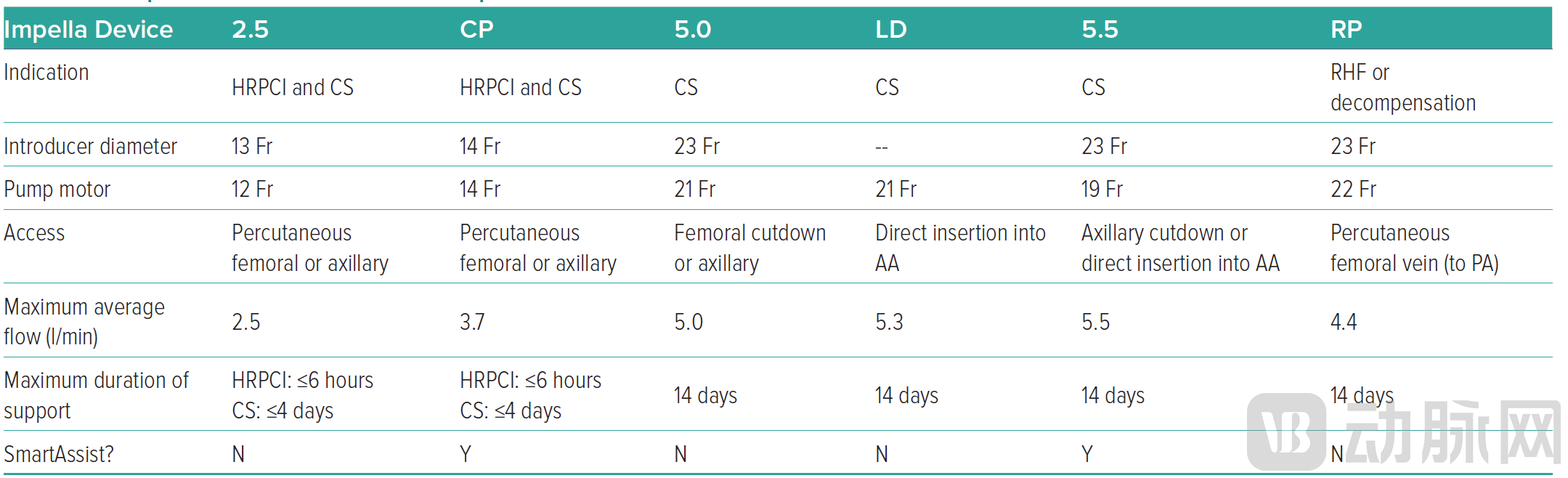 Figure 1
Source: Zein 2022, A Review of the Impella Devices
The Impella products currently on the market include Impella 2.5.®、Impella CP®、Impella 5.0®、Impella LD®、Impella 5.5®and Impella RP®, product iterations aim for greater traffic and longer support periods.
However, with the launch of Impella ECP, the world’s smallest hemodynamic support cardiac pump, its development has been directed toward achieving a smaller interventional profile while maintaining high flow rates and prolonged support duration—a key pain point in the field of percutaneous artificial hearts.
In a research report released last June, Deutsche Bank pointed out that since Impella received FDA approval for the indication of high-risk PCI in 2015–2016, its penetration rate and patient usage in the field of interventional cardiology have grown rapidly year by year. To date, the overall penetration rate of Impella across all PCI procedures has reached 19% (Figure 2), while its penetration rate in high-risk PCI has reached 34% (Figure 3). Interviews with U.S. physicians indicate that both cardiologists and cardiac surgeons expect Impella to maintain rapid growth over the next two to three years, with its penetration rate reaching 27% of total PCI procedures (Figure 2). Currently, among U.S. cardiologists using circulatory support devices during high-risk PCI, Impella accounts for 64% of all types of circulatory support devices used; specifically, standalone use of Impella reaches 57%, whereas the usage share of the traditional approach, intra-aortic balloon pump (IABP), has shrunk to 28% (Figure 4).
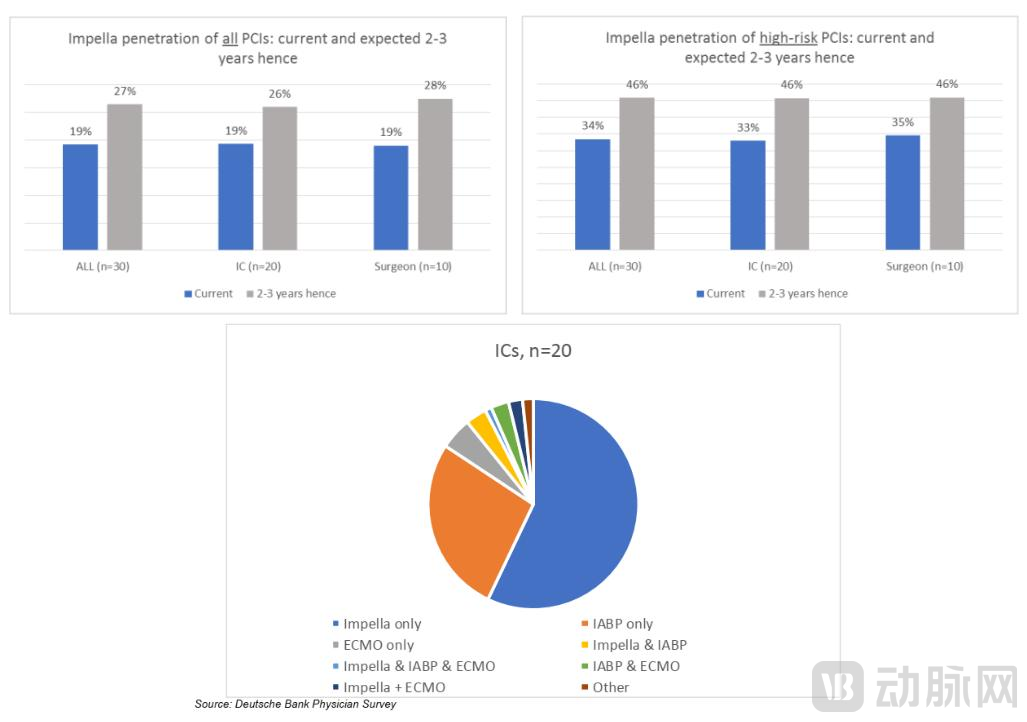 Figure 2
Source: Deutsche Bank Physician Survey
Conservatively estimated, the U.S. target market for Impella is 335,000 cases, while the current penetration rate is only 9%. Therefore,Miniaturization of devices will drive higher utilization rates,This has been supported by cardiac surgeons and interventional cardiologists in clinical surveys.
A Survey of U.S. Physicians Using Impella Shows,The most critical factors influencing utilization rates are device size, safety (vascular complications), and clinical evidence; among these three, two-thirds are directly related to device size, and one-third is associated with size/flow.In a meta-analysis of the real-world application of Impella in patients with AMICS, the incidence of major bleeding complications requiring transfusion was 19.6%, and vascular complications requiring surgical intervention were 6.3%; these complications are closely associated with the currently oversized insertion profile of Impella devices.
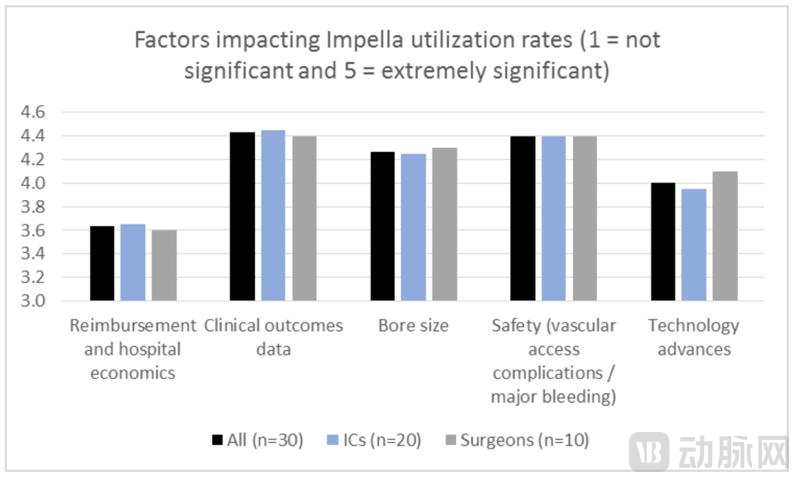
Figure 3
Source:https://inf.news/en/economy/962e4f2141f475ecfa75241c42a49f27.html
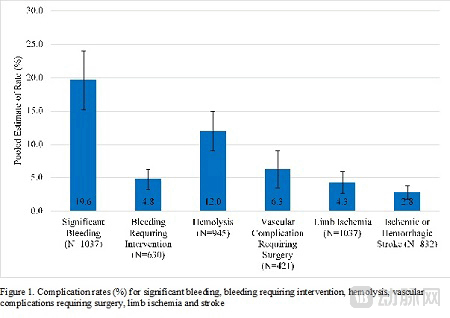
Figure 4
Source: Abstract 13816: Real-World Impella Complications in Acute Myocardial Infarction Complicated by Cardiogenic Shock: A Meta-Analysis
The Impella ECP has a diameter of only 9 Fr (3 mm). Despite its small size, it delivers a substantial flow rate of over 3.5 L/min. Upon removal of the sheath, it can expand to approximately 18 Fr. The post-procedural removal process is also straightforward: the heart pump is simply retracted back into the 9 Fr protective sheath and withdrawn via the same access path. In 2022, the Impella ECP initiated a multicenter clinical trial for hemodynamic support during high-risk PCI procedures. The selection of major vascular complications and device-related major bleeding as the primary safety endpoints underscores the confidence in the Impella ECP’s safety profile.
Smaller puncture sites and larger pump heads represent the core product value of percutaneous artificial hearts, and are also key to unlocking the mechanical circulatory support market and influencing clinical decision-making in the future.
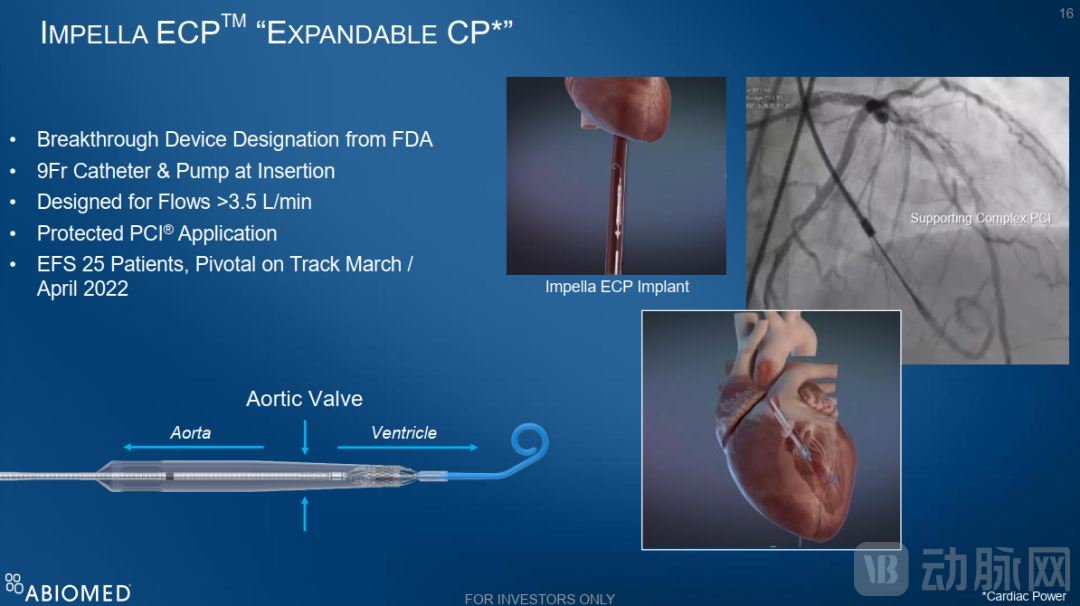 Figure 5