

Bellerophon Therapeutics Highlights INOpulse Platform Advancements and Submits IPO Prospectus

Venrock
Venture Capital Firm

New Mountain Capital
A company engaged in private equity and growth capital investments in non-cyclical growth industries

ARCH Venture Partners
Venture Capital Firms

5AM Ventures
Venture Capital Firm

Bellerophon Therapeutics
Drug Delivery Device Developer

Aravis
Private Equity Firm
Recently, U.S. biopharmaceutical company Bellerophon Therapeutics announced the latest trial progress of its proprietary pulsed nitric oxide delivery system—INOpulse—for the treatment of fibrotic interstitial lung disease (fILD). The study demonstrated that patients’ cardiopulmonary function was significantly improved with INOpulse. Subsequently, Bellerophon applied to conduct a Phase 2 trial for the treatment of pulmonary hypertension associated with sarcoidosis (PH-Sarc), which received FDA approval.
Bellerophon Therapeutics is dedicated to developing innovative therapies aimed at addressing unmet medical needs in the current treatment of cardiopulmonary diseases. The company is currently planning to develop multiple product candidates within its INOpulse platform.. The platform is expected to serve 200,000 patients with fibrotic interstitial lung disease (fILD) and taps into a potential market for pulmonary hypertension (PH) and chronic obstructive pulmonary disease (COPD) valued at over $1 billion.
Targeted NO delivery via nasal cannula; book-sized for multi-scenario use
INOpulse delivers inhaled nitric oxide (iNO) directly to the patient’s lungs via a delivery device and nasal cannula.When nitric oxide (NO) enters smooth muscle cells, it directly activates soluble guanylate cyclase (sGC) within these cells. Subsequently, sGC generates cyclic guanosine monophosphate (cGMP), which induces relaxation of smooth muscle cells, thereby facilitating vasodilation of arteries, reducing pulmonary blood pressure, and alleviating right ventricular pressure.
Furthermore, INOpulse is designed to deliver NO in a targeted manner, primarily acting on the well-ventilated regions of the lungs. Due to the high affinity of NO for heme proteins, any amount of iNO rapidly binds to hemoglobin after being delivered to the lungs and entering the bloodstream, therebyEliminate the possibility of systemic vasodilation.
The INOpulse device is lightweight and portable, allowing patients to use it daily at home or outdoors:
Similar in size to a paperback book, weighing approximately 1.1 kg
Battery life after a full charge is approximately 16 hours.
Simple, Intuitive, and User-Friendly Interface
Compatible with many long-term oxygen therapy systems that operate via nasal cannula
Automatically adjusts the patient's breathing pattern to deliver a stable and accurate dose.
Proprietary triple-lumen nasal cannula for more precise delivery of the set dose to patients
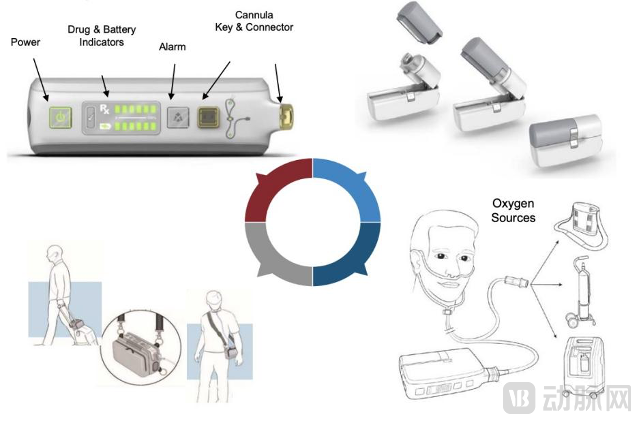
INOpulse
Image source: Bellerophon official website
Three Major Pipelines Covering a PH Market Exceeding $4 Billion
Bellerophon is currently developing three candidate products within its INOpulse platform. The first product, indicated for the treatment of fibrotic interstitial lung disease (fILD), has recently entered Phase 3 clinical trials. In prior studies, INOpulse therapy alleviated patients’ pulmonary vascular resistance (reduced by 21%) and mean pulmonary arterial pressure (reduced by 12%).
Fibrotic interstitial lung disease (fILD), as a more severe form of interstitial lung disease (ILD), can lead to dyspnea, declined pulmonary function, and hypoxemia. The number of fILD patients in the United States is approximately 226,000, among whom about 30%-40% are associated with pulmonary hypertension (PH).
PH is hypertension of the pulmonary vasculature (pulmonary arteries). It prevents the pulmonary arterial walls from dilating, thereby impeding blood flow and hindering the right side of the heart from pumping blood into the arteries, which can lead to heart failure. Studies have shown that PH associated with fILD further reduces patient survival rates.In the United States, the treatment market for fibrosing interstitial lung disease (fILD) with moderate-to-high risk pulmonary hypertension (PH) is valued at over $2 billion.
Furthermore, INOpulse has entered Phase 2 clinical trials for the treatment of pulmonary hypertension associated with chronic obstructive pulmonary disease (PH-COPD) and sarcoidosis-associated pulmonary hypertension (PH-Sarc). Data indicate that INOpulse improves hemodynamics in patients with PH-COPD and PH-Sarc and is well tolerated.
Chronic obstructive pulmonary disease (COPD) is a chronic condition caused by chronic inflammation and damage to the airways and lung tissue. Although COPD is primarily a respiratory disease, long-term exposure to toxins in tobacco smoke can lead to changes in pulmonary circulation, resulting in chronic pulmonary vasoconstriction and pulmonary hypertension (PH). There are approximately 12.7 million COPD patients in the United States, of whom 27% have PH, with a five-year survival rate of only 37%.The treatment market is valued at over $1 billion.
Sarcoidosis is characterized by the growth of inflammatory cells (granulomas) in the lungs or lymphatic tissue. Symptoms include fatigue, weight loss, joint pain, dry eyes, knee swelling, blurred vision, shortness of breath, dry cough, and skin lesions. There are approximately 200,000 patients with sarcoidosis in the United States, 30% of whom have pulmonary hypertension (PH), with a five-year survival rate of only 59%.The treatment market is valued at over $1 billion.
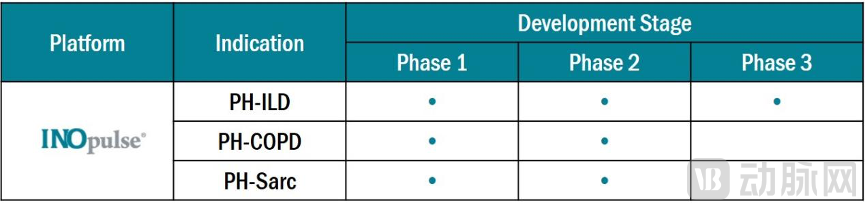
R&D Pipeline
Image source: Bellerophon official website
Secured over $100 million in financing within six years, with projected future revenue growth of 80.5%
Bellerophon, formerly known as Ikaria Development, obtained the global exclusive rights to develop and commercialize the INOpulse program from Ikaria in February 2014. Today, Bellerophon is an experienced team specializing in the fields of rare diseases and respiratory disorders.
Peter Fernandes, Chief Executive Officer and Chief Regulatory, Safety, and Quality Officer of Bellerophon, joined the company in 2015. Prior to this, Fernandes had over 30 years of global development experience in respiratory and cardiovascular diseases, leading teams to secure approvals for many well-known drugs such as Flomax, Spiriva, and Omnaris. He also led the U.S. regulatory affairs team for respiratory and gastrointestinal drugs at Boehringer Ingelheim. Additionally, Fernandes serves as co-chair of the Pulmonary Vascular Research Institute (PVRI) Innovative Drug Development Program, working with academia, industry, and regulatory bodies to develop regulatory and clinical trial designs for pulmonary hypertension (PH).

Peter Fernandes
Image source: Bellerophon official website
On February 13, 2015, Bellerophon completed its initial public offering (IPO), issuing 5 million shares at a final price of $12 per share. In 2017, Bellerophon announced the sale of approximately 19.4 million shares of common stock and warrants, generating total proceeds of approximately $23.4 million. Investors in this offering included Puissance Capital Management and Venrock Healthcare Capital Partners, among others.
In April 2020, Bellerophon announced the completion of an issuance of approximately 1.28 million shares of common stock at a price of $12.00 per share, with total proceeds of $15.3 million. On May 22, 2020, Bellerophon announced the closing of its previously announced public offering. In this offering, Bellerophon issued 3,365,384 shares of common stock in a public offering at $13.00 per share, concurrently with a registered direct offering, generating total proceeds of approximately $43.7 million.
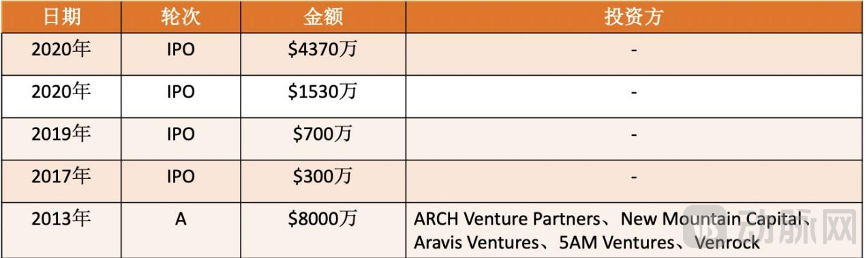
Bellerophon Financing History (Partial) | Graphic by VCBeat
Bellerophon used these funds for general corporate purposes, including research and development, clinical trials, manufacturing, and administrative expenses. From January to June 2022, Bellerophon’s R&D expenses amounted to $8.9 million, compared with $6.8 million during the same period in the prior year. This increase was primarily driven by the ongoing Phase 3 trial for fILD. Recently, the FDA approved Bellerophon’s request to reduce the scale of this trial. The announcement led to a 24% surge in Bellerophon’s stock price (closing at $1.10 per share as of November 10, 2022).
Analysts predict that Bellerophon’s annual revenue growth will reach 80.5% over the next few years (compared to an average annual revenue growth of 7% in the U.S. market), while its annual profit growth will reach 30.7% (compared to an average annual profit growth of 13.3% in the U.S. market).
The global iNO market has a compound annual growth rate of 8.04%, with significant room for exploration.
The global iNO market was valued at approximately $801.21 million in 2022 and is projected to reach $1,179.42 million by 2027, representing a compound annual growth rate (CAGR) of 8.04%.
The global iNO market is fragmented, with multiple key players including Air Liquide, Bellerophon Therapeutics, BOC Healthcare, Beyond Air, Praxair, and Vero Biotech. These suppliers focus on research and development activities to develop advanced innovative products and strengthen their product portfolios. To maintain competitiveness and capture revenue from major markets, they also sell and distribute their products globally through robust distribution channels and subsidiaries.
From 2022 to 2027, North America will maintain its leading position in the global iNO market, accounting for 31% of the global market share. Key drivers include a large number of suppliers, a well-developed healthcare sector, and the rising prevalence of respiratory diseases. During this period, the major consuming regions will be the United States, China, India, Germany, and the United Kingdom.
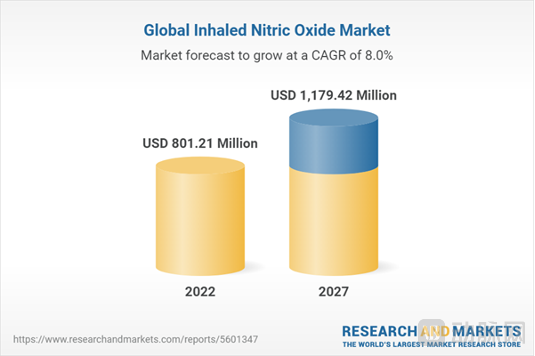
Global iNO Market Forecast
Source: Research and Markets
The global iNO market can be segmented into neonatal respiratory therapy, chronic obstructive pulmonary disease (COPD), acute respiratory distress syndrome (ARDS), and others. Among these, neonatal respiratory therapy accounts for the largest share of the global iNO market. This is due to the rising prevalence of neonatal conditions, such as persistent pulmonary hypertension of the newborn (PPHN) and hypoxic respiratory failure (HRF) in newborns.
Due to the successful application of iNO therapy in the past, related research and development activities have increased in recent years, including the use of iNO to treat adult sickle cell disease, bronchopulmonary dysplasia, and malaria. Additionally,There remains significant room for market participants to explore in areas such as respiratory tract infections and tumor prevention.For example, no drugs have been approved to treat neonates with acute bronchiolitis, which is one of the most common neonatal diseases worldwide.