

Mental Health Sector Rides the Tailwinds: How to Spot the Next Dark Horse?
The pandemic is like a massive wave of uncertain recurrence, continuously battering global healthcare systems and economic structures. The resulting uncertainty and insecurity have invisibly eroded people’s psychological resilience, giving rise to negative emotions such as anxiety, feelings of insecurity, impulsivity, fatigue, and impatience.
As negative emotions continue to accumulate, psychological issues such as depression and anxiety have gradually come to the forefront. It is estimated that nearly 1 billion people worldwide currently suffer from mental disorders.Following the COVID-19 pandemic, there has been a significant increase in the global prevalence of depression and anxiety disorders. The number of individuals with depression surged by 53 million, representing a 27.6% increase, while those with anxiety disorders rose by 62 million, marking a 20.8% increase.
However, the overall development of China’s mental health and psychiatric care sector still faces significant challenges, including a large patient population, a continuously rising prevalence rate amid the pandemic, inadequate treatment rates, and a growth rate in mental health service institutions and personnel that lags far behind the increase in patients.Latest public data show that the annual outpatient volume for patients with depression is increasing by at least 20%, yet approximately 80% of general hospitals in China lack a psychiatry department.
Evidently, the impact of this tidal wave has not only failed to subside but has also posed significant challenges to the diagnosis and treatment of mental and psychological disorders, thereby exposing the field’s shortcomings more prominently.
Governments worldwide, as well as industry participants, have begun to reevaluate the value of mental health and psychiatric care, seeking solutions to address the aforementioned pain points. The sector is experiencing a surge in policy releases, with significant capital inflows driving its development, while innovative solutions for mental and psychological health are emerging in abundance. It appears that the long-awaited boom in the mental health sector has truly arrived.
However, in the face of psychiatric disorders with particularly complex pathogenesis, what kind of solutions can better address industry pain points and align with future industry development trends? These questions still warrant further exploration. Next, VCBeat will attempt to answer this question from the perspectives of policy, industry trends, and technological advancements.
Following the outbreak of the pandemic, the rising incidence of mental health issues and psychiatric disorders has drawn significant national attention to the psychological well-being of citizens in the post-pandemic era. In response, a series of policies have been intensively rolled out; the establishment of the National Center for Mental Health and Psychiatric Disease Prevention and Control has been accelerated; and research into theories, policies, standards, and planning for mental health and psychiatric disease prevention and control has been progressively initiated. Throughout this process, the mental health and psychiatric disease prevention and control service system has been gradually improved.
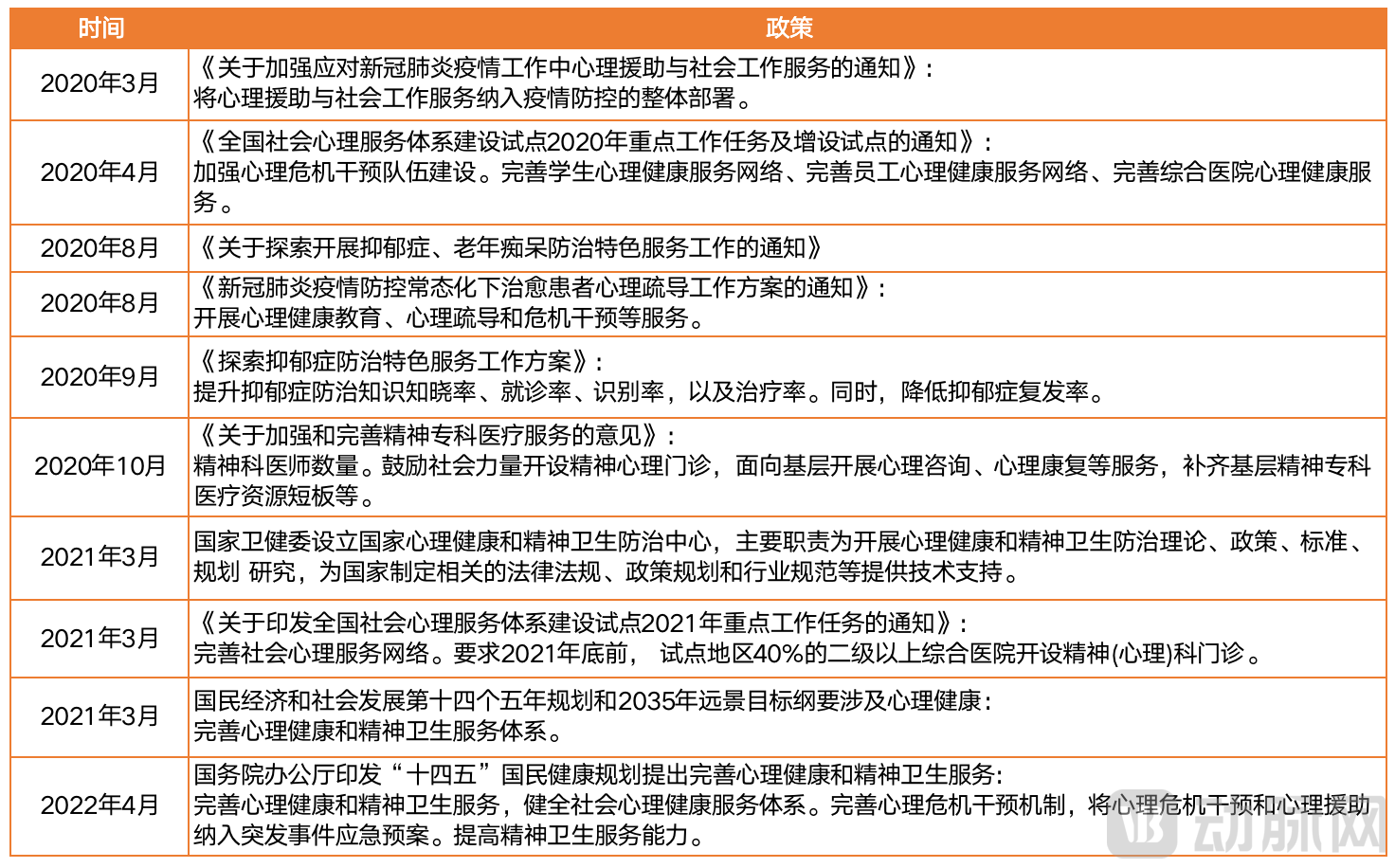
Selected Policies on Mental Health and Psychiatric Care in the Post-Pandemic Era
At the press conference held by the National Health Commission on June 17, Lu Lin, an academician of the Chinese Academy of Sciences and president of Peking University Sixth Hospital, served as one of the spokespersons. He introduced the progress and achievements in the prevention and control of major diseases since the 18th National Congress of the Communist Party of China, and shared that the number of mental health service institutions nationwide has reached 5,936, representing a 205% increase compared with 2010.
VCBeat’s review of relevant policies reveals that, driven by policy support, China has been continuously strengthening its mental health and psychiatric care infrastructure with remarkable results. The field of mental health and psychiatric care is now reaching its inflection point for growth.
Overall, the Chinese government has integrated psychological assistance into its comprehensive strategy for epidemic prevention and control, and has proposed improvements to mental health services and system development in the 14th Five-Year Plan for National Health. First, emphasis is placed on increasing awareness, consultation rates, identification rates, and treatment efficiency for mental disorders. Second, efforts are being made to increase the number of psychiatrists while encouraging non-governmental entities to establish psychiatric and psychological clinics, providing psychological counseling and rehabilitation services at the grassroots level, and strengthening specialized mental healthcare infrastructure in primary care settings. Third, "specialized" services for mental disorders continue to be explored.
As the country gradually incorporates the development of mental health into its policies, it is evident that the government is firmly and vigorously promoting progress in this field. Meanwhile, relevant policy provisions are being progressively refined. Through descriptions such as improving awareness rates, consultation rates, identification rates, and treatment efficiency for mental disorders, as well as strengthening “specialized” services for mental illnesses, it is not difficult to seeThe treatment of future mental health disorders may see widespread adoption, with personalized therapy also advancing. Related therapeutic approaches are likely to increasingly integrate with technologies such as big data and AI, leading to a richer variety of solution formats.
Amidst this surge in momentum, numerous practitioners have emerged in recent years to explore relevant solutions aimed at addressing the industry’s current pain points. Although participants in the mental health and psychological well-being industry employ diverse strategies, we can observe thatThe mental health industry is undergoing an evolution from manualization to automation and then to intelligentization.
The complexity of the human brain is akin to a vast ocean, comprising 86 billion neurons and 500 trillion synapses. Various complex factors, including neurotransmitters composed of amino acids, peptides, and proteins, are present in the human brain. Meanwhile, the pathogenesis and biological markers of psychiatric disorders remain unclear.Therefore, mental disorders require multidimensional tools to effectively guide diagnosis and treatment.
In the case of depression alone, its etiology includes psychological states such as anxiety and stress, as well as the interactive effects of conditions like cardiovascular and cerebrovascular diseases and diabetes. Its pathophysiological mechanisms involve physiological changes in neurobiochemistry, neuroendocrinology, and neuroimmunology, along with multiple factors including genetic predisposition, early neurodevelopmental abnormalities, and postnatal environmental influences.
However, when it comes to psychiatric disorders with particularly complex pathogenesis, most current mental health institutions still rely on traditional rating scales, combined with clinicians’ professional theoretical knowledge and practical experience, to observe and diagnose patients’ behaviors and self-reports, thereby assessing their mental health status. This diagnostic approach is not only inefficient but also lacks large-scale longitudinal and cross-sectional data comparisons, resulting in insufficient accuracy.
Specifically, manual screening methods are heavily reliant on physicians’ experience and are inherently subjective. Without the aid of instrumental examinations or biochemical tests, and relying solely on physicians’ professional theoretical knowledge and practical experience to observe and diagnose patients’ behaviors and self-reports, it is nearly impossible to establish a comprehensive understanding of the progression of mental disorders, which often results in low screening accuracy.
Meanwhile, the paper-based format of screening scales fails to collect patient data efficiently and effectively. If vast amounts of patient information cannot be effectively integrated, in-depth longitudinal and cross-sectional comparisons of patient data will not be possible. Consequently, it will be difficult to comprehensively improve the accuracy of diagnosis and treatment for mental disorders, as well as the therapeutic methods and interventions.
Given the characteristics of the mental health field, automated and intelligent solutions demonstrate distinct advantages.
Automated and intelligent diagnostic and therapeutic technologies can not only provide timely responses to patient inquiries regarding mental health disorders and popularize mental health knowledge, thereby expanding treatment coverage and accelerating the development of related infrastructure. They also offer more diverse treatment modalities for mental health conditions, while precisely collecting patient data to enhance diagnostic accuracy and efficiency, thus driving progress in the field of mental health—a trend that is inevitable.
At this juncture, the industry is clearly brimming with potential. Yet, the broader the industry prospects and the greater the freedom for corporate development, the more essential it becomes for practitioners to remain calm and cautious in order to pinpoint the right direction for growth. Our analysis reveals that,Regardless of the development model adopted, enterprises must establish four key barriers to successfully break out from the competition. So, what specific characteristics should companies in the mental health and psychological well-being sector possess?
Given the irreversible nature of mental disorders, advancing the timing of diagnosis is critically important. To address these key challenges, following interviews with clinical and industry experts,VCBeat has identified four key barriers that leading companies in the future mental health and psychiatric care sectors must possess:
First, multidimensional biological markers.It is difficult to improve the accuracy of diagnosis and treatment solely through traditional diagnostic methods. Only by conducting multi-dimensional biomarker assessments of patients' brains using various instruments during the golden window period before disease onset, thereby gaining a true understanding of the pathogenesis, can diagnostic accuracy be further enhanced.
Second, high-quality cohort data.China’s vast population and abundant real-world data related to mental health create a fertile ground for the research and development (R&D) of AI-based medical devices. However, the quality of real-world data is often inconsistent, lacking governance standards to support device R&D. This forces developers of AI medical devices to take indirect approaches, expending substantial resources on redundant clinical trials. Such efforts are not only time-consuming, labor-intensive, and costly, but the resulting products also fail to withstand validation against real-world data during promotion and application. Currently, China lacks high-quality data capable of comprehensively supporting intelligent equipment for mental health screening, diagnosis, and intervention. To address this challenge, the industry requires close collaboration between enterprises and institutions that possess high-quality clinical cohort data characterized by large sample sizes, comprehensive biomarkers, and high homogeneity. Such partnerships will facilitate the translation and application of domestically developed AI technologies and products in the field of mental and psychological health.
Third, it aligns with the national top-level design. In the post-pandemic era, mental health has received significant attention from the state, ushering in a period of intensive policy releases. Therefore, closely following the national top-level design is crucial.According to the notice issued by the National Health Commission on July 29 regarding the establishment of the National Medical Center for Mental Disorders, three national-level medical centers have currently been established, tasked with driving the construction and development of the mental health sector across China. For the mental health and psychological well-being industry, which is still in its early stages of development, this clearly indicates the future direction of the sector. In the future, the industry must align with national top-level design, use these future trends as a benchmark for continuous product iteration, and foster enterprises capable of developing innovative solutions that address market pain points.
Fourth, interdisciplinary teams.The structure of the human brain is exceptionally complex. To fully unravel its “secrets,” it requires not only time and sustained, in-depth research, but also cognitive breakthroughs and deep integration among industry, academia, and research institutions. Today, a prominent trend across nearly all technological fields—not just mental health—is that an increasing number of significant breakthroughs are emerging from interdisciplinary and cross-disciplinary domains. This demands that practitioners comprehensively refine their expertise from multiple perspectives, including neuroscience, biology, medical imaging, and computer-based behavioral analysis algorithms. Therefore, building a team with interdisciplinary backgrounds is key to achieving sustainable corporate development.
Shanghai NIACIN TECH Co., Ltd. (hereinafter referred to as “NIACIN TECH”)It is an innovative enterprise founded by the head of a national-level key discipline, a leading engineering and algorithm team, and serial healthcare entrepreneurs, specializing in the screening and diagnosis of mental health disorders and non-pharmacological interventions.The Company believes that, given the irreversible nature of mental health disorders, it is essential to establish a multimodal product matrix integrating software and hardware across “screening, diagnosis, prevention, and treatment” to address the prevailing pain points in the entire mental health industry. By combining medical devices with intelligent technologies, this approach aims to advance the timing of disease identification and genuinely improve cure rates. NIACIN TECH’s overall strategic framework and product R&D direction are centered around these four pillars.
In fact, innovative technologies not only enable in-depth research into deep brain stimulation for psychiatric disorders and virus-mediated gene delivery for diagnosis and treatment, but also facilitate the elucidation of a more comprehensive pathophysiological mechanism of depression by integrating psychological and environmental factors. This, in turn, supports the development of drugs or therapeutic approaches that target multiple pathogenic mechanisms of the disease. Furthermore, establishing systematic solutions that combine multimodal data with integrated hardware and software can achieve population-wide screening, as well as diagnosis, intervention, and treatment for at-risk populations, thereby shifting the treatment window for psychiatric disorders earlier and genuinely improving cure rates.
Addressing the aforementioned four barriers, a multidimensional approach that integrates hardware and software while adhering to the standards of rigorous clinical medicine is undoubtedly a critical direction. It can be inferred that companies innovating with a “screening, diagnosis, prevention, and treatment” product model based on objective biomarkers will emerge as dark horses in this industry, aligning with the mental health sector’s transition from manual processes to automation and intelligence.
At the outset of the pandemic, philosopher Slavoj Žižek appeared to recognize the significance of mental health, categorizing the crises of the pandemic era into three layers: medical, economic, and psychological. He argued that although the mental health crisis is pervasive yet invisible, its impact should not be underestimated.He reminds people that during periods of global socio-environmental instability, the real conditions of human survival and mental health issues are particularly worthy of attention.
Although the mental health sector remains in its early stages of development, advances in genetics, imaging, neuroimmunology, and related technologies have fortunately enabled deeper research into psychiatric disorders, laying a solid foundation for the future growth of the mental health field. This progress will inevitably lead to improved screening, diagnosis, treatment, and prevention strategies for psychiatric conditions, ultimately allowing humanity to “dwell poetically” within the realm of the mind.