

Cyclerion Therapeutics Advances Multiple CNS Drug Candidates into IND-Enabling Stage, Leveraging NO-sGC-cGMP Signaling Pathway
Cyclerion
Biopharmaceutical Manufacturer
With global demographic shifts and an aging population, central nervous system (CNS) disorders have become a major public health and social challenge for countries worldwide.
According to data released by the U.S. National Institutes of Health, the prevalence rates of depression and severe mental illness in the United States have reached relatively high levels of 7% and 4%, respectively, and overall remain atRising Incidence RatesandTrend Toward Younger Onsettrend. The number of Alzheimer’s disease (AD) cases is also on the rise, with an estimated 50 million people worldwide living with AD and other forms of dementia. This figure is projected to increase to 82 million by 2030 and to over 100 million by 2050.
Currently, CNS diseases such as Alzheimer’s disease (AD) and amyotrophic lateral sclerosis (ALS) are widely recognizedLowest Contribution of PharmacotherapyandHighest Unmet Clinical Needone of the disease areas.According to WHO predictions, CNS diseases will become the second leading cause of death within 20 years.
According to Frost & Sullivan statistics, the global CNS drug market size was $124.5 billion in 2019, making it the fourth-largest pharmaceutical market. Over the next 15 years, the global CNS drug market is expected to maintain steady growth, reaching $172.1 billion by 2034.
In 2019, the market size of CNS drugs in China was $29.6 billion. Over the next 15 years, the Chinese CNS drug market is expected to achieve rapid growth, reaching $57.1 billion by 2034. Based on China’s pharmaceutical sales revenue in 2019, the therapeutic area for central nervous system disorders accounted for 12.5% of the total pharmaceutical market share that year.
CNS disorders—including schizophrenia, addiction, depression, and Alzheimer’s disease (AD)—affect more than 5 million people in China, with existing treatments demonstrating less than 50% efficacy. This represents substantial unmet clinical needs and significant market potential. Clearly, the CNS field has become the next frontier for new drug development.
Cyclerion Therapeutics (hereinafter referred to as “Cyclerion”) is a clinical-stage biopharmaceutical company founded in 2019 and headquartered in Massachusetts, United States. Cyclerion is dedicated to the discovery, development, and commercialization of CNS drugs,Listed on NASDAQ in 2019, with three rounds of equity financing totaling $217 million.
Peter M. Hecht is the Co-founder and Chief Executive Officer of Cyclerion. Mr. Hecht holds a master’s degree from Stanford University and a Ph.D. in Molecular Biology from the University of California, Berkeley, with over 20 years of experience in the biopharmaceutical industry.
Previously, as co-founder and CEO of the biotechnology company Ironwood, Peter helped build a pipeline of multiple drug candidates and secured over $1 billion in financing. Meanwhile, Peter is also a researcher at Ariadne Labs, jointly established by Harvard T.H. Chan School of Public Health and Brigham and Women’s Hospital.
For DNS diseases, Cyclerion’s mission is to develop new drugs and establish treatment regimens for patients to improve brain function.Nitric oxide (NO) is one of several fundamental neurotransmitters, and therefore holds significant therapeutic potential for the central nervous system.。
Based on this understanding, Cyclerion has developedTwo clinical-stage drugs and two candidate drug pipelines——Currently developing multiple indications, including mitochondrial encephalomyopathy, lactic acidosis, and stroke-like episodes (MELAS), Alzheimer’s disease (AD), and cognitive impairment associated with schizophrenia (CIAS).
Nitric oxide (NO) is a unique gaseous signaling molecule that participates in many important physiological processes, such as vasodilation, neurotransmission, platelet aggregation, immunity, cell proliferation, and mitochondrial respiration.
Dysregulation of NO signaling is associated with cardiovascular diseases, sepsis, acute lung injury, and multiple organ failure. NO does not readily penetrate the target cell membrane, and after diffusing across the membrane,Combination Therapy Activates Soluble Guanylate Cyclase (sGC), which is the primary NO receptor. Here, sGC serves as the sensor for NO molecules.
sGC catalyzes the cyclization of guanosine triphosphate (GTP) to generate inorganic pyrophosphate andSecond Messenger Cyclic Guanosine Monophosphate (cGMP)Subsequently, cGMP acts on downstream effectors, including cGMP-regulated protein kinases, phosphodiesterases, and ion channels, to regulate physiological processes within cells.
For centuries, the nitric oxide (NO) donor nitroglycerin has been widely used to alleviate angina pectoris, and the soluble guanylate cyclase (sGC) stimulator riociguat has now been approved for the treatment of pulmonary arterial hypertension. Based on pathophysiological insights into the NO-sGC-cGMP signaling pathway, sGC activators and stimulators are being investigated inFibrotic diseases, systemic sclerosis, chronic kidney disease, neuroprotection, dementia, and sickle cell diseasehas therapeutic potential.
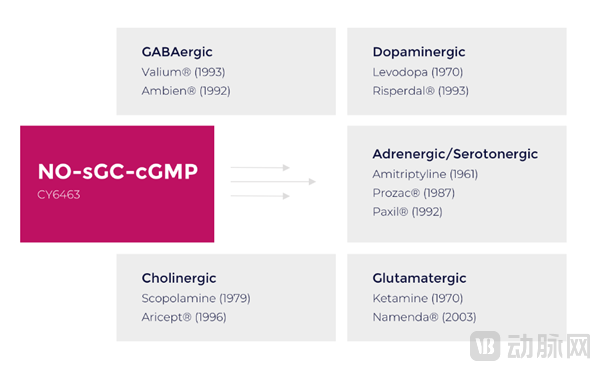 Drug Development Based on the NO-sGC-cGMP Signaling Pathway Source:Cyclerion
Currently, Cyclerion has two clinical-stage drugs and two candidate drugs under development for multiple indications.
Cyclerion's two clinical-stage drugs includePraliciguat and Olinciguat. Praliciguat is a systemic sGC stimulator for the treatment of severe cardiovascular and renal diseases, and has been licensed to Akebia Therapeutics for development in renal indications.
Olinciguat is a vascular sGC stimulator that has undergone clinical studies in sickle cell disease. Results have demonstrated its favorable pharmacological effects in conditions including pulmonary arterial hypertension (PAH), idiopathic pulmonary fibrosis (IPF), and heart failure.
Cyclerion’s two drug candidates are CY6463 and CY3018, with CY3018’s development pipeline having entered the IND-enabling stage.
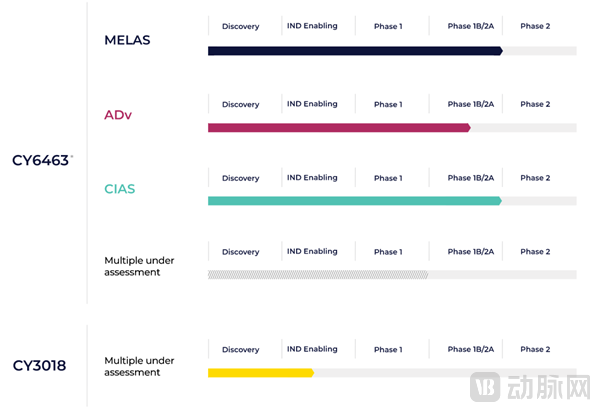 Candidate Drug Pipeline Source: Cyclerion
CY6463 is the first sGC stimulator designed and under development worldwide for neurodegenerative diseases. In preclinical studies, CY6463 has demonstrated benefits across multiple animal models and in four domains of human neurodegenerative diseases.
First,Enhancing Neuronal Function: Enhances memory function and spinal bone density in aged animals; increases long-term potentiation (LTP) in models of neurodegenerative diseases.
Second,Reducing Neuroinflammation: Reduced levels of in vitro LPS (lipopolysaccharide)-induced neuroinflammatory markers (ICAM1/VCAM1/IL6).
Third,Enhancing Cellular Bioenergetics: Increase ATP (adenosine triphosphate) and restore gene expression in cells of patients with mitochondrial diseases.
Fourth,Increase Cerebral Blood Flow: Increases cerebral blood flow in brain regions associated with memory and arousal via functional magnetic resonance imaging.
Currently, CY6463 is under development for the indications of MELAS, ADv, and CIAS.
MELAS: Phase 2a Clinical Trial Completed
MELAS is a syndrome characterized by mitochondrial myopathy, encephalopathy, lactic acidosis, and stroke-like episodes. It is one of the most common and severe mitochondrial diseases, capable of affecting nearly all bodily functions. Common central nervous system symptoms include stroke-like episodes, seizures, headaches, and cognitive impairment. It is estimated that 1 in 4,300 individuals has a mitochondrial disease, and 80% of patients with mitochondrial diseases present with central nervous system symptoms.
MELAS is a genetically inherited orphan disease for which no approved treatments currently exist. This condition impairs individuals' ability to live independently, leading to reduced social participation and overall quality of life, with death occurring 17 years after the onset of central nervous system symptoms.
The NO-sGC-cGMP signaling pathway is crucial for the regulation of mitochondrial function and biogenesis.Preclinical results indicate that CY6463 has the potential to improve mitochondrial function and cerebral blood flow. The study demonstrated support for multiple clinical endpoint correlations, with several biomarkers in MELAS patients returning to baseline levels after discontinuation of treatment.
Based on the Phase 2a clinical results, Cyclerion is expected to initiate the FDA registration process in 2023.
ADv: Phase 2a Clinical Study Initiated
Common forms of dementia include Alzheimer’s disease (AD) and vascular dementia (VD). Typically, these conditions do not occur in isolation; more than 50% of patients with AD also exhibit signs of VD, leading to faster disease progression and greater severity. Currently, there are no approved treatments for VD, and therapies used for AD have limited efficacy in patients with both conditions.
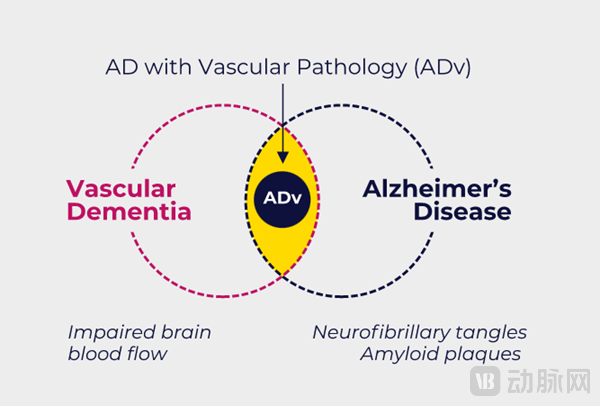 ADv Source:Cyclerion Official Website
ADv reflects the complex interplay of multiple pathological mechanisms underlying dementia, including neurovascular dysfunction, impaired cellular bioenergetics, and inflammation. Patients with ADv are defined by the coexistence of Alzheimer’s disease pathology, subcortical vascular disease, and cardiovascular (CV) risk factors.
Currently, Cyclerion is initiating a Phase 2a clinical study for ADv to evaluate the safety, tolerability, and pharmacological rationale of CY6463 in this disease. The data are expected to be released in the first half of 2023.
CIAS: Completion of Phase 2a Randomized Double-Blind Trial
Schizophrenia (CIAS) is a complex, chronic, and disabling disease that ranks among the top 15 causes of disability worldwide. Patients with schizophrenia exhibit a range of positive symptoms (such as hallucinations, delusions, and disorganized thinking), negative symptoms (such as blunted affect, anhedonia, avolition, and asociality), and cognitive impairments, including deficits in attention, memory, and executive function.
Globally, at least 21 million people suffer from schizophrenia, with 98% of these patients experiencing cognitive impairment. Cognitive impairment is one of the key determinants of disability in schizophrenia. Among currently approved medications for schizophrenia, there is little to no efficacy in improving cognitive impairment, and no drugs have been approved specifically for this indication.
The NO-sGC-cGMP signaling pathway plays a critical role in various physiological processes underlying overall brain health and function, including those involved in learning and memory. As a soluble guanylate cyclase (sGC) stimulator that amplifies endogenous NO-sGC-cGMP signaling, CY6463 can restore impaired signaling, thereby improving cognitive function in patients with schizophrenia.
Cyclerion conducted a randomized, double-blind, placebo-controlled, multiple ascending-dose trial. Clinical data for CY6463 demonstrated a positive impact on cognitive enhancement in patients with CIAS and broad beneficial effects on inflammatory biomarkers.
Furthermore, Cyclerion plans to develop CY6463 for additional indications.
In October 2022, Cyclerion announced mitochondrial encephalomyopathy, lactic acidosis, and stroke-like episodes (MELAS) as a key strategic priority for the company. The company planned to meet with the U.S. Food and Drug Administration (FDA) in the fourth quarter of 2022 to discuss its drug development program for this indication. Upon meeting regulatory standards, CY6463 would become the first approved therapy for patients with rare mitochondrial diseases.
Human Brain Research Is Constrained by Scientific and TechnologicalDevelopmentconstraints, and it was not until the past two decades that certain breakthroughs were achieved. Nevertheless, our understanding of the human brain remains below 10% of its total structure and function. The complexity of the central nervous system (CNS) poses significant challenges to CNS drug development, resulting in progress that lags far behind that of other therapeutic areas.
Specifically, CNS drug development faces various challenges, including the difficulty in developing preclinical models of diseases, the need for drugs to cross the blood-brain barrier, limited understanding of relevant pathophysiology, difficulties in assessing target engagement, heterogeneity of clinical phenotypes, limited understanding of the heterogeneity of neurobiological phenotypes, and lack of sensitivity in clinical rating scales.
Furthermore, the overall success rate of CNS drug development has declined, characterized by low returns and long timelines; consequently, despite the potential for a vast market and significant social benefits, such projects are often not pursued. According to the 2021 annual reports of the top ten “Global Largest Pharmaceutical Companies,” apart from Roche and Sanofi, which maintain a presence in the CNS field, most other major companies have largely exited this area.
However, driven by the growing demand for drug development for brain disorders and ongoing advances in understanding brain biology and disease mechanisms, major countries have launched national brain initiatives, including the U.S. BRAIN Initiative, the European Union’s Human Brain Project (HBP), Japan’s Brain/MINDS, and China’s China Brain Project (CBP).
These trends and policies all point to one fact:The CNS therapeutic area harbors significant market opportunities, and CNS drug development is poised for a renewed surge in vitality.