

China Launches First-Ever Provincial Alliance Procurement for Traditional Chinese Medicine Decoction Pieces, Emphasizing Quality Standards and Systematic Framework with 21 Pilot Varieties
On November 18, following a public consultation period, the Procurement Office of the Sanming Procurement Alliance’s Inter-Provincial Traditional Chinese Medicine (TCM) Materials Procurement Alliance officially released the *Joint Procurement Document for TCM Decoction Pieces under the Sanming Procurement Alliance’s Inter-Provincial TCM Materials Procurement Alliance* (hereinafter referred to as the “Joint Procurement Document”). This marked the finalization of a joint procurement framework centered on the principles of “ensuring quality, upgrading standards, and stabilizing supply,” thereby fully launching China’s first-ever national joint procurement of TCM decoction pieces, an initiative that has drawn significant attention from the industry.
It is reported that the enterprise application process for this initiative will be conducted online, with the shortlisting and selection results to be announced via the Shandong Internet Traditional Chinese Medicine (Materials) Trading Center designated by the alliance.www.bqex.com) for release.
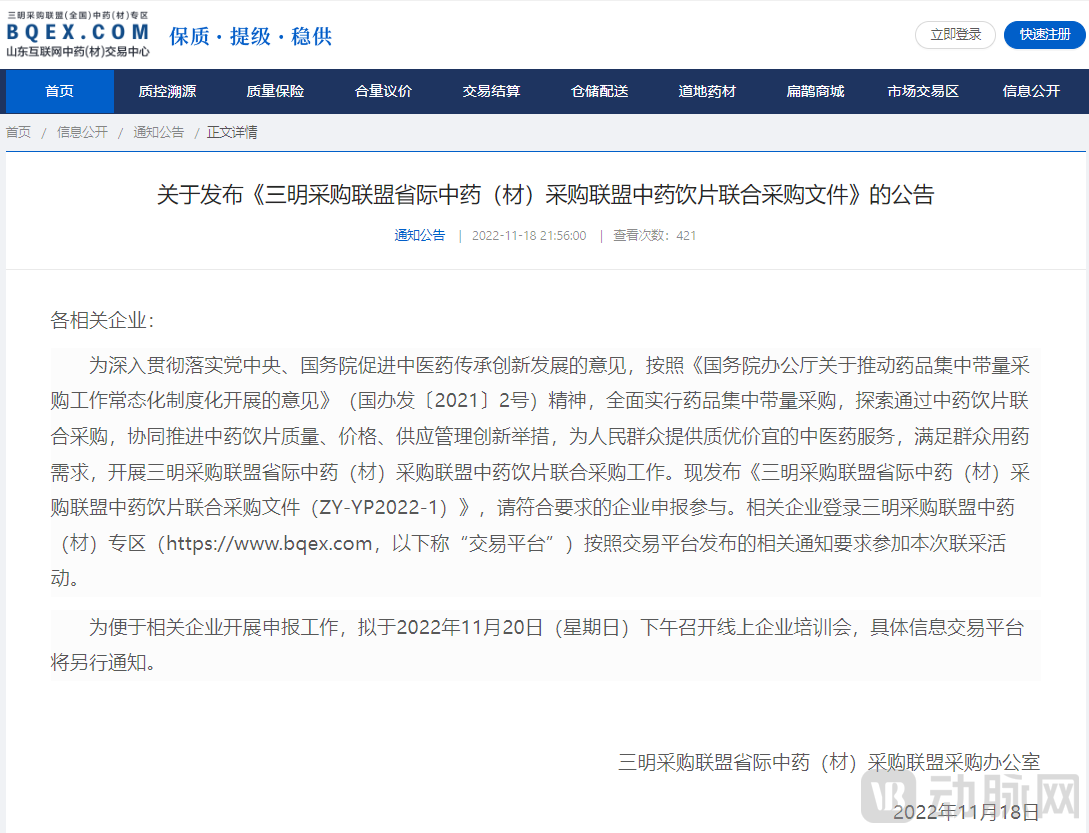 China Releases First-Ever Joint Procurement Documents for Traditional Chinese Medicine Decoction Pieces
As another significant implementation measure of China’s healthcare insurance payment reform, this centralized procurement of traditional Chinese medicine (TCM) decoction pieces adheres to volume-based procurement principles and explores the establishment of an intensive, standardized, and digitalized trading system. Centered on promoting the development of a full-process traceability system for TCM medicinal materials and decoction pieces, the initiative focuses on “ensuring quality, upgrading standards, and stabilizing supply,” with the aim of providing the public with high-quality and affordable TCM services and striving to drive the healthy development of TCM medicinal materials and decoction pieces toward “high quality at reasonable prices.”
In the context of the normalization of national centralized volume-based drug procurement, launching joint procurement for traditional Chinese medicine (TCM) decoction pieces has become a key solution to longstanding industry pain points, including significant quality variability, high price volatility, unstable supply, and irregularities in production and distribution markets.
In early 2022, under the support and guidance of the National Healthcare Security Administration (NHSA), the Inter-provincial Procurement Alliance for Traditional Chinese Medicines (TCM) Materials, led by Shandong and more than ten other provinces (municipalities), joined the Sanming Procurement Alliance. The two entities merged to establish the Sanming Procurement Alliance Inter-provincial TCM Materials Procurement Alliance (hereinafter referred to as the “Alliance”), with the aim of carrying out normalized cross-regional joint procurement of TCM materials. The NHSA has encouraged all provinces to participate in the Alliance’s joint procurement initiatives. Many provinces have proactively joined, collaborating on this joint procurement effort based on their respective regional needs.
In March 2022, the Alliance issued a notice on the volume reporting for traditional Chinese medicine (TCM) decoction pieces; in late October, the “Joint Procurement Document for TCM Decoction Pieces of the Sanming Procurement Alliance Inter-Provincial TCM (Materials) Procurement Alliance” was released for public consultation. With the official release of this joint procurement plan, the TCM decoction pieces joint procurement organized by the Alliance and led by Shandong Province has once again taken substantial steps forward.
The “Joint Procurement Document” states that the Alliance Procurement Office leads the joint procurement of traditional Chinese medicine (TCM) decoction pieces. Shandong, Shanxi, Inner Mongolia, Jilin, Heilongjiang, Anhui, Fujian, Jiangxi, Hunan, Yunnan, Tibet, Qinghai, Ningxia, the Xinjiang Uygur Autonomous Region, and the Xinjiang Production and Construction Corps participate at the provincial level or through selected cities, representing public medical institutions (including military medical institutions) in their respective regions, as well as privately operated medical institutions designated for basic medical insurance reimbursement that voluntarily join, and designated retail pharmacies. The agreed procurement volume for the first year in the alliance regions is determined by aggregating 80% of the pre-procurement demand volumes reported by the participating healthcare institutions.
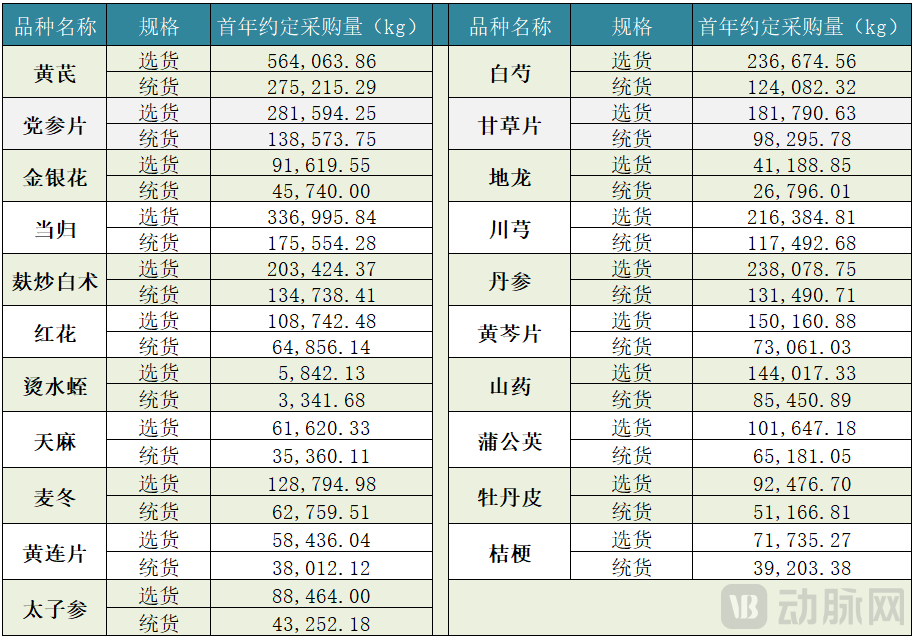 First-Ever Centralized Procurement of Traditional Chinese Medicine Decoction Pieces: Agreed First-Year Purchase Volume for 21 Varieties and 42 Specifications
Compared with the draft for comments, the most closely watched aspect of the officially released “Joint Procurement Document” is the clarification of the agreed procurement volumes for the first year, covering 21 varieties and 42 specifications. The agreed first-year procurement volume for Astragali Radix alone exceeds 800 metric tons, with the total for all 21 varieties surpassing 5,000 metric tons.
It is reported that the release of the draft for public comment has drawn widespread attention from both within and outside the industry, as well as from all sectors of society, with active suggestions and recommendations offered. The Joint Procurement Office and the Joint Procurement Expert Panel carefully reviewed and discussed the collected feedback, incorporating all feasible optimization proposals into the officially released document.
The improvements and supplements to the “Joint Procurement Document” include: adjusting the allocation principle for the agreed procurement volume reported by medical institutions, changing the distribution from 60% allocated to selected drugs and 40% reserved as unallocated volume (as stated in the draft for comments) to an even 50/50 split; strengthening detection mechanisms for non-compliant practices in joint-procured traditional Chinese medicine decoction pieces, such as dyeing, weight adulteration, falsification, and unauthorized use of bulking agents; further clarifying the responsibilities of all parties during the acceptance phase and adding procedures for resolving disputes over testing indicators for selected drugs; permitting selected enterprises to supply other commonly used clinical packaging specifications, with prices calculated based on the price differential ratio of the selected drugs; and optimizing backup supply measures for cases where the production capacity of provisionally selected drugs fails to meet the alliance’s agreed procurement volume, among other updates.
According to the announcement issued by the Alliance Procurement Office, to facilitate the declaration process for relevant enterprises, the Alliance plans to hold the first online corporate training session on Sunday, November 20, 2022, from 14:00 to 17:00. Follow-up targeted training sessions will be conducted based on enterprise needs. Enterprises are advised to monitor the official website and WeChat service account of the Shandong Internet Traditional Chinese Medicine (Materials) Trading Center for related notifications.
An analysis of the "Joint Procurement Document" reveals that the centralized procurement of traditional Chinese medicine (TCM) decoction pieces is more closely aligned with industry-specific characteristics and draws greater reference from market-based transaction mechanisms. It proposes the approach of "ensuring quality, upgrading standards, and stabilizing supply," rather than prioritizing price reductions. Instead, it places greater emphasis on system and standard development, a strategy that has been widely welcomed by all stakeholders in the industry.
In the scoring criteria for the joint procurement program, emphasis is placed on quality assurance and supply volume guarantees. Key indicators include product supply capacity, planting (or breeding) bases, traceability systems, alliance procurement demand, coverage of allied medical institutions, production management capabilities, quality control capabilities, supply guarantee commitments, authentic medicinal materials, and Good Agricultural Practice (GAP) bases. The price component accounts for 15 points, representing one-eighth of the total score of 120 points.
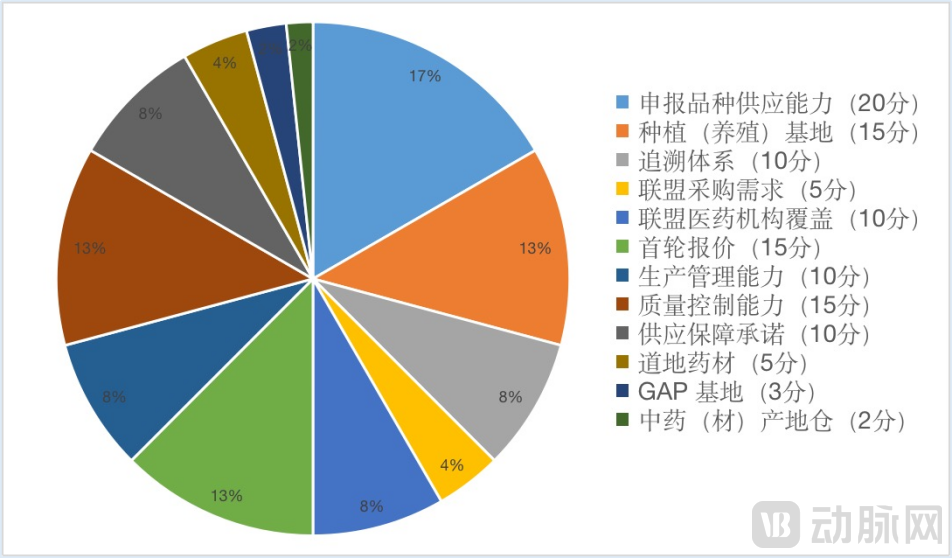 Comprehensive Evaluation Criteria Scoring Items
Meanwhile, shortlisted companies are required to submit product samples for conformity assessment of quality grades by an expert panel. Companies failing to meet the requirements shall be disqualified from the shortlist, while those meeting the requirements must retain reference samples for future inspection.
To safeguard the legitimate rights and interests of all parties involved in transactions, the Shandong Internet Traditional Chinese Medicine (Herbal Materials) Trading Center, under the guidance of the Alliance Procurement Office, has formulated the “Quality Assurance Service Specifications for TCM Decoction Pieces” and a supporting service system. This system comprises three core components—quality standards, quality traceability, and quality-assured warehousing—and three supporting measures—quality insurance, inspection and testing, and integrity evaluation. By leveraging a digital platform to establish a robust quality assurance framework, it has charted a path for the development of an intensive, standardized, and digital trading system for the joint procurement of TCM decoction pieces.
Taking the quality traceability system as an example, service specifications require that manufacturers of traditional Chinese medicine (TCM) decoction pieces must establish and effectively operate an information-based traceability system on the basis of sound Good Manufacturing Practice (GMP) for production quality management. This enables end-to-end traceability throughout the entire process, extending upstream to raw material suppliers and herbal cultivation bases, and downstream to distribution enterprises and medical institutions.
“Building on the earlier 7S traceability system for Chinese herbal medicines, the Trading Center is fully developing a ‘3G One-Code’ traceability system that integrates Good Agricultural Practice (GAP), Good Manufacturing Practice (GMP), and Good Supply Practice (GSP) to cover the entire supply chain from cultivation through decoction piece processing and production to sales. This initiative is being implemented in parallel with the current joint procurement effort and is scheduled to be completed before the announcement of the evaluation results. At that time, it will truly resolve the millennia-old challenges of inconsistent quality and difficult process traceability for Chinese herbal medicines and their decoction pieces,” said Sun Jingmeng, head of the Shandong Internet Traditional Chinese Medicine (Herbal Materials) Trading Center.
In October 2019, the Central Committee of the Communist Party of China and the State Council issued the "Opinions on Promoting the Inheritance, Innovation, and Development of Traditional Chinese Medicine," which pointed out the need to vigorously promote the improvement of traditional Chinese medicine (TCM) quality and high-quality industrial development. It proposed strengthening quality control of TCM medicinal materials, enhancing the quality of TCM decoction pieces and proprietary Chinese medicines, improving the standard system for TCM decoction pieces, optimizing the market competition environment, promoting premium pricing for high-quality TCM decoction pieces, and facilitating industrial upgrading and structural adjustment.
The first-ever national joint procurement of processed Chinese herbal slices represents a significant initiative to implement the guiding opinions and provide the public with high-quality, affordable traditional Chinese medicine (TCM) services. As the scope of jointly procured products and participating regions rapidly expands, this effort will become a key pathway for advancing health insurance payment method reforms and fostering innovative development in the TCM industry.
By collaboratively advancing management innovations in the quality, pricing, and supply of traditional Chinese medicine (TCM) decoction pieces, centralized procurement of TCM decoction pieces plays a significant role in improving standards and quality management systems for TCM materials, regulating production and distribution markets, encouraging enterprises to place greater emphasis on standard compliance and quality control, promoting online and transparent procurement practices in medical institutions, enhancing the quality of procurement by medical institutions, and better meeting the public’s healthcare needs.
Seizing this opportunity, the joint procurement of TCM decoction pieces will also facilitate the smoother flow of factor resources for TCM decoction pieces on a broader scale, contribute to building a unified national market for traditional Chinese medicine that is efficient, standardized, fairly competitive, and fully open, enhance industry concentration and governance standards, and support the innovative inheritance and development of traditional Chinese medicine.