

Yishi Wins 'Annual New Product Leadership Award' with Hypoallergenic Organic Millet Powder as It Files IPO to Enter China's Billion-Dollar Infant Food Market
The infant and young child complementary food sector has welcomed another formidable “disruptor.”
This month, at the "Natural New Forces" Innovative Product Selection Competition hosted by Plant Extraction Bridge,“Chickpea Probiotic Nutritional Organic Rice Powder,” produced by Yishi (Hangzhou) Nutrition Technology Co., Ltd. (hereinafter referred to as “Yishi”), has been honored with the “Annual New Product Leadership Award.”。
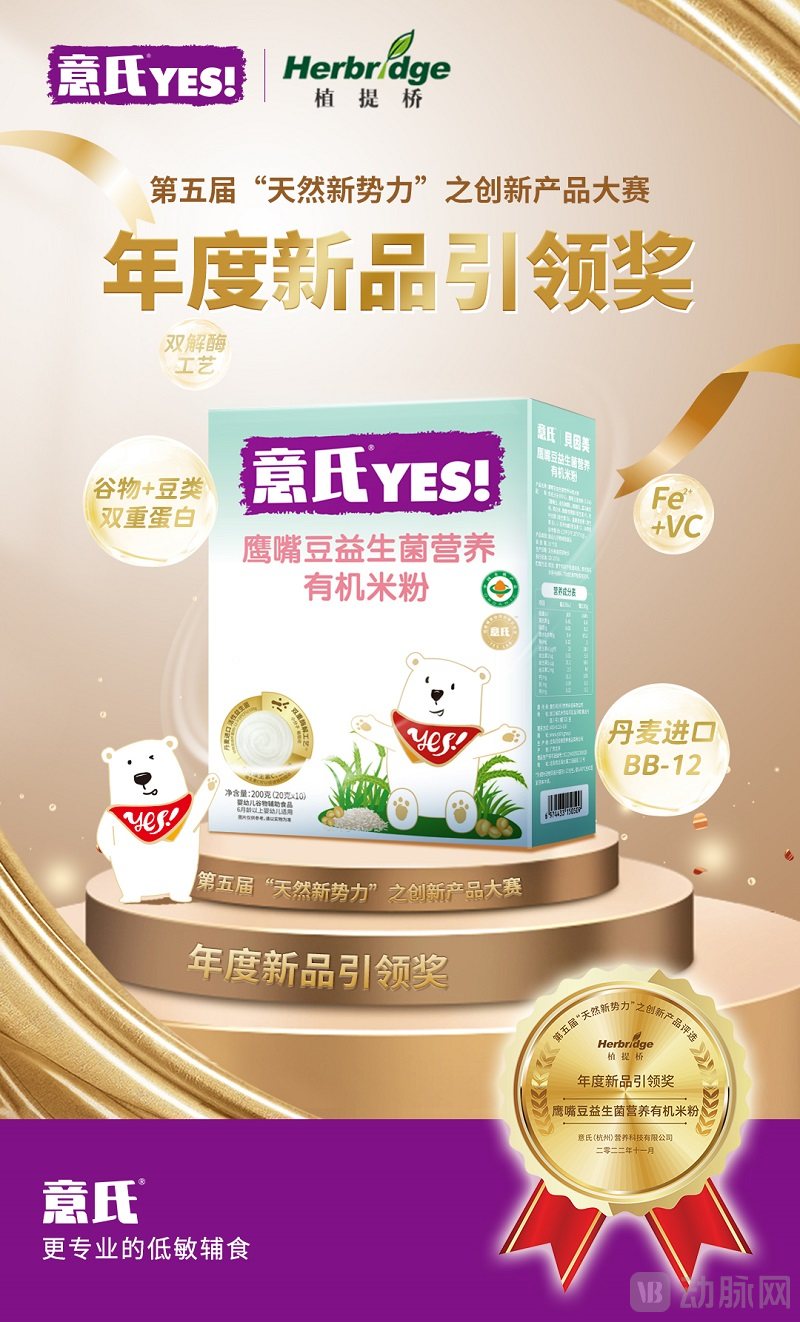
In fact, this is the fifth edition of the competition hosted by Plant Extract Bridge. As a highly reference-worthy contest in the health industry, the “New Natural Forces” Innovative Product Competition adheres to the judging principles of scientific rigor, professionalism, and application experience, dedicated to identifying high-quality products with strong R&D capabilities and innovation in the natural health sector.
Since the launch of the evaluation campaign this July, over 130 brand enterprises and more than 260 innovative products have participated. After rigorous multi-stage selection based on multiple criteria—including product positioning, formulation, taste, user experience, efficacy, and packaging—Yi’s new product, “Yi Chickpea Probiotic Nutritional Organic Rice Cereal,” stood out and jointly received the “Annual New Product Leadership Award” alongside other notable entries such as Yili Collagen Light Milk Powder.
And this,This also serves as a strong endorsement of Yishi’s achievements in innovating hypoallergenic plant-based nutritional complementary foods.
Currently, the infant and toddler complementary food market remains immature, presenting substantial room for growth. According to a research report by Southwest Securities, as living standards rise and awareness of infant and toddler nutrition continues to strengthen, consumer spending on infant and toddler foods is gradually shifting from “merely purchasing infant formula” to “buying complementary foods to diversify infants’ and toddlers’ dietary structures.”
During this process, the infant and toddler complementary food market has ushered in significant growth opportunities. Driven by consumption upgrades, the market for complementary foods targeting children aged 6 months to 3 years is even expected to achieve an annual market size of tens of billions of yuan.
However, this sector is often dominated by foreign companies. According to research by LeadLeo Research Institute, “the major infant and toddler complementary food brands in the Chinese market include Heinz, Nestlé, Gerber (Nestlé), Fangguang, and Engnice. The infant and toddler complementary food industry is highly concentrated, with the top five brands accounting for approximately 50% of the market share.”Among them, foreign brands hold a significant market share in China's infant and young child complementary food industry, with the U.S. brand Heinz consistently maintaining its position as the market leader in baby food.”
To some extent, this is related to the competitiveness of current state-owned infant and toddler complementary food brands—
On the one hand, compared with foreign brands, domestic infant and toddler complementary food brands started later, lack brand awareness, have a single category of complementary foods, and mostly imitate well-known foreign brands, which has led to lower public recognition of domestic brands.
On the other hand, due to the failure to effectively establish industry standards, domestic brands frequently encounter food safety issues.Parents are increasingly demanding safe, hazard-free, green, and natural infant and toddler products, leading them to prioritize product safety and emphasize quality when making purchases. This trend has also made parents with sufficient purchasing power more inclined to choose well-known imported brands.
The ultimate outcome is the dominance of overseas infant and toddler complementary food products in related fields.
However, if parents place greater emphasis on food safety, they are more likely to pay attention to a critical issue for infants and young children: allergies.
According to “Research Progress on Food Allergy in Infants and Young Children” published in Medical Recapitulate, the prevalence of food allergy among infants and young children is as high as 6%–8%. “Infants and young children with food allergies have an increased risk of developing bronchial asthma (approximately 15%), while the incidence of asthma among those allergic to cow’s milk is 26%.” In addition to causing malabsorption and impaired growth and development during food intake, food allergies may also pose other potential risks. Therefore, prevention of allergies in infants and young children is particularly important.
In the current domestic market, there is still a lack of providers specializing in “hypoallergenic complementary foods and snacks exclusively for allergy-prone infants and young children.”As a professional hypoallergenic infant and toddler complementary food brand under the KHS Group, Yishi aims to address food allergy issues among Chinese infants and toddlers through product innovation and R&D investment, striving to become the leading brand in the hypoallergenic infant and toddler complementary food sector.The award-winning product, Chickpea Probiotic Nutritional Organic Rice Cereal, represents its breakthrough attempt in the infant and toddler (hypoallergenic) complementary food market.
Chickpeas, hailed as the "King of Legumes" for their hypoallergenic properties, offer chickpea protein isolate with advantages such as high yield, a well-balanced essential amino acid profile, and high bioavailability. Their protein content accounts for 15%–30% of the dry weight of the seeds, comparable to that of fish, meat, and eggs. Chickpeas are rich in 18 types of amino acids, including all eight essential amino acids required by the human body.
“Yi’s Chickpea Probiotic Nutritional Organic Rice Cereal” features a scientifically formulated blend of premium chickpeas from Xinjiang and organic rice. The addition of high-quality protein from hypoallergenic chickpeas sets an industry precedent for hypoallergenic rice cereals. Furthermore, the double enzymatic hydrolysis process breaks down ingredients into small molecules, enhancing their absorbability by the human body. Currently, Yi is applying for patents related to its core technology: the double enzymatic hydrolysis process.
In fact, there are a few companies currently on the market offering hypoallergenic complementary food products for infants and young children. However, Yishi’s unique advantage lies in its greater professionalism in the field of hypoallergenic infant complementary foods and its stronger focus on meeting the nutritional needs of infants and young children.
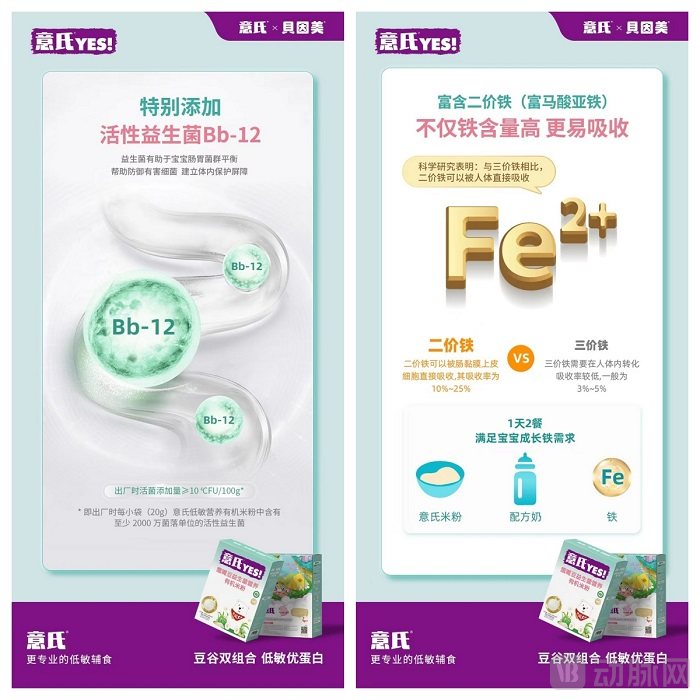
To better reduce the incidence of allergies in infants and young children and facilitate optimal nutrient absorption, Yishi has incorporated Danish-imported BB-12 active probiotics into its product formulation. These premium probiotics, known for producing antimicrobial substances and enhancing gastrointestinal mucosal protection, help maintain a balanced gut microbiota and defend against harmful bacteria. Furthermore, by scientifically selecting ferrous iron, which is more readily absorbed by intestinal mucosal cells, and adopting an iron-fortified formula combining “ferrous iron + vitamin C,” the absorption of iron in infants and young children is further promoted.
The successful launch of this product is closely tied to Yishi’s inherent strengths.
Reportedly, as China’s first “dual-legume-and-cereal hypoallergenic nutritional organic rice cereal,” Yishi Chickpea Hypoallergenic Organic Rice Cereal was jointly developed by the Yishi research team and Academician Chen Jian’s team at Jiangnan University, and co-launched with Beingmate.
On the one hand, the team's technical expertise ensured the smooth research and development of the product.From the innovative R&D of formulas and raw materials to the selective collaboration on processes and quality control, Yishi haswith Academician Chen Jian’s team at Jiangnan UniversityCo-establishment of the “Hypoallergenic Complementary Food Collaborative Innovation Laboratory”Established its own technological barriers at the source, which also fundamentally aligns with the original intent of the “Natural New Force” competition hosted by the Plant Extract Bridge—to meet consumers’ growing demands for healthier and higher-quality food products, while driving continuous product innovation and accelerating iterative upgrades. Moreover, various technologies, including low-molecular-weight enzymatic hydrolysis technology, will serve as core competitive advantages and constitute part of its commercial barriers.
On the other hand, the product production and quality control system of listed companies ensures the quality of final products.In terms of production quality control, the product is jointly manufactured by Yishi and Beingmate. It utilizes the Dutch Gouda drum drying process, while its proprietary low-molecular-weight enzymatic hydrolysis technology ensures that the rice cereal is fine in texture and easily absorbed. Furthermore, product quality is further guaranteed through the quality control system of a publicly listed company.
It is reported that Yishi will leverage the team of Academician Chen Jian from Jiangnan University to optimize and enhance its manufacturing processes while continuing to develop related hypoallergenic complementary food products. Clearly, Yishi’s ambition extends beyond the development of a single product. Leveraging its core R&D team and production quality control system, Yishi currently offers a comprehensive portfolio of hypoallergenic products, including nutritional rice cereal, wheat-free noodles and flour, imported New Zealand hypoallergenic vitamin D3, infant hypoallergenic probiotic complexes (15 billion CFU), hypoallergenic algal oil DHA (100 mg), hypoallergenic rice crackers, and hypoallergenic puffs, among other complementary foods, snacks, and nutritional supplements.
By adhering to a dual-engine strategy driven by both scientific research and brand building to create more professional hypoallergenic complementary foods, Yishi aims to achieve the goal of “fewer allergies for babies, greater peace of mind for parents.” Ultimately, while providing hypoallergenic complementary food solutions for Chinese infants and toddlers, Yishi seeks to compete on equal footing with overseas brands in the domestic hypoallergenic complementary food market.