

Trinomab Completes RMB 750 Million Pre-IPO Financing to Advance First-in-Class Anti-Infective Antibody Pipeline
Trinomab
Developer of Natural Fully Human Monoclonal Antibody New Drugs
Recently, Trinomab announced the completion of a Pre-IPO financing round of approximately RMB 750 million. The round was led by Gree Financial Investment and Xicheng Jinrui, with participation from Yifeng Capital, Shenhong Gejin, Jiaxing Weilong, Haichuang Anda, Xintaige, and Qinwan Capital. Existing shareholders, including Conba Pharmaceutical, Wuxi State-owned Union, and Jinhang Group, continued to increase their investments.
Trinomab’s Integrated Technology Platform for the Development of Natural Fully Human Monoclonal Antibodies (HitmAb®), developing novel fully human monoclonal antibody drugs derived from natural sources. Currently, the Company’s TNM001 injection (a long-acting anti-RSV monoclonal antibody) and TNM002 injection (an anti-tetanus toxin monoclonal antibody) have successively entered clinical development stages.
Trinomab has consistently been favored by the capital market, thanks to its proprietary fourth-generation antibody technology, original innovation and differentiated strategic layout, as well as efficient advancement of its drug pipeline. Its cumulative financing has exceeded RMB 2 billion.

Trinomab's Financing Status
Why Does Trinomab Frequently Attract Investment Firms? What Investment Opportunities Remain in China’s Biopharmaceutical and Antibody Drug Market? As Trinomab Completes a New Round of Financing, VCBeat Held Discussions with Chen Leiwen, Managing Partner at Xicheng Jinrui, and Li Ling, Senior Investment Manager at Gree Capital.
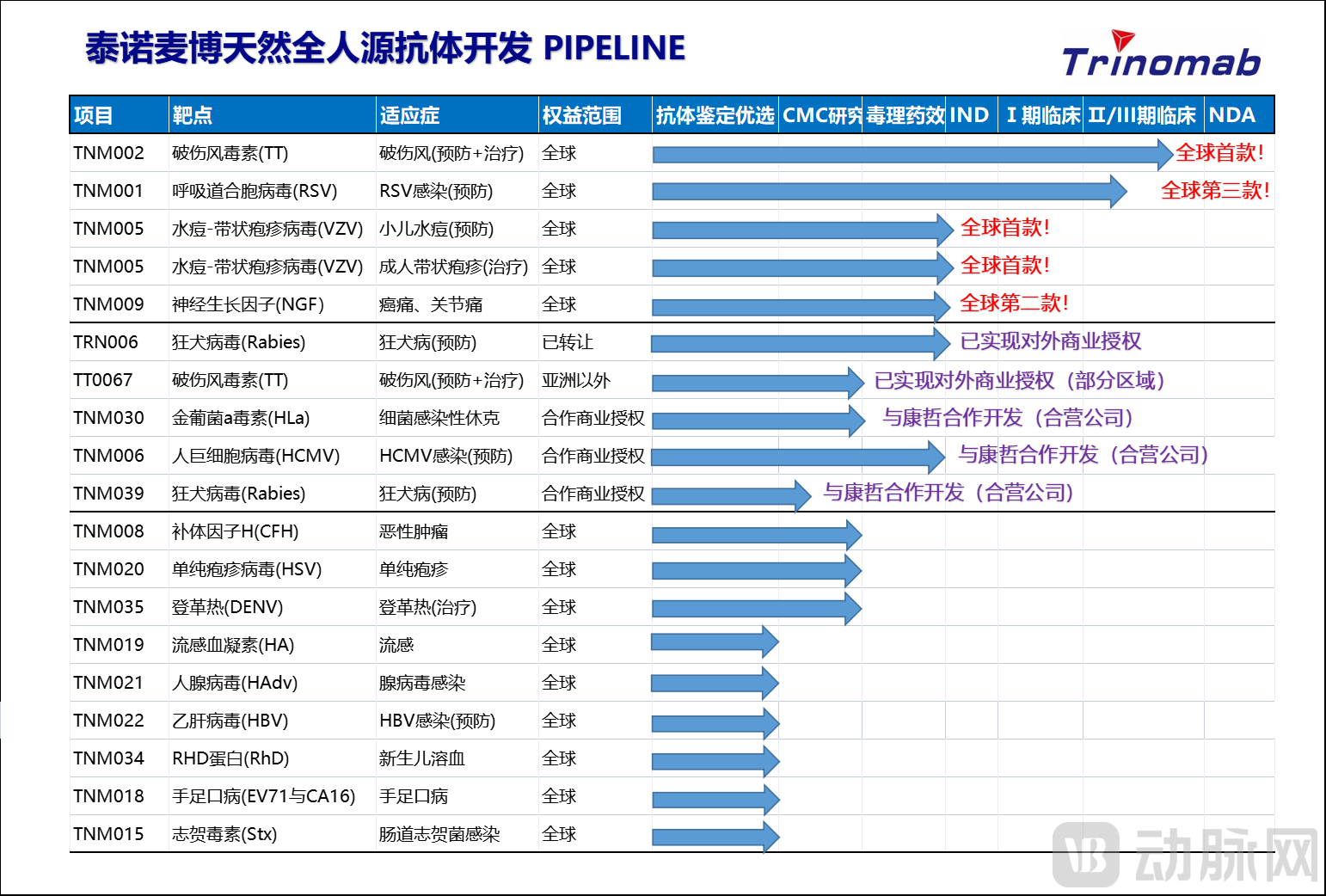
“Innovation” and “differentiation” were frequently mentioned during the conversation, which are precisely the distinguishing features of Trinomab. Beyond the increasingly crowded oncology space, Trinomab has strategically differentiated itself by establishing a presence in the anti-infective disease sector, with itsTNM002 is the world’s first monoclonal antibody against tetanus, while TNM001 is the third globally and the first in China to target RSV., the company is leveraging its leading presence in the anti-infective field to drive new growth in the monoclonal antibody market.
Trinomab Product Pipeline
With their well-defined targets and mechanisms of action, as well as their ability to significantly enhance drug efficacy and safety, monoclonal antibody therapeutics have become one of the fastest-growing segments in the pharmaceutical industry.
According to the Cortellis database, since the advent of Muromonab-OKT3, the world’s first murine monoclonal antibody drug, in 1986, approximately 243 monoclonal antibody drugs have been approved for marketing globally. Among these, 26 are registered, 44 are pre-registered, 215 are in Phase III clinical trials, 441 are in Phase II, and 503 are in Phase I. The monoclonal antibody market is becoming increasingly mature, with companies continuing to focus on new target discovery and technological innovation.
On the other hand, the monoclonal antibody market faces challenges such as the extreme difficulty in discovering new targets, the inability to establish differentiated advantages by developing drugs based on existing druggable targets, and increasing crowding in the fields of oncology and autoimmune diseases. A large number of companies are stuck in a phase of "incremental innovation," resulting in limited competitiveness.
Consequently, many enterprises are no longer confined to monoclonal antibody (mAb) technologies; instead, they are leveraging mAb platforms to expand into areas such as antibody-drug conjugates (ADCs), peptides, and peptide-drug conjugates (PDCs). In the investment landscape, some investors have gradually shifted their focus from mAbs to emerging technologies like gene therapy and mRNA vaccines. Meanwhile, a select few companies have dedicated themselves to innovation within the mAb sector, carving out unique development paths. For instance, Trinomab has taken an alternative approach by strategically positioning itself in the anti-infective disease field, which still faces substantial unmet clinical needs.
No matter how you look at it,China’s monoclonal antibody drug market has long remained a highly active potential market.Blockbuster monoclonal antibody products have generated hundreds of billions in sales. In 2021, the FDA approved the 100th antibody drug, and the use of monoclonal antibodies to treat infectious diseases was named one of Science magazine’s Top 10 Scientific Breakthroughs of the Year. Furthermore, innovations across various technologies are making the development of antibody drugs more efficient and diverse. In short, the market for monoclonal antibodies and antibody-based therapeutics still holds immense opportunities.
We have noted that Gree Financial Investment and Xicheng Jinrui are closely monitoring the antibody drug market.
Among them, Gree Financial Investment began focusing on the antibody drug sector in 2018, with Trinomab being a representative antibody drug company in its investment portfolio. Xicheng Jinrui focuses primarily on the biopharmaceutical field and has invested in technologically leading enterprises such as Imunocan, Yijieli Ke, Inoricon, and Hualan Vaccine. Its investment in Trinomab represents a significant strategic move in the biopharmaceutical sector, enabling synergistic advantages with its other portfolio companies.
Why Are We Bullish on the Monoclonal Antibody and Antibody Drug Market in the Long Term? Chen Leiwen, Managing Partner at Xicheng Jinrui, stated, “We have indeed observed intensifying competition within the industry, such as the crowded development landscape around the PD-1 target. Nevertheless, we remain optimistic about the future prospects of monoclonal antibody drugs. Database searches reveal more than 1,500 potential antibody drug targets, with nearly 400 of them currently in clinical stages. Among these, only 40–50 targets are being developed domestically. This means that over 300 targets already in clinical trials abroad have not yet been pursued by any companies in China.”In terms of quantity, diversity, and quality, China's monoclonal antibody drugs still have room for improvement.”
In this context,Many investors remain enthusiastic about the monoclonal antibody market, paying close attention to companies that stand out in this field with international innovation and differentiated R&D capabilities.。
“Specifically, we focus on companies that are deeply committed to differentiated disease areas, such as the anti-infective field, which currently sees relatively little competition. In this segment, Trinomab’s pipeline for tetanus prevention and RSV infection shows promising prospects. In 2020, the volume of tetanus-specific immunoglobulin administered in China exceeded 6 million doses. Additionally, globally, approximately 64 million people are hospitalized each year due to lower respiratory tract diseases caused by RSV infection. Meanwhile, Trinomab’s differentiated technology platform and leading product pipeline are key factors we consider,” said Li Ling, Senior Investment Manager at Gree Financial Investment.
In the future, driven by breakthroughs in basic research and the continued refinement and application of single-cell sequencing, genomics, and proteomics technologies, new therapeutic targets will continue to emerge. Antibody-based drugs will also expand into a broader range of indications, presenting substantial opportunities for companies and investors to explore.
Regarding how to measure the investment value of antibody drug companies, Xicheng Jinrui has already established a comprehensive system, willEvaluation from multiple dimensions, including the team, R&D platform, clinical progress, market size and competitive landscape, probability of successful drug development, and financial returns.
“For example, founders should possess both R&D and commercial experience; the R&D platform must demonstrate a sustained capacity for developing innovative drugs and have been validated by the market. In terms of disease areas, pipeline layout, and clinical progress, the assets should exhibit characteristics such as substantial market potential, a favorable competitive landscape, and leading clinical development stages. Furthermore, safety and efficacy must be clinically verified, ensuring a high degree of certainty for market approval. We also verify the drug’s production costs, as innovative drugs may face national reimbursement negotiations shortly after launch, necessitating adequate profit margins and thorough consideration of commercialization and profitability,” Chen Leiwen further explained.
Xicheng Jinrui and Gree Capital Investment have both conducted thorough research on the antibody drug market, summarizingTrinomab is a highly unique target in the fields of antibody drugs and anti-infectives.
Team Expertise and Experience:The anti-infective sector presents high barriers to entry, requiring years of experience and accumulated expertise from R&D personnel. Dr. Liao Huaxin, founder of Trinomab, formerly served as Director of the Duke Human Vaccine Institute at Duke University in the United States, bringing profound insights into the anti-infective field. Combined with CEO Zheng Weihong’s successful track record in pharmaceutical commercialization, the company has built a team that integrates scientific rigor with business acumen, establishing a comprehensive pathway spanning antibody screening, R&D, clinical development, and commercialization.
In terms of technical platform layout,Trinomab is at the forefront of technological innovation in antibody therapeutics, with its HitmAb platform for fourth-generation natural fully human antibody development.®Outstanding Advantages with Preliminary Market Validation. Natural fully human antibodies are obtained through the maturation and differentiation of B cells in the human body, followed by direct selection. They demonstrate significant advantages in the development of anti-infective therapies, including antiviral and antibacterial agents. These antibodies exhibit excellent affinity for antigens while minimizing immunogenicity, thereby addressing the issue of anti-drug antibody responses caused by immunogenicity in traditional antibody drugs and substantially improving the success rate of drug development.
Leveraging natural fully human monoclonal antibody technology with lower immunogenicity and higher druggability, Trinomab has avoided the heavily crowded and fiercely competitive fields of oncology and autoimmune diseases, instead making differentiated and forward-looking strategic entries into the blue ocean market of anti-infective therapies.
Pipeline-wise,Trinomab has developed nearly 20 antibody molecules, with five in-house products having entered or approaching clinical trials, two products successfully licensed to publicly listed companies, and three products under co-development with publicly listed companies. Its core pipeline demonstrates leading progress and clear commercial value.TNM002 is the world’s first monoclonal antibody against tetanus., currently in Phase III clinical trials, having received Breakthrough Therapy designation from China’s CDE and Fast Track designation from the U.S. FDA,TNM001 is the first RSV monoclonal antibody in China. Meanwhile, the company is developingNovel Natural Fully Human Monoclonal Antibody DrugPoised to Resolve the Long-Standing Global Challenge of Dengue Fever。
Li Ling stated, “Overall, Trinomab’s strategic layout, progress, and innovativeness can be regarded as the industry benchmark. We look forward to the successful market launch of TNM002 and the rapid advancement of TNM001, with new breakthroughs in key data such as efficacy. We also anticipate that the company will leverage its existing antibody screening platform to expand into more clinical indications and technical directions, thereby driving the development of Zhuhai’s local biopharmaceutical industry.”
As is well known, in 2022, the healthcare sector experienced a chill in investment and financing due to multiple factors, including the recurrent COVID-19 pandemic, macroeconomic pressures, cooling valuations of biopharmaceutical companies in the secondary market, and challenges related to pricing and hospital access.
However, for investment institutions, this period also presents an opportune moment to deeply identify companies with innovative technological pathways, robust founding teams, excellent operational management, and efficient commercialization capabilities. For innovative pharmaceutical companies, effective strategies to break through market barriers include adopting a patient-centric approach, addressing unmet clinical needs, conducting in-depth research into pathological mechanisms, laying out new targets, advancing technological iterations, avoiding homogeneous competition, and implementing differentiated marketing by uncovering the needs of patients and physicians.
“During challenging times, the bubble bursts and falsehoods are stripped away to reveal the truth, allowing outstanding enterprises to truly emerge. Trinomab’s natural fully human antibody drug discovery platform has demonstrated its capability in developing an innovative drug pipeline, helping Chinese innovative drugs take a solid step from ‘incremental innovation’ to ‘global first-in-class.’ We hope to continue witnessing the clinical benefits for patients brought by breakthroughs in the company’s innovative pipeline in the future, and look forward to seeing the company develop into a next-generation large-scale biopharmaceutical R&D and manufacturing enterprise,” said Chen Leiwen.