

MedVision Announces Breakthrough in 3D Medical Imaging and Mixed Reality Navigation for Neurosurgery in Collaboration with Huashan Hospital
Recently, Shanghai Yishiji Technology (hereinafter referred to as “Yishiji”) assisted neurosurgeons at Huashan Hospital of Fudan University in successfully performing a complex intracranial tumor surgery, leveraging 3D visualization of medical imaging and mixed reality augmentation technologies. This milestone represents a key component of the collaborative efforts between Yishiji and Huashan Hospital to advance smart healthcare solutions, and it is one of more than 100 successful cases where this technology has been deployed across multiple hospitals in Beijing, Shanghai, Jiangsu, Tibet, and other regions.
Neurosurgery is the surgical specialty that demands the highest level of precision. The human central nervous system contains hundreds of millions of neurons, along with intricate bundles of nerve fibers and complex vascular networks. Surgical injury to any functional area can result in severe sequelae for the patient, or even pose a life-threatening risk. Therefore, precise localization of the lesion both preoperatively and intraoperatively is a critical step to ensure surgical success, minimize tissue damage, and optimize patient prognosis.
However, achieving “precise positioning” is no easy feat.Conventional medical imaging techniques (CT or magnetic resonance imaging (MRI)) can only present two-dimensional images; the neuroanatomical structures of the brain cannot be fully reconstructed from medical images, and intuitive three-dimensional visualization is not provided.In most current neurosurgical procedures, clinicians must rely on their own experience to mentally reconstruct the three-dimensional structure of the nervous system as a basis for disease diagnosis and treatment. This method of image interpretation places high demands on clinicians’ spatial imagination and ability to visualize anatomical structures. Junior physicians often struggle to obtain comprehensive and accurate disease information from two-dimensional images, leading to an increased risk of misdiagnosis, missed diagnosis, and incorrect diagnosis. Although well-equipped hospitals can currently purchase neuronavigation systems for preoperative and intraoperative localization, the prohibitive cost—often running into millions of yuan—and high maintenance fees deter many small and medium-sized hospitals from adopting this technology.
“We aim to help neurosurgeons achieve minimally invasive and precise surgeries through automatic annotation of medical images and 3D visualization, and this can be accomplished without the need to purchase large equipment, using only a smartphone or tablet.”Zhao Yiyang, Founder and Part-time Chief Operating Officer of MedVision International, told VCBeat.
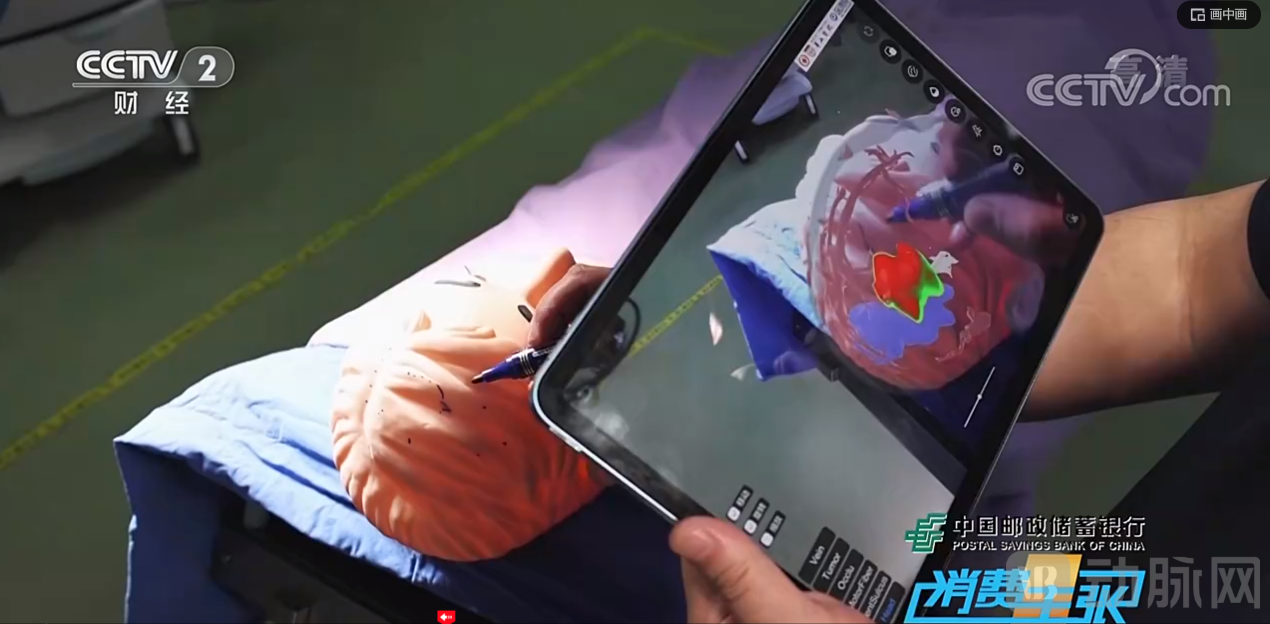
YiShiJi 3D Visualization and Mixed Reality Enhancement Technology for Medical Imaging
Since 2018, the founding team of MedVision has been deeply engaged in integrating medical imaging algorithms with XR technology, continuously exploring the intersection of technology and clinical practice while conducting R&D activities. In 2019, MedVision launched “3Dslicer Community,” the largest public community for neurosurgeons in China (with over 13,000 registered neurosurgeons), and released a beta version of its XR image localization and interaction software. The product has been continuously iterated based on feedback from clinicians using the beta software.
The team is dedicated to providing 3D digital solutions for medical imaging based on algorithmic and XR media technologies, enabling rapid segmentation of multiple structures and lesions in CT and MRI images. Meanwhile, the team employs rendering imaging techniques to accurately present 3D images on portable smart devices (such as smartphones or tablets). By offering multi-dimensional information and a more intuitive visualization of anatomical structures, this approach reduces uncertainties associated with 2D imaging during clinical surgeries. This not only enhances surgical safety but also eliminates dependence on imported large-scale neuronavigation systems.
According to Yishijie,The solutions provided by the company are designed with physician involvement from the outset, ensuring that the products truly align with clinical needs and address critical clinical demands. Furthermore, leveraging the extensive clinical data accumulation and annotation contributed by the co-founders and professional physicians within the community, the algorithms are thoroughly trained to enable rapid and accurate processing of imaging information. The neurosurgery public community operated by the company provides continuous informational and data support for product iteration and pipeline development, while further validating the real-world clinical value of the solutions, thereby helping the company refine its product development.
Currently, Yishiji has established three product pipelines based on 3D imaging, algorithmic models, and data mining in neurosurgery: preoperative surgical planning, real-time intraoperative imaging presentation and feedback, and surgical robots.In the future, companies will also leverage algorithmic models based on neurosurgical imaging (encompassing arteries and veins, nerve bundles, lesions, and brain tissue) to continuously expand applications to other medical departments.
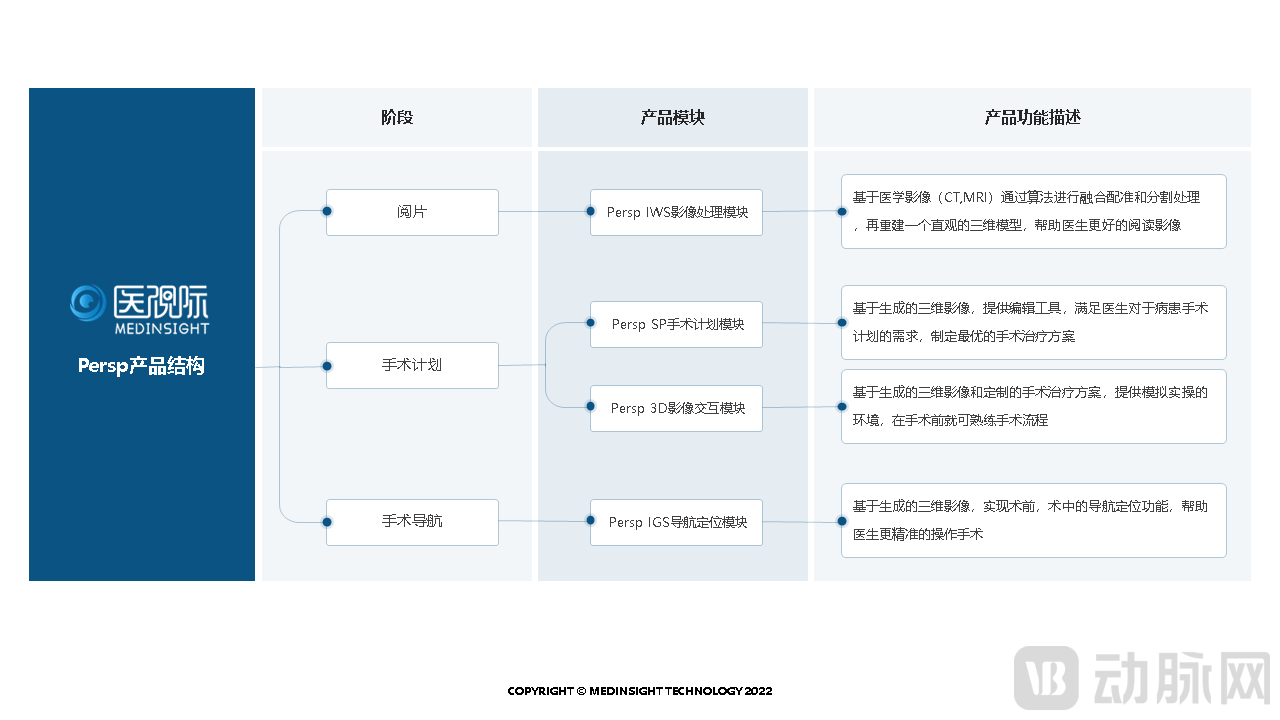
Persp Product Structure
Traditional neurosurgical procedures and their corresponding navigation systems are generally confined to a single spatial setting (the same operating room), with each device serving only one surgery at a time. According to data from the China Health Statistics Yearbook, the number of hospitalized patients with various neurological disorders has been rising year by year. In 2019, the number of craniotomies performed nationwide in China approached 700,000, representing a year-on-year increase of approximately 15%. Limited medical resources are hardly able to keep pace with the rapidly growing volume of neurosurgical craniotomies.
To break through this bottleneck,Since 2020, Yishiji has collaborated with network operators such as China Unicom and China Telecom to deploy image analysis and navigation functionalities on cloud servers, enabling real-time, multi-site, multi-task surgical collaboration via high-speed networks.
In 2020, Yishiji collaborated with Huashan Hospital to provide remote neurosurgical navigation for a Tibetan patient located in Shigatse. Furthermore, Yishiji’s remote multi-task neurosurgical navigation system has been routinely implemented at multiple medical institutions, including the General Hospital of the Eastern Theater Command.
The human brain is akin to a “dark forest.” It contains 86 billion neurons, 500 trillion synapses, and various complex factors such as neurotransmitters composed of amino acids, peptides, and proteins, which organically form an immensely intricate neural network. To better elucidate the pathogenesis and progression of more brain disorders and ultimately improve therapeutic outcomes, it is essential to unravel the secrets of this “dark forest.” Three-dimensional digital solutions for medical imaging undoubtedly represent a beacon of hope in illuminating this dark forest.
Currently, although Yishiji’s core product remains in beta testing, it is already being used by physicians at more than 100 hospitals. Meanwhile, the company continues to collaborate with hospitals and research institutes to iterate its products and better meet market demands.