

Another Internet Healthcare Firm Files for IPO: Fangzhou Jianke Seeks to Capitalize on Chronic Disease Management Growth

Fangzhou Pharmaceutical
Chronic Disease Service Platform
On the evening of November 21, Fangzhou Pharmaceutical, under the entity Fangzhou Yunkang Holdings Co., Ltd. (hereinafter collectively referred to as “Fangzhou Pharmaceutical”), submitted a listing application to the Hong Kong Stock Exchange, becoming another company in the internet healthcare sector to pursue an initial public offering (IPO).
In its prospectus, Fangzhou Pharmaceutical positions itself as an online chronic disease management platform; according to data from Frost & Sullivan, it is China’s largest online chronic disease management platform based on average monthly active users in 2021.
Since its inception as an online pharmacy, Fangzhou Pharmaceutical has developed three core business segments: comprehensive medical services, online retail pharmacy services, and customized content and marketing solutions. According to data from its prospectus, the company’s revenue is derived from these three business segments. In the first half of 2022, revenue from comprehensive medical services amounted to RMB 350 million, accounting for 35.2% of total revenue during the same period. Since 2019, both the revenue and the proportion attributable to comprehensive medical services have consistently increased, reaching 40.9% in 2021.
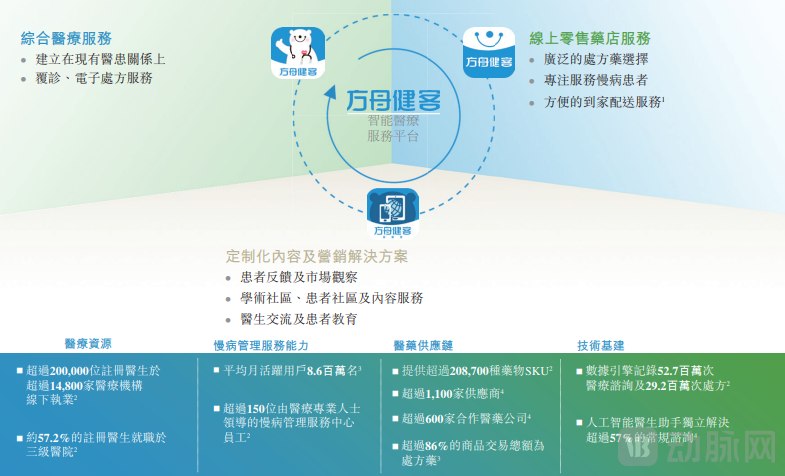
Fangzhou Pharmaceutical’s Business Model, Source: Prospectus
Revenue from medical services remains a persistent challenge for internet healthcare companies. Financial data shows that Fangzhou Pharmaceutical has a relatively high proportion of revenue derived from medical services. What are the sources of this income, and what capabilities underpin it? As a chronic disease management platform, what will drive Fangzhou Pharmaceutical’s future growth? VCBeat provides an analysis.
In recent years, Fangzhou Pharmaceutical has achieved sustained performance growth. In 2019, 2020, and 2021, the company generated revenues of RMB 303 million, RMB 1.16 billion, and RMB 1.759 billion, respectively. In the first half of 2022, its revenue reached RMB 993 million, representing a year-on-year increase of 30.7%.
Among its revenue sources, comprehensive medical services primarily consist of H2H (Hospital to Home) services and offline medical services. Online retail pharmacy services mainly provide users with a variety of healthcare products, particularly prescription drugs, which are delivered through third-party express delivery companies. Customized content and marketing solutions are primarily targeted at pharmaceutical companies, facilitating their digital marketing efforts through products such as academic communities and Fangzhou Yiliao.
The sustained revenue growth across its three major business segments has driven Fangzhou Pharmaceutical’s overall performance improvement. Among these, the online retail pharmacy is Fangzhou Pharmaceutical’s core strength; as of June 2022, its pharmaceutical supply chain offered more than 208,700 drug SKUs. Meanwhile, comprehensive medical services have emerged as a new and robust growth driver.
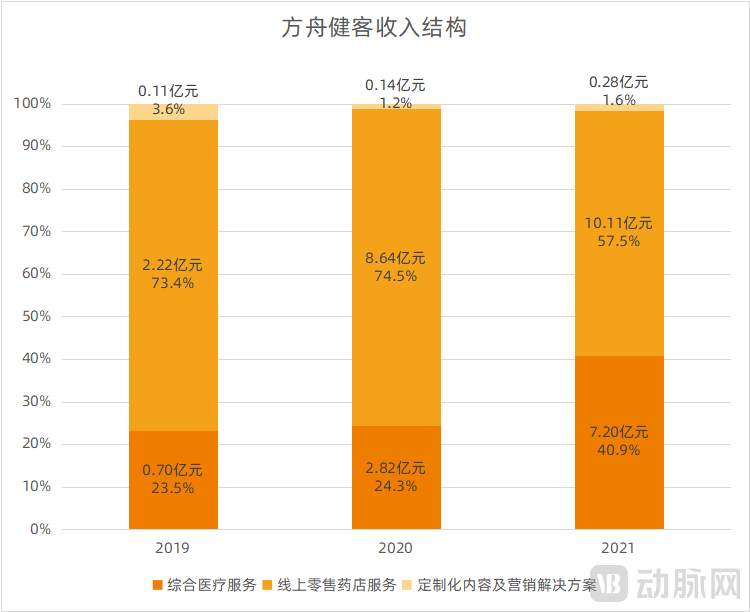
Revenue Structure and Changes of Fangzhou Pharmaceutical, Data Source: Prospectus
From 2019 to 2021, revenue from comprehensive medical services grew from RMB 70 million to RMB 720 million, with a growth rate far exceeding that of overall revenue. Its share of total revenue increased from 23% to 40.9%. In the first half of 2022, comprehensive medical services generated RMB 350 million in revenue, accounting for 35.2% of total revenue.
The prospectus discloses that revenue from integrated healthcare services primarily comprises: online consultation services, e-prescription services, and sales of pharmaceuticals and other products to individual customers through the integrated healthcare service platform; as well as physician consultation services, health examination services, surgical services, and hospital sales of pharmaceuticals to individual patients.
Among the aforementioned revenue, offline services such as medical check-ups and surgeries are primarily derived from Jingtai Hospital, a subsidiary of Fangzhou Pharmaceutical, serving as a complement to its online medical services.
H2H services are the core of integrated healthcare services, delivered to patients by physicians registered with Jianke Hospital (the physician-facing portal) through platforms such as the Jianke Doctor App and WeChat Official Accounts (the patient-facing portals).
An analysis of the prospectus and other public disclosures reveals that Fangzhou Pharmaceutical primarily drives the development of its Hospital-to-Home (H2H) services by establishing physician networks, patient services, and chronic disease management centers, thereby achieving growth in comprehensive medical services.
Doctor resources are the most critical assets for internet healthcare platforms.
Fangzhou Pharmaceutical attracts physicians to register by expanding its presence in offline hospitals and collaborating with pharmaceutical companies; it also enhances its platform influence through the development and optimization of physician services and system tools, thereby attracting physicians to join via positive word-of-mouth.
Thanks to the continuous development of its business and platform, as of June 2022, Fangzhou Pharmaceutical’s H2H service had registered more than 200,000 doctors from 14,800 medical institutions. Among them, approximately 57.2% of the registered doctors were from tertiary hospitals.
To ensure medical quality, the platform requires physicians to inquire about patients’ complete medication and treatment histories when providing consultation services, and mandates timely responses to patient inquiries. The system calculates the response rate for each registered physician; those with a monthly response rate below 70% will receive reminders from relevant physician management personnel. If no improvement is observed, the physician’s privilege to provide consultation services on the platform will be suspended for a specified period.
Meanwhile, Fangzhou Pharmaceutical pays service fees to physicians.
From 2019 to 2021, service fees paid to registered physicians as part of Fangzhou Pharmaceutical’s selling and distribution expenses increased year by year, accounting for a significant proportion. In 2021, these fees reached RMB 97 million, representing 31.3% of total selling and distribution expenses. In the first half of 2022, benefiting from economies of scale, promotional and incentive expenditures directed toward participating physicians decreased; consequently, the corresponding expenses remained flat compared with the same period in the previous year, while their proportion declined.
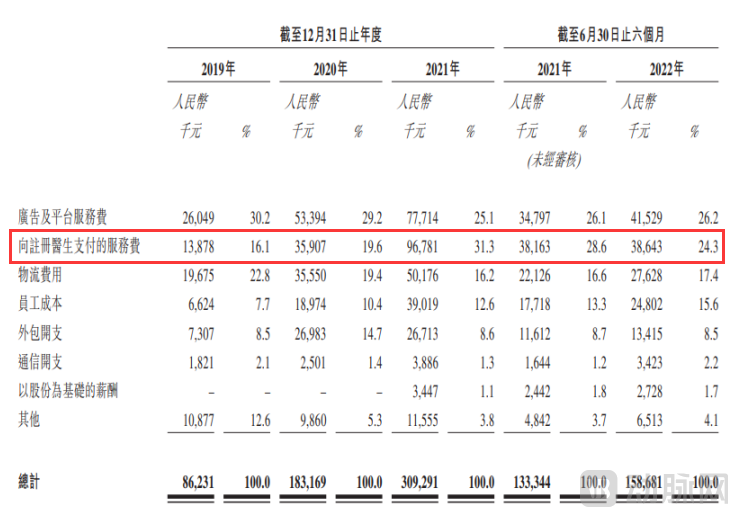
Fangzhou Pharmaceutical’s Sales and Distribution Expenses | Source: Prospectus
Overall, Fangzhou Pharmaceutical has invested heavily in physician resources, primarily because physicians are not only direct providers of medical services but also a key asset for attracting and retaining patients. Fangzhou Pharmaceutical provides each registered physician with a unique QR code; when patients scan the code, they can establish a connection with the physician to access follow-up services such as online consultations and electronic prescriptions.
On the one hand, leveraging physician resources can help expand the user base.
In its prospectus, Fangzhou Pharmaceutical stated that, with respect to its Hospital-to-Home (H2H) services, the vast majority of patient users were invited to the platform by registered physicians during offline consultations. Physicians introduce new patients to the platform, while existing patients engage with their physicians through the platform, thereby driving continued growth in user base and user retention rates. For the year ended June 30, 2022, the average retention rate of registered physicians on the H2H service platform was approximately 81.7%, and the average retention rate of online patients was approximately 59.4%.
On the other hand, patients referred by physicians exhibit more inelastic and higher-frequency demand for medical services, enabling higher paid conversion rates.
Patients acquired through offline medical scenarios, particularly those with chronic diseases, typically have follow-up consultation and prescription renewal needs, making them more targeted than patients from public-domain traffic. The prospectus indicates that patients on the H2H service platform are usually referred by physicians after initial offline consultations, and thus generally demonstrate a strong willingness to pay. From 2019 to 2021, the conversion rate of active users to paying users on the H2H service platform increased steadily, reaching 19.8%, 29.1%, and 32.6%, respectively; in the first half of 2022, this conversion rate reached 35.2%.
Overall, Fangzhou Pharmaceutical has simultaneously expanded resources on both the physician and patient ends through a “physician-referring-patient” model, thereby driving user payment conversion and maximizing the value of this typical customer acquisition strategy in internet healthcare.
Patient traffic is hard-won; therefore, many internet healthcare platforms integrate internet hospitals and pharmaceutical e-commerce into a single app or patient portal, whereas Fangzhou Pharmaceutical has adopted a model that separates the medical and pharmaceutical entry points.
In terms of medical services, patient care is primarily delivered through the Jianke Doctor APP and WeChat Official Account. For pharmaceuticals, drugs are mainly sold via the Fangzhou Pharmaceutical Online Pharmacy APP, WeChat Official Account, Mini Program, and website.
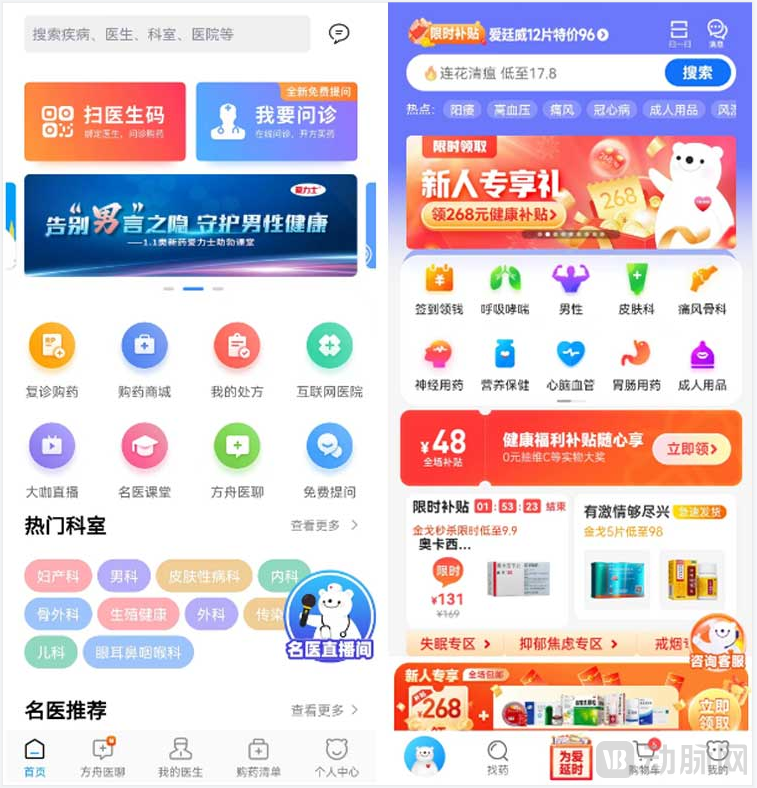
Screenshots of the Jianke Doctor homepage (left) and the Fangzhou Pharmaceutical online pharmacy homepage (right)
The homepages of the two client types also exhibit significant differences. As shown in the figure above, the Jianke Doctor homepage prominently features functions such as scanning doctor QR codes, online consultations, and prescription renewals, while presenting additional medical services and information categorized by department and health education. In contrast, the Fangzhou Pharmaceutical online pharmacy displays content organized by drug categories, with a prominent emphasis on promotional and discount information.
There is some overlap in the service offerings of Jianke Doctor and Fangzhou Pharmaceutical’s online pharmacy: users can purchase medications through Jianke Doctor, while those purchasing prescription drugs via Fangzhou Pharmaceutical’s online pharmacy may access prescription services when necessary. Overall, however, an examination of page presentation, service workflows, and service content reveals that Jianke Doctor exhibits stronger medical attributes, whereas Fangzhou Pharmaceutical’s online pharmacy demonstrates more pronounced e-commerce characteristics.
H2H services are the core of Fangzhou Pharmaceutical’s integrated healthcare offerings, with Jianke Doctors serving as the platform for delivering these H2H services to patients. As Jianke Doctors provide a comprehensive suite of services spanning both medical care and pharmaceuticals, the total revenue generated by Jianke Doctors includes income from both sectors. However, this pharmaceutical revenue is distinct from the pure e-commerce sales derived from Fangzhou Pharmaceutical’s online pharmacy.
Overall, Jianke Doctor, with its independent entry point, is regarded as a platform providing medical and related services. It has been fully integrated into comprehensive medical services, with its corresponding revenue becoming a significant contributor to the income from such services.
As a capability support for its comprehensive medical services, Fangzhou Pharmaceutical has also established a Chronic Disease Management Service Center to provide users with services such as consultation follow-up, prescription counseling, and patient education.
As of June 2022, the Chronic Disease Management Service Center had assembled a team of over 150 members led by medical professionals, including physician assistants, specialized healthcare and pharmacy personnel, and expert consultants in specialized medical fields.
Physician assistants serve as the first point of contact for patient services. With a medical background or experience, they typically handle routine communications during patient visits, provide guidance and responses to basic medical inquiries, and aim to improve patient adherence.
Licensed physicians and pharmacists provide patients with systematic treatment recommendations, medication guidance, or disease management.
Special Medical Expert Consultants are chief physicians or higher-ranking doctors with more than 15 years of clinical practice experience. These expert consultants provide consultation and guidance on complex medical cases, as well as deliver training lectures to internal medical professionals.
At the Chronic Disease Management Service Center, internal medical professionals follow up with and document patients’ health status and medication adherence via telephone, establish online health records for patients, and provide regular reminders for health check-ups based on these records. When patients have questions regarding prescriptions or orders, internal medical professionals or registered physicians are available to offer consultation services.
The center also provides popular science education on chronic disease management, along with dietary and exercise planning recommendations, through its online WeChat account and telephone services. To improve medication adherence, the center sends medication reminders via WeChat messages or its app when patients are due to take their medications. Additionally, when patients need follow-up visits and prescription refills, the center sends reminders through WeChat messages, phone calls, text messages, or its app.
In addition, the Chronic Disease Management Service Center collaborates with pharmaceutical companies by providing patients with medication guidance, collecting patient feedback, informing patients about drug side effects, and assisting pharmaceutical companies in addressing patients’ medication-related inquiries.
For comprehensive medical services, the Chronic Disease Management Service Center enhances operational efficiency for registered physicians through roles such as physician assistants, thereby providing patients with more comprehensive and timely care, which in turn strengthens the overall capacity of comprehensive medical services.
For the entire Fangzhou Pharmaceutical platform, the Chronic Disease Management Service Center serves as the business “hub,” connecting doctors, patients, and pharmaceuticals, as well as internal and external medical resources. By collaborating with pharmaceutical companies to serve patients, it facilitates the establishment and deepening of digital marketing services tailored for pharmaceutical enterprises.
In recent years, countless enterprises have entered the field of online chronic disease management, with internet healthcare companies serving as the primary force. Medical device manufacturers and pharmaceutical companies have also made significant strategic investments in this area. Even physical hospitals are expanding their service scope through internet hospitals, conducting post-consultation follow-ups, chronic disease management, or whole-course disease management.
The vast market potential of chronic disease management is self-evident; however, the industry’s development has been constrained by challenges such as poor patient adherence and low willingness to pay for services, which fundamentally limit its growth pace.
As the largest online chronic disease management platform, how can Fangzhou Pharmaceutical address challenges and further consolidate its market position in its future development? Based on the above analysis, VCBeat believes that the following points are key.
Refined Chronic Disease Management Model, with Greater Emphasis on the Effectiveness of Management Outcomes.
The effectiveness of chronic disease management holds significant importance for both patients and physicians. Over an extended period in the past, the industry has established various online chronic disease management models based on internet platforms, smart devices, and other technologies, achieving a high level of infrastructure maturity.
However, both various platforms and individual participants, such as physicians, are still in the exploratory phase regarding pathways for online chronic disease management. The inconsistency in service processes, content, and quality has led to varying user-perceived outcomes and differing effectiveness as measured by available data. Therefore, it is necessary to further refine chronic disease management models, serving patients with higher-standard processes and content to enhance the effectiveness of outcomes.
In its prospectus, Fangzhou Pharmaceutical stated that it will provide more efficient and effective solutions to meet the needs of patients with chronic diseases in the future; leveraging its established ecosystem, it will enter other therapeutic specialty and indication markets with significant unmet demand.
Meanwhile, we will collaborate with experienced specialists, medical institutions, and pharmaceutical companies to share their expertise and develop standardized treatment protocols, enabling other physicians on the platform to quickly and easily reference them.
As the platform expands, Fangzhou Pharmaceutical also plans to add more modules, such as connectivity with wearable devices to enable real-time monitoring and diagnosis.
Strengthen physician operations to reduce associated costs.
As internet healthcare platforms deepen their development and more public internet hospitals are established, competition for physician resources within the industry has intensified. A recent survey conducted by VCBeat’s Eggshell Research Institute also revealed that 71.5% of online physicians practice on only one to three platforms. Although internet healthcare amplifies the efficiency of medical resource utilization, physicians have limited energy and can therefore serve only a limited number of platforms.
Strengthening physician operations is essential to better retain physicians, thereby reducing overall physician-related costs. This is especially critical for Fangzhou Pharmaceutical, which relies primarily on externally registered physicians.
The prospectus indicates that Fangzhou Pharmaceutical intends to expand its operations team to provide better support for physicians on its platform, particularly newly registered doctors who may be unfamiliar with the platform’s functionalities. The company also plans to segment registered physicians based on criteria such as geographic region, years of experience in the medical industry, professional title, hospital tier, and platform engagement levels, aiming to enhance physician activity through more targeted operational strategies.
Research by VCBeat’s Eggshell Institute also indicates that the standardization of platform diagnosis and treatment processes and content, as well as social influence, are important factors in attracting physicians; Fangzhou Pharmaceutical can strengthen its efforts in these areas.
Establish a multi-channel payment system.
To date, public internet hospitals have made rapid progress in integrating with medical insurance payment systems, whereas private internet healthcare companies have lagged behind. For a long time, patients have shown limited willingness to pay for services, preferring instead to pay for products and tangible goods. This has resulted in an industry landscape where pharmaceutical sales remain the primary source of revenue.
In the management of chronic diseases, healthcare team services and diverse medication needs—particularly for innovative drugs—require stronger payment channels as support.
Public information indicates that in 2021, Fangzhou Pharmaceutical partnered with insurance companies such as People’s Insurance Company of China (PICC), Sunshine Insurance Group, China United Property Insurance, and Zijin Insurance to continuously advance the development of innovative payment solutions, further leverage the synergistic effects of the “medical care–pharmaceuticals–insurance” model, and complete the online healthcare closed loop.
However, Fangzhou Pharmaceutical’s prospectus contains scant disclosure regarding insurance-related matters. To perfect the online healthcare closed loop, it must accelerate its moves in the payment segment.
In any case, judging from the IPOs and IPO applications of internet healthcare companies over the past two years, the industry has overall entered a new stage. Although business models and revenue structures are not yet perfect, taking this step heralds the arrival of a new starting point.