

Chased by Awards, These Young Scientists Are Finally Being Seen!
Young scientists are garnering significant attention.
In recent times, three major awards (Fourth Science Exploration Prize, DAMO Academy Qingcheng Award, MIT Technology Review’s “Innovators Under 35” Asia-Pacific(hereinafter referred to as TR35) honored a total of 100 young scientists, among whomThere are 20 winners in the medical field., it is the most numerous in its niche segment.
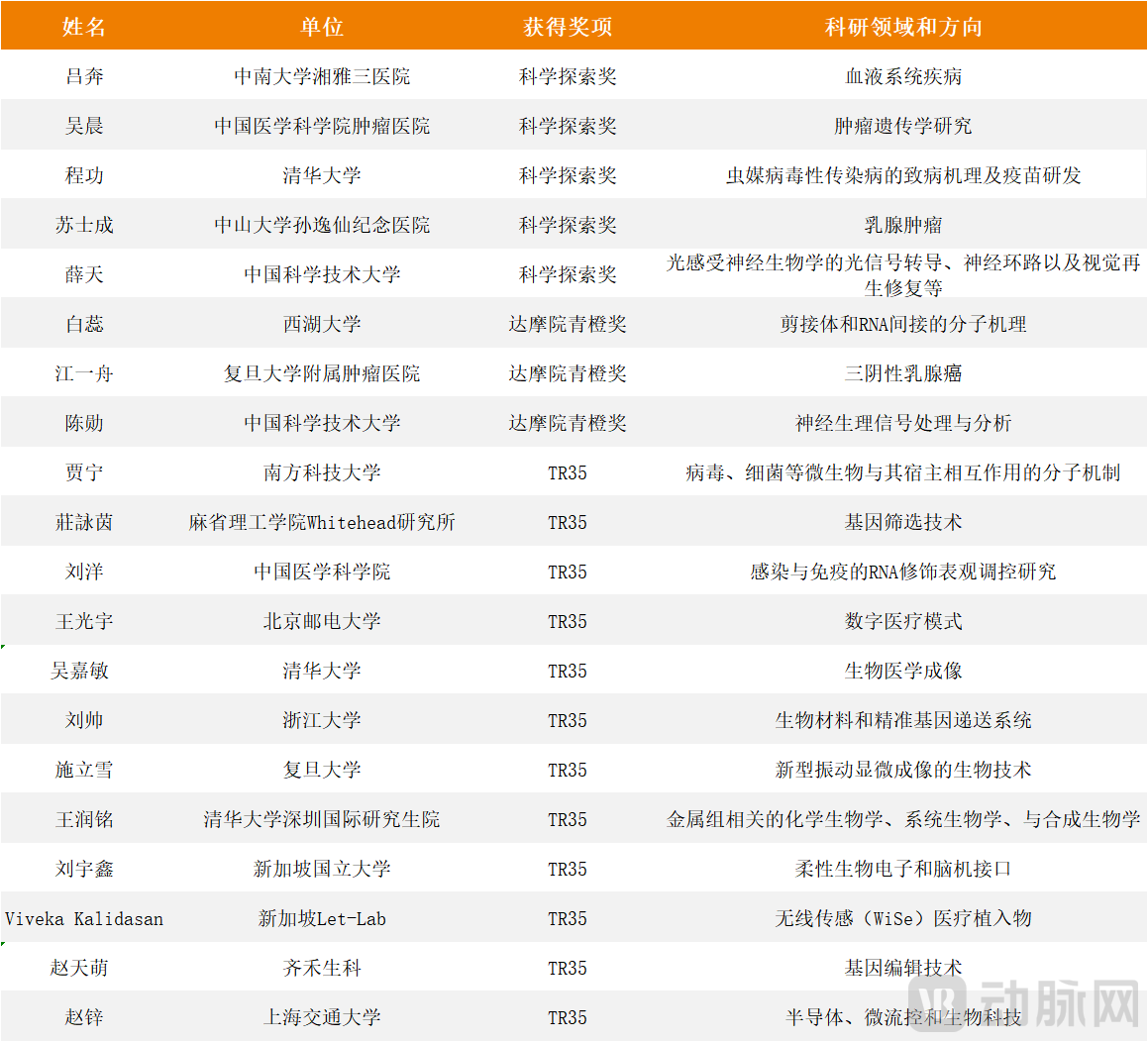
So, who exactly are these young scientists? Why have they been honored with awards? And what challenges are they facing in the process of translating their research into practical applications?
Both academia and industry need them.
Why Focus on Young Scientists?
Throughout the long history of medical development, many young pioneers have emerged. For instance, Andreas Vesalius of Brussels completed his magnum opus, De Humani Corporis Fabrica (On the Fabric of the Human Body), which described the human body in terms of major systems such as the skeletal, tendinous, and nervous systems, at the age of 28; Louis Pasteur proposed a new theory on the essence of fermentation based on microbial metabolic activity at the age of 38; and Edward Jenner discovered cowpox vaccination at the age of 41. Why, then, is the world once again focusing its attention on these figures? Our analysis reveals three primary reasons:
First, from the perspective of development in the medical field, exploring uncharted territories and discovering more cutting-edge technologies has always been the law of technological advancement, and theseMost of the latest and most significant achievements have come from young scientists.
VBInsight analyzed 435 Nobel laureates in the natural sciences and found that 354 of them—more than 81% of the total—were aged 45 or younger when their award-winning achievements were made.
Second, from the perspective of industrial development, China has transitioned from imitation to independent innovation. For technology enterprises to evolve from being large to becoming strong, they must possess original technologies., the influx of young scientists is an inevitable trend as China enters the era of hard technology.Furthermore, as healthcare increasingly extends into the high-tech sector, startups are in greater need of possessing “hard” capabilities, and investment institutions are seeking a new generation of entrepreneurs.
So, for investment institutions, what is new about young scientists?
First, the technology is novel. Young scientists possess a profound academic knowledge background; they have long been deeply engaged in scientific research, achieving significant depth and staying at the forefront in specific niche fields.Capable of building technical barriers and identifying technological breakthroughs, thereby helping enterprises achieve breakthroughs in cutting-edge technologies.
Secondly, they are new and more promising. Young scientists are not only buried in experiments; they also actively participate in major national projects and even the formulation of certain national standards. Meanwhile, in the process of entrepreneurship, due toCross-disciplinary backgrounds or overseas study experiences enable faster mental leaps from academia to industry.
Finally, for capital investors, supporting young scientists in starting businesses offers a high cost-performance ratio; they possess solid technology and have access to resources that ordinary entrepreneurs cannot reach.Network and Resources. For healthcare enterprises whose vitality and business cycles are driven by technology, young scientists launching startups clearly possess a more robust "moat."
Third,Young scientists are also a vital element in building the scientific and technological ecosystem.. The essence of innovation-driven ecological development is talent-driven growth, with young talents serving as the primary resource for innovation.
As a global leader in biomedicine and a world-class hub for innovation, the Greater Boston area is home to more than 40 top-tier universities. These institutions annually supply tens of thousands of young talents in biotechnological innovation, whose contributions have enabled Boston to delve deeper into basic scientific research and significantly driven the development of its local ecosystem.
Furthermore, in the course of building innovation ecosystems, many regions have introduced a wide range of policies to attract young scientific researchers. Taking the Chongqing International Bio-City as an example, it has adopted measures such as the “talent + project” implementation model and support for overseas talents to start businesses in the Bio-City, with their professional titles evaluated through a “green channel” for returning overseas scholars based on their actual professional expertise and capabilities, thereby attracting high-level and overseas scientific researchers to join.
They Venture into Uncharted Territory at Universities and Research Institutes
Young scientists carry many labels, such as being young, highly educated, and working with cutting-edge technologies. Next, VCBeat will elaborate on the characteristics of these young scientists and how they are changing the world.
The first point isSources Are More Diverse, with Universities and Research Institutes Becoming the Mainstay for Young Scientists.
VBInsight analyzed the affiliations of 20 young scientists who received awards in the medical field, revealing that 12 (60%) were from universities, 3 (15%) from research institutes, 4 (20%) from hospitals, and 1 (5%) from enterprises.
Second, the achievements of young scientists are largely concentrated in frontier fields. Through analysis, we have found that these sciences are mostly focused onGene Editing, Brain Science, Stem Cells and Regenerative Medicine, with 9 out of 20 individuals focusing on these cutting-edge fields.
In addition, the emerging technology-driven digital healthcare model promoted by Professor Wang Guangyu and synthetic biology selected by Professor Zhao Xin are also highly promising hot fields.
Next, VCBeat’s Orange Bureau will provide an analysis from the perspectives of gene editing technology and brain science.
Let’s begin with gene editing technology. The rise of genomics, along with advances in molecular diagnostics and genetic testing, has introduced new approaches to the precise diagnosis and treatment of diseases. Meanwhile, the development of gene editing technologies has made it straightforward to perform modifications such as insertions and knockouts in the human genome, thereby providing novel therapeutic strategies for genetic disorders, including rare hereditary diseases and cancer.
According to statistics, among the TR35 honorees, there are five young scientists focusing on related technological fields, hailing from SouthProfessor Jia Ning from the Department of Biochemistry, School of Medicine, Fang University of Science and Technology,is one of them.
She is uncovering insights by integrating techniques from biochemistry, molecular biology, and structural biology.Core Molecular Mechanisms of CRISPR-Cas Gene Editing Tools, elucidating the molecular mechanisms by which the archaeal Type III CRISPR-Csm system defends against phage infection through degradation of phage DNA/RNA fragments, as well as the mechanisms by which phages evade immunity by suppressing the bacterial Type VI CRISPR-Cas13 system via CRISPR proteins, thereby providing new avenues for disease treatment and diagnosis.
Recently, she elucidated the molecular mechanism by which the Type III-E CRISPR-Caspase system defends against phage invasion, providing a theoretical basis for the development of RNA-activated protease tools.
Furthermore, the interdisciplinary integration of cognitive neuroscience with medicine, information science, and other fields is facilitating in-depth investigation into brain disorders. According to statistics, patients with brain disorders account for approximately 11% of all disease cases globally, while the associated social burden approaches 30% of the total burden of human diseases. In China, the number of individuals affected by various brain disorders is nearly 130 million, including 9.83 million patients with Alzheimer’s disease, over 2 million children under the age of 12 with autism spectrum disorder (with 200,000 new cases annually), and more than 50 million individuals with depression.
Among them, Professor Chen Xun, recipient of the DAMO Academy’s Qingcheng Award, and Professor Liu Yuxin, featured in TR35, both specialize in the treatment of neurological disorders.Professor Chen Xun focuses on the processing and analysis of neurophysiological signals, facilitating the development of practical brain-computer interfaces for open environments, while Professor Liu Yuxin specializes in deformable bioelectronics for neural interfaces., developed the first implantable electronic device with a Young's modulus comparable to that of neural tissue, successfully addressing the challenges of foreign body response and implant rejection. Meanwhile, to accommodate the dynamic deformation of biological organs, he also developed a soft and elastic neurotransmitter sensor array, achieving for the first time continuous monitoring of multiple neurochemical messengers in the brain-gut axis.
Young scientists not only lead in technology but also excel in commercialization. The third point highlights how young scientists are making significant strides in translating research outcomes into practical applications, thereby becoming entrepreneurial young scientists.
For young scientists, the advantages of transitioning from academia to industry lie not only in breaking through frontier technologies and establishing technical barriers, as mentioned above, but also in the vitality of their teams. Kai-Fu Lee once summarized the factors contributing to the success of overseas tech giants in his blog, noting that one key factor is the higher success rate among entrepreneurs aged 30 to 40.
Young scientists starting businesses are clearly more flexible. When they enter the industry, they can often “switch mindsets,” applying different ways of thinking to achieve technology transfer and commercialization—for example, by serving exclusively as Chief Technology Officers (CTOs) with a focus on product design and optimization, or by aligning with investors’ needs to plan both short- and long-term development strategies.
Among these 20 young scientists,Dr. Tianmeng Zhao and Professor Xin Zhao have both brought the outstanding results from their experiments to market.. In September 2021, Dr. Zhao Tianmeng co-founded Qihe BioScience with Researcher Gao Caixia, a leading expert in gene-edited breeding in China, and assembled an experienced team for R&D, operations, and commercialization to further build a gene-editing enterprise with independent intellectual property rights.
Dr. Zhao Tianmeng, CTO, focuses on developing a high-throughput platform for directed protein evolution and has leveraged it to evolve an upgraded, precision base-editing tool for the treatment of sickle cell anemia, progeria, spinal muscular atrophy, and other human genetic diseases.
It is reported that,Qihe Life Sciences completed a $20 million seed funding round in March 2022., this represents the largest seed-round investment in a gene-editing company ever disclosed in China.
Give Them a “Best of Times”
Translating scientific achievements into practical applications is not easy, and the same holds true for young scientists, who are encountering a variety of challenges on their path toward commercialization.
Bai Rui, a recipient of the Alibaba DAMO Academy’s Qingcheng Award, lost a race in the summer of 2017 when the MRC Laboratory of Molecular Biology at the University of Cambridge published research findings in the same field ahead of her team. “At that time, I just collapsed beside the lab bench, with no mind to continue,” Bai recalled, feeling utterly disheartened.
Actually, the path of scientific research is tortuous and brutal,Young scientists must frequently contend with the frustration of failure. In basic research, scooping is not uncommon; once a finding is preemptively published by others, one’s own efforts may be rendered worthless.
In addition, young scientists are also trapped inSurvival Pressure, most of them also shoulder teaching responsibilities at universities and colleges. They often refer to themselves as “young academics” and self-deprecatingly remark on their low salaries, which make it difficult for them to settle down in first-tier cities.
Meanwhile,Sprint-Style CompetitionThe close alignment with the existing evaluation system has also subjected young scientists to intense promotion pressure, where “everything is judged by quantitative metrics—number of publications, impact factors, funding amounts, and number of academic titles—all of which must be achieved within specified timeframes.” Without these impressive figures, young scientists cannot secure promotions, and without promotions, they cannot maintain a decent standard of living. Furthermore, lacking certain academic titles places them at a disadvantage when competing for academic resources in society.
These dilemmas are being seen by more people!
First, at the policy level, this year, the state issued“Notice on Launching a Special Campaign to Alleviate the Burdens on Young Scientific Researchers”(hereinafter referred to as the “Notice”), launching Action 3.0 to alleviate the burdens on young researchers and strongly supporting young scientists in taking on leading roles. The Notice stipulates that the proportion of young talents under the age of 40 serving as project leaders and core members in the National Key R&D Program shall be increased to 20%; for newly approved projects under the Chinese Academy of Sciences’ Strategic Pioneer Special Fund, no less than 50% of the project leaders shall be young researchers under the age of 45.
Furthermore, in recent years, local governments have made significant efforts to attract and retain young scientists, extending policy support from settlement assistance to scientific research, with various regions extending their most generous offers to young scientists.
Secondly, at the university level, we should vigorously support the development of young scientists. First,Safeguarding Research Funding, providing stable support for young scientists in universities to conduct independent scientific research; secondly,Strengthening the Construction of National Key Laboratories in Universities, improve the innovation environment for young scientists in universities; third,Incorporating the Translation of Scientific Research Achievements into Professional Title Evaluation and Assessment, providing young scientists with a more flexible environment for R&D and entrepreneurship
At the capital level, investing early, investing in small ventures, and backing scientists have become a certain consensus. For scientists, capital is increasingly focusing on young scientists; according to statistics from VCBeat’s Orange Fruit Bureau, inAmong the 121 startups that completed early-stage financing in the first half of 2022, 76% of the founders had a scientific background, with the majority being young scientists.
Finally, at the industry level, numerous leading enterprises have entered the market,Tencent established the "Science Exploration Award,"Each year, 50 laureates are selected from over a thousand applicants. Each recipient will receive a RMB 3 million award, funded by the Tencent Foundation, disbursed over five years. Notably, the awardees have full discretion over the use of the funds.
In addition,Alibaba Group Invests Tens of Millions to Establish the “DAMO Academy Qingcheng Award”", in addition to receiving a cash prize of RMB 1 million, each laureate will also gain comprehensive R&D resource support from DAMO Academy.
From a material perspective, Tencent invests 150 million yuan annually to help young scientists alleviate various burdens. For scientists aged 45 and under, most of whom have not yet achieved widespread recognition and face varying degrees of financial pressure, these grants can relieve their economic stress, allowing them to devote more energy to scientific research.
In summary, the influence of young professionals is continuously growing. Although young scientists are demonstrating increasingly significant value in China’s healthcare sector, further improvements are still needed in areas such as their livelihood concerns, career advancement pathways, and the translation of research achievements into practical applications.
Greater intervention from the state and society will be needed in the future to help these brilliant “madmen” venture into uncharted territory, whileThey will bring more possibilities to this world.