

Korean Regulator Outlines Three Key Criteria for Digital Therapeutics Review at DTx Asia Summit
On November 8, 2022, a South Korean government official responsible for reviewing digital medical devices presented three key criteria used by regulatory authorities to evaluate digital therapeutics (DTx) products at the Digital Therapeutics Asia Summit (DTx Asia) held in Seoul.
At the afternoon session of the Digital Therapeutics Asia Summit, Han Young-min, Assistant Director of the Digital Medical Devices Division at South Korea’s Ministry of Food and Drug Safety (MFDS), presented South Korea’s regulatory guidelines on digital therapeutics.
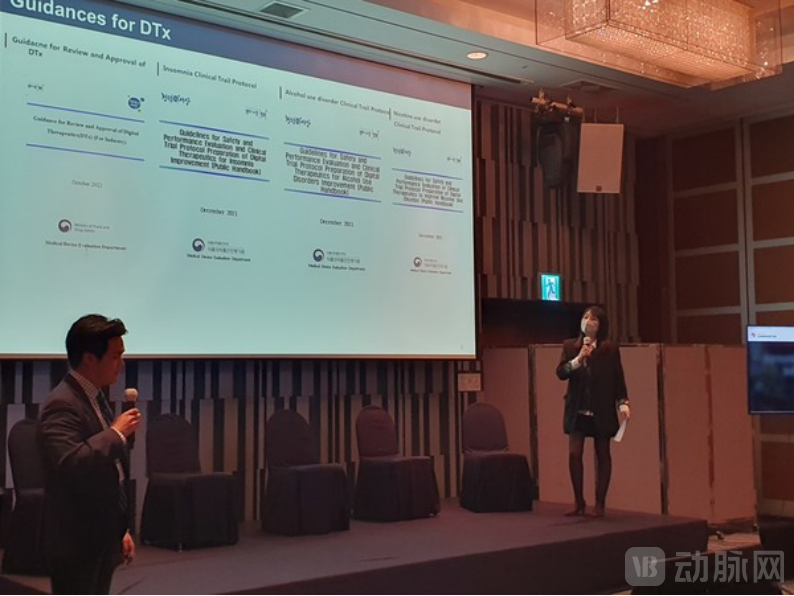 Han Young-min, Assistant Director of the Digital Medical Devices Division at the MFDS (right), introduced South Korea’s regulatory pathway for digital therapeutics (DTx) in Seoul on November 8, 2022.
According to the MFDS, digital therapeutics are defined as interventions delivered directly to patients, grounded in evidence-based medicine, and aimed at preventing, managing, and treating medical diseases and conditions; they may be used either independently or in conjunction with existing treatments.
In the field of digital therapeutics, regulatory agencies review Software as a Medical Device (SaMD), AI-based medical devices, digital therapeutics, and related cybersecurity.
She added that the department also supports the commercialization and post-launch marketing of digital therapeutics.
Han summarized the three criteria used by the MFDS in reviewing digital therapeutics.
Han stated that the primary consideration is whether the device meets the criteria to be classified as Software as a Medical Device (SaMD), such as having embedded PC software, mobile products, or general-purpose hardware.
Next, she emphasized the importance of defining the scope of application, which requires determining whether the product is intended for the prevention, management, or treatment of diseases, wherein the disease conditions must be classified according to the International Classification of Diseases (ICD) or the Korean Standard Classification of Diseases (KCD).
Finally, she emphasized that the mechanisms of action of digital therapeutics should be supported by clinical practice guidelines, other peer-reviewed journals, or pilot studies.
Han added that the MFDS is currently collaborating with the International Medical Device Regulators Forum (IMDRF) and hopes to expand its cooperation with the FDA to develop more guidelines for the development of the digital therapeutics industry both in China and globally.
The MFDS has not yet approved any digital therapeutics products.
However, as of October 2022, 15 companies had submitted clinical trial protocols, with their research plans approved for indications such as insomnia, generalized anxiety disorder, and alcohol use disorder.
South Korea moved swiftly in establishing regulations for digital therapeutics, releasing its first guideline in August 2020.
In 2021, the MFDS released model clinical trial protocols for products indicated for the treatment of chronic insomnia and alcohol use disorder.
"We also plan to release guidelines specifically for generalized anxiety disorder," Han said.
Megan Coder, Chief Policy Officer of the Digital Therapeutics Alliance (DTA), praised South Korea’s efforts in regulating digital therapeutics.
Coder stated, “South Korea has played a pivotal role in defining digital therapeutics as Software as a Medical Device (SAMD). The Digital Therapeutics Alliance (DTA), along with other countries we support, will follow South Korea’s lead, and we look forward to its future advancements.”
Source: KBR (http://www.koreabiomed.com)
Original Author: Marianne Chang
Original Title: Korean Regulator's 3 Criteria for Digital Therapeutics Review Explained
Original text: http://www.koreabiomed.com/news/articleView.html?idxno=14995