

Genext Medical Aims to Break Western Dominance in Organ Transplantation with New Sci-Tech Board IPO Filing
Recently, Shanghai Genext Medicine Technology Co., Ltd., a domestic organ transplant enterprise, submitted its prospectus to the Shanghai Stock Exchange in an effort to list on the STAR Market. The company plans to raise RMB 1.023 billion, which is expected to be used for research and development at its organ transplant innovation platform, the localization and upgrading of kidney transplantation equipment, as well as the registration and promotion of liver transplantation equipment and in vitro diagnostic reagents in the transplantation field.
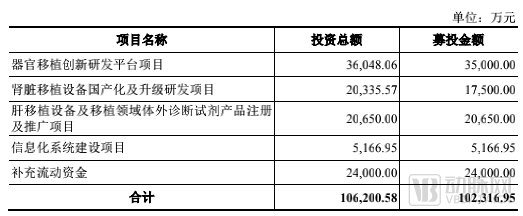 Use of Proceeds from Genext Medicine's IPO
This is not the first time that Shanghai Genext Medicine Technology Co.,Ltd. has sought to list on the A-share market. The company previously filed for an IPO on the STAR Market in May 2020, passed the inquiry phase, and was scheduled for a listing committee review on December 18 of that year. However, on the eve of the review, the Shanghai Stock Exchange published an announcement stating that Shanghai Genext Medicine had voluntarily withdrawn its application.
Compared with its initial filing, Genext Medicine’s current fundraising efforts are more focused on product upgrades and promotion. During the reporting period, the issuer’s sales revenue from kidney perfusion consumables amounted to RMB 261.942 million, RMB 285.5243 million, RMB 337.3851 million, and RMB 87.0704 million, respectively, accounting for 71.54%, 73.53%, 75.87%, and 83.98% of its total operating revenue. A single product line has contributed the vast majority of the company’s revenue. Upon completion of the financing, Genext Medicine is expected to mitigate potential risks associated with its reliance on a single business segment and effectively expand its addressable market in the future.
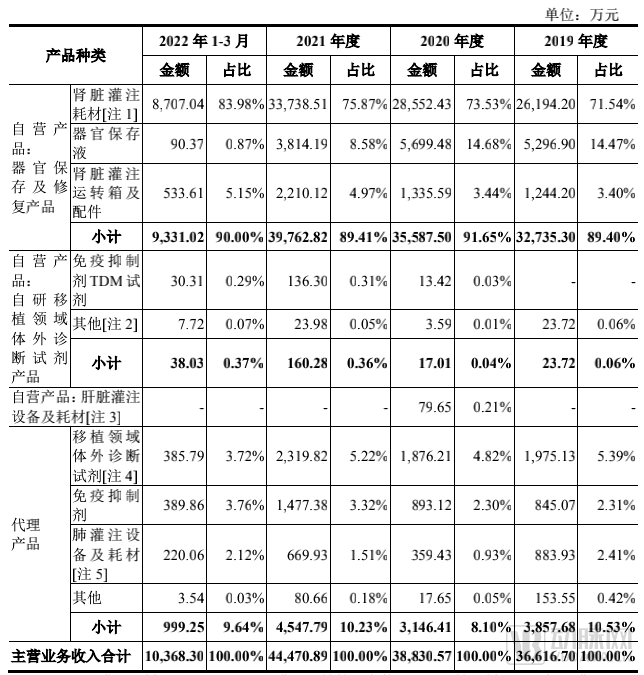 Revenue Composition of Genext Medicine's Main Business
Organ transplantation refers to the surgical transfer of a viable donor organ into a patient’s body to replace an organ that has lost its function.
Currently, transplantation of most major organs in the human body has been achieved, including the heart, lungs, liver, kidneys, pancreas, and small intestine. Furthermore, tissue transplantation procedures, such as those for corneas and blood vessels, are highly mature.
Kidney transplantation, commonly known as "kidney replacement," involves transplanting a healthy kidney from a donor into a patient with renal pathology who has lost kidney function. The human body has two kidneys, left and right; typically, a single kidney is sufficient to support normal metabolic demands.
When bilateral renal function is lost or chronic renal insufficiency progresses to end-stage renal disease, kidney transplantation is the preferred treatment option when feasible. Furthermore, compared with peritoneal dialysis and hemodialysis, kidney transplantation offers significant advantages in terms of long-term survival rates, quality of life, and treatment costs.
However, the availability of mature kidney transplantation technology does not guarantee that every patient will receive the corresponding treatment.
Kidney transplantation primarily relies on histocompatibility matching; however, due to the scarcity of donor kidneys and the risk of matching failure, many patients pass away without ever receiving the opportunity for treatment. According to data from the International Registry of Organ Donation and Transplantation, more than 345,400 patients were still waiting for organ transplants at the end of 2020. In that year, 23,103 patients on the kidney transplant waiting list died regretfully without receiving a donor kidney.
Another set of data more directly illustrates the current situation: among the over 2.66 million patients with end-stage renal disease (ESRD) undergoing dialysis treatment worldwide, only 5.65% are able to receive a kidney transplant.
The contradiction of donor shortage is more prominent in China. The prospectus mentioned that in 2020, the organ donation rate in the United States was 38 per million population, and the supply-demand ratio for organ transplantation was approximately 1:4; in China, the organ donation rate after citizen death was 3.6 per million population, and the supply-demand ratio for organ transplantation was approximately 1:30. According to the 2021 Annual Data Report of the United States Renal Data System (USRDS), the median waiting time for kidney transplantation in the United States exceeded 50 months; while in China, this figure may be even longer.
Low long-term survival rates after organ transplantation represent another major challenge for patients.
Despite significant improvements in short-term survival rates following kidney transplantation, driven by advances in surgical techniques and the development of novel immunosuppressants, long-term patient survival remains challenging due to chronic allograft rejection. According to the 2021 Annual Data Report of the United States Renal Data System (USRDS), the 10-year survival rates after kidney transplantation were 49.5% for deceased donor transplants and 65.5% for living donor transplants.
Infection is the most common cause of early mortality following kidney transplantation, associated with factors such as excessive postoperative immunosuppression, malnutrition, and postoperative complications. Taking excessive immunosuppression as an example: in patients who have undergone kidney transplantation, insufficient immunosuppression may lead to rejection, resulting in structural damage to the graft, loss of graft function, and difficulties in re-transplantation; conversely, excessive immunosuppression increases the risk of infections and malignancies. Long-term, continuous care and management are crucial for these patients. Physicians need to continuously monitor and adjust the patient’s immune status and graft function to detect and intervene in problems at the earliest possible stage.
Addressing the dual challenges of donor scarcity and improving long-term survival rates after organ transplantation requires the involvement of different stakeholders through distinct approaches.
Organ donation involves multi-layered issues spanning social, ethical, religious, and political domains, grounded in the cultural contexts and national conditions of each country. Countries with high organ donation rates per million population, such as Spain and France, implement an “opt-out” system (presumed consent), whereby individuals who have not explicitly refused donation during their lifetime are presumed to be organ donors. In contrast, most U.S. states adopt a system in which individuals register their willingness to donate organs when applying for a driver’s license.
In recent years, policy changes in multiple countries have been positive. The new organ donation laws in the Netherlands and England came into effect in 2020, implementing "default consent." China is also continuously and actively promoting the concept of organ donation, with the expectation of increasing the number of organ donations over the long term to alleviate the shortage of donors as much as possible.
In contrast, addressing how to extend long-term survival rates for patients after organ transplantation requires the involvement of professionals. Currently, hospitals, physicians, and enterprises are collaborating to optimize the entire organ transplantation process, continuously improving the quality of transplant surgeries and maximizing patients’ long-term postoperative survival rates.
As a globally leading medical device product and service provider in the field of organ transplantation, Shanghai Genext Medicine Technology Co., Ltd.’s existing product portfolio includes equipment for organ preservation, transportation, assessment, and repair during transplantation; supporting consumables for transplant surgery; and in vitro diagnostic reagents. These offerings cover the entire spectrum of organ transplantation, from pre-transplant assessment and perioperative management to long-term post-transplant care. Among these, the organ preservation and repair product line constitutes the company’s primary source of revenue.
According to Shanghai Genext Medicine Technology Co.,Ltd., ex vivo organ preservation is mainly divided into two technical approaches: static cold storage and mechanical perfusion.
Static Cold Storage (SCS), also known as “ice bucket” preservation, involves placing ex vivo organs in organ preservation solutions at approximately 4°C. This low-temperature environment suppresses organ metabolism and enzymatic degradation, thereby mitigating organ injury. SCS remains the most commonly used technique in clinical practice.
Mechanical perfusion is a relatively innovative method for organ preservation and transportation. After organ retrieval, the blood vessels are connected to a mechanical perfusion system. During the preservation and transport phases, the system continuously delivers perfusate to the ex vivo organ while supplying oxygen, nutrients, and other essential substances.
Due to the severe shortage of donor organs, countries around the world have had to take measures to expand donor sources by adopting expanded criteria donors (ECD), including those from donation after circulatory death (DCD), elderly donors, and obese donors.
Although incorporating donation after circulatory death (DCD) into acceptance criteria can increase the donor pool by 2.5- to 4.0-fold, DCD donor kidneys undergo prolonged warm ischemia after circulatory arrest, leading to a significant increase in the incidence of delayed graft function (DGF) and primary non-function (PNF). The incidence of biliary complications is also significantly higher in DCD donor livers. Furthermore, pre-existing conditions in the donor, such as hypertension, diabetes, and atherosclerosis, also contribute to an increased risk of DGF and PNF.
Against this backdrop, the adoption of ECD grafts presents a dilemma requiring careful consideration among organ discard, donor shortage, suboptimal donor kidney quality, and high complication rates. For such organs, SCS technology can no longer meet clinical needs.
Compared with static cold storage (SCS), machine perfusion continuously pumps preservation solution and nutritional substrates into the donor organ via the artery, which can flush out red blood cells, microthrombi, and metabolites from the vasculature, thereby creating conditions closer to the physiological state. Furthermore, it enables the assessment of organ viability through dynamic monitoring of parameters such as perfusion flow and resistance index, achieving simultaneous organ preservation and repair. Machine perfusion technology holds significant value in extending organ preservation time limits and improving and assessing organ quality; therefore, it is expected to gradually replace SCS and become the primary method for organ preservation and transport in transplantation.
Shanghai Genext Medicine Technology Co., Ltd. is betting on hypothermic machine perfusion (HMP). Its core product, the LifePort Kidney Transporter, is the most widely used HMP device in clinical practice and currently the only kidney machine perfusion product to have obtained regulatory approval in the three major markets of China, North America, and Europe. It is utilized by hundreds of Organ Procurement Organizations (OPOs) and transplant centers across nearly 40 countries and regions.
Two large-scale randomized controlled trials published in The New England Journal of Medicine, reporting short- and long-term follow-up results based on the LifePort Kidney Transporter hypothermic machine perfusion system, demonstrated that hypothermic machine perfusion (HMP) significantly reduces the incidence of delayed graft function (DGF) after kidney transplantation and improves one- and three-year graft survival rates. In particular, HMP yields substantial benefits for extended criteria donor (ECD) kidneys, helping to expand the donor pool while providing objective metrics for organ assessment, thereby reducing postoperative risks associated with donor organ quality issues and minimizing unnecessary organ discard.
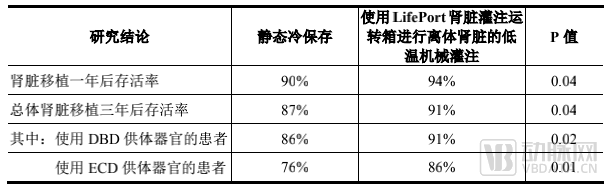 Randomized Controlled Double-Blind Trial Study
In the field of kidney machine perfusion, Genext Medicine’s main global competitors include Waters Medical Systems in the United States and XVIVO in the Netherlands. In the Chinese market, Genext Medicine is the only company that has obtained an NMPA registration certificate for kidney machine perfusion products, with no mature competitors currently present.
Although Shanghai Genext Medicine Technology Co.,Ltd. holds an absolute leading position in the global field of mechanical kidney perfusion, the market capacity for organ preservation and repair products is constrained by the number of donations after citizen death and the volume of organ transplant surgeries, with these figures rarely experiencing large-scale declines or growth. Therefore, to maintain sustainable growth in the long term, not only Shanghai Genext Medicine Technology Co.,Ltd. but every company in the industry needs to plan the direction of production line expansion.
Let’s first discuss horizontal expansion. The manufacturing of mechanical perfusion equipment occupies an upstream position in the organ transplantation sector. Companies can choose to enter the midstream by developing in vitro diagnostic reagents for transplantation, or venture downstream to engage in postoperative patient management.
Genext Medicine has currently established a presence in the field of therapeutic drug monitoring (TDM) for immunosuppressive agents. The company has developed multiple series of TDM reagents based on latex-enhanced competitive immunoturbidimetric assays, among which its Tacrolimus Assay Kit (latex-enhanced immunoinhibition method) and Cyclosporine Assay Kit (latex-enhanced immunoinhibition method) have successfully obtained marketing approval in China.
However, it is important to note that product approval does not have a significant causal relationship with subsequent commercialization. The domestic immunosuppressive drug market is highly concentrated with strong customer stickiness; nearly half of the market is occupied by Abbott, Siemens accounts for approximately 45%, and the remaining small share is primarily held by Roche. These IVD giants possess extensive reagent product lines and manufacture in vitro diagnostic equipment, giving them substantial competitive advantages. It is difficult for Shanghai Genext Medicine Technology Co., Ltd. to break this market structure.
Monopolization by multinational corporations is also evident in the fields of transplant typing and antibody detection, as well as in post-transplant monitoring for organ transplant recipients. In the field of transplant typing and antibody detection, the Chinese market is dominated by One Lambda (a subsidiary of Thermo Fisher Scientific) and Immucor. In the field of post-transplant monitoring for organ transplant recipients, key players in the U.S. market include CareDx, Natera, and Eurofins (following its acquisition of TGI), with CareDx holding the majority market share. Meanwhile, there are currently no approved post-transplant monitoring products, such as dd-cfDNA assays, available in China.
Leveraging policy advantages, Shanghai Genext Medicine Technology Co.,Ltd. has the potential to drive domestic substitution of in vitro diagnostic reagents in the transplantation field to a certain extent. However, to further expand its market share, the company must introduce differentiated products and achieve competitive success through enhanced efficiency.
Horizontal expansion is a more challenging yet effective strategy for circumventing competitors. Leveraging its R&D experience and clinical accumulation in kidney machine perfusion, Shanghai Genext Medicine Technology Co., Ltd. can more rapidly advance into machine perfusion technologies for other organs, such as the liver.
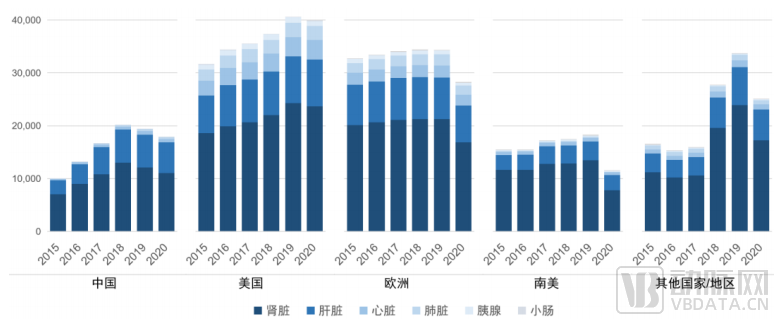 Global Organ Transplant Volume
Liver transplantation ranks second in volume among solid organ transplants. It is the only effective treatment for many cases of end-stage liver disease and the sole curative option for certain inherited metabolic disorders.
SCS is the mainstream clinical method for liver preservation, but even standard donor livers with excellent parameters can only be preserved for up to 12 hours. ECD livers have an even shorter preservation window, their quality is difficult to assess, and they are associated with a higher discard rate.
From 2020 to 2021, only 29% of donation after circulatory death (DCD) donor livers in the United Kingdom were ultimately transplanted into recipients, compared with 26% in the United States. Consequently, the academic community is focusing on mechanical liver perfusion; numerous studies have demonstrated that mechanical perfusion can significantly mitigate ischemia-reperfusion injury (IRI) and improve outcomes in transplantation of extended criteria donor (ECD) livers.
Mainstream liver machine perfusion is categorized into two technical approaches: normothermic perfusion and hypothermic perfusion. Liver normothermic machine perfusion (NMP) maintains a perfusion temperature of 35–38°C, keeping the organ in a state of physiological metabolism with high oxygen consumption; therefore, oxygenated blood products are required for perfusion. The advantages include the ability to assess liver quality through bile production and lactate clearance rates, offering potential for therapeutic delivery applications in the future. The disadvantages include the risk of secondary ischemic injury to the liver even from brief interruptions in perfusion, risks associated with blood products, operational complexity, and high perfusion costs.
Hypothermic Machine Perfusion (HMP) of the liver maintains perfusion temperatures at 0–12°C, suppressing hepatic metabolism under hypothermic conditions. Its advantages include enhanced hepatic tolerance to ischemia at low temperatures, reduced incidence of postoperative biliary complications caused by ischemia, and prevention of warm ischemic injury and functional loss due to brief technical failures. A disadvantage is that there are fewer indicators available for assessing liver function under hypothermic conditions compared with Normothermic Machine Perfusion (NMP).
Hepatic normothermic machine perfusion (NMP) and hypothermic machine perfusion (HMP) each have their own advantages and disadvantages; they are not in a purely competitive relationship and can serve different donor types and therapeutic scenarios. There is also future potential for the combined use of HMP and NMP in the same donor.
Among the currently commercialized liver mechanical perfusion devices, Transmedics and OrganOx both utilize normothermic machine perfusion (NMP) technology, while XVIVO employs a temperature-controlled perfusion system. In contrast, Genext Medicine’s liver mechanical perfusion system adopts hypothermic machine perfusion (HMP) technology, which is expected to create differentiated competition with existing marketed devices.
Notably, liver perfusion devices currently approved in European and American markets have been available for a relatively short period, involve complex operational procedures, and continue to exhibit low clinical acceptance, thereby limiting their widespread adoption; meanwhile, no mechanical liver perfusion device has yet received regulatory approval in China.
In this context, Genext Medicine’s liver perfusion product is currently the only hypothermic mechanical liver perfusion system in the United States to have entered the FDA registration phase, and the company also plans to expand into the Chinese market in the future. If approval is successfully obtained, Genext Medicine is poised to reshape the market landscape with its breakthrough technology.