

CompAI Medical Files IPO Prospectus to Advance Global Leadership in Comprehensive Breast Cancer Care Solutions
Whether leading the development of control systems at SLAC National Accelerator Laboratory, developing proton radiotherapy devices at Varian, or serving as Director of Control Computing at the National Superconducting Cyclotron Laboratory in the United States; or, after returning to China, taking the helm of Evergrande Health and establishing a specialized breast cancer hospital in collaboration with Brigham and Women’s Hospital, affiliated with Harvard Medical School,Peng Sheng, Founder of Kangpai MedicalThe original aspiration to “develop high-end domestic medical equipment, make it accessible to Chinese patients, and expand into European and American markets” has remained unchanged.

Peng Sheng Delivers a Speech at Harvard University
Breast cancer has become the most common cancer worldwide and the leading cancer among Chinese women, posing a serious threat to women’s quality of life and health. Generally, breasts with less fat and more glandular tissue have higher density, which is associated with a higher risk of developing cancer. Compared with women in Europe and America,Asian women generally have higher breast density, which is associated with an increased risk of breast cancer.
Ultrasound screening, which is widely used in China, relies heavily on the technical expertise of sonographers. However, China faces a significant shortage of ultrasound physicians, and standardization of their technical proficiency remains difficult to achieve. Due to factors such as late detection, limitations in equipment standards, and prevailing medical concepts, the breast-conserving surgery rate in China is less than 20%, far below the nearly 70% observed in developed countries in Europe and America. The loss of breasts has profound physiological and psychological impacts on women. All these factors collectively impose a substantial burden on families and society.
Since its inception in 2019, Kangpai Medical has focused on the prevention and treatment of female breast cancer. Addressing clinical pain points within the current breast diagnosis and treatment system, the company has localized and innovatively improved advanced technologies widely used in leading European and American breast centers. Committed to developing a full series of equipment with world-leading capabilities and independent intellectual property rights, Kangpai Medical aims to facilitate early screening, early diagnosis, precise treatment, and postoperative rehabilitation for breast cancer. By promoting the mutual reinforcement of early detection and precision therapy, the company strives to make breast cancer more preventable, controllable, and treatable, thereby improving clinical prognosis and quality of life for patients.
According to Professor Pei Xiaohua, Chairman of the Surgical Branch and Vice Chairman of the Breast Disease Branch of the China Association of Chinese Medicine, microcalcifications are an important or even the sole mammographic manifestation of early-stage breast cancer. Currently, early diagnosis of breast cancer relies primarily on mammographic screening. Once a case suspicious for breast cancer is identified, biopsy of the calcified lesion is required. After the biopsied tissue is sent to the pathology department, pathological diagnosis of intramammary calcified lesions becomes critically important. However, accurately obtaining pathological specimens from calcified foci and making correct pathological diagnoses are key factors determining the surgical approach and accurately assessing patient prognosis.
Intraoperative Specimen Photography System is an Essential Device for Breast-Conserving Surgery.Years of clinical practice in Europe and the United States have also demonstrated its important role in breast-conserving surgery for breast cancer, as it enables immediate assessment of surgical margins during breast cancer operations. Studies have shown that itReducing the volume of breast tissue resected in breast-conserving surgery is of significant importance for postoperative body contour restoration in patients.
The specimen photography system can also perform X-ray imaging of gross pathological specimens, effectively indicating the location and extent of suspicious lesions, thereby providing more accurate guidance for tissue sampling by pathologists to obtain precise pathological results.
However, the market for breast biopsy specimen imaging systems and intraoperative specimen imaging systems has long been monopolized by foreign giants. In China, intraoperative breast specimen imaging systems are predominantly imported from the United States; these expensive devices, often costing millions of yuan, remain difficult to widely adopt.
In the wave of domestic substitution,Kangpai MedicalRise to the challenge.
The company launched its first product in 2021.Intraoperative Specimen Photography System for Breast Surgery, filling the domestic gap in related technical equipment and achieving remarkable results.
In October 2020, Kangpai Medical entered the industry finals of the 12th China Shenzhen Innovation and Entrepreneurship Competition;
From late 2020 to early 2021, Kangpai Medical’s intraoperative specimen photography system for breast surgery successively obtained U.S. FDA 510(k) clearance, EU CE marking, and UK MHRA certification, initiating global sales.
In December 2021, Kangpai Medical (Shenzhen) was recognized as a National High-Tech Enterprise;
In November 2022, Kangpai Medical (Suzhou) was recognized as a National High-Tech Enterprise;
In November 2022, Kangpai Medical won the Excellence Award at the Finals of the 11th China Innovation and Entrepreneurship Competition.
According to Peng Sheng, founder of Kangpai Medical, higher imaging resolution enables more reliable identification of minute calcifications. The imaging resolution of imported products is 75 μm; by continuously optimizing key components and refining algorithms based on clinical data, Kangpai Medical’s technical team has increased the resolution to50μm, enabling Kangpai’s breast specimen radiography system to achieve international leading standards in the detection of microcalcifications and surgical margins.

Kangpai Medical's Intraoperative Specimen Photography System for Breast Surgery
This device enables rapid intraoperative testing within the operating room. By simply placing the specimen in a self-shielded imaging cabinet, physicians can efficiently capture high-resolution images and clearly visualize specimen details within one minute. The system provides real-time margin identification to guide surgical decisions immediately, eliminating the need to send resected tissues to the radiology department for examination and waiting. This streamlines the workflow, resulting in shorter and safer surgical procedures for patients.
To facilitate intraoperative surgical manipulation, the Kangpai Medical Intraoperative Breast Specimen Imaging System can be usedVoice ControlContactless Operation. From specimen placement to the completion of X-ray imaging, physicians do not need to touch the equipment at any point; they simply issue designated commands. Meanwhile, this device can alsoAutomatic Identification of Suspicious Calcifications in Samples, enabling physicians to rapidly identify the location of calcified lesions during high-pressure surgical procedures.
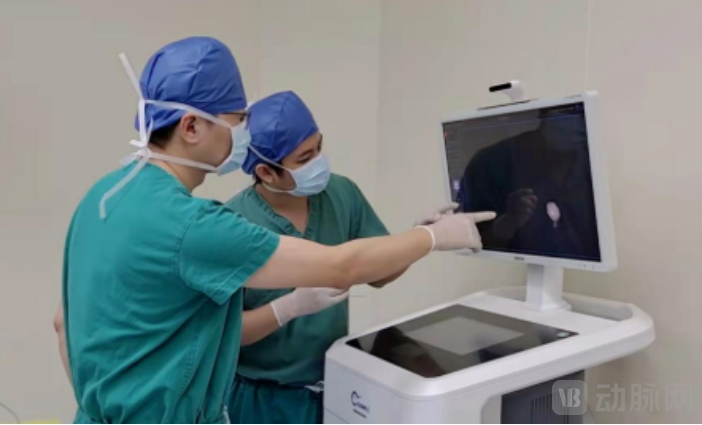
Breast surgeons use Kangpai Medical's equipment
Moreover, Kangpai Medical’s intraoperative breast specimen imaging system features powerful image processing capabilities, enabling side-by-side comparison of optical and X-ray images, automatic detection of microcalcifications, and a range of functions including window adjustment, image zooming in/out, rotation, measurement, and window width/level adjustment. The user-friendly interface is simple and easy to operate. The unit incorporates self-shielding, eliminating the need for additional radiation protection, and features an exclusively patented 3D specimen holder that supports multi-angle imaging for precise assessment of specimen margins. Equipped with a built-in UPS and silent casters, it allows rapid movement between operating rooms and supports multiple concurrent surgical procedures.
The introduction of the Kangpai Intraoperative Specimen Photography System can effectively enhance the standard of breast cancer surgery, optimize surgical workflows, and improve patient turnover, thereby increasing hospital efficiency. It can significantly increase breast-conserving rates, promote precision treatment for breast diseases, reduce the incidence of false-negative results, and spare patients the distress of secondary surgeries. The system enables rapid intraoperative imaging and archival of specimens, helping to mitigate potential doctor-patient disputes in the future. By shortening the duration of each procedure, it ensures the effective utilization of hospital resources, increases hospital revenue, and effectively reduces medical insurance expenditures.
The breast specimen imaging system, embodying the collective wisdom of Kangpai Medical’s R&D team, has applied for or obtained nearly 50 invention patents, utility model patents, design patents, and software copyrights, and has passedU.S. FDA Certification, EU CE CertificationandUK MHRA Certification, the product began global sales in 2021.
“Technologically and in terms of application, we are in no way inferior to leading international brands; indeed, the performance of some of our products even surpasses theirs. We chose to return to China to start our business with the aim of elevating ‘Made in China’ to ‘me-better.’ Our product positioning at Kangpai is to deliver high performance and superior quality at lower prices with better service. This should also reflect the vision and ambition of our generation of Chinese entrepreneurs in building industries,” said Peng Sheng firmly.
Leveraging its superior performance and competitive pricing, Kangpai Medical’s intraoperative specimen imaging system has also overcome the impact of the pandemic and successfully opened upOverseas high-end markets such as the United States, the United Kingdom, and Europe, it also achieved a breakthrough in the Chinese market, earning high recognition from experts at numerous leading Grade A tertiary hospitals, and realized steady growth despite adverse market conditions. It was revealed that the company will further expand itsMarkets in Asia-Pacific countries such as Australia and Southeast Asia, as well as Middle Eastern countries, completing the global market layout.
Not long ago, Kangpai Medical completed a funding round led byQianhang CapitalandBo Yong Investment, a fund under Boji Venture Capital, in which Bojie Medical holds an equity stakeCo-investedSeries A Financing, is vigorously advancing the commercialization of its existing products in global markets and accelerating the R&D of its full pipeline of products. It is currently seeking collaborations with additional medical institutions and pursuing a new round of financing.