Alibaba Health Reports Interim Results: Chronic Disease Management Now Covers 12 Therapeutic Areas with 46% YoY User Growth
On the evening of November 28, Alibaba Health announced its interim results for the six months ended September 30, 2022. During the reporting period, Alibaba Health’s revenue reached RMB 11.5 billion, representing a year-on-year increase of 22.9%. Meanwhile, the company achieved profitability, with a profit of RMB 160 million and an adjusted net profit of RMB 350 million.
During the reporting period, Alibaba Health continuously upgraded its professional healthcare service experience, providing users with an integrated online-to-offline medical and health service system through platforms such as Taobao, Tmall, Alipay, the Yilu App, Amap, DingTalk, Hema, and Quark Search. This system encompasses services including traditional Chinese medicine, health check-ups, nucleic acid testing, online consultations, appointment registration, vaccinations, dental care, psychological counseling, optometry, and nursing care. As of September 30, 2022, the total number of licensed physicians, licensed pharmacists, and nutritionists contracted by Alibaba Health to provide online health consultation services reached nearly 180,000, representing an increase of over 40,000 compared to the same period last year. During the reporting period, revenue from medical health and digital services amounted to approximately RMB 420 million, a year-on-year increase of 74.9%.
Leveraging its high-quality, extensive physician resources, as well as leading digital technology and digital operational capabilities, Alibaba Health Internet Hospital provides inclusive and accessible comprehensive medical services for patients with chronic diseases through online consultations, prescription renewals, affordable quality medications, targeted education, precise follow-up, peer support, and after-sales assurance. Meanwhile, it also establishes a new channel for pharmaceutical companies to deliver out-of-hospital services.
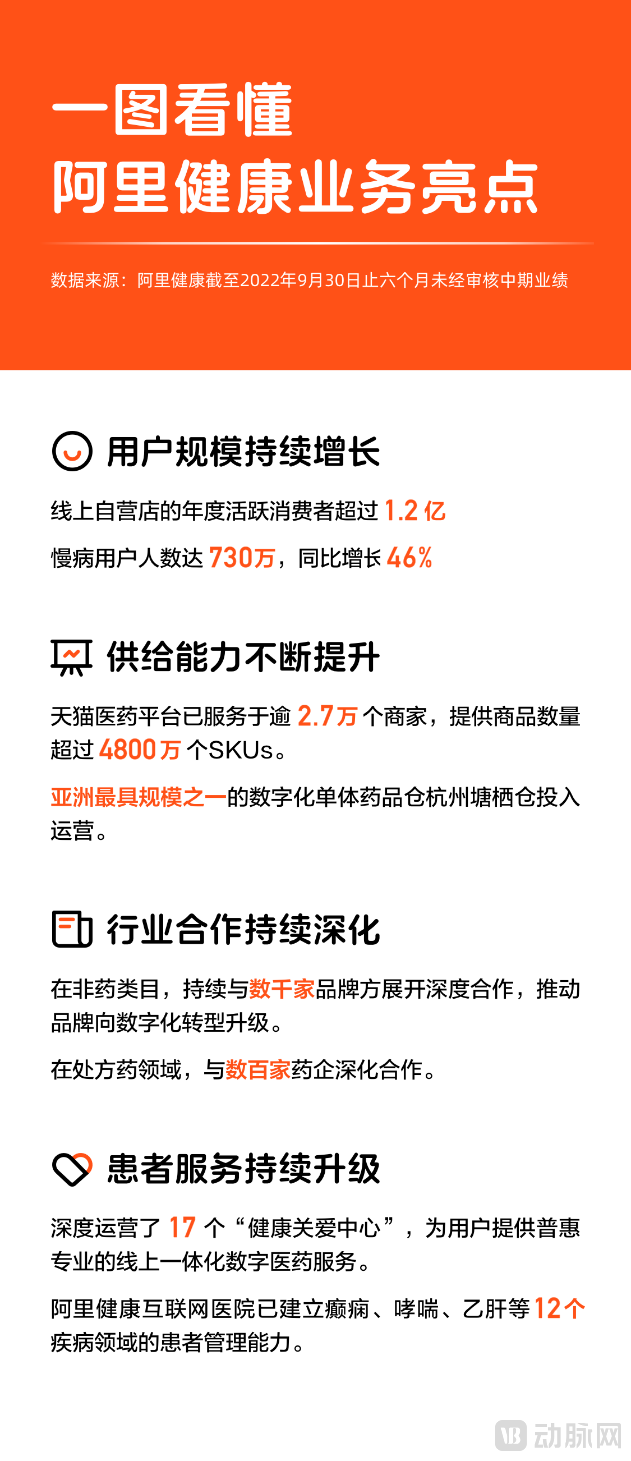
As of the end of the reporting period, the number of chronic disease patients served by Alibaba Health reached 7.3 million, representing a year-on-year increase of 46%. The average duration of medication use per user and the user repurchase rate also continued to rise rapidly. It is reported that Alibaba Health Internet Hospital has established patient management capabilities across 12 disease areas, including epilepsy, asthma, and hepatitis B, and has partnered with renowned pharmaceutical companies both domestically and internationally, such as GlaxoSmithKline and Merck & Co.
Robust patient outreach and management capabilities have not only improved access to high-quality medical resources but also positioned Alibaba Health as a key partner for pharmaceutical companies pursuing digital innovation in China. At the fifth China International Import Expo, which opened on November 4, multinational pharmaceutical companies including Novartis, Pfizer, Organon, and Senesthia each signed strategic cooperation agreements with Alibaba Health to jointly explore patient-centric, end-to-end digital healthcare service models.
Alibaba Health’s financial report reveals that revenue from its self-operated pharmaceutical business reached approximately RMB 10.08 billion, representing a year-on-year increase of 24.2%. In the prescription drug sector, Alibaba Health’s self-operated business has deepened collaborations with hundreds of pharmaceutical companies. Leveraging its digital advantages and utilizing an omnichannel ecosystem operation framework as a carrier, it has launched specialized initiatives focused on diseases, product categories, and specialty care features, thereby establishing service channels for patients, physicians, and pharmaceutical enterprises. Alibaba Health’s self-operated business has intensively operated 17 “Health Care Centers,” covering disease areas such as cardiovascular conditions, dermatology, and oncology, enabling consumers to access more inclusive and professional integrated online digital pharmaceutical services.
In the non-pharmaceutical category, Ali Health adheres to its business philosophy of providing users with a rich and secure one-stop shop for health products. By continuously expanding its non-pharmaceutical product offerings and cultivating trending categories, Ali Health has achieved significant year-on-year growth in the number of non-pharmaceutical users served. The company continues to engage in deep collaborations with thousands of brands, empowering their operations and driving their digital transformation and upgrading.
“Adhering to industry-leading standards of compliance and quality control, while closely addressing users’ healthcare needs, we leverage advanced digital technologies and operational capabilities. With ‘cloud infrastructure’ as the foundation, ‘cloud pharmacy’ as the core, and ‘cloud hospital’ as the engine, we provide inclusive, convenient, efficient, and safe medical and health services to hundreds of millions of families,” stated Alibaba Health in its financial report.