

The Next Step for AI-Driven Drug Discovery Companies: Pathways to Commercialization
From Breakthroughs in Single Technologies to the Construction of Technology Platforms: Driven by the Market, AI-Enabled New Drug Companies Have Been on a Constant Journey to “Prove Themselves.” As Capital Markets Gradually Cool Down, Attention Is Increasingly Focused on the Implementation and Commercialization of Achievements by AI-Driven Pharmaceutical Companies.
How can Chinese AI-driven drug discovery companies overcome commercialization challenges? How should foundational computing platforms for AI-based drug discovery be built? What are the differences between domestic and international collaborative ecosystems? And how can small AI-driven drug discovery startups survive and thrive?Recently, Arterial New Medicine partnered with Beiyun Cloud to host an online panel, inviting representative enterprises and investment institutions in the field to discuss the current status of AI drug technology application and implementation in China, as well as its commercialization path, focusing on major deals in the AI + new drug sector.
The guests participating in the discussion included: Jue Wang, Director of Business Development at Insilico Medicine; Sheng Wang, CEO of Zhiyu Biotech; Tao Huang, Founder of Zhiyao Technology; Rui Ma, Partner at FreeS Fund; and Jianxin Feng, CEO of Beikun Cloud.
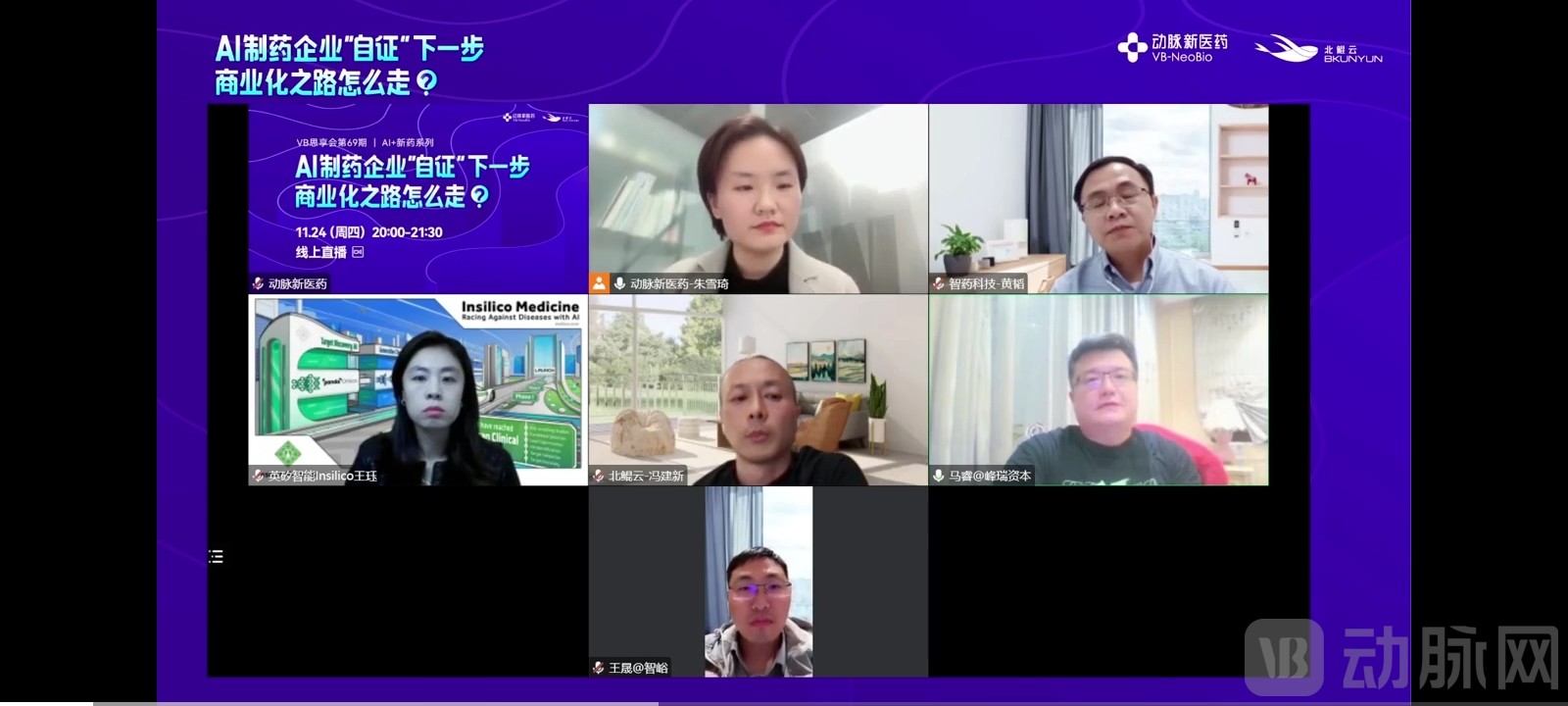
▲Guests in the photo, from left to right:
(First row)Zhu Xueqi, Executive Editor-in-Chief of VBInsight; Huang Tao, Founder of Zhiyao Technology
(Second Row)Jue Wang, Director of Business Development at Insilico Medicine; Jianxin Feng, CEO of Beikun Cloud; and Rui Ma, Partner at FreeS Fund
(Third row)Wang Sheng, CEO of Zhiyu Life Sciences
The core of commercialization lies in robust technology and addressing acute pain points, while simultaneously exploring partnerships and validating one’s value proposition.
How Far Have Chinese AI Drug Discovery Companies Advanced in Commercialization, and How Can Current Challenges Be Addressed?
Wang Jue, Director of Business Development at Insilico Medicine:The explosive growth of commercialization hinges on two conditions: one is that technological accumulation has reached a stage of relative recognition, and the other is self-validation.Demonstrate R&D capabilities through progress in the pipeline, and showcase the capabilities of the AI technology platform through software.
Meanwhile, companies should also adopt an open attitude toward various collaboration models. Partners should include not only pharmaceutical companies and large multinational corporations (MNCs), but also biotech and biopharma firms, as well as extensive academic collaborations. These partnerships serve to broaden clients’ understanding of the company’s AI technologies, with some new models gradually emerging through the collaborative process.
Wang Sheng, CEO of Zhiyu Biotech:The concept of AI-driven drug discovery in China is gradually transitioning from a blue ocean to a red ocean market. Given the lengthy validation cycles inherent in pharmaceutical development, two critical issues must be addressed amid the current capital winter: first, how to carve out a unique path and differentiate oneself from competitors; second, how to implement strategic adjustments to shorten the self-validation cycle.
Our commercialization strategy begins with building a platform that continuously expands through modular computing services, thereby generating significant user traffic. Leveraging this traffic-driving effect, we will gradually deepen and broaden our collaborations with partner enterprises. On this foundation, once the platform’s effectiveness is validated and successful implementation cases are established, we will commence the development of our proprietary pipeline.
Huang Tao, Founder of Zhiyao Technology:If domestic biopharmaceutical companies in China wish to pursue innovation, they must avoid homogeneous projects and shift their focus toward novel targets, new sites, or new types of molecular entities, such as molecular glues and PROTACs. This approach is essential to avoid being placed in an awkward position amid increasingly intense competition.
Beikun CEO Feng Jianxin:Beikun Cloud has indeed been privileged to serve many outstanding AI-driven pharmaceutical companies. Whether they operate under the AI SaaS, AI CRO, or AI biotech model, these variations do not alter the overall trajectory of AI in drug discovery. The market still needs to extend greater patience and confidence to these young AI pharmaceutical enterprises, including from a capital perspective. In recent years, when this sector was exceptionally hot, a surge of capital and startups flooded in, with many investors who previously overlooked this area jumping on the bandwagon. This led to numerous unrealistic expectations regarding the development of AI-driven drug discovery. As time goes on, immature capital and entrepreneurs lacking clear strategic vision will be filtered out by the industry, leaving behind only those investors and companies truly committed to execution, long-term investment, and patience.
From the perspective of the companies themselves, the monetization pathway in the novel drug industry is indeed protracted, with substantial upfront investments. Consequently, AI-driven pharmaceutical companies are exploring various strategic alternatives. For instance, some firms transfer the risks associated with pipeline development to more mature pharmaceutical companies with greater risk tolerance, thereby mitigating their own financial and temporal risks. In the future, as their in-house R&D capabilities become more robust, their capital reserves grow stronger, and their risk tolerance increases, these companies may then consider developing their own drug pipelines. These are trends we have observed through recent exchanges with several AI-focused enterprises.
Ma Rui, Partner at FreeS Fund:From an investor’s perspective, AI-driven drug discovery is still in its early stages, with numerous technical bottlenecks. Many companies boast strong AI teams, yet collaboration remains challenging.There are three major challenges: first, insufficient fundraising capabilities; second, many technical bottlenecks remain unresolved; and third, the purchasing power of Chinese pharmaceutical companies is currently relatively weak.
On this basis, determining whether a project is commercially viable requires evaluating not only the technology but also the specific pain points the enterprise aims to address. It is essential to comprehensively assess factors such as the company’s capability to resolve these issues and its ability to secure financing, in order to judge its commercialization potential.
How is the development of underlying computing platforms for AI-driven drug discovery in China? What are the key supporting factors?
Beikun Cloud CEO Feng Jianxin:AI-driven drug discovery encompasses a wide array of computational scenarios, ranging from protein structure prediction and virtual screening/docking to molecular dynamics simulations and crystal form prediction. Each scenario involves distinct computational workflows, with numerous options available for software, hardware, and data sources at every stage. This diversity leads to highly variable underlying infrastructure requirements, along with elevated computational complexity and uncertainty. Many traditional pharmaceutical companies lack substantial accumulation in foundational computing platforms, while many AI-focused drug discovery startups established in recent years have no mature pathways to follow. Consequently, most organizations are simultaneously exploring best practices and building their infrastructure from the ground up.
In recent years, we have served a large number of leading AI-driven drug discovery companies. We have also accumulated substantial expertise in building computational platforms for AI-based drug development, including automatic resource allocation tailored to different computational stages, standardized templates generated for diverse computing scenarios, and more flexible workflow construction through modular operators.
As for the support provided by China’s underlying computing platforms, it primarily hinges on talent and infrastructure. In terms of talent, interdisciplinary professionals with composite skills required for AI-driven drug discovery are indeed scarce. Fortunately, driven by capital investment in recent years, a cohort of such interdisciplinary talents has been attracted to and cultivated within the industry, thereby providing China with a certain degree of support in this regard. Regarding infrastructure, China’s computational power, storage capabilities, and network infrastructure are highly competitive on a global scale.
Jue Wang, Director of Business Development at Insilico Medicine:During the platform’s development, it is essential to maintain a strong sense of crisis and urgency, and to prioritize technological upgrades and iterations.Technological advancement is proceeding at a breakneck pace, making it easy for highly specialized technologies to achieve leapfrog development. Therefore, on the one hand, it is essential to cultivate sensitivity to emerging technologies; on the other hand, one must have the courage to experiment with the latest innovations to explore their potential integration with the unique characteristics of proprietary technology platforms and their application in real-world implementation scenarios.
Ma Rui, Partner at FreeS Fund:I may focus more on the perspective of self-reliance and controllability.It is not only about algorithmic innovation; biological computing software, or industrial software, is also a significant weakness in China. Therefore, undertaking foundational work toward industrialization or software development may be even more critical.
Expanding the domestic and international collaborative ecosystem requires both long-term source innovation and short-term survival capabilities.
How to Collaborate with Major Global Pharmaceutical Companies? What Are the Differences Between the Domestic and International Pharmaceutical Collaboration Ecosystems?
Jue Wang, Director of Business Development at Insilico Medicine:When collaborating with large foreign pharmaceutical companies, it is important to focus on the manner of communication, ensuring clear, truthful, and candid sharing.Major international pharmaceutical companies have accumulated substantial knowledge and understanding of leading technologies. During discussions, it is certainly important to highlight the advantages of your platform and technology. However, when asked about areas that are genuinely beyond your capabilities or not your strengths, it is advisable to respond with greater honesty and provide more authentic answers. This approach not only preserves the hard-earned trust established throughout the collaboration process but also makes partners more likely to believe in the affirmative responses you do provide. This is a modest lesson Insilico Medicine has learned from its collaborative experiences.
Furthermore, while major collaborations are still relatively uncommon among domestic AI drug discovery companies, I believe this is undoubtedly the trend of the future. Moreover, it is not only large multinational corporations (MNCs) that are active in this space; many Chinese companies also have the courage to make strategic investments in the field of AI-driven drug discovery. Of course, to secure a starting point for such partnerships, AI drug discovery companies may need to undertake more self-validation efforts.
Huang Tao, Founder of Zhiyao Technology:There are significant differences between international and domestic markets in terms of pipeline strategies, molecular requirements, and the definition of clinical needs. Due to their historical data accumulation and mature commercialization teams, multinational pharmaceutical companies have vastly different AI demands compared to their Chinese counterparts. As our primary focus is on the domestic market, we will concentrate on the situation in China.
The most critical aspect of self-validation is helping customers achieve the value they desire.For domestic pharmaceutical companies, the current predicament is glaringly obvious. This year, in particular, represents not only a capital winter but, in a sense, a broader downturn for the entire innovative drug industry, prompting all players to rethink their approaches to drug development. In this context, if our enterprise is to establish its foothold in China, it must look beyond merely an industry perspective and also consider the societal dimension, making meaningful contributions to Chinese society as a whole.
The core issue is that the “fast-follow” or “me-too” strategies long adopted by Chinese domestic pharmaceutical companies over the past decade are no longer viable. Current regulatory requirements in China mandate head-to-head comparisons with the current optimal clinical solutions for drug applications, effectively closing off the commercialization pathway that relied on time-lag advantages from “me-too” or “fast-follow” approaches. This is, in effect, compelling the industry to pivot toward source innovation.
Currently, we observe that some clients are striving toward source innovation, while others continue to follow established patterns by tracking patents and engaging in imitative innovation. It is difficult to definitively state which approach is superior in the long run. However, from my perspective, emerging biotech companies lacking commercialization capabilities must prioritize source innovation. In this process, AI-driven pharmaceutical companies not only need to address existing gaps but also accumulate significant technical expertise and drive knowledge innovation. This represents the most challenging step in the current transformation of Chinese enterprises and constitutes a critical challenge in advancing into the 2.0 era of innovative drugs. Despite the difficulties, we must press forward; this mission is imperative. Without such efforts, it will be exceedingly difficult for Chinese pharmaceutical companies to compete with large multinational pharmaceutical corporations on the global stage.
Ma Rui, Partner at FreeS Fund: I believe that domestic AI drug discovery companies have competitive advantages over their foreign counterparts in three areas.
First, China’s national context is unique; in many industries, including AI-driven drug discovery, digitalization and industrialization are occurring simultaneously, which presents both a challenge and an opportunity.
Second, although the ultimate goal of AI-driven pharmaceutical companies is to replace manual labor while improving efficiency, the industry itself remains highly labor-intensive due to the scarcity of interdisciplinary professionals. However, China still benefits from an “engineer dividend,” enabling the recruitment of numerous cross-disciplinary talents to jointly tackle key challenges.
Third, compared with the United States, China holds greater advantages in manufacturing-oriented industries such as CROs, CDMOs, and synthetic biology. There is no doubt that these sectors, combined with AI and AI-enabled services, will successfully expand into global markets; the key lies in leveraging strengths while mitigating weaknesses.
How Can Small AI Drug Discovery Companies Survive in a Capital Winter?
Ma Rui, Partner at FreeS Fund:The current situation facing the entire industry is that investors may no longer have the patience to listen to explanations of what a company does and why its business model makes sense. However, in the long run, AI will undoubtedly have a profound impact on pharmaceutical development. That said, certain critical technical challenges remain unresolved. Therefore, for small enterprises, the first priority is to ensure survival by securing breakthroughs in either fundraising or revenue generation, thereby navigating through this difficult period. Secondly, it is essential to analyze the challenges encountered by the previous generation of AI-driven drug discovery companies, clarify one’s own strategic positioning, identify pathways for differentiation, and determine which unresolved problems can be addressed.
Huang Tao, Founder of Zhiyao Technology:The survival challenge is not caused by excessive competition among AI-driven drug discovery companies, but rather by industry-wide difficulties, with the most significant issue being reduced demand from downstream clients. Currently, the downstream customers of AI drug discovery firms are typically well-established pharmaceutical companies or promising biotech startups—this represents the prevailing customer profile. However, the entire industry has become highly cautious about expanding new pipelines and developing novel products. The decline in customer demand means significantly fewer opportunities to engage clients and demonstrate capabilities. Under these circumstances, it is crucial for small AI drug discovery companies to let go of their attachment to technological prestige and pride, and prioritize survival by any means necessary.
Organizer Introduction
Shenzhen Beikun Cloud Computing Co., Ltd. is dedicated to bridging the gap between users and cloud computing infrastructure. Serving end-users, the company builds efficient, stable, high-performance multi-cloud interconnected supercomputing platforms tailored to diverse business scenarios and R&D environments.
Beikun Cloud has successfully served over 2,000 enterprises, research institutes, and universities. Recognized by more than 20,000 users as an industry expert in Cloud-HPC solutions, its product suite centers on CLOUD-HPC, delivering a comprehensive solution spanning from IaaS to PaaS and SaaS layers. The company currently holds multiple national independent intellectual property rights, nearly 100 software copyrights, and over 10 patents. It serves as the “new engine” driving user-centric high-performance computing in the cloud.
VBio, a media and research platform under VCBeat focused on biopharmaceuticals, delivers “in-depth” and “incremental” communication value to innovators and entrepreneurs through both content and operations. On the content front, it features exclusive financing announcements, corporate interviews, the “Drug Developers” column, in-depth industry analyses, and sector reports. Operationally, through its branded series “VB Think Tank,” it focuses on practical challenges, discusses industry trends, and fosters tangible collaborations through the exchange of ideas.
Special Reports: [IPO Financial Statement Analysis] [iPSC] [Radiopharmaceuticals] [Protein Degraders] [Upstream Tools] [Synthetic Biology] [Organoids] [VB Thought Leadership Forum]
VB Think Tank is one of VCBeat’s flagship events, serving as a face-to-face platform centered on exploring solutions in the pharmaceutical and healthcare sectors, with the mission to “focus on practical challenges and discuss industry trends.” The event conducts in-depth discussions, analyses, and exchanges on the current development status of core themes, addressing encountered difficulties, pain points, and barriers. Meanwhile, it gains a deeper understanding of the resource endowments of participating enterprises, fostering practical collaborations through intellectual exchange. “Each edition features one theme, one platform, and one ecosystem.”