

UESTC Professor's Startup Advances Novel Islet Microencapsulation Technology to Disrupt the $10B+ Diabetes Therapeutics Market
Make Insulin Injections for Diabetes a Thing of the Past.
This is exactlyProf. Yi Wang, School of Medicine, University of Electronic Science and Technology of Chinaas hoped. In daily life, diabetes is a familiar condition to many. According to data from the International Diabetes Federation, as of 2021, there were 537 million people aged 20–79 living with diabetes worldwide. China ranked first in the number of diabetic patients, with a total exceeding 140 million, and the market size reached RMB 74.6 billion.
As a disease for which there is currently no complete cure,Most patients with type 1 diabetes must receive lifelong insulin injections., this is not only insufficient to control blood glucose but also leads to side effects and progressive complications, such as kidney damage and neuropathy.
Breaking Free from Research Constraints: Professor Wang Yi Focuses on Microencapsulated Xenogeneic Islet Transplantation, andA Novel Islet Microencapsulation Technology That Avoids Immune Rejection. Recently, at the invitation of the “Sci-Tech China” Second Biomedical High-Value Patent Project Selection Activity,VBInsightA Discussion with Professor Wang Yi’s Team on the Ins and Outs of Islet Microencapsulation Technology
Islet Transplantation Shows “Beautiful” Efficacy, but Clinical Translation Remains Challenging
So-called islet transplantation refers to a surgical procedure in which pancreatic tissue donated by a donor is processed through digestion, separation, and purification steps in a laboratory compliant with Good Manufacturing Practice (GMP) standards to obtain high-purity islet cell clusters, which are then transplanted into the patient.
Unlike solid organ transplantation (such as pancreatic transplantation), which involves significant trauma, islet transplantation only requiresLocal AnesthesiaUnder the guidance of ultrasound and digital subtraction angiography (DSA) imaging, the cells are injected into the patient's body via puncture. Postoperatively, with the help of the newly introduced islet cells, the patient can resume endogenous secretion of insulin and glucagon, thereby achieving long-term independence from exogenous insulin and stable blood glucose levels.
Not only is it minimally invasive, but the efficacy of islet transplantation in treating advanced-stage diabetes is also remarkably “impressive.”The overall effect is comparable to that of pancreatic transplantation.。
According to data from the 2014 World Transplant Congress, approximately 60% of patients remained free from exogenous insulin use five years after islet transplantation, with the longest duration of insulin independence following a single infusion reaching 16 years.
It can be said that,Islet transplantation is currently the only clinical treatment modality capable of achieving a cure for advanced-stage diabetes through minimally invasive intervention.
However, two major obstacles stand in the way of bringing “fist” technologies into clinical practice:
First,The severe shortage of available donor organs has consequently disrupted the supply chain for pancreatic islets.It is reported that in 2021, the number of diabetes-related deaths in China approached 1.4 million, while fewer than 50 patients received islet transplantation, indicating that the national supply of islets met less than 0.003% of the demand;
Second,Early Graft Loss of Islet Cells Due to Rejection and Adverse Drug ReactionsOn the one hand, hypoxia and inflammatory responses in islet cells can lead to necrosis and apoptosis of up to 60% of these cells; on the other hand, while oral immunosuppressive drugs can exert local inhibitory effects against immune rejection following islet transplantation, the immunosuppressive agents themselves often cause numerous adverse reactions, which may also induce apoptosis of islet cells.
Currently, although some companies internationally have conducted Phase I/II clinical trials in which six diabetic patients no longer required diabetes treatment after surgery, these patients failed to achieve immune isolation and still require long-term use of immunosuppressants.
“A wide chasm still separates ideals from reality.”“Wang Yi lamented.”
Although islet transplantation has demonstrated significant efficacy in the treatment of diabetes, it has not achieved the widespread adoption anticipated. In light of the current lack of curative therapeutic options, Wang Yi identified the potential of islet microencapsulation technology to improve the survival environment of transplanted islets by reducing the immunogenicity of both the encapsulating materials and the encapsulated contents.
Novel Islet Microencapsulation Technology Achieves “Immune Isolation”
Encapsulating islets within a shell material similar to that used in pharmaceutical capsule formulations to create an “islet capsule,” thereby mimicking the micro- and macro-environments of natural islets, constitutes islet microencapsulation technology, also known as islet encapsulation technology. In essence, this is an immune isolation strategy designed to protect transplanted islet cells.
Specifically, encapsulating transplanted islet cells within semi-permeable microcapsules serves as a mechanical barrier to isolate the graft from the host, thereby protecting the transplanted islets from immune cell- and antibody-mediated rejection. This approach achieves two effects:
First, animal islets (porcine islets) can be used as a donor source.Xenogeneic Islet Transplantation; secondly, after transplantation, the patientNo Long-Term Use of Immunosuppressants Required, with no related adverse reactions and improved quality of life.
“This technology offers numerous advantages in clinical applications. In addition to addressing the shortage of donor organs, it helps prevent the loss of transplanted islets by reducing or eliminating rejection responses,” said Wang Yi.
Compared with non-encapsulated islets, microencapsulated islets exhibit goodMechanical Properties, Biocompatibility, and Semi-permeable Membrane CharacteristicsFirst, regarding mechanical properties: the islet cells do not deform under compression after being transplanted into the body. Second, concerning biocompatibility: they can evade recognition and attack by the immune system. Finally, in terms of controllable semi-permeability: the microcapsule pore size allows bidirectional diffusion of glucose, oxygen, nutrients, metabolic waste, and signaling molecules across the microcapsule membrane, while simultaneously preventing immune cells and immune-active substances from attacking the transplanted islet cells.
It is worth noting that the three major advantages mentioned above are underpinned by the materials constituting the microcapsules.
Currently, hydrogel materials used for microcapsule fabrication are categorized into natural and synthetic hydrogels. “Natural hydrogels (alginate, agarose, chitosan, collagen, and poly-L-lysine) exhibit good biocompatibility and low production costs, but they have poor stability under physiological conditions,” says Wang Yi.
Synthetic hydrogels (such as polyethylene glycol and polymethyl methacrylate) outperform others in terms of pore size, mechanical strength, and elasticity, enabling precise control over material properties to achieve more suitable porosity, higher mechanical resistance, and enhanced elasticity.
1+1>2: Currently, Wang Yi’s team has combined natural hydrogels with synthetic hydrogels to leverage their respective strengths, compensate for their weaknesses, and balance their advantages and disadvantages, ultimately developing a perfectYCQ-01 Microcapsules, its perfection is manifested in two aspects:
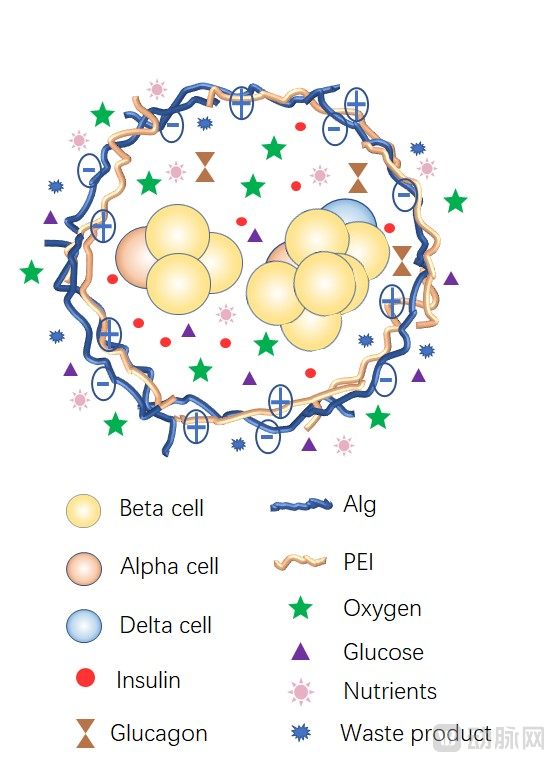
Figure: YCQ-01 Microcapsule Model
First isThe Only Domestic Provider with Genuine Animal Trial Data, the survival duration and functional efficacy of transplanted islet cells in the absence of immunosuppressive drugs both rankGlobal First Tier. Test results indicated that during the 140-day (six-month) observation period, diabetic animals did not require insulin or immunosuppressants postoperatively.
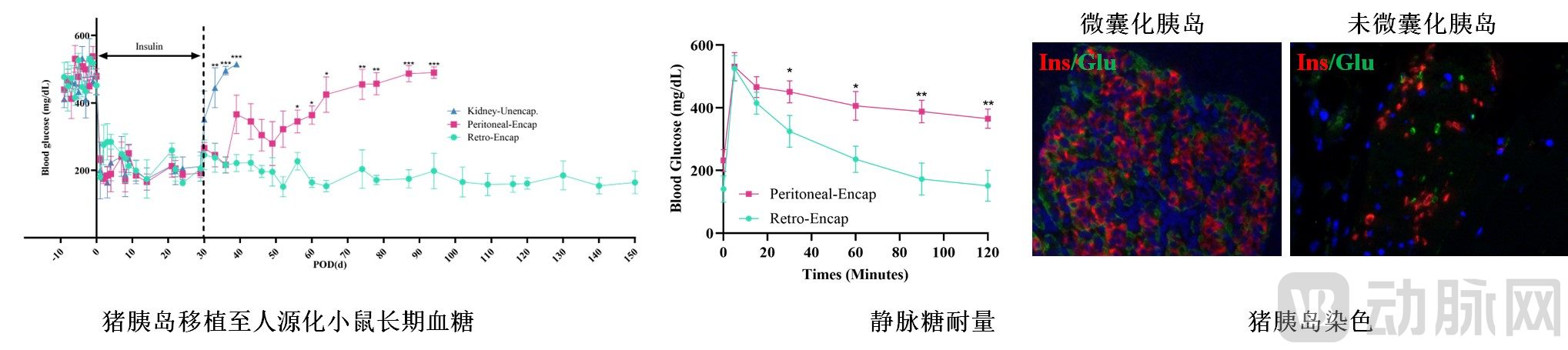 Note: Viable islet cells can be stained (in red, green, etc.).
Secondly,Uniform Nanoscale Pore Size in Microcapsules, which can be considered the optimal size for microencapsulated cell transplantation. It is reported that the diameter of metabolic waste products ranges from 0.05 to 1 nanometer, while that of globular proteins ranges from 2 to 10 nanometers. This implies that the pore size effectively prevents immune damage to the transplanted cells while ensuring the release of bioactive substances and the exchange of nutrients.
“The pores of the material must be of optimal size.“, to allow for nutrient exchange while preventing immune responses,” said Wang Yi.
In addition to focusing on the research and development of islet microencapsulation technology, Wang Yi is also activelySearch for a new transplant site.
Team members revealed that the hepatic portal vein and the intraperitoneal cavity are not ideal sites for microencapsulated islet transplantation. Identifying immune-privileged areas as transplantation sites can effectively address islet function loss and fibrosis formation caused by immune rejection.
Professor at the Helm of the Company, with Multiple Patents Applied For
January 21, 2022Chengdu Yichaqing Biotechnology Co., Ltd.(hereinafter referred to as Yichaqing Bio) was officially established. This startup, less than a year old, has made meticulous strategic arrangements in multiple areas.
First, withWorld-Class Technological Expertise Led by Professors, combined withProf. Wang Yi, Prof. Leo BuhlerPioneering cutting-edge technologies and securing multiple invention patents, Professor Leo Buhler has dedicated over three decades to xenotransplantation. As the world’s first expert in encapsulated porcine hepatocyte xenotransplantation, he pioneered clinical studies on transplanting porcine hepatocytes into humans, a achievement widely regarded as a milestone in medical history.
Next is team building, membersExtensive Industry Experience, Comprehensive Configuration. Overall strategic planning, daily corporate operations, external relations, sales layout, and operational management are all overseen by professionals.
Finally, the product pipeline combines short-term and long-term returns.Prioritize the development of the microencapsulated islet cell transplantation product pipeline, while simultaneously advancing the “microencapsulated hepatocyte transplantation” pipeline. It is reported that China has as many as 200 million patients with liver disease, yet the effective treatment rate for those with end-stage liver disease remains below 5%. Due to the scarcity of donor livers for organ transplantation, which fails to meet clinical demand, hepatocyte transplantation has become a lifeline for these patients.
Currently, Yichaqing BiotechCurrently in the fundraising stage, the next steps include completing the establishment and operation of a standard laboratory, and advancing primate and human clinical trials for microencapsulated islet transplantation.Building on YCQ-01 microspheres as the foundation for corporate development, we strive to make injectable diabetes therapy a thing of the past.